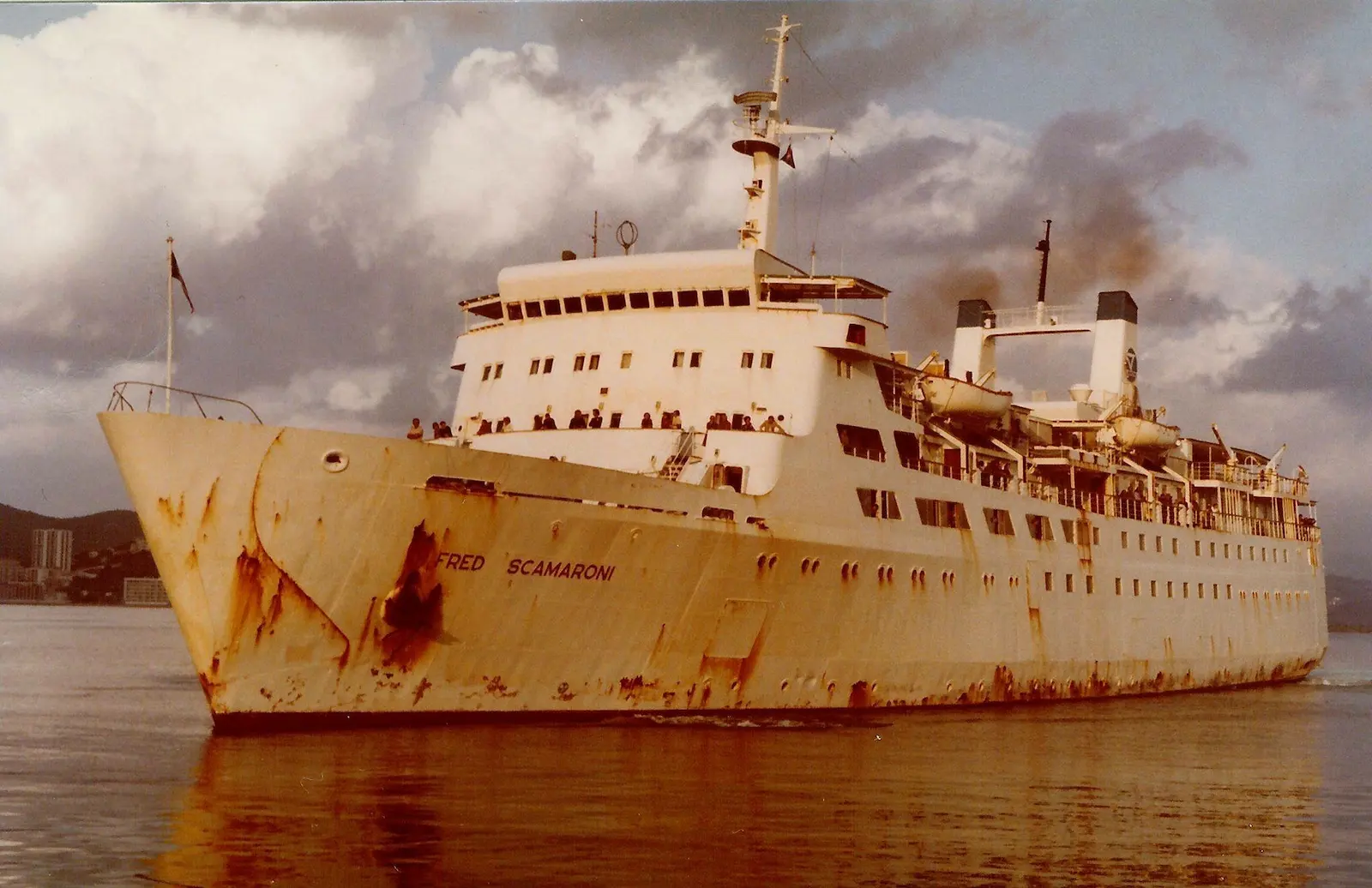
The Salem Express is the most ethically complicated dive in the Red Sea. It's not just a wreck — it's a graveyard. Hundreds of people died here within minutes of each other, and many of those bodies remain inside the ship. Whether to dive the Salem Express is a question every prospective diver should answer honestly before booking. This guide gives you the facts you need to decide.
What happened on 14 December 1991
The Salem Express began life in 1965 as the Fred Scamaroni, a roll-on/roll-off ferry built at La Seyne, France for the Marseille-to-Ajaccio route. Named after a French Resistance fighter killed in WWII, she was 115 metres long, 18 metres wide, and could carry 1,200 passengers and 142 vehicles. After 22 years on Mediterranean routes she was sold in 1980, changed hands twice, and ended up with the Egyptian Samatour shipping company in 1988 — renamed the Salem Express, running pilgrim ferries between Jeddah and the Egyptian port of Safaga.
Her final voyage began in Jeddah on 13 December 1991, two days behind schedule due to a mechanical fault. The ship carried somewhere between 578 and 1,600 passengers — the manifest was disputed even at the time — most of them Egyptian and Moroccan-French pilgrims returning from the Hajj. Many had spent years saving for the pilgrimage. Their luggage was packed with gifts for relatives at home.
The 450-mile crossing from Jeddah to Safaga normally takes about 36 hours. Captain Hassan Moro, who had commanded the ship since 1988, knew these waters well. By the night of 14 December, with high winds and heavy seas slowing the ship, he made a decision that would prove fatal: instead of taking the long, safer route around Panorama Reef to the north of Safaga, he steered the ferry toward an unauthorised shortcut between Hyndman Reef and the Egyptian coast.
Just before midnight, the ship's bearings drifted approximately one kilometre off course. At 11:13 PM the Salem Express struck Hyndman Reef. The impact tore a gaping hole in the starboard bow and forced the ship's bow car doors open, allowing seawater to flood the vehicle deck. The ferry developed a severe starboard list within minutes. Twenty minutes after the strike, she had sunk in 30 metres of water.
The combination of high seas, the ship's overcrowded state, the night-time conditions, and the speed of the sinking trapped most passengers below decks. About 180 survivors managed to swim away — many had to swim hours to reach shore. Captain Moro and two other crew members were found later in the bridge area, contradicting persistent rumours that the captain abandoned ship.
The official death toll is 464, though the true loss of life is widely believed to be far higher — often cited at well over 1,000 and possibly as many as 1,600 — because the passenger manifest was disputed and many travelled unrecorded. Only a fraction of the dead were ever recovered: the Egyptian Navy spent three days bringing up bodies, assisted by local divers from Hurghada and Safaga whose task was so traumatic that several never dived again, but the great majority of victims remained inside the ship as the salvage was deemed too dangerous to continue. The exact total may never be known.
The ethical question — should you dive it?
Diving the Salem Express has been controversial since the day she went down. Three concerns dominate the debate:
Recency. The Thistlegorm sank in 1941 — its dead are figures in history books. The Salem Express sank in 1991. Family members of victims are alive today. Some live in Safaga. Their grief is recent.
Remains in situ. Many bodies could not be recovered. Egyptian authorities welded shut the lower-deck access points where most casualties occurred, in accordance with Islamic burial customs that recommend leaving remains undisturbed. The wreck was officially declared a maritime tomb. Despite the welded openings, divers occasionally still find personal possessions — a child's tricycle, a handbag, a packed suitcase — that anchor the dive in human tragedy.
Commercialisation of grief. Some argue that selling dive tours to a mass grave is fundamentally inappropriate. Others argue it parallels visiting Auschwitz, the Titanic, or any other site of historical tragedy — that respectful witnessing is not the same as exploitation.
Our position at Aquarius: this is a personal decision, and we will not pressure divers either way. If you decide to dive the Salem Express, we will guide you respectfully, brief you thoroughly on the history, and enforce strict no-touch, no-penetration-of-restricted-areas, no-flippant-photography rules. If you decide not to dive it, we will run any of the many other excellent wrecks and reefs in the area instead. There is no wrong answer here.
The site at a glance
The Salem Express lies on her port side on a flat sandy bottom, with the shallowest section of the hull (now starboard side, facing up) at 7-12 metres and the seabed at 32 metres. The wreck is huge — at 115 metres long, you cannot see the entire ship from any single position. Most divers cover only half on a single dive; complete exploration requires two dives.
Despite three decades underwater, coral growth on the Salem Express remains modest. The depth, the relative recency of the sinking, and possibly the spiritual aura that some divers report all seem to keep the wreck looking starkly metallic compared to the dramatic encrustation on older wrecks like the Thistlegorm.
The dive plan
Most operators run two dives on the Salem Express in a single day, separated by a long surface interval. Visibility is typically good (15-30m) due to the open offshore location. Currents can be strong; check before each dive.
First dive — the stern
Descent to the deepest point of the wreck, the stern at 32 metres. Two intact propellers and the rudder are dramatic photographic subjects. Working forward and shallower, divers pass the smokestacks (often described as the ship's most photogenic feature, with significant coral growth on the exhausts) before reaching the upper decks at 18-20 metres. The ship's two cargo decks (where penetration is permitted) lie below.
Second dive — the bow and the reef
The bow rests at the shallow end. The breach in the starboard bow that caused the sinking is visible — twisted metal where the bow door was forced open. Some divers ascend over the saddle of Hyndman Reef itself to see the actual reef segment that the ship struck. Lifeboat davits hang empty (the second lifeboat is on the seabed near the hull). The ship's name "Salem Express" remains visible in faded paint on the side.
Memorial plaque
A memorial plaque was placed near the wreck for visiting divers to leave tributes. Many divers carry a flower, a small note, or simply a moment of silence. This is increasingly the meaningful end of the dive for visitors who recognise what the site truly is.
How to dive the Salem Express respectfully
- No penetration of welded sections. The lower passenger decks are welded shut for a reason. The metal can be cut, but doing so violates Egyptian law and, more importantly, basic decency. Stay external or in the cargo deck area only.
- Do not touch personal belongings. Suitcases, shoes, toys, prayer rugs — these belonged to people. They are not souvenirs, photo props, or items to rearrange for "better" shots. Leave everything where you find it.
- Photography with restraint. Photographing the wreck structure, marine life, and landscape is fine. Posing for celebratory selfies in front of obvious personal effects is not. If you wouldn't do it at a war memorial, don't do it here.
- Keep the briefing serious. Some operators downplay the history to make the dive feel "fun." That's wrong. A proper Salem Express briefing covers what happened, who died, and what's expected of divers on the wreck. If your operator skips this, find another.
- Surface conduct matters too. Local Safaga families know what's at the bottom. Loud post-dive celebration on a boat full of locals on the way back to port is poor form.
Getting there from Hurghada or Sharm
The Salem Express sits south of Safaga, which is roughly 50 km south of Hurghada by road. Two routes:
From Safaga. The shortest boat ride — about 90 minutes from the Safaga port to the wreck. Day-trips depart most mornings during the season. If Salem Express is your specific objective, basing yourself in Safaga (rather than Hurghada or Sharm) is the most efficient option.
From Hurghada. Long day-trip (5-6 hours each way by sea) or, more commonly, a road transfer to Safaga then a boat from there. Aquarius can arrange this on request — it works as a single day or as part of a multi-day southern Red Sea trip.
From Sharm El Sheikh. Not practical as a day-trip. The Salem Express is over 200km from Sharm by sea. If you're staying in Sharm and want to dive the Salem Express, plan to relocate to Safaga or Hurghada for a few days, or include the Salem Express in a southern Red Sea liveaboard itinerary.
As a liveaboard stop. Many southern Red Sea liveaboards include the Salem Express on their northern itineraries. This is often the most convenient way to dive it without dedicated travel.
Common mistakes
- Diving the Salem Express without understanding what it is. Some operators sell it as "an exciting wreck dive" without context. Then divers descend and discover they're swimming through a graveyard. Do your reading before booking. This article exists in part for that reason.
- Underestimating the emotional weight. Even prepared divers often surface shaken. Allow yourself a quiet day after the dive. This is not a dive to schedule before a celebratory dinner.
- Pairing it with a "fun" wreck on the same day. Some operators schedule Salem Express in the morning and a different wreck in the afternoon. Mixing emotional registers like this rarely works for divers. Keep the day singular.
- Being underprepared for depth. The wreck reaches 32m. AOW is the floor; experience matters more than the certification. Don't book Salem Express as your first deep wreck — get experience on something less heavy first (El Mina is a good starter wreck for Hurghada-based divers).
Alternative wrecks if you'd rather not dive Salem Express
If you've read this far and decided the Salem Express is not for you — that's a perfectly valid choice. The Egyptian Red Sea has spectacular wreck diving without the ethical weight:
SS Thistlegorm. The world's most famous wreck dive. WWII cargo ship full of motorbikes, trucks, locomotives, rifles. Sunk 1941, eight decades old. Crew losses are remembered, but the wreck itself is unambiguously a heritage diving site.
El Mina. Egyptian minesweeper sunk in 1970, just outside Hurghada Marina. Real warship, real combat history, no fatalities — the crew evacuated before she went down.
Sha'ab Abu Nuhas (the "Ships' Graveyard"). Seven cargo wrecks in one location near Hurghada. The Giannis D, Carnatic, Chrisoula K, and Kimon M are all accessible to AOW divers. Some loss of life occurred but nothing on the Salem Express scale.
Numidia and Aida. Two wrecks at Big Brother Island (liveaboard only). Stunning wall-adjacent wrecks with significant marine life.
SS Dunraven. Victorian-era wreck near Sharm El Sheikh, sunk 1876. Atmospheric and uncontroversial.
Frequently asked questions
Is it ethical to dive the Salem Express?
Diving the Salem Express remains controversial in the diving community due to the heavy loss of civilian life and the continued presence of remains inside the wreck. Many divers and dive professionals refuse to dive the site as a matter of personal ethics. Others approach it as a maritime memorial similar to a battlefield tour. Whether to dive it is a personal decision; if you do, do so with respect — no looting, no penetration of welded-shut areas, no flippant photography of personal belongings.
How deep is the Salem Express?
The wreck rests on her port side, with the shallowest point at about 7-12 metres and the deepest at 32 metres. Most external exploration happens between 18 and 30 metres.
When did the Salem Express sink?
On the night of 14-15 December 1991. The ship was returning from Jeddah to Safaga carrying pilgrims home from Hajj when she struck Hyndman Reef and sank in 20 minutes. The official death toll is 464; some estimates range much higher.
Can I penetrate the Salem Express?
Limited penetration is permitted in the cargo decks at the back of the ship. The lower decks where most casualties occurred are welded shut and treated as a maritime tomb under Islamic burial customs. Penetration anywhere on the wreck is dangerous and should only be attempted with a guide who knows the wreck.