Common Red Sea species
Some of the nudibranchs you're most likely to see:
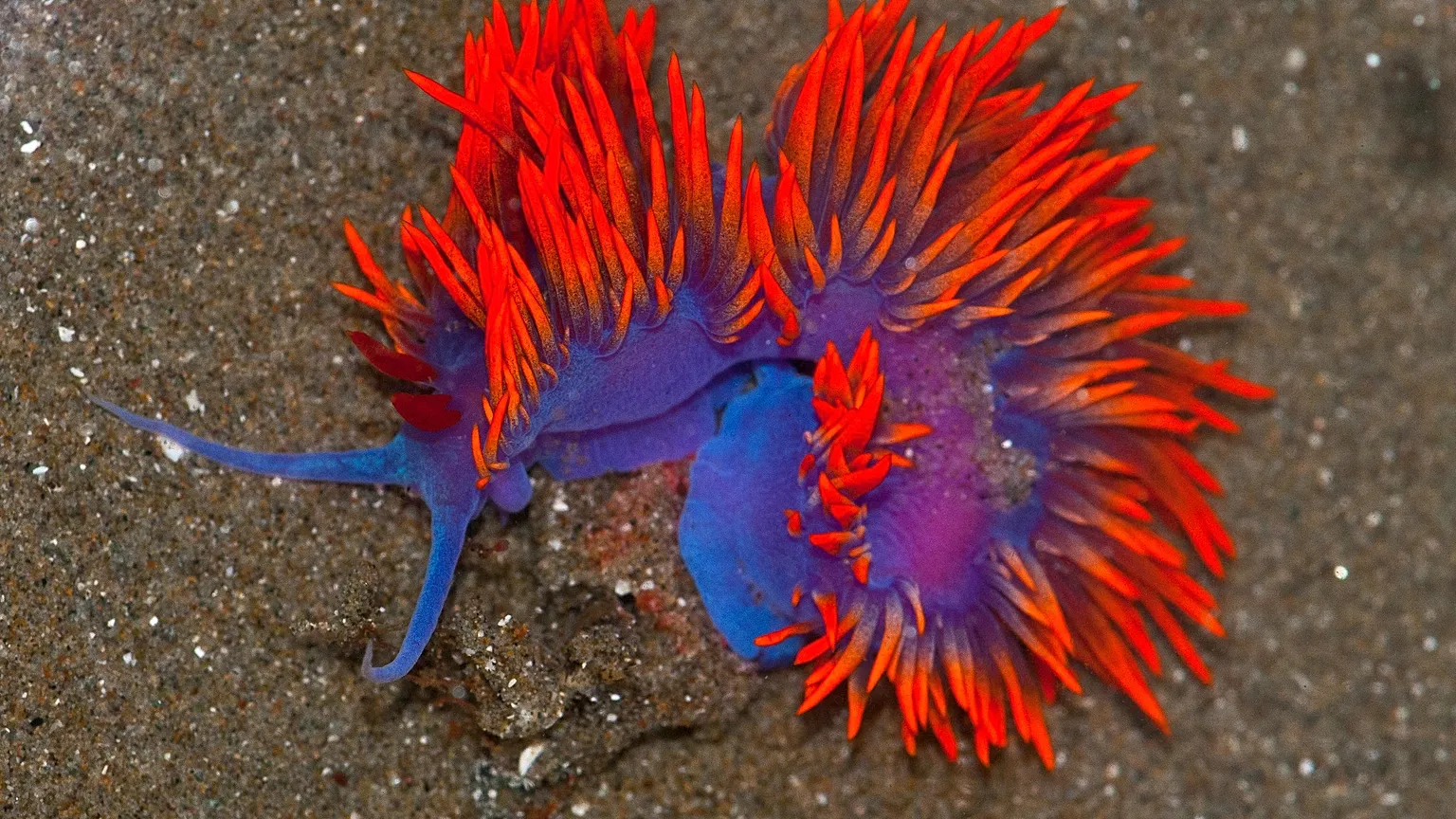
- Spanish Dancer (Hexabranchus sanguineus) — the giant of the group at 15-40 cm. Often seen free-swimming at night, flaring red "skirts" as they undulate through open water.
- Chromodoris magnifica — white body with purple-and-yellow bands, very photogenic, common on sponges.
- Chromodoris quadricolor — Red Sea endemic with four distinct colour bands.
- Risbecia pulchella — frequently seen travelling in follow-the-leader pairs; a mating behaviour.
- Phyllidia ocellata — orange with black rings, toxic, common in shallow reef.
- Nembrotha megalocera — purple-black body with orange gills, found on ascidians (sea squirts).
- Pteraeolidia ianthina — long-tailed blue-purple "blue dragon", found on hydroids.
Where to find them
Nudibranchs are specialist feeders — knowing what they eat tells you where they live:
The finding technique
This is the most underrated skill in Red Sea diving. Most divers miss every nudibranch on a reef because they're moving too fast and looking at the wrong thing.
- Slow down. Stop kicking. Neutral-buoyancy hover.
- Pick one coral head. Commit to it for 3-5 minutes.
- Scan every surface systematically. Top, then sides, then base, then around the back.
- Look for their food first, not the nudibranch. A patch of the right sponge, tunicate, or hydroid means probability of inhabitants.
- Once your eyes calibrate, they're everywhere. Like "Magic Eye" puzzles — once you see one, you start finding them on every reef.
Photography tips
- Use a macro lens — 60mm or 100mm. Most species are 1-5 cm.
- Shoot at eye level, not top-down. Get the rhinophores (head tentacles) in focus — they're the "face".
- Two strobes, pulled wide. Even illumination brings out iridescent colours that single-strobe lighting flattens.
- Do not touch or move them. Many species carry toxic defensive chemicals; contact damages their skin and can kill the animal.
- Use a pointer to stabilise yourself — never to touch or reposition the subject.
- Shutter speed 1/160+ to freeze surge motion.
- F/11-F/16 aperture for depth of field on small subjects.
Etiquette
- Never touch. Many species are toxic and all are fragile.
- Never remove a nudibranch from its food source for a better photo angle — shoot where you find it.
- Keep fins well clear of the reef when hovering low. Silt destroys macro shots and damages the animals' habitat.
- Do not crowd. If another photographer is shooting a subject, wait your turn.
Frequently asked questions
The Red Sea is home to over 100 documented nudibranch species, with several endemic species including Chromodoris quadricolor. New species are still being described, particularly from deeper waters. The combination of warm water, high salinity, and isolated geography produces unusually high diversity.
The Spanish Dancer (Hexabranchus sanguineus) is the largest, reaching 40 cm. They are most often seen at night, free-swimming with characteristic red 'skirt' undulations. Daytime sightings are rare as they hide in reef structures.
The Makadi Bay and Sahl Hasheesh house reefs are excellent for macro diving with less time pressure than busier sites. Soft coral walls, ascidian-covered reef walls, and coral rubble zones from 5-15 metres consistently produce species. Night dives anywhere will reveal Spanish Dancers and species that hide during daylight.
No. Many species secrete toxic defensive chemicals that can damage human skin and certainly damage them. Touching also displaces them from their food sources, often killing them. All nudibranch photography must be done where the animal is found, with no contact. Use a pointer to stabilise yourself, never to manipulate the subject.
Scientific reference: Wikipedia — Red Sea Nudibranchs