Where to see oceanic whitetips
The most reliable sites are all in the southern Red Sea, accessible by liveaboard:
When to see them
Oceanic whitetip activity in the Red Sea peaks when water cools and plankton moves deeper. Activity is sparse in summer, builds through September, peaks October-December, then tapers.
How to identify
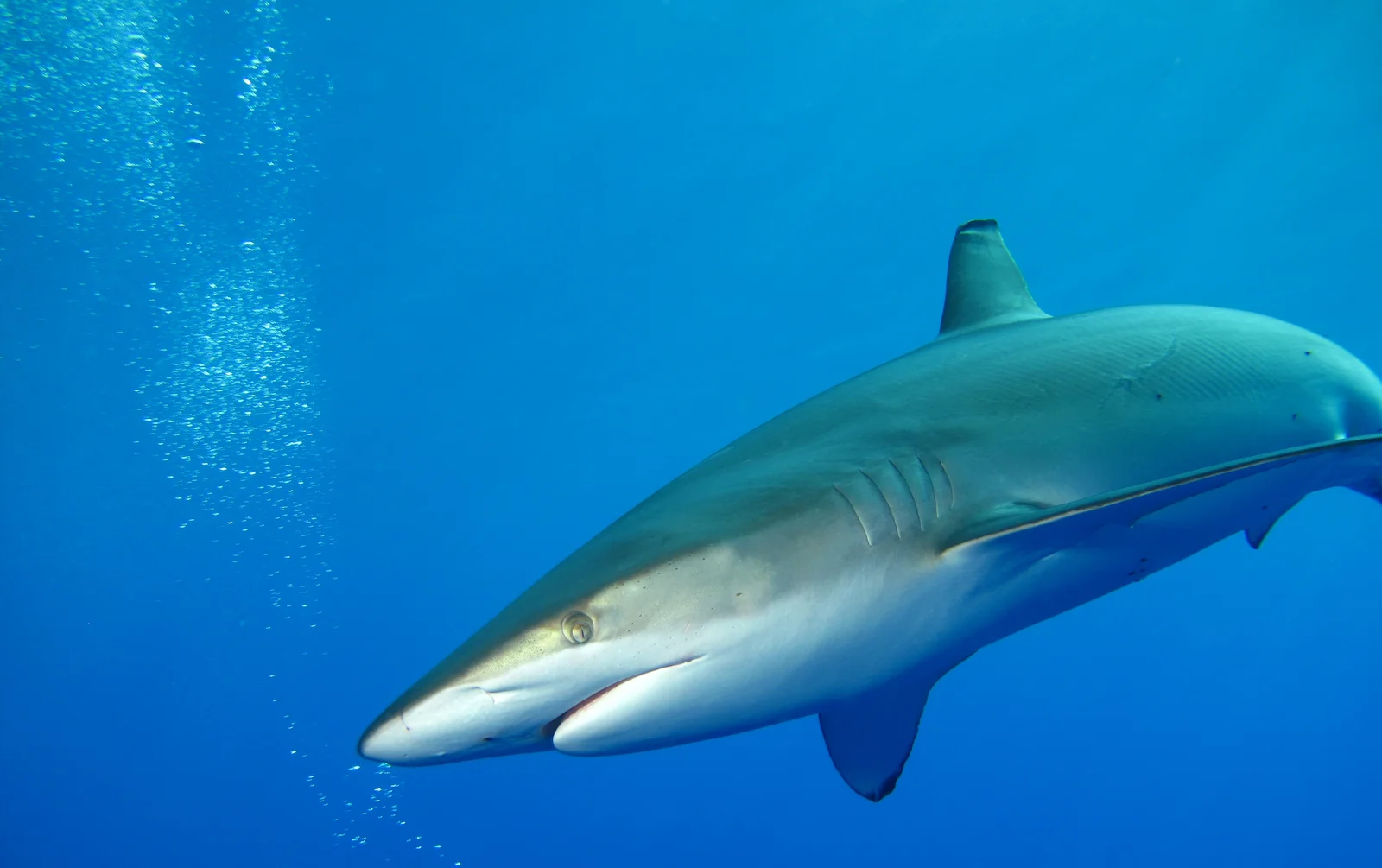
Oceanic whitetips are unmistakable once you've seen one:
- Rounded, paddle-shaped fins with striking white tips on pectoral, first dorsal, pelvic and caudal.
- Stocky build with a broad, rounded snout — very different from the streamlined reef sharks.
- Curious approach pattern: they swim directly toward divers rather than circling at distance.
- Typical size 1.8-2.5 m in Red Sea waters; pups under 1 m in summer are exceptionally rare sightings.
Behaviour & what to expect
OWTs are investigative, not aggressive — but they will test. Expect close approaches (often within 2 metres), multiple passes, and occasional bump-and-sniff behaviour on equipment. This is normal. Confusing it with predation is the mistake that leads to panicked behaviour that makes things worse.
Safe diving etiquette
- Never feed, chum or bait. Full stop — this creates dangerous learned behaviour.
- Stay horizontal and move calmly. Vertical splashing from the surface mimics distressed prey.
- Keep the shark in sight at all times. If it disappears behind you, turn to face it.
- Ascend together in a group. The surface interval is the highest-risk period.
- Carry a blunt object (camera housing, reef pointer) for redirection — never to strike.
- Do not pursue the shark. Let it approach and leave on its own terms.
Conservation
Oceanic whitetips were declared Critically Endangered by the IUCN in 2019 after pelagic populations collapsed by over 95% globally due to longline bycatch and shark-fin fishing. The Red Sea population is one of the last strongholds thanks to protected-area management and the absence of commercial pelagic longlining in Egyptian waters.
Responsible dive tourism directly supports their protection — diveable sharks are more economically valuable alive than dead, and every well-behaved group that leaves Elphinstone with photos strengthens the case for continued protection.
Frequently asked questions
Oceanic whitetip activity in the Red Sea peaks October to December at offshore reefs like Elphinstone, the Brothers Islands and Daedalus. Activity builds through September and tapers after December. They are sparse in summer.
Oceanic whitetips are investigative, not aggressive. They will approach divers closely and make multiple passes — this is normal behaviour, not predation. Following standard guidelines (no feeding or baiting, calm horizontal posture, group ascent, keep the shark in sight) is sufficient. There has never been a fatal recreational scuba incident with an oceanic whitetip on a properly run Red Sea dive.
The most reliable Red Sea sites for oceanic whitetips are all liveaboard destinations in the southern Red Sea: Elphinstone Reef, Big Brother and Small Brother islands, and Daedalus Reef. They are not seen reliably on day-boat trips from Hurghada or Sharm El Sheikh.
Oceanic whitetips were declared Critically Endangered by the IUCN in 2019 after global pelagic populations collapsed by over 95% due to longline bycatch and the shark-fin trade. The Red Sea population is one of the last strongholds because Egyptian waters do not allow commercial pelagic longlining.
Related: For the complete picture of all Red Sea shark species, see our Shark Diving in the Red Sea hub guide.
Scientific reference: Wikipedia — Oceanic Whitetip Shark