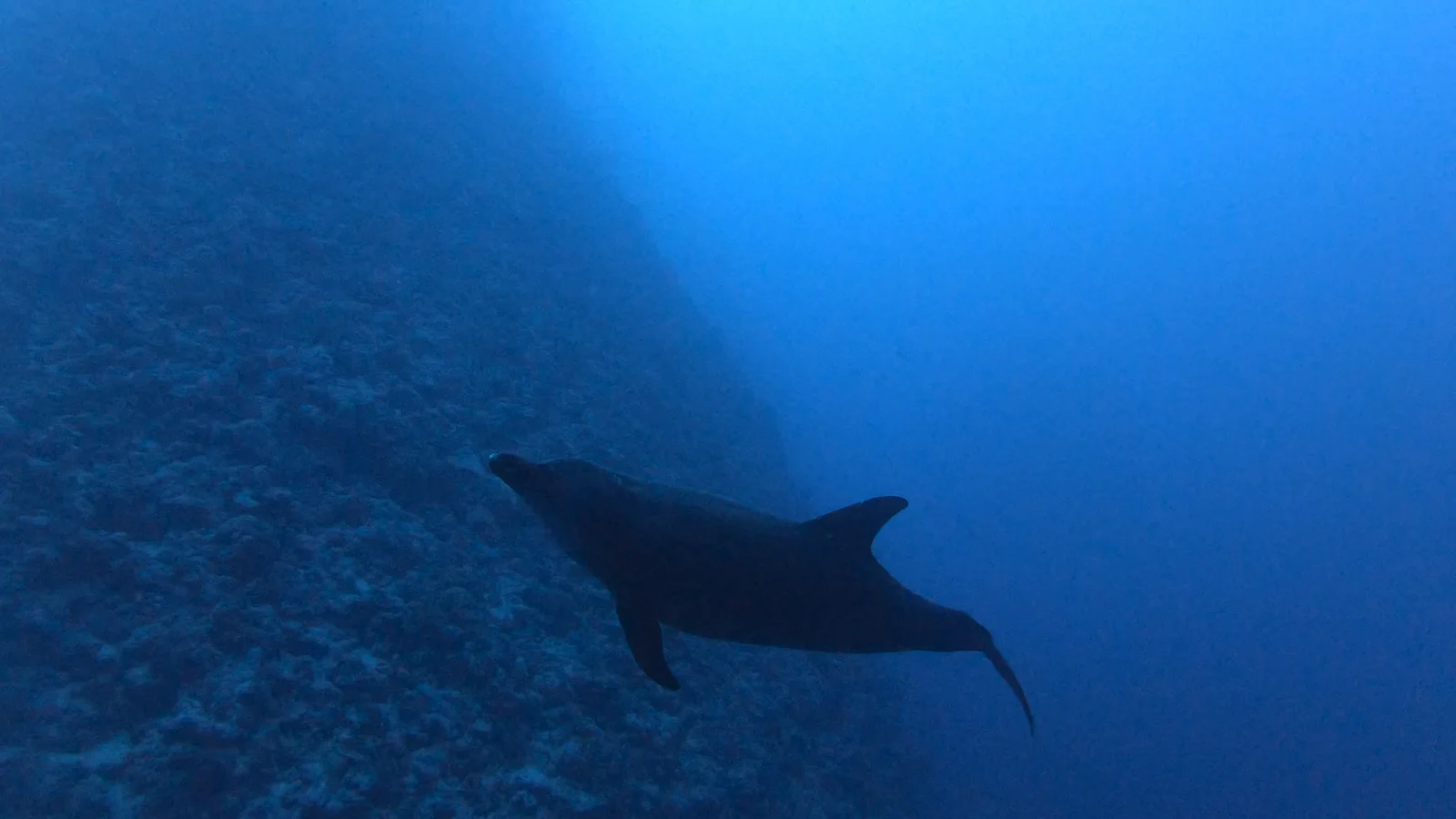
Why spinner dolphins rest during the day
These are nocturnal feeders — they hunt at night in deep water, pursuing bioluminescent prey that migrates up from depth at dusk. By sunrise they've had a long, calorie-expensive night, and return to shallow sheltered lagoons to rest, socialise, and avoid predators.
Understanding this rhythm is everything. They need the lagoons quiet in the morning. Dolphin-tourism pressure has already changed behaviour at some Red Sea sites, which is why regulated access zones exist.
Where to see them
How to identify
- Long, thin beak — the longest of any dolphin species.
- Dark-grey back, lighter-grey flanks, white belly.
- The spin. Adults jump and rotate up to 7 times in mid-air — behaviour no other dolphin displays.
- Social size: Red Sea pods usually 10-80 animals; occasional large aggregations of 200+.
When to see them
Spinner dolphins are present year-round, but encounters work best when water is calm:
Responsible encounters
- Enter the water quietly — no jumping, no splashing.
- Stay on the surface if snorkelling — do not free-dive down on them.
- Never chase. If they move away, let them go.
- Stay 30 m from resting groups; join only if they approach you first.
- Avoid Dolphin House afternoons — the zone closes to protect the pod's rest.
- No touching, no flash photography.
Dolphin House regulations
Sha'ab Samadai is managed by the EEAA (Egyptian Environmental Affairs Agency) with strict rules that change periodically. Current framework typically includes a morning "no-entry" zone in the inner lagoon, a snorkel-only outer zone, and an afternoon full-site closure. Pay the site fee, respect the ranger zones, follow your guide.
Frequently asked questions
The most reliable sites are Sha'ab Samadai (Dolphin House) near Marsa Alam, Sataya Reef in the southern Red Sea (liveaboard), and Sha'ab El Erg near Hurghada. Bow-riding pods often join offshore boat crossings — frequently the best encounters happen unplanned.
Spinner dolphins are present year-round. Encounters are weather-dependent rather than seasonal — calm seas in spring and autumn give the best surface conditions. Dolphin House requires morning visits as the inner lagoon closes in the afternoon to let the pod rest.
Spinner dolphins are nocturnal feeders that hunt in deep water at night. By sunrise they are tired, and they return to shallow sheltered lagoons to rest, socialise and avoid predators. This is why morning encounters at Dolphin House are non-disruptive but afternoon visits would interfere with their rest cycle.
Enter the water quietly with no splashing. Stay on the surface if snorkelling — do not free-dive down on resting groups. Stay 30 metres from resting pods and let them choose to approach. Never chase, never touch, no flash photography. Sha'ab Samadai is managed by EEAA with enforced zones — follow ranger instructions.
Scientific reference: Wikipedia — Spinner Dolphin