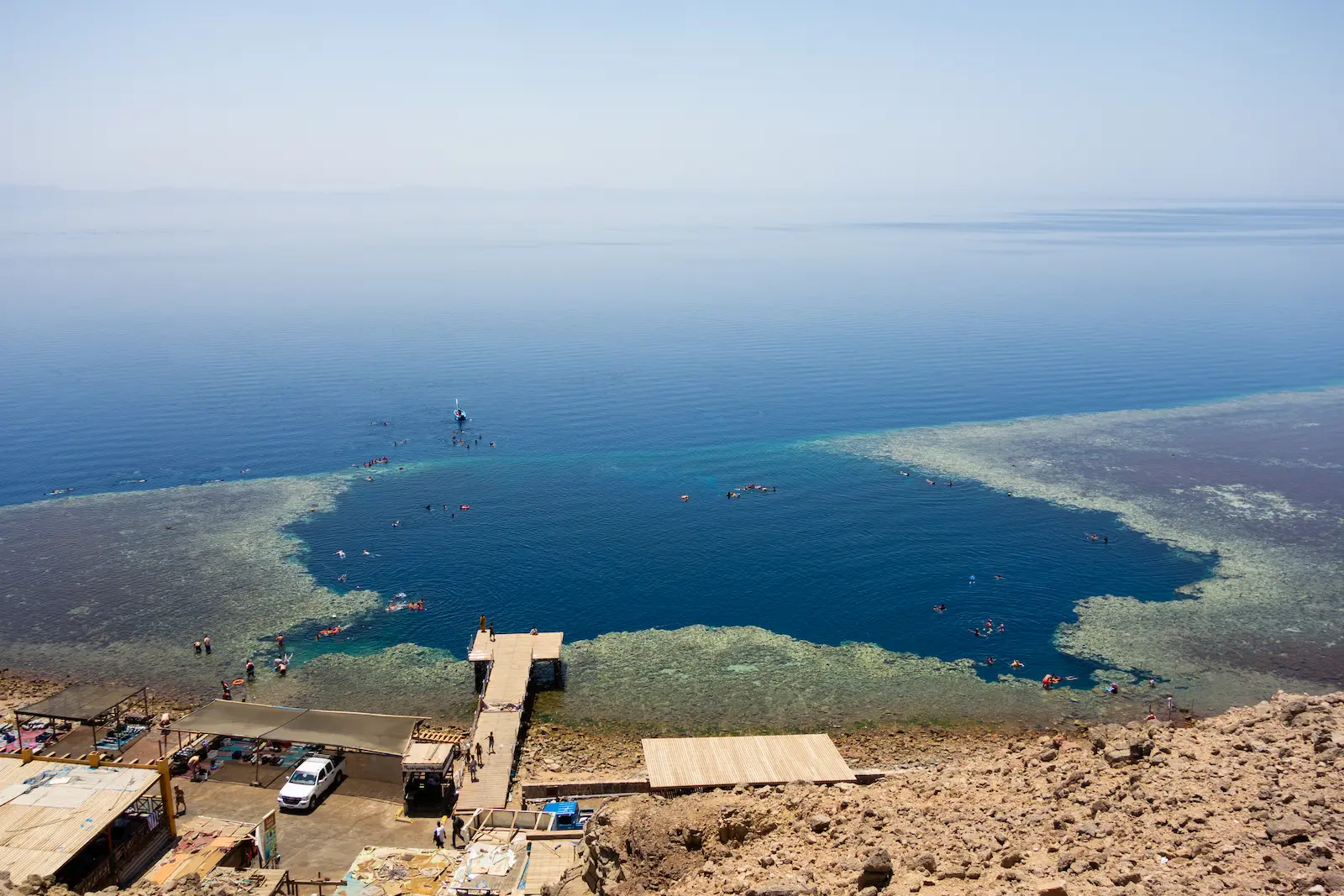
The Dahab Blue Hole has a reputation it doesn't deserve. Yes, more than 130 divers have died there. No, it is not the "world's most dangerous dive site" — almost all those deaths were preventable, involving untrained divers attempting the Arch on a single tank. The recreational route — Bells to Blue Hole — is one of the most beautiful drift dives in the Red Sea. Here's how to do it properly.
Why both sites in one day
Dahab is a 90-minute drive from Sharm El Sheikh up the Sinai coast — a journey worth doing for either the Blue Hole or the Canyon, but ridiculous to make for just one. The two sites are 25 minutes apart on the road north of Dahab town. Every operator that runs Dahab day-trips combines them into a two-dive day:
- Morning dive: The Canyon. Easier site, gentler depth profile, gets divers warmed up.
- Lunch: Bedouin restaurant near the Blue Hole entry point. Camel rest spot, photo opportunity, and one of the better seafood lunches in Sinai.
- Afternoon dive: Bells to Blue Hole. The headline dive of the trip.
Doing the Blue Hole alone (without the Canyon) wastes the journey. Doing the Canyon alone misses the point. Both together is a proper day's diving — and one of the most rewarding day trips you can take from Sharm.
The Canyon
The Canyon is a vertical fissure in the reef — an underwater split in the rock that opens at 18m and descends to 30m, with a narrower continuation deeper that's only for technical divers. The dive starts from a shore entry, swimming through a shallow lagoon (1-3m) which exits the reef into open water on the other side.
Once you're past the reef into the open seabed, you find yourself in a slope-and-coral-garden scene. The slope drops gently from 10m to 20m. The Canyon entrance appears as a black slot in the rock — a striking sight even before you descend into it.
Inside the Canyon, the experience is otherworldly. Light shafts pierce down through cracks in the reef ceiling, illuminating columns of plankton and the soft coral-encrusted walls. A resident school of dusky sweepers (small silvery fish) circles in the deepest pocket. Moray eels and shrimp inhabit the wall crevices. Bring a dive light if you have one — even a small torch transforms the deep crevice photography.
Exit at the bottom of the Canyon at 30m and ascend along the outer wall, finishing the dive in the shallow coral garden of "the fishbowl" — a small basin teeming with anthias, lionfish, and the occasional Red Sea Walkman scorpionfish. Total dive time around 40-45 minutes.
The Blue Hole — what it is
The Blue Hole is a vertical underwater sinkhole right at the shore of the Sinai coast, north of Dahab. Approximately 30 metres in diameter and over 100 metres deep, it sits inside a fringing reef that's only a metre or two above the surface — meaning you can stand on the edge and look straight down into impossibly deep blue water.
The Hole is connected to the open sea through a 26-metre-long natural tunnel called the Arch, which opens at 55 metres depth. The tunnel is the geological source of the Hole's existence and the source of its dark reputation — almost every Blue Hole fatality has involved the Arch.
The Blue Hole is famous for three communities:
Recreational divers dive the safe route: enter at El Bells nearby, drift along the wall, and finish by crossing the Hole's shallow saddle at 7m. They never approach the Arch.
Technical divers with proper trimix training and equipment occasionally swim through the Arch as a planned technical dive. The Egyptian Chamber for Diving and Watersports (CDWS) requires Tec 60 minimum certification.
Freedivers use the Blue Hole as one of the world's premier training and competition sites. Walking past the Hole during a recreational dive trip you'll see freedivers training along buoy lines, descending and surfacing on a single breath.
The truth about the fatalities
The Blue Hole has earned the nickname "the divers' cemetery." A small memorial above the entry point shows the names and dates of divers who died at the site — most from the late 1990s and 2000s. Estimates of total fatalities range from 130 to 200 since the early 1990s.
The honest reality: almost every fatality involved someone attempting the Arch without proper training. The pattern is depressingly consistent:
- An overconfident diver (often an instructor or experienced sport diver) decides to attempt the Arch on a single tank of regular air.
- At 50+ metres on air, nitrogen narcosis is severe. Judgement is impaired.
- The tunnel appears shorter than it is (~26m, but feels less than 10m) because of clear water and light at the far end.
- Gas runs low mid-tunnel. Or a small equipment problem (a stuck inflator, a leaking O-ring) becomes a fatal one because narcosis prevents proper response.
- The diver doesn't make it through. Their body is later recovered by technical divers — often by Tarek Omar, the Dahab tech diver who has spent decades performing these recoveries.
The 2000 death of Yuri Lipski, an Israeli instructor who attempted the Arch alone on regular air with a helmet camera, was particularly haunting because the camera survived and recorded his last minutes. His mother received the footage of her son drowning — a story that still circulates in diving communities as a warning about the Hole.
None of this should put you off the recreational dive. The standard Bells-to-Blue-Hole route never goes near the Arch. Maximum depth is 30 metres at El Bells; you ascend along the wall to 7 metres at the Blue Hole's saddle and exit there. It's no more dangerous than any other AOW-level Red Sea dive. The CDWS now requires a certified local guide for all Blue Hole diving, with personnel on-site enforcing skill matches — a regulation that has dramatically reduced fatalities.
The Bells-to-Blue-Hole route
This is the dive that makes the journey worth it. It's a drift dive — current carries you in one direction along the wall — with two dramatic features: the chimney descent at El Bells, and the saddle crossing into the Blue Hole.
El Bells entry
El Bells is a small crack in the reef table, about 200m north of the Blue Hole. You walk in full kit from the parking area along a rocky shoreline (this part is genuinely awkward — the rocks are sharp and slippery) and reach a small rock platform with a slot in the reef. The slot is just wide enough for one diver at a time. Giant-stride into the slot.
The Bells is a vertical chimney in the reef wall. You descend through it — passing through openings at 26m and 32m — like riding an elevator into the abyss. The name comes from the bell-like ringing of dive tanks scraping the chimney walls. It's narrow but never enclosed; you can exit horizontally at any depth.
The wall
You exit El Bells around 28m onto an open vertical wall that drops past 100 metres into the deep blue. This wall is the highlight of the dive. Lush soft coral cover, sea fans, anthias clouds, occasional turtles and big fish in the blue. You drift slowly south toward the Blue Hole, ascending gradually along the wall.
The wall is genuinely dramatic — perfectly vertical, kilometres deep, lit from above by streaming sunlight. Spend a minute or two looking down into the blue. You can't see bottom because there isn't one within visible range. This is the kind of dive that reframes a diver's sense of scale.
The saddle
After 20-30 minutes drifting along the wall, you reach the Blue Hole's saddle — a coral-covered shelf at 7 metres that connects the open sea wall to the inside of the Hole. Crossing the saddle is the moment of the dive. On one side, the open Red Sea. On the other side, the Hole's vertical walls dropping into darkness.
You cross the saddle at safety-stop depth, complete your three-minute stop drifting over the inside of the Hole, then exit at the small steps cut into the reef on the Hole's shoreward side. Above water, you're standing 50 metres from the parking lot and 100 metres from your lunch.
The day trip from Sharm
Aquarius Sharm runs the Dahab Blue Hole + Canyon as a full-day land-and-shore-diving trip. Standard schedule:
7:30 AM: Pickup from your Sharm hotel. We use 4WD pickups for the gear.
9:00 AM: Arrive at the Canyon site (a small bay 25 minutes north of Dahab town). Brief on the dive, kit up, walk to the entry point.
9:30 - 10:30 AM: Canyon dive. Surface, swim back to entry point, exit, change tanks at the truck.
11:00 AM: Drive to the Blue Hole site (10 minutes). Surface interval at one of the Bedouin restaurants overlooking the water.
12:00 PM: Lunch. Fresh fish, salads, bread, tea — Bedouin hospitality. The restaurants here are the most authentic in Sinai.
1:00 PM: Walk to El Bells entry point. Brief, kit up, dive.
2:00 - 3:00 PM: Bells-to-Blue-Hole dive.
3:30 PM: Pack up, drive back to Sharm.
5:00 PM: Drop-off at hotel.
It's a long day — about 9 hours from pickup to drop-off — but the diving is genuinely some of the best you can do in Egypt. Many of our customers describe it as the highlight of their Sharm trip.
Requirements and what to bring
Certification: Advanced Open Water (or equivalent — SSI, BSAC, CMAS**) is the floor. The dive isn't doable on Open Water due to El Bells' depth.
Dive log: 15 logged dives minimum. We check this on booking — not bureaucracy, but reality. The Blue Hole rewards experienced divers; nervous first-time AOW divers should build experience on Sharm's local sites first.
Recent diving: Last dive within the past 12 months. If you've been out of the water longer, we'll add a refresher dive on our Sharm house reef the day before — costs less than redoing the trip later.
Bring:
- Sun protection (hat, high SPF) — long surface intervals in direct sun
- Sturdy footwear for the rocky entry walks (booties for the dives are fine, but you also need shoes for the truck-to-water walks)
- Cash for the optional Bedouin lunch (~£15-20)
- Cash for the small entrance fee (5-10 EGP, paid at the road entry)
- A dive light if you have one — transforms the Canyon
- Wide-angle camera if you photograph — both sites are huge in scale
- Warm clothing for the truck ride back; you'll be wet and tired
Common mistakes
- Booking the Blue Hole as your first AOW dive. AOW is the minimum, but if you've just earned the cert and have only the four training dives, you'll struggle with the Bells chimney and the depth. Build at least 10-15 logged dives elsewhere first.
- Underestimating the journey. 90 minutes by truck on Sinai roads, 25 minutes between sites, 5+ hours total in transit per day. Plan a rest day after.
- Going with the cheapest operator. The Blue Hole is one site where guide quality genuinely matters — both for safety and for finding the best parts of the wall. Don't book the cheapest day-trip you can find.
- Bringing the wrong gear. Wetsuit thickness should match Dahab water temperatures, which can be 1-2°C cooler than Sharm — divers in 3mm shorties get cold on the long Bells dive. Bring a 5mm if you have it.
- Photographing the memorial. The memorial above the Hole is a real grief site for real families. Don't pose for selfies in front of it. A respectful photo of the names is fine; a smiling group shot is not.
- Trying to dive the Arch. If anyone in your group raises this, the answer is no. The Arch requires Tec 60 + trimix + planning + redundancy. There is no recreational shortcut.
Frequently asked questions
Is the Dahab Blue Hole safe to dive?
The recreational route — entering at El Bells and drifting along the wall to the Blue Hole's saddle at 7m — is no more dangerous than any other Red Sea dive. Almost all Blue Hole fatalities (130+ deaths since the 1990s) involved divers attempting the Arch tunnel at 55m without proper technical training. With Advanced Open Water certification and an experienced guide, the standard route is a stunning, safe dive.
Can I do the Blue Hole as a day trip from Sharm El Sheikh?
Yes. Aquarius runs daily Blue Hole + Canyon trips from Sharm. Pickup around 7:30 AM, 90-minute drive to Dahab, two dives (Canyon and Bells-to-Blue-Hole), lunch in a beachside Bedouin restaurant, return by late afternoon. AOW certification and 15 logged dives required.
What is the Arch?
The Arch is a 26-metre-long underwater tunnel connecting the inside of the Blue Hole to the open sea, with its top at 55 metres depth. Diving through the Arch requires technical training, mixed gases, and proper planning. It is responsible for the majority of Blue Hole fatalities. Recreational divers should never attempt it.
What certification do I need?
Advanced Open Water certification (or equivalent) plus 15 logged dives is required for the Bells-to-Blue-Hole and Canyon dives. The reef around the Blue Hole's saddle can be dived by Open Water divers, but the El Bells entry point reaches 28-30m which is beyond Open Water depth limits.