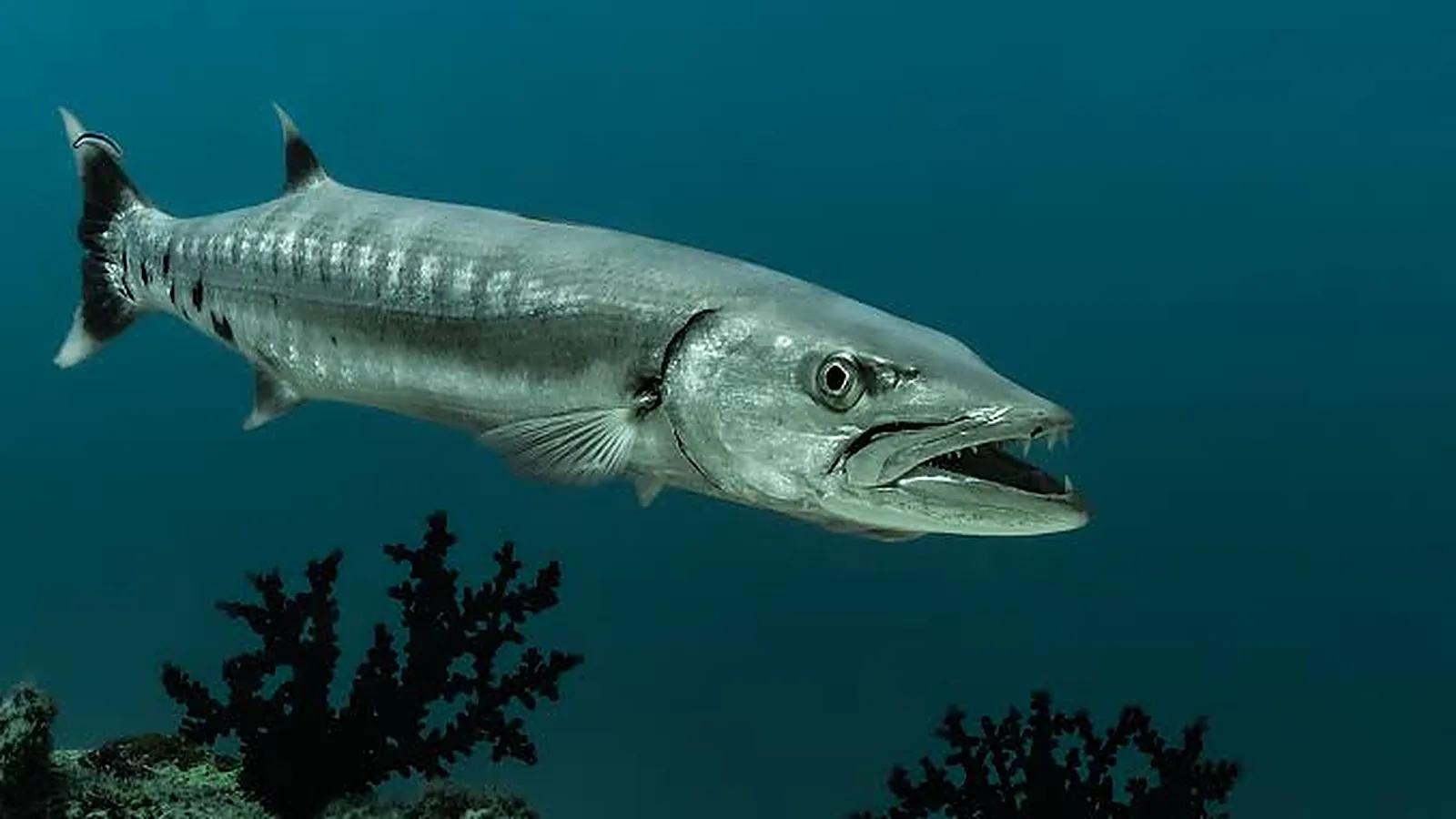
Where to see them
When to see them
Great barracuda are present in the Red Sea all year, so there is no narrow "season" to plan around. They are most reliably seen on current-swept reefs and drop-offs where baitfish concentrate — conditions that occur year-round across Egyptian dive sites. Encounters with the schooling barracuda that form the famous vortices are more dependent on current and site than on calendar month.
Year-round resident Best on current-swept reefs
How to identify a great barracuda
The great barracuda is hard to mistake once seen. A few key features:
- Body shape: Long, slender and torpedo-like, rounded through the mid-section. Built for short bursts of explosive speed rather than sustained cruising.
- Colour: Blue-grey on the back fading to bright silver and chalky white below. There is often a scatter of dark blotches low on the rear flanks — a useful field mark that the schooling barracuda lack — and sometimes faint darker bars on the upper body.
- Head and jaw: A large mouth with a projecting lower jaw and a near-flat top of the head between the eyes. The jaw holds fang-like teeth of unequal size — an outer row of small sharp teeth and an inner row of long, knife-like teeth, some pointing backwards to hold slippery prey.
- Size: The largest barracuda species. Adults are commonly 60–100 cm; large individuals reach around 1.5 m, with exceptional fish near 1.9–2 m.
- Behaviour as a clue: A single large barracuda hanging motionless near the reef, often watching you, is almost always a great barracuda. Tight, fast-moving schools are usually a different species (see below).
Solitary great barracuda vs the schooling "tornado"
This is the point most often confused. Adult great barracuda (Sphyraena barracuda) are largely solitary — the lone sentinel hovering by the wall. The mesmerising silver "barracuda tornadoes" — hundreds of fish wheeling in a slow vortex — that divers travel for are usually formed by a different, schooling species: the chevron or blackfin barracuda (Sphyraena qenie), which carries roughly 20 dark chevron-shaped bars and is typically around 1.4 m (to about 1.7 m). Smaller schooling barracuda such as the yellowtail barracuda (Sphyraena flavicauda) also occur in the region.
On a typical Egyptian Red Sea trip you may well see both: a solitary great barracuda holding station near a drop-off, and, on the more current-exposed reefs, tight schools of the smaller barracuda circling overhead. Both are dramatic; only the great barracuda is reliably a loner.
Behaviour and diet
The great barracuda is an ambush predator. It relies almost entirely on sight, hangs quietly to conserve energy, and then accelerates in a sudden, explosive lunge to seize prey — its backward-angled inner teeth stopping a slippery fish from escaping. Its diet is overwhelmingly fish — jacks, grunts, snappers, mullets, small tunas, anchovies, silversides and similar species — taken throughout the water column, with the occasional squid or shrimp.
Around divers, that sight-driven curiosity produces the species' signature behaviour: a lone adult will trail a snorkeller or hold position beside a diver, watching. It is reading the scene for a feeding opportunity — divers sometimes flush small fish into the open — not sizing up the diver. The stare is unnerving precisely because the fish is so still, but it is curiosity, not a prelude to attack.
Are they dangerous? The honest answer
Calmly: almost never. The great barracuda's menacing looks have earned it a reputation out of all proportion to the risk. The facts:
- Attacks are exceedingly rare. Confirmed unprovoked barracuda bites on people number only a handful worldwide, far below shark incidents, with just two recorded fatalities (1947 and 1957). Barracuda do not hunt humans.
- When it happens, it is mistaken identity. The fish lunges at a flash of shiny metal or jewellery — a dive knife, watch, buckle or bright camera — that resembles the glint of a small fish, usually in murky or low-visibility water. The result is a single fast strike and a laceration, not a sustained attack.
- Spearfishing raises the risk. A barracuda will try to steal a speared, struggling fish, which puts a hand near those teeth. This is a spearfishing hazard, not a recreational diving one.
How to keep an encounter relaxed: avoid shiny jewellery and dangling reflective gear in low visibility; never feed or chase the fish; do not hold speared catch; and let a curious barracuda watch from its own distance — it will lose interest and move on. A barracuda hovering and staring is doing exactly what barracuda do, and is not a sign of aggression.
A note on ciguatera — don't eat large reef barracuda
One genuine caution about the great barracuda has nothing to do with diving and everything to do with the dinner plate. As an apex reef predator, it sits at the top of the food chain and accumulates ciguatoxin from the smaller reef fish it eats. Large barracuda are among the most significant carriers of ciguatera fish poisoning, whose symptoms include gastrointestinal illness, limb weakness and a hallmark reversal of hot-and-cold sensation that can last for weeks. Health authorities specifically advise against eating large barracuda. For divers this is simply a reason to admire the fish underwater and never order it.
Diving and photography etiquette
Great barracuda make calm, cooperative subjects if treated with respect:
- Let it come to you. A solitary barracuda will often approach and hold station of its own accord. Slow, relaxed movement keeps it comfortable; sudden lunges or chasing send it off.
- Mind the shine. The same reflective objects that occasionally trigger a strike will also spook a wary fish. Tuck away dangling gauges and bright accessories.
- Wide-angle wins. A wide-angle or fisheye lens captures the full silver length and the underslung jaw; a side-on profile shows the dark rear-flank blotches that separate it from schooling species.
- Don't crowd a school. If you find a barracuda vortex, hang at its edge and stay neutrally buoyant — pushing into the centre breaks the formation and ends the moment for everyone.
Conservation status
The great barracuda is listed as Least Concern on the IUCN Red List (assessed 2015). Its very wide circumtropical distribution — the western Atlantic, the Caribbean, the Indo-Pacific and the Red Sea — and overall stable populations keep it out of any global threat category. There is localised fisheries concern in some regions (a noted decline in Florida, for instance, where catch limits have been considered), but nothing that applies at a global level. Avoiding the consumption of large barracuda, sensible on ciguatera grounds alone, also happens to protect the biggest and most reproductively valuable individuals.
Related Red Sea predators
Divers drawn to the great barracuda's predatory presence often want to read about the Red Sea's other apex and reef hunters:
- Reef sharks — grey reef and whitetip sharks patrol the same current-swept walls in the Straits of Tiran.
- Schooling barracuda — the chevron/blackfin barracuda (Sphyraena qenie) responsible for the famous vortices.
- Trevally and tuna — fast pelagic hunters that share the reef edge with barracuda.
For the bigger picture of pelagic and shark encounters across the region, see the Shark Diving in the Red Sea hub guide, and for the current-swept reefs where barracuda are most reliably seen, the best dive sites in Sharm El Sheikh & Ras Mohammed. To browse the full encyclopedia, visit the Red Sea marine life guides.
Frequently asked questions
Very rarely. Barracuda do not see divers as prey, and confirmed unprovoked attacks are exceedingly rare — far below shark incidents, with only two recorded fatalities (1947 and 1957). The rare bites are almost always mistaken identity: the fish lunges at a flash of shiny metal or jewellery in murky water. Avoid flashy gear, never feed or chase them, and don't hold speared fish.
Curiosity. Barracuda are sight-oriented predators and a lone adult will often hold station near a diver or trail a snorkeller, watching for feeding opportunities — divers can flush small fish into the open. It is studying the area, not stalking you. Stay calm and avoid sudden shiny movements and the encounter stays relaxed.
Usually not. Adult great barracuda (Sphyraena barracuda) are solitary. The shimmering schooling "tornadoes" are normally formed by the chevron or blackfin barracuda (Sphyraena qenie), a smaller relative with chevron-shaped bars. On a Red Sea trip you can see both — a lone great barracuda by the wall and tight schools of the smaller species in the blue.
They are the largest barracuda. Mature fish are commonly 60–100 cm; large individuals reach about 1.5 m and exceptional specimens approach 1.9–2 m and around 50 kg. A solitary adult of 1–1.5 m is a typical Red Sea sighting.
Large reef barracuda should not be eaten. As an apex predator it accumulates ciguatoxin from the reef fish it eats, making it a major carrier of ciguatera fish poisoning (gastrointestinal illness, limb weakness, and a reversal of hot-and-cold sensation that can last weeks). Health authorities advise against eating large barracuda. It has no bearing on the safety of watching them while diving.
Great barracuda are present year-round, so there is no narrow season. They are most reliable on current-swept reefs and drop-offs where baitfish gather — sites such as the Straits of Tiran and Ras Mohammed. Sightings of the big schooling vortices depend more on current and site than on the calendar month.