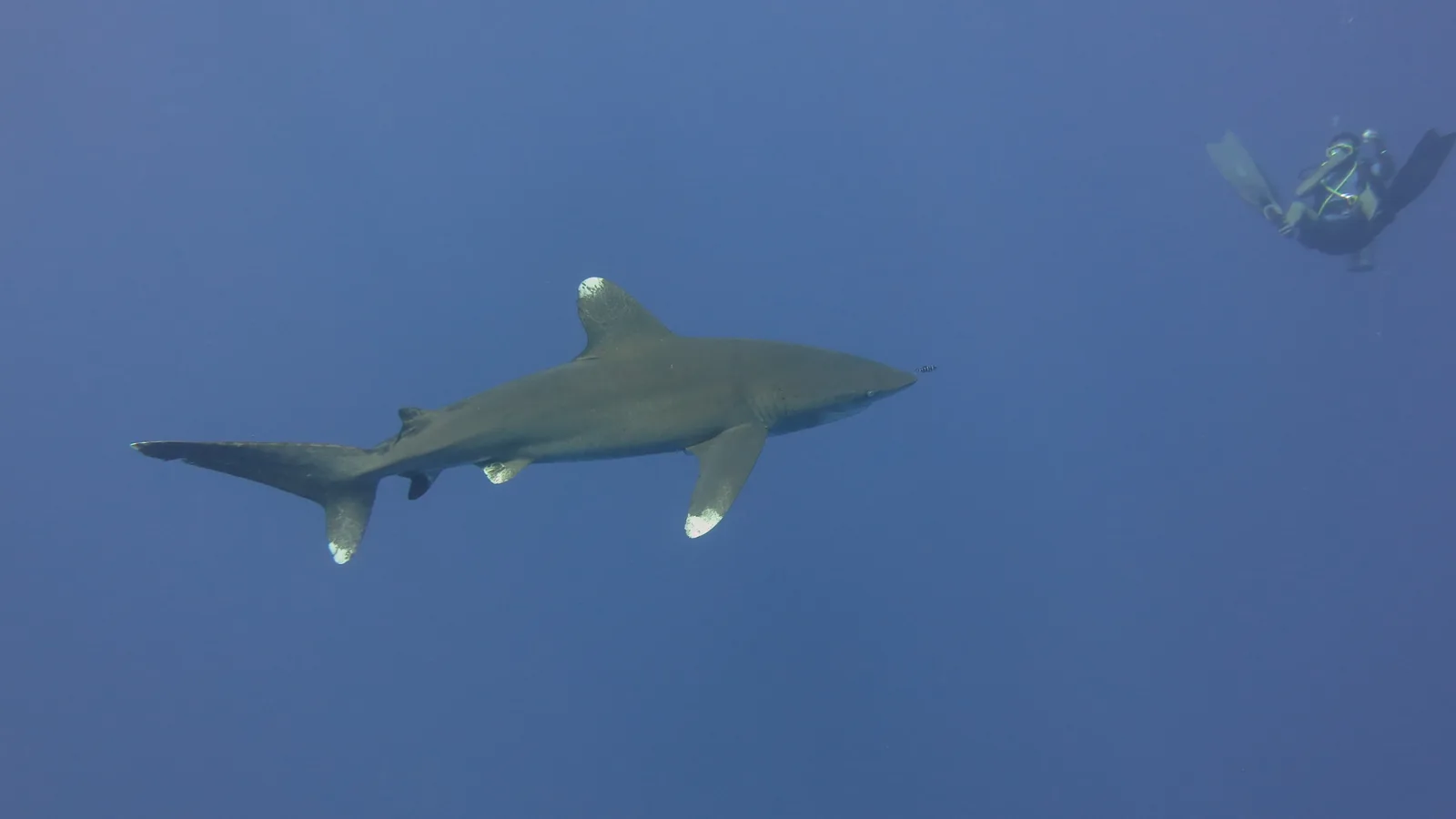
After 30 years of running boats in the Red Sea, here is the honest, site-by-site, species-by-species shark guide we wish every diver had before booking. We've removed the marketing hype, included the truth about sighting odds, and mapped every reasonable shark experience in Egyptian waters to specific dive sites you can actually book. This is the hub — for deeper detail on each species, follow the linked species guides.
How many shark species are in the Red Sea?
Approximately 44 shark species have been recorded in the Red Sea. The actual encounter list for recreational divers is much shorter — about 10-12 species are seen with any regularity. Here is the practical encounter list, in rough order of how often divers actually see them:
| Species | Encounter frequency | Best site | Best season |
|---|---|---|---|
| Whitetip reef shark | Very common | Most reefs | Year-round |
| Blacktip reef shark | Common (shallow) | Hurghada north reefs | Year-round |
| Grey reef shark | Common (deeper) | Ras Mohammed, Tiran, Brothers | Year-round |
| Scalloped hammerhead | Seasonal | Jackson Reef, Brothers, Daedalus | Jul–Oct (Aug–Sep peak) |
| Oceanic whitetip | Seasonal | Brothers, Daedalus, Elphinstone | Oct–Dec |
| Thresher shark | Seasonal | Elphinstone, Brothers | Apr–Jul |
| Whale shark | Rare seasonal | Brothers, Daedalus | May–Aug |
| Silky shark | Rare | Brothers, Daedalus offshore | Summer |
| Tiger shark | Very rare | Southern Red Sea | Year-round |
| Nurse shark (tawny) | Occasional | South Red Sea coves | Year-round |
Shark diving safety — the honest reality
Let's address this first because it's the question every new diver actually has. Recreational scuba diving with Red Sea sharks is extraordinarily safe. There has never been a fatal shark incident on a properly conducted Red Sea recreational scuba dive in the modern era. The species you encounter — reef sharks, hammerheads, oceanic whitetips, threshers — are shy of divers in the case of reef sharks and hammerheads, or curious-but-non-predatory in the case of oceanic whitetips.
The handful of negative shark incidents in Egyptian waters over recent decades have almost without exception involved snorkellers in shallow water near places where beach fish-feeding has artificially habituated sharks to humans-as-food-source. These incidents have not involved scuba divers on properly run dives. The boats at Aquarius and other reputable PADI 5-Star operators follow strict no-feed, no-bait protocols on every dive.
If you've absorbed shark imagery from Jaws, the Discovery Channel, or social media, your fear-to-reality calibration is probably off by an order of magnitude. The right framing: sharks are wild animals, treat them with respect, follow your guide's protocols, and you'll have one of the great wildlife experiences on this planet. Falling out of bed kills more people per year than diving with sharks.
Reef sharks — your everyday encounter
Scalloped hammerheads — Jackson Reef in summer
Oceanic whitetip — autumn at offshore reefs
Thresher sharks — Elphinstone specialty
Whale sharks — summer offshore
Other species — silky, tiger, nurse, mako
- Silky shark (Carcharhinus falciformis) — slender, schools in summer at offshore reefs (Brothers, Daedalus). Often confused with grey reef shark from a distance. AOWD level, liveaboard sites.
- Tiger shark (Galeocerdo cuvier) — extremely rare in Egyptian Red Sea but occasional southern sightings around St John's reefs. The famous Fuvahmulah tiger shark site is in the Maldives, not Egypt.
- Tawny nurse shark (Nebrius ferrugineus) — occasionally seen resting on sandy plateaus in the south. Slow, harmless, distinctive long second-dorsal fin.
- Shortfin mako (Isurus oxyrinchus) — open ocean sharks rarely encountered by divers in the Red Sea. Sightings are exceptional rather than reportable.
- Bull shark (Carcharhinus leucas) — recent unusual encounters reported in 2022-2023 along the Egyptian Red Sea coast. Not a recreational dive target species.
The Red Sea's top 7 shark-diving sites
Ranked roughly by combination of access, sighting reliability and species variety:
- Brothers Islands (Big & Small Brother) — Liveaboard. Multi-species: oceanic whitetip (Oct-Dec peak), thresher (Apr-Jul), grey reef sharks year-round, scalloped hammerhead (May-Jul), occasional whale shark.
- Daedalus Reef — Liveaboard. Often the highest-density oceanic whitetip site in the world during October-November. Hammerheads, grey reef sharks, thresher possible.
- Elphinstone Reef — Day boat from Marsa Alam, or liveaboard. Famous for thresher sharks at dawn (Apr-Jul), oceanic whitetips in autumn, occasional hammerheads.
- Jackson Reef (Tiran) — Day boat from Sharm El Sheikh, 45-60 minutes. Scalloped hammerheads Aug-Sep peak. Grey reef sharks year-round on the south plateau.
- Ras Mohammed (Sharm) — Day boat. Grey reef sharks at Shark Observatory; whitetips throughout the national park.
- Sha'ab El Erg / Sha'ab Sabrina (Hurghada) — Day boat. Whitetip and grey reef sharks reliable.
- St John's reefs (far southern) — Long-haul liveaboard from Marsa Alam/Port Ghalib. Quieter sites, oceanic whitetips, grey reef sharks, occasional pelagic visitors.
Best base for each species
| If you want... | Best Aquarius base | Note |
|---|---|---|
| Reef sharks year-round | Hurghada or Sharm | Both work; Sha'ab El Erg, Gordon, Tiran |
| Hammerheads (Aug-Sep) | Sharm El Sheikh | Day boats to Jackson Reef |
| Oceanic whitetip (Oct-Dec) | Hurghada (liveaboard) | Brothers/Daedalus liveaboard week |
| Thresher (Apr-Jul) | Hurghada (liveaboard) | Brothers/Elphinstone liveaboard |
| Whale shark (May-Aug) | Hurghada (liveaboard) | Offshore reefs in summer |
| Variety in one week | Xplorer Aquarius liveaboard | Southern reefs autumn |
Liveaboard vs day-boat shark diving
The single most important strategic decision for shark-focused trips: liveaboard or day-boat?
Day-boat shark diving is excellent for reef sharks and the seasonal Jackson Reef hammerhead window. From Sharm El Sheikh, day-boat access to Tiran (Jackson) makes hammerheads in summer a realistic single-day target. From Hurghada, day-boat reef shark sightings are reliable year-round at multiple sites. Day boats are cheaper, work around hotel-based trips, and suit divers travelling with non-divers.
Liveaboard shark diving is non-negotiable for the headline pelagic experiences — Brothers, Daedalus, Elphinstone. These offshore sites are 70+ km from shore and accessible only by overnight boat. The trade-off: 7 days on a boat, significantly higher cost (€800-1,800 for the trip), AOWD minimum, and weather-dependent itineraries. The reward: multiple shark species in a single week, far fewer crowds, and the world's best pelagic shark diving outside of Cocos and Galapagos.
Shark diving etiquette & safety protocols
The same protocols apply across species. They keep both sharks and divers safe.
- Never feed, chum or bait sharks. Full stop. Feeding habituates sharks to humans-as-food-source, creates dangerous interactions, and damages the long-term diving economy that protects them.
- Stay horizontal and calm. Vertical kicking and splashing at the surface mimics distressed prey. Move slowly and deliberately.
- Keep the shark in sight at all times. If a shark moves out of view, turn to face it. Don't let it approach from behind.
- Don't pursue. If a shark passes, let it. Chasing closes the distance and stresses the animal. The encounter is on the shark's terms.
- Ascend as a group. Open water at the surface during the safety stop is the highest-risk period. Tight group, keep watching.
- Carry a reef pointer or camera housing for redirection in the rare case of unwanted close contact. Use it to gently redirect, never to strike.
- Minimise bubbles when possible on long deep hangs (hammerhead dive at Jackson). Sharks associate continuous bubbles from below with predator threat.
Aquarius briefings cover these protocols on every dive that includes shark-likely sites. Our guides on the Sharm Tiran day boats and Xplorer Aquarius liveaboards enforce strict no-feed, no-bait standards.
Conservation — what's at stake
Most of the shark species you can encounter in the Red Sea are threatened globally. The IUCN Red List status of common Red Sea sharks:
- Scalloped hammerhead — Critically Endangered (2019), >80% global decline over 3 generations
- Oceanic whitetip — Critically Endangered (2019), >95% pelagic population collapse
- Whale shark — Endangered
- Pelagic thresher — Endangered
- Grey reef shark — Endangered
- Whitetip reef shark — Vulnerable
- Blacktip reef shark — Vulnerable
- Tiger shark — Near Threatened
The Red Sea is one of the global strongholds for several of these species because Egyptian waters do not allow commercial pelagic longlining and most of the offshore reefs sit within designated marine protected areas. Recreational diving directly supports their continued protection — diveable sharks are economically more valuable alive than dead, and citizen-science data from divers (sighting reports, photo IDs) has been instrumental in designating sites like Jackson Reef as Important Shark and Ray Areas (ISRAs).
What you can do:
- Choose operators with no-feed, no-bait protocols (Aquarius is one)
- Report sightings to citizen-science platforms like eOceans, Divelogger, or directly to HEPCA in the Egyptian Red Sea
- Don't purchase shark products (fins, teeth, jaws) anywhere
- Spread accurate information — the fear-based narrative around sharks undermines conservation efforts globally
- Consider the PADI AWARE Shark Conservation specialty — available at all Aquarius bases
Diving sharks with Aquarius
Aquarius is a PADI 5-Star Resort & IDC operating in the Egyptian Red Sea for 30+ years. For shark-focused diving:
- Sharm El Sheikh base — Day boats to Jackson Reef for hammerheads (Aug-Sep) and Tiran year-round reef sharks. Sharm daily diving page shows current schedules. Best for hammerhead trips.
- Hurghada base — Day boats to reef shark sites (Sha'ab El Erg, Sha'ab Sabrina, Umm Gamar) plus departure port for our Brothers/Daedalus/Elphinstone liveaboards. Hurghada daily diving for day-boat shark sites; Xplorer Aquarius fleet for liveaboards.
- Makadi Bay base — Quieter resort area; day boats to north Hurghada reef-shark sites by transfer. Best for divers travelling with non-diving partners who want a calmer hotel.
- Sahl Hasheesh base — Luxury resort cluster, day boats by transfer to Hurghada north sites. Best for divers combining shark trips with a high-end resort.
For any shark-focused trip, contact us before booking to confirm the species you're targeting can be matched to your trip window. Hammerhead trips require August/September dates; oceanic whitetip trips require autumn liveaboard bookings. Our team can help build the itinerary around your target species.
Plan your Red Sea shark trip
Tell us which species you want to see and your dates. We'll match you to the right base, the right boat, and the right month.
Contact Aquarius →Frequently asked questions
How many shark species are in the Red Sea?
Approximately 44 shark species have been recorded in the Red Sea, though only about 10-12 are regularly encountered by recreational divers. The most commonly seen are whitetip reef shark, blacktip reef shark, grey reef shark. The most sought-after pelagic encounters are scalloped hammerhead, oceanic whitetip, and thresher sharks at specific sites and seasons.
Are sharks in the Red Sea dangerous to divers?
Recreational diving with Red Sea sharks is extremely safe. There has never been a fatal shark incident on a properly conducted Red Sea recreational scuba dive. Reef sharks and hammerheads are shy and typically swim away from divers. Standard protocols (no feeding, no baiting, no chasing, calm horizontal posture) keep encounters safe.
What is the best shark dive in the Red Sea?
For day-boat accessibility, Jackson Reef in the Straits of Tiran during August-September for scalloped hammerheads is the best shark-specific dive without requiring a liveaboard. For variety, a liveaboard week to the Brothers, Daedalus and Elphinstone in autumn delivers oceanic whitetips, hammerheads, threshers and grey reef sharks in one trip.
Do I need to be an advanced diver to see sharks in the Red Sea?
Reef sharks (whitetip and blacktip) are reliably encountered at many day-boat sites suitable for Open Water Divers. Pelagic shark encounters at deeper sites typically require Advanced Open Water certification due to depths of 25-40 m. For headline sites like Jackson Reef back, Brothers Islands and Daedalus, AOWD is the practical minimum.
When is whale shark season in the Red Sea?
Red Sea whale shark sightings peak May to August at offshore reefs in the central Red Sea — the Brothers Islands, Daedalus Reef, and occasionally Elphinstone. Sightings are never guaranteed; whale sharks are seasonal visitors following plankton blooms.