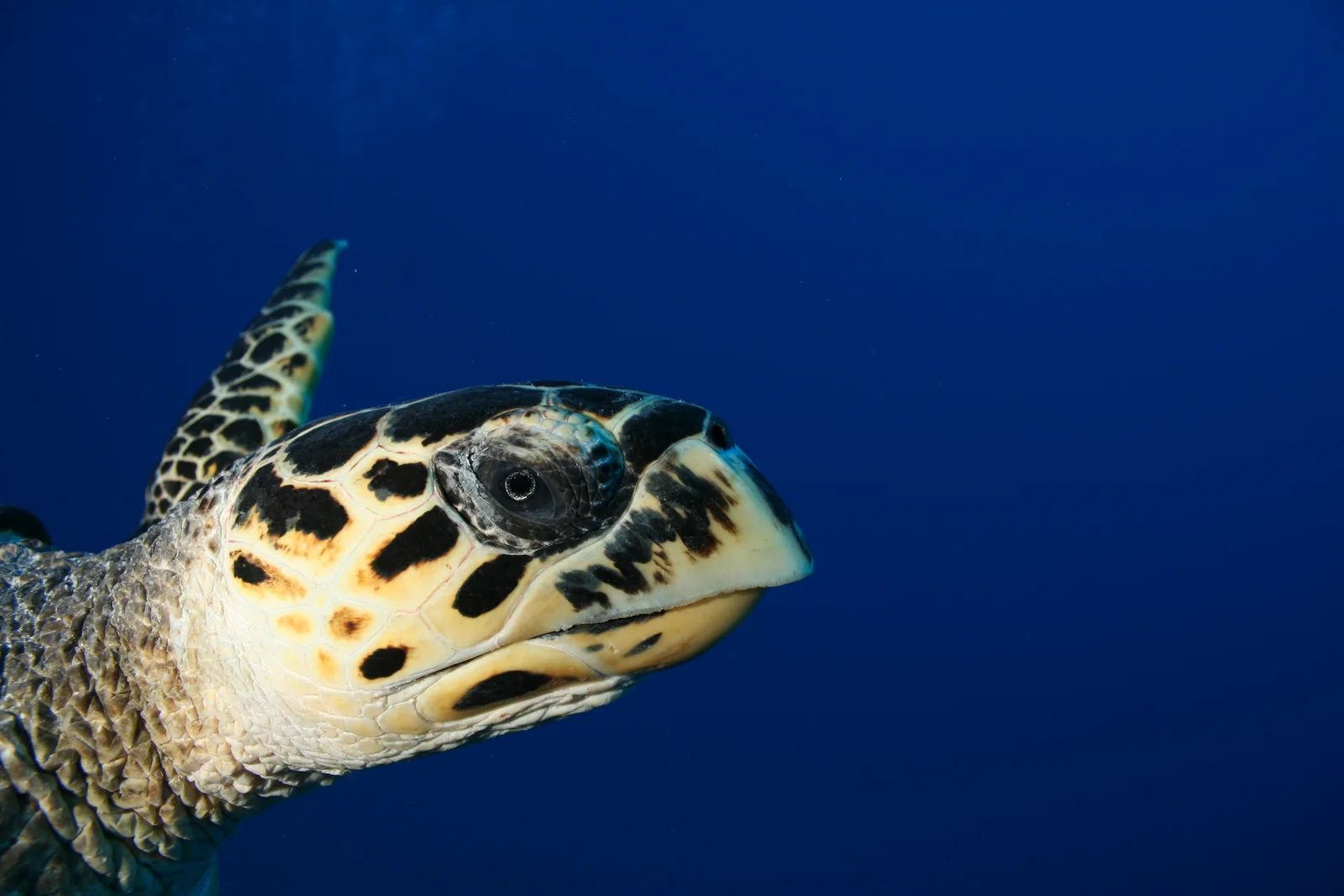
How to identify
Green turtles are distinguishable from the Red Sea's other common turtle species (the hawksbill) by:
- Rounded, smooth carapace edge (hawksbills have a serrated edge and more pointed scutes).
- Small, rounded head with one pair of prefrontal scales (hawksbills have two pairs).
- Short, blunt beak — they're grazers, not predators.
- Single claw on each front flipper.
- Adult carapace length 80-150 cm; larger than most hawksbills you'll encounter.
Best Red Sea sites
When to see them
Resident turtles are visible year-round. Nesting season on Egyptian beaches peaks July-September — Zabargad Island is the most significant Red Sea nesting site, though access is restricted.
Green turtles are present all year — viewing chances are essentially weather-dependent, not seasonal.
Behaviour
Adult green turtles spend their days grazing on seagrass and occasionally algae. They surface to breathe every 5-30 minutes depending on activity level — resting turtles can stay down much longer. Cleaning-station behaviour is common: a turtle parks on a coral head and lets cleaner wrasse groom its shell and flippers.
They are remarkably tolerant of divers if approached calmly. Many sites have individuals so accustomed to human presence that they're essentially indifferent — which is a privilege, not an invitation to harass.
Conservation status
Globally, the green turtle was reassessed by the IUCN to Least Concern (IUCN Red List, 2025), reflecting recovering nesting populations in several regions. That is the worldwide picture — locally it is more fragile: the North Indian Ocean subpopulation, which includes the Red Sea, remains Vulnerable. Red Sea populations are affected by:
- Boat strikes — propeller injuries are unfortunately common on the carapace.
- Plastic ingestion — plastic bags resemble jellyfish, a prey item for juveniles.
- Nesting-beach disturbance — lighting, vehicles, and construction disrupt nesting females.
- Bycatch in gillnets — less of an issue in the Egyptian Red Sea than elsewhere but not zero.
Diving with turtles responsibly
- Never touch. Skin mucus loss can cause infection.
- Do not block access to the surface — turtles breathe air, and stressing them by blocking ascent can drown them.
- Give space when they are feeding. A feeding turtle is already stressed by your presence; back off 3+ metres.
- Keep lights off at night near known nesting beaches. Torch beams disorient hatchlings.
- Report injured or entangled turtles to HEPCA (Hurghada Environmental Protection & Conservation Association).
Frequently asked questions
Reliable sites include Marsa Mubarak and Abu Dabbab (shore-accessible turtle and seagrass sites near Marsa Alam), Giftun Island lagoons and Sha'ab El Erg in Hurghada, Ras Umm Sid in Sharm El Sheikh (resident cleaning station), and house reefs at Makadi Bay and Sahl Hasheesh.
Green turtles are resident year-round, so encounters are essentially weather-dependent rather than seasonal. Nesting season on Egyptian beaches peaks July to September, with Zabargad Island the most significant nesting site (access restricted).
Green turtles have a rounded smooth carapace edge, small rounded head with a short blunt beak, and one pair of prefrontal scales. Hawksbills have a serrated carapace edge, two pairs of prefrontal scales, and a sharper hooked beak. Green turtles also tend to be larger as adults.
No. Touching turtles damages the protective mucus layer on their skin and shell, which can cause infections. Beyond that, blocking a turtle from reaching the surface to breathe can cause panic and drowning. Stay 3 metres back, especially at cleaning stations and during feeding, and let the turtle dictate the encounter.
Scientific reference: Wikipedia — Green Sea Turtle