2026 has started strong for Hurghada diving. Visibility peaked above 40 metres at Giftun Islands in March, and our guides have mapped two new cleaning stations near Carless Reef. The summer whale shark season is just around the corner (May–August, peak June–July). These are our honest rankings based on what we're actually seeing underwater this season.
Who this guide is for
This is the most opinionated dive site ranking we publish, and it works best if you fit one of these profiles:
- You're certified (Open Water minimum) and want to know which sites are genuinely worth booking versus tourist filler.
- You're choosing between Hurghada and Sharm and need to know what the diving here actually delivers.
- You're already booked in Hurghada and want to brief your dive centre on which sites you specifically want to visit.
- You're a returning Hurghada diver and want to know what's changed underwater since your last trip — visibility, marine life, new sites.
This guide is not for: snorkellers (we'll publish a separate snorkelling guide), liveaboard travellers (different sites entirely), or divers expecting Sharm-style pelagic action without a long boat ride. Hurghada's strengths are different — and we'll be straight about both.
Quick comparison — all the sites at a glance
Use this table to filter sites by your own priorities before reading the full breakdowns below:
| Site | Depth | Skill | Boat time | Best for | Avoid if |
|---|---|---|---|---|---|
| 1. Police Station | 5–30 m | All | 45 min | All-rounder, photography | You hate longer drifts |
| 2. Abu Ramada | 8–25 m | Beginner+ | 60 min | Fish density, schooling | Strong currents bother you |
| 3. Carless Reef | 15–40 m | Advanced | 75 min | Pelagic chance, hammerheads | You're newly certified |
| 4. Sha'ab El Erg | 5–18 m | All | 90 min | Dolphin encounters | You want depth/walls |
| 5. Banana Reef | 5–22 m | All | 50 min | Training, night dives | You want big animals |
| 6. El Fanadir | 10–28 m | All | 25 min | Quick trips, reef sharks | You hate busy sites |
| 7. Umm Gamar | 10–35 m | Intermediate+ | 60 min | Walls, anthias clouds | You're new to drift diving |
| 8. Sha'ab Sabina | 3–15 m | Beginner | 40 min | OW training, macro | You want depth or pelagic |
| 9. Erg Somaya | 10–25 m | Intermediate | 65 min | Combo dive with Abu Ramada | You're looking for unique sites |
1. Giftun Island – Police Station
Police Station has held our #1 spot for four years running. The site is a long sloping wall on the eastern side of Big Giftun, dropping from a shallow reef plateau down past 30 metres into deep blue water. Cleaning stations everywhere — bring a slate and you can spend a full dive watching turtles, snappers and the occasional eagle ray getting serviced. Morning light on the eastern wall between 9 and 10 AM is unmatched for photography.
What to look for
The wall has three distinct zones that each reward attention. Above 12 metres, the soft coral cover is what you came for — pulsing pink and purple Dendronephthya, with anthias clouds that part as you swim through them. Between 12 and 20 metres, the cleaning stations cluster: blue-streak cleaner wrasse working over groupers, snappers and the occasional turtle. Below 22 metres, watch the blue water — eagle rays cruise the wall in pairs and we've had two whale shark sightings here in the last two summers, both in late July.
Pro tip from our guides
Ask your guide to drop you on the southern tip and drift north — currents are usually mild but you'll cover three distinct reef zones in one dive. Skip the standard mooring drop unless conditions are rough.
2. Abu Ramada – "The Aquarium"
The nickname is earned. Abu Ramada hosts the densest fish life of any reef in the Hurghada area — massive schools of barracuda hovering over the plateau, walls of bannerfish, and some of the healthiest hard coral tables left in the Red Sea. The site is wonderfully forgiving: shallow, currentless most days, and great for newer divers wanting their first "wow moment" without the depth.
3. Carless Reef
Two large coral pinnacles rising from a sandy bottom at 30 metres — Carless is the closest thing Hurghada has to a Sharm-style pelagic site. Hammerheads pass occasionally during the summer months (peak July-September is when northern Red Sea hammerheads are most active), and the pinnacles host enormous moray eels, hawksbill turtles and the new cleaning stations our team mapped in late 2025.
Dive these sites with us
Aquarius runs daily boat trips to all these sites from our Hurghada Marriott marina base.
See Hurghada Dive Trips →4. Sha'ab El Erg – Dolphin House
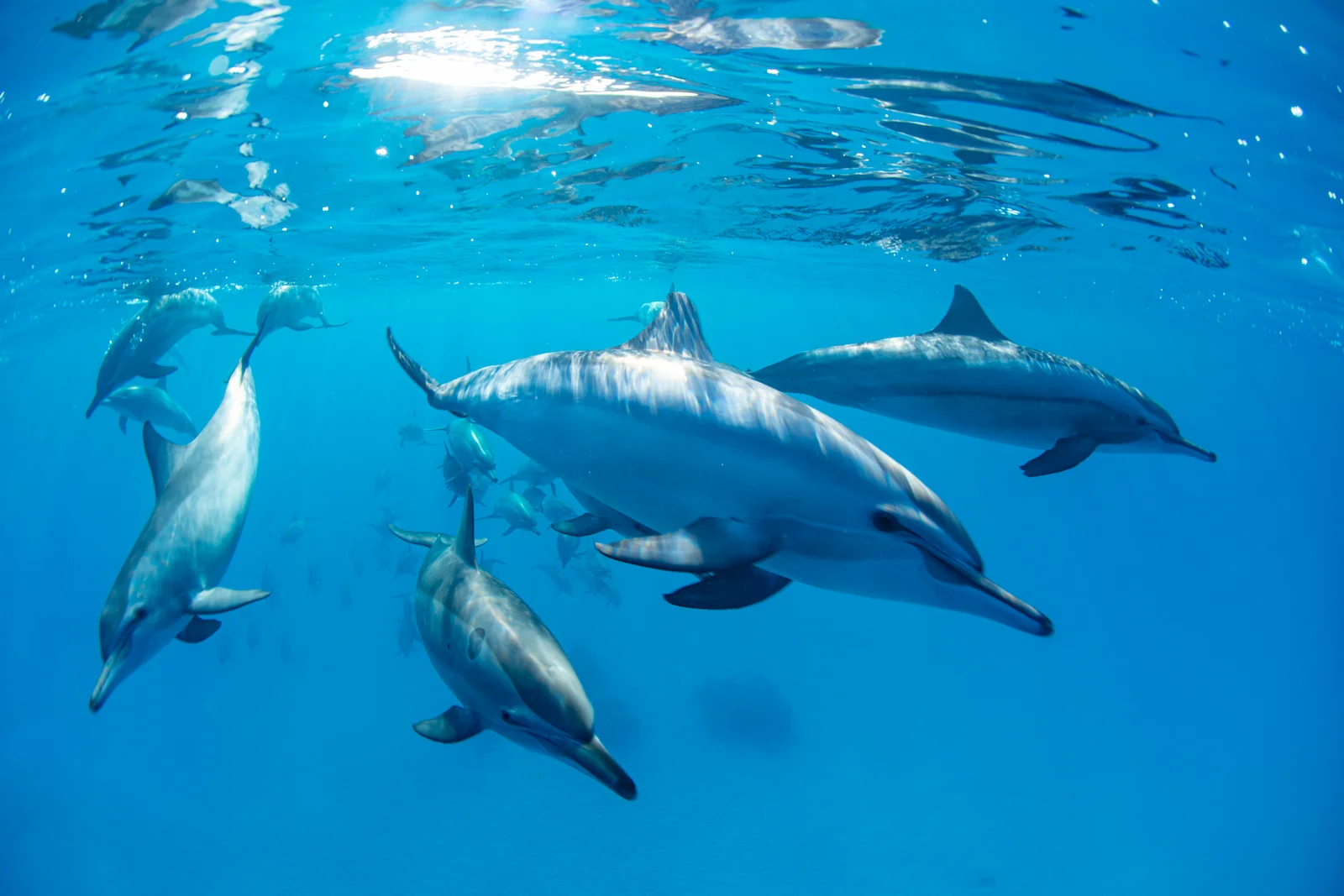
The famous horseshoe-shaped reef where spinner dolphins come to rest. Book with operators that follow strict no-chase guidelines, dive early before snorkel boats arrive, and you'll have one of the most magical experiences of your life. See our full spinner dolphin species guide.
5. Small Giftun – Banana Reef
A long crescent-shaped reef on the west side of Small Giftun, sheltered from prevailing winds. Perfect for second dives, training dives and night dives. Resident green turtles and a famous octopus colony in the shallows.
Why it's underrated
Banana Reef rarely makes "best of" lists because it lacks the dramatic walls of Police Station or the fish density of Abu Ramada. But it's our most-used site for mid-skill divers because the conditions are reliably calm regardless of wind direction. A resident colony of 5–8 green turtles grazes the seagrass on the southern end. Octopus sightings on night dives are the highest of any Hurghada site we know — we routinely see 4–6 individuals in a 50-minute dive.
Best uses
- Refresher dives after long surface intervals — calm, shallow, low-current.
- Open Water training dives 3 and 4 — depth options, plenty of marine life for skill demonstrations.
- Photography practice — predictable subjects, good light penetration to 12m+.
- Night dives — by far our top pick. Octopus, basket stars, hunting moray eels, cleaner shrimp activity.
6. El Fanadir Reef
The closest serious dive site to Hurghada marina — only 25 minutes by boat. A long wall covered in soft corals with regular reef shark sightings on the deeper sections.
The wall and its layers
El Fanadir's wall runs for nearly 800 metres, with three distinct dive plans depending on entry point. The "north plateau" entry drops you onto a sandy plateau at 22 metres scattered with coral heads — frequent stingrays, garden eels, and the chance of grey reef sharks circling on the deep edge. The "central wall" entry is the classic dive: a vertical drop covered in soft coral, anthias clouds, and resident giant morays in every other crevice. The "south arrow" entry leads to a famous swim-through at 18 metres that exits onto a smaller secondary wall.
Why it gets busier
El Fanadir's accessibility means most Hurghada operators schedule it for the second dive of the day after a longer site like Police Station. Expect to see 2–3 other dive boats on the mooring lines, especially November-March. We dive it earlier in the morning when crowds are thinner.
7. Umm Gamar
Northern site with one of the most beautiful drop-offs in the area. Anthias clouds, glassfish under overhangs, and seasonal mantas if you're very lucky.
The site structure
Umm Gamar is a long narrow island with vertical walls on both eastern and western sides, dropping past 50 metres in places. The famous "Cathedral" cavern at 18 metres on the east side is filled with millions of glassfish moving as a single organism — one of the most photogenic sights in the Red Sea. Outside, the wall is encrusted with healthy soft coral and hard coral. Manta sightings happen mostly January–March on the northern tip, often coinciding with plankton-rich water.
Skill notes
Currents at the northern point can be strong. Newly-certified divers should stick to the sheltered southern end. The cavern penetration is straightforward but requires good buoyancy — silt accumulates quickly with a single fin-kick.
8. Sha'ab Sabina
Sandy lagoon perfect for Open Water training, with a surprising amount of macro life if you slow down — frogfish, ghost pipefish, and a resident family of bluespotted stingrays.
For training
This is where the majority of our PADI Open Water dives 1 and 2 happen. The lagoon is sheltered from currents in any wind direction, the bottom slopes gently from 3 to 12 metres, and the visibility is consistently above 20 metres even when other sites get murky. New divers love the resident 50+ rabbitfish that follow the group around like a curious shoal.
For experienced divers
Slow down and look. The site has an unfair reputation as "boring" because most divers blast through it as a stopover. We've found ghost pipefish here on every dedicated macro dive in the last 12 months, plus regular frogfish, two species of seahorse on the seagrass beds, and an unusually photogenic family of bluespotted stingrays.
9. Erg Somaya
Small isolated pinnacle with surprising fish density. Often combined with Abu Ramada as a two-tank trip.
The pinnacle
Erg Somaya is essentially one giant coral head rising from a sand bottom at 25 metres to within 6 metres of the surface. Despite its small footprint — you can circumnavigate it in 8 minutes — the marine life density is comparable to much larger reefs. Resident schools of orange-spotted snappers, a healthy population of unicornfish, and frequent visits from passing barracuda schools.
How to dive it
Most operators pair Erg Somaya with Abu Ramada because they're 15 minutes apart. The two sites complement each other — Abu Ramada for the schooling action and macro, Erg Somaya for relaxed circumnavigation and photography of the pinnacle structure itself. As a standalone dive it's underwhelming.
Common mistakes Hurghada divers make
Things we see new visitors get wrong, and how to avoid them:
- Booking the wrong skill level for Carless or Umm Gamar. Both sites can have strong currents and depth above what newly-certified divers should attempt. If you've done fewer than 30 logged dives, ask your operator to honestly assess whether these sites are a good fit. A good operator will say no.
- Skipping the longer-distance sites for "convenience." Some operators push El Fanadir as the standard second dive because it's a 25-minute boat ride. The reality is that Police Station, Abu Ramada and Carless are all worth the longer ride. Insist on quality over convenience.
- Trying to "do everything" in one week. Trying to dive every site in a 7-day trip is too many. Pick 5–6 and dive each one twice — you'll see far more on the second dive once you know the layout. We almost always recommend repeat visits to Police Station and Abu Ramada.
- Booking based on price alone. Hurghada has a wide quality range. The cheapest "cattle boats" pack 25+ divers per boat. The reefs are the same; the experience isn't. Pay 30% more for a small-group operator and your trip improves dramatically.
- Not asking about visibility before booking the day. Wind shifts can drop visibility to 8 metres at exposed sites. Good operators will switch the boat itinerary to sheltered sites. If yours doesn't, you've picked the wrong operator.
- Diving the same sites on consecutive years without checking what's changed. Coral cover, fish populations, and even bottom topography change year to year. Our 2024 ranking had Carless at #2; in 2026 it's #3 because Abu Ramada's coral recovered exceptionally after the 2025 bleaching event mostly missed Hurghada.
When to dive Hurghada in 2026
- March-May: Spring conditions, water warming from 22°C to 25°C, calm winds, good visibility before peak summer.
- June-August: Peak visibility (often 35m+), warm water (28°C), busiest crowds, whale shark season at its best.
- September-November: Our pick — perfect temps, excellent viz, quieter boats.
- December-February: Cooler (22-24°C), quieter reefs, fewer tourists, lower prices.
For a deeper breakdown, see Best Time to Dive the Red Sea.
How to dive these sites with Aquarius
Aquarius Diving Club has operated in Hurghada for 30+ years and runs daily boat trips to all these sites from our Marriott marina base. We also operate from Sharm El Sheikh, Makadi Bay and Sahl Hasheesh.
Frequently asked questions
What is the best dive site in Hurghada?
Police Station at Giftun Island is consistently ranked the best dive site in Hurghada, with a wall dropping from 5 to 30+ metres, cleaning stations for turtles and snappers, and visibility typically 35-42 metres in 2026.
Can beginners dive in Hurghada?
Yes, many Hurghada sites suit beginners including Abu Ramada (nicknamed The Aquarium for its dense fish life), Small Giftun Banana Reef, and Sha'ab Sabina — all with shallow profiles and mild currents.
When can I see whale sharks in Hurghada?
Whale sharks are most likely in Hurghada from May to August, peaking in June and July when summer plankton blooms are at their densest. They are never guaranteed — sightings are rare and require offshore reefs like Giftun Islands and Sha'ab Abu Nuhas. Outside this window, sightings drop to occasional one-off encounters.
How much does a day of diving cost in Hurghada?
A standard 2-tank Hurghada day boat trip in 2026 costs €50-80 per person, including equipment, lunch and hotel transfer. Premium trips to Dolphin House or Thistlegorm day-trips cost more.