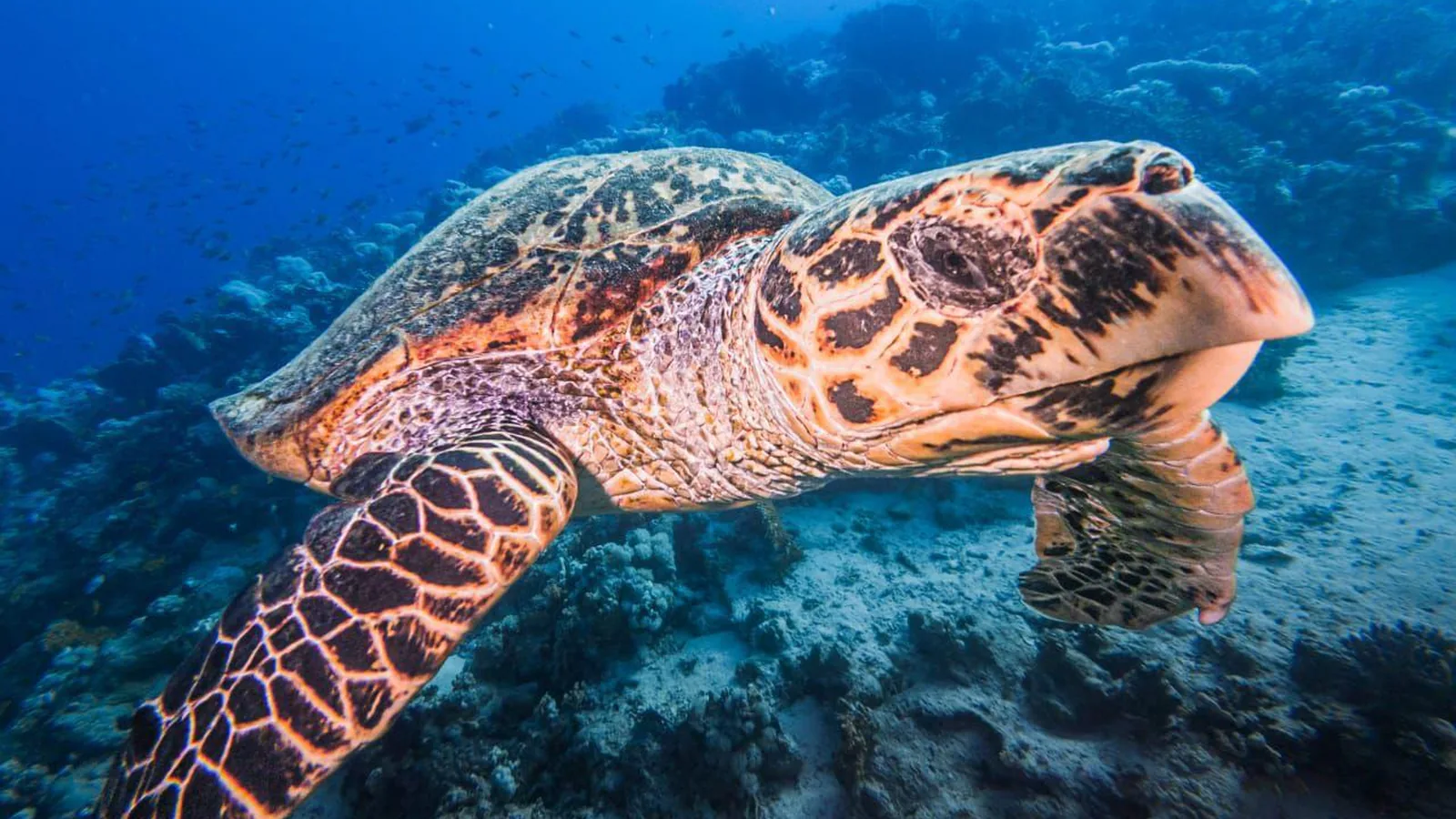
How to identify a hawksbill
The hawksbill is one of the easiest Red Sea animals to identify confidently once you know the cues — and telling it apart from the green turtle is the skill worth having, because the two share the same reefs.
- The beak. The give-away. A hawksbill has a narrow, tapering, hooked upper jaw that genuinely resembles a hawk's beak — the feature it is named for. It evolved to probe into reef cracks and ledges for food. A green turtle's beak, by contrast, is short, blunt and rounded.
- Overlapping scutes. The bony plates (scutes) on a hawksbill's shell overlap like roof tiles — a feature unique to this species among sea turtles. The shell carries the rich, mottled "tortoiseshell" patterning that historically made the animal a target.
- Serrated shell edge. The rear margin of the carapace is strongly saw-toothed. Run your eye along the trailing edge of the shell — if it looks jagged and serrated, it is a hawksbill; a green turtle's shell edge is smooth.
- Head scales. Hawksbills have two pairs of prefrontal scales between the eyes; green turtles have a single pair. Useful on a clear close-up photo.
- Size and build. Adults reach roughly 0.8–1 m of shell length and around 45–90 kg — slimmer and generally smaller than an adult green turtle.
| Feature | Hawksbill (E. imbricata) | Green turtle (Chelonia mydas) |
|---|---|---|
| Beak | Narrow, pointed, hawk-like | Short, blunt, rounded |
| Scutes | Overlapping (tile-like) | Smooth, side by side |
| Shell rear edge | Strongly serrated | Smooth |
| Prefrontal scales | Two pairs | One pair |
| Adult diet | Mainly sponges (spongivore) | Mainly seagrass & algae (herbivore) |
| Typical setting | Coral reef walls & ledges | Seagrass beds & lagoons |
For the full picture on the other resident species — including why it grazes the seagrass meadows rather than the reef — see the green turtle species guide.
Where to see them
When to see them
Hawksbills are resident on Red Sea reefs all year, so there is no true "off" season — if the reef is healthy, the turtles are there. Sightings tick up over the warm months (roughly May–October), which overlaps the nesting period when adults are most active around the coast. Visibility and calm summer conditions also make turtle-watching easier in that window.
Resident year-round Peak activity May–October (nesting season)
Biology & ecology
The hawksbill is a small-to-medium sea turtle built for one job: living on coral reefs. A few facts worth knowing:
- A sponge specialist. Hawksbills are spongivores — sponges make up the large majority of their diet, with studies reporting roughly 70–95% in many populations. They are the only sea turtle whose diet is dominated by sponges.
- Built to handle toxic food. Many reef sponges are defended by glassy silica spicules and chemicals that are toxic to other animals. Hawksbills tolerate them; some of the chemical compounds accumulate in their tissues, which is one reason their meat can be unsafe to eat.
- Reef gardeners. By eating sponges that compete with stony corals for space on the reef, hawksbills help keep the balance between sponges and reef-building corals — a role considered important for coral-reef health.
- Slow to mature, long-lived. Hawksbills are estimated to reach breeding maturity only after about 20–35 years and may live 50 years or more. That slow life history is exactly why losses are so hard to recover from.
- Reproduction. Females nest at night on isolated beaches, usually only every 1–3 years (sometimes up to 5), laying several clutches per nesting season of roughly 130–160 eggs each; incubation takes about two months. In Egypt, hawksbills both feed and nest along the Red Sea coast.
- Wide-ranging. Sea turtles undertake long migrations between feeding and nesting grounds, and Egypt's hawksbills are part of a wider Red Sea population rather than an isolated one.
Behaviour and what to expect
Hawksbill encounters on Red Sea dives tend to take one of these forms:
- The feeder. The classic sighting — a turtle moving slowly along a reef wall, pausing to push its beak into cracks and ledges after sponges, often surrounded by reef fish picking up scraps. These animals are absorbed in feeding and frequently tolerate calm divers nearby for long stretches.
- The rester. A turtle tucked under a coral overhang or wedged on a ledge, sitting out a surface interval. Resting turtles should be given space — do not crowd a sheltering animal.
- The surfacer. Turtles are air-breathers and rise to the surface to breathe. Never position yourself, or your group, between a turtle and open water above it.
Hawksbills are generally relaxed around divers and can be wonderfully approachable when left alone — but "approachable" is something the turtle decides, not the diver. The right approach is simple: stay low, stay calm, keep a few metres back, and let the animal carry on. If it is curious it will come to you.
Diving with hawksbills — practical guide
The good news for anyone hoping to see a turtle in the Red Sea: you do not need a special trip, a liveaboard, or a deep dive.
Where to aim
Because hawksbills are reef residents, a normal day's reef diving around Hurghada, Makadi Bay, Sahl Hasheesh, Sharm El Sheikh or Marsa Alam carries a genuine chance of a sighting. Coral-rich walls and shallow coral gardens are the best bet. The Giftun Islands off Hurghada are a long-standing favourite.
Skill level
Most hawksbill encounters happen between the surface and about 20 metres, so recreational levels are plenty — Open Water for the shallow reefs, with Advanced opening up the deeper walls. The relevant skill is not depth but buoyancy: holding position calmly without finning at the turtle. Snorkellers do well too, since hawksbills feed at reef-crest depths.
Etiquette that actually matters
No touching, no chasing, no riding, no feeding, no blocking the path to the surface. These are not just courtesies — for a Critically Endangered species on protected reefs they are the rules, and they also produce far better encounters: a stressed turtle leaves, a calm one stays.
Conservation
The hawksbill is the most threatened of all the sea turtles. It is listed as Critically Endangered on the IUCN Red List, banned from international trade under CITES Appendix I, and listed as Endangered under the United States' Endangered Species Act. The threats are well documented:
- The tortoiseshell (bekko) trade. For centuries the hawksbill's patterned shell was harvested to make "tortoiseshell" combs, jewellery and ornaments. This historical take, into the tens of millions of animals over the trade's lifetime, is the main reason the species collapsed. International trade is now prohibited, but illegal demand persists in some markets.
- Bycatch. Hawksbills are caught and drowned in fishing gear — particularly gillnets and hook-and-line fisheries operating in the coastal reef habitats where they live.
- Loss of nesting and feeding habitat. Coastal development, artificial lighting on nesting beaches, and the degradation of coral reefs and seagrass beds all erode the habitats turtles depend on.
- Marine debris. Turtles ingest plastic and other floating debris, which can be fatal; pollution also drives disease.
- A slow life history. Maturing only after two to three decades and nesting only every few years, hawksbill populations simply cannot replace heavy losses quickly.
In the Egyptian Red Sea, conservation work focuses on protecting nesting beaches and feeding grounds, reducing harmful coastal development and boat impacts, and promoting responsible turtle-encounter behaviour through codes of conduct for divers and snorkellers.
What divers can do
- Keep your distance. The single most useful thing is also the simplest — never touch, chase, ride or feed a turtle, and never block its route to the surface.
- Photograph the face, not by crowding it. A clear shot of the head (beak shape, prefrontal scales) helps confirm the species; shoot from a respectful distance with a wide or zoom setup rather than pushing in close.
- Choose low-impact operators. Dive with centres that brief turtle etiquette and enforce no-touch, no-feed policies on the reef.
- Refuse tortoiseshell products. Never buy combs, jewellery or ornaments made from turtle shell — the demand is what keeps the illegal trade alive.
- Cut single-use plastic. Less plastic in the sea means fewer turtles eating it.
Photographing hawksbills — quick guide
Hawksbills are among the most rewarding Red Sea subjects: they move slowly, they live in the shallows where light is good, and a feeding turtle often gives you minutes rather than seconds.
- Lens: A wide-angle setup (fisheye or rectilinear wide zoom) captures the turtle in its reef setting; a mid-range zoom works for portraits without crowding the animal.
- Light: Shooting in shallow water means plenty of ambient light — strobes at modest power lift the shell colour and the reef without harsh backscatter.
- Angle: Get level with or slightly below the turtle and shoot as it moves along the reef; eye-level beats shooting down onto the shell.
- Settings: ISO 200–800, shutter around 1/125–1/200, aperture f/8–f/11 for depth of field on a moving subject.
- Behave first, shoot second: Let the turtle settle into feeding before you frame up. A photo is never worth pushing the animal off the reef.
Other Red Sea turtles & reef life
Four sea turtle species have been recorded in the Egyptian Red Sea, but only two are resident:
- Green turtle (Chelonia mydas) — the other resident, a herbivore of the seagrass meadows with a blunt beak and smooth shell. See the green turtle guide for how to tell them apart at a glance.
- Loggerhead, olive ridley and leatherback — recorded but rare visitors to Egyptian waters, far less likely on a typical reef dive.
For the bigger picture of what swims the Egyptian reefs, browse the full Red Sea marine-life encyclopedia, or start with the complete guide to scuba diving the Red Sea.
Frequently asked questions
Yes. The hawksbill is one of two resident sea turtle species in the Egyptian Red Sea (the other is the green turtle). Hawksbills both feed and nest along the Egyptian coast and are seen regularly on coral reefs from Hurghada south, around the Giftun Islands and on shallow house reefs. As reef specialists, they turn up exactly where divers spend most of a dive.
Check the head and shell. A hawksbill has a narrow, pointed, hawk-like beak, two pairs of scales between the eyes, overlapping shell scutes and a strongly serrated rear shell edge. A green turtle has a short, rounded beak, one pair of prefrontal scales and a smooth, non-overlapping shell. See the green turtle guide for a side-by-side.
Mainly sponges — roughly 70–95% of the diet in many populations, making the hawksbill the only sponge-specialist sea turtle. Its pointed beak reaches sponges wedged into reef cracks. It also takes some algae, soft coral and other invertebrates. By grazing sponges that compete with corals, hawksbills help keep reefs in balance.
They are listed as Critically Endangered — the most threatened sea turtle. The main historical cause was the tortoiseshell (bekko) trade in their patterned shells; today the major threats are bycatch in fishing gear, loss of nesting beaches and reef/seagrass habitat, and ingestion of plastic. A very slow life history — maturity after 20–35 years and nesting only every few years — makes recovery slow.
Adults reach roughly 0.8–1 metre of shell (carapace) length and weigh around 45–90 kg. That makes the hawksbill a small-to-medium sea turtle — generally slimmer and smaller than an adult green turtle.
No. Touching, chasing, riding or feeding a sea turtle is harmful and illegal in protected areas. It stresses the animal and can block its path to the surface to breathe. Keep several metres back, stay calm, and let the turtle move freely — calm behaviour also gives you a far longer encounter.
Hawksbills are resident year-round, so any season can produce a sighting on a healthy reef. Activity tends to peak over the warm months (about May–October), which overlaps the nesting season and brings the calm, clear conditions that make turtle-watching easiest.