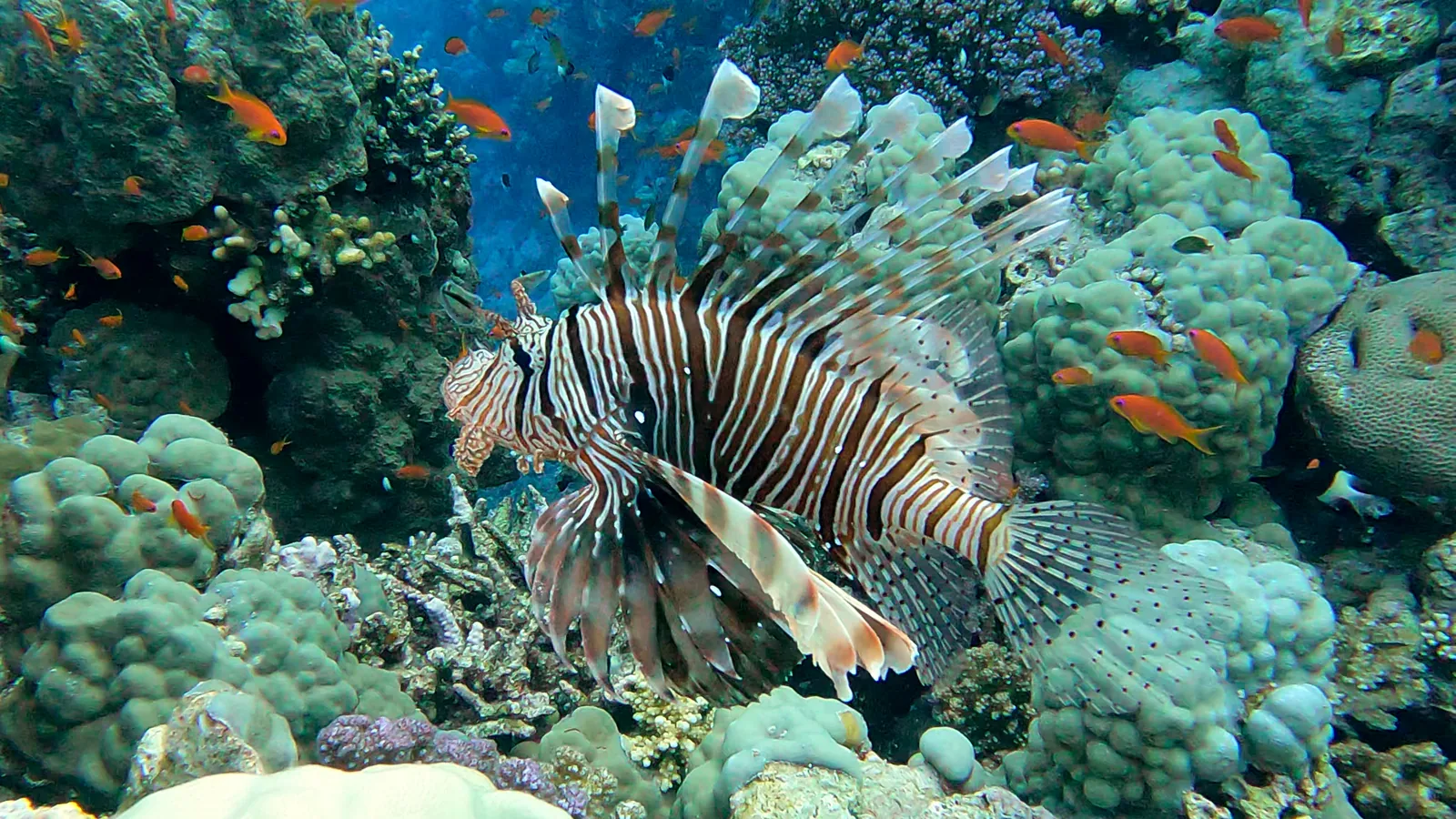
Where to see them
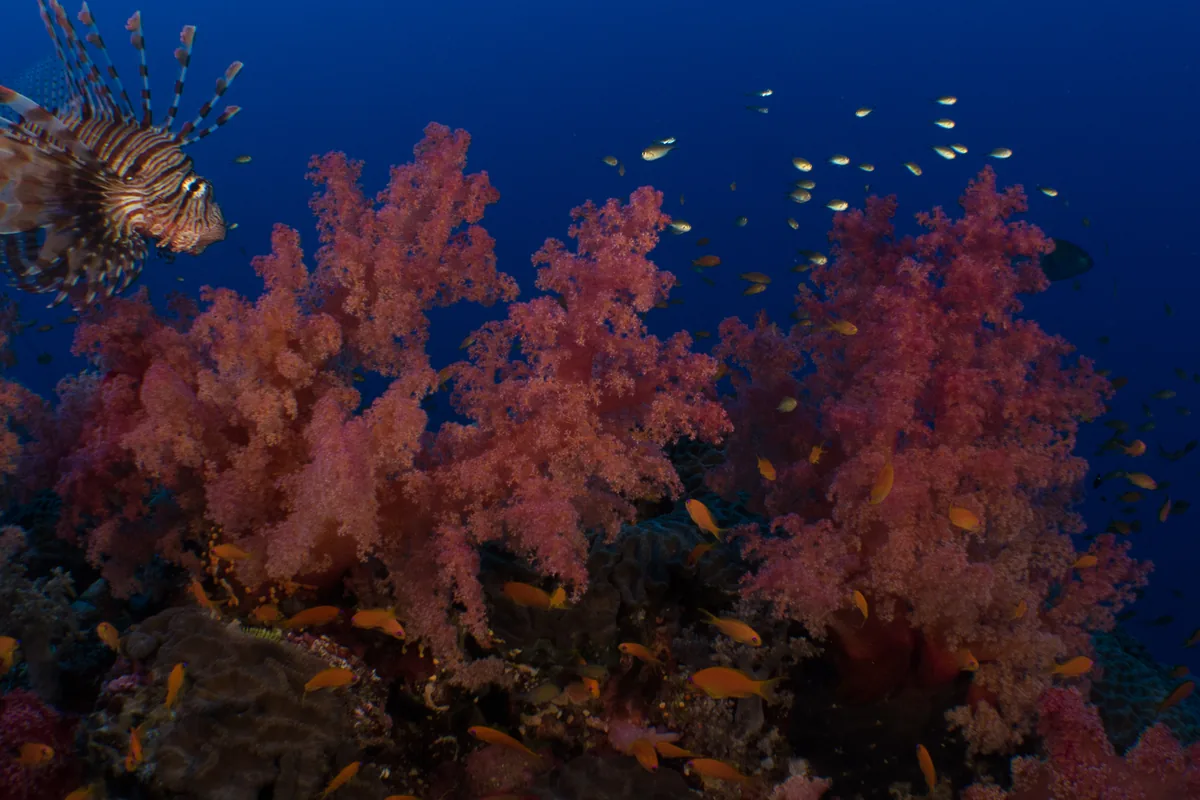
When to see them
Lionfish are year-round residents of every Red Sea reef — there is no migration. Sightings peak at dusk and on night dives, when they hunt.
Year-round resident Active hunter at dusk + night
Two species, two stories — and why you need to know the difference
The "lionfish problem" you may have read about in marine biology news is real — but it is about lionfish where they don't belong, not lionfish in the Red Sea. There are actually multiple lionfish species in the Pterois genus; for Red Sea divers, only one matters as a regular encounter, and the second matters only as context for the invasive-population story:
| Feature | Pterois miles (devil firefish) | Pterois volitans (red lionfish) |
|---|---|---|
| Native range | Red Sea, Indian Ocean, South Africa to Sumatra | Pacific Ocean, southern Japan to Pitcairn |
| Red Sea native? | Yes — this is "the" Red Sea lionfish | No — not native here |
| Invasive in Atlantic? | Minor presence | Major invasive (most invasive lionfish are this species or hybrids) |
| Invasive in Mediterranean? | Yes — main invasive species, via Suez Canal | Rare in Mediterranean |
| Distinguishing features | One less dorsal soft-fin ray than P. volitans (10 vs 11) | Nearly identical appearance to P. miles |
| Genetics | Pure species | Atlantic populations show hybridisation with P. miles and P. russelii |
The two species are so visually similar that distinguishing them in water is nearly impossible — they were considered the same species until 1986. The species you see on Red Sea reefs is reliably Pterois miles. The species causing the Atlantic invasion (first reported off Florida in 1985) is predominantly P. volitans with significant hybrid populations involving P. miles. For practical diving purposes: the lionfish on your Red Sea reef is a native species, not an invader.
Identification
Lionfish are unmistakable. Even non-divers recognise them — they're the showpiece exotic-aquarium fish on posters everywhere. In the water:
- Body: Compressed, elongated, typically 25-35 cm long (up to 38 cm typically; maximum recorded 43 cm). Body striped in red-brown, white and dark brown vertical bands.
- Pectoral fins (the "mane"): Enormous, fan-like, spread when the fish is displaying or hunting. These are NOT venomous — they are display and prey-corralling structures.
- Dorsal spines: 13 long, sharp spines extend along the back. These ARE venomous.
- Pelvic spines: 2 small spines on the underside. Venomous.
- Anal spines: 3 short spines near the tail. Venomous.
- Soft dorsal and anal rays: Behind the spines, the rear soft-rayed parts of these fins are flexible — not venomous.
- Total venomous spines: 17-18 across the three fin groups.
- Eyes: Large, often with small tentacles above (ocular tentacles).
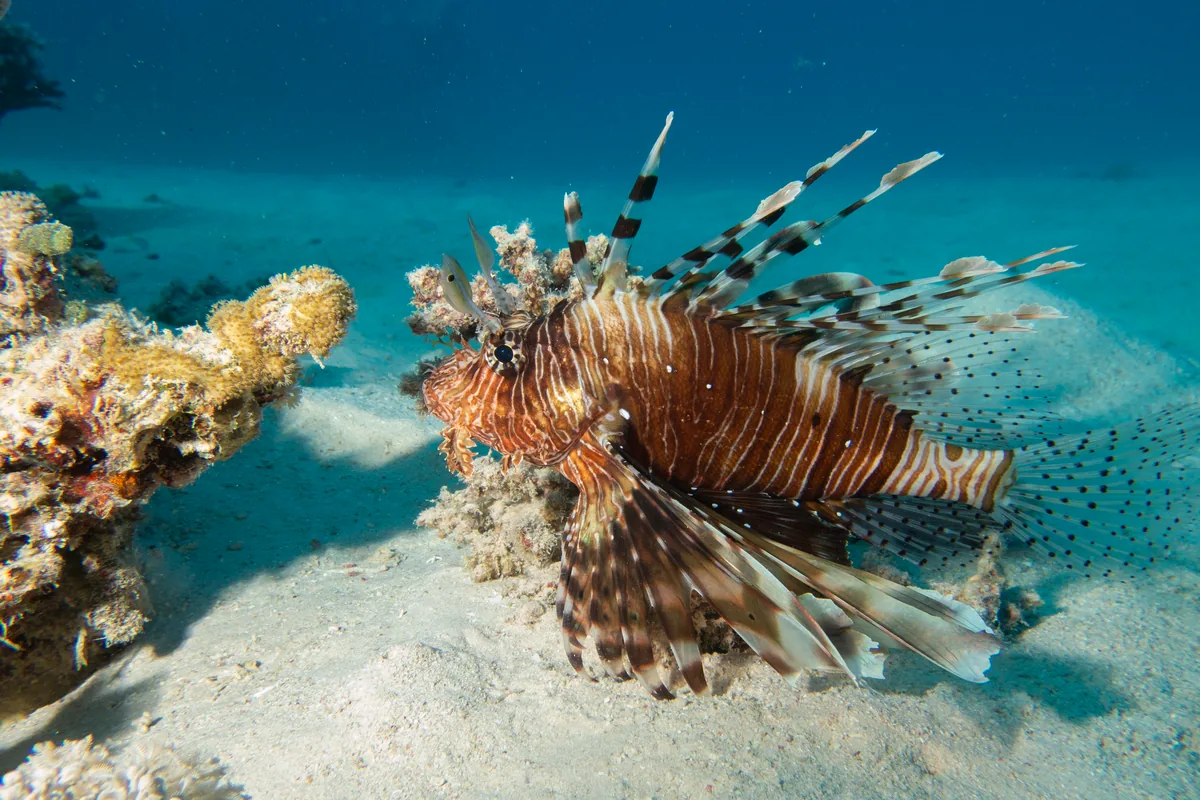
Juveniles are smaller (5-15 cm) but otherwise look identical to adults — there is no dramatic colour change with age. Sexual dimorphism is minimal in Pterois miles; males and females look essentially the same.
Behaviour and where you see them
Lionfish in the Red Sea are typically solitary, though loose aggregations of 2-5 fish on a single reef ledge are common. Their behaviour is shaped by a single fact: they are ambush predators that rely on stealth and on the fact that almost nothing wants to eat them.
- Hunting: They hover stationary near coral overhangs, then accelerate in a sudden burst, often using their flared pectoral fins to corner small fish against a surface before striking. Strikes are extraordinarily fast — under 50 milliseconds from hover to engulfment.
- Daytime hiding: By day, they tuck under coral ledges, in crevices, and under boat wrecks. They sometimes hang upside down on a vertical surface, head-down, perfectly stationary.
- Crepuscular hunting: Most active hunting happens at dawn and dusk. Night divers see lionfish actively patrolling open reef in the dark.
- Confidence: Unlike most reef fish, lionfish do not flee from divers. They have no need to — almost nothing in the reef ecosystem can eat them, and their venomous spines mean even casual contact is costly for would-be predators.
- Display: When threatened or approached too closely, lionfish flare their pectoral fins, lower the front of the body, and orient their dorsal spines toward the threat. This is a clear warning.
Where to see them on Red Sea dives
Lionfish are reliable encounters on virtually every Red Sea reef. Specifically:
- Under coral overhangs at 5-25 m on any standard reef site
- Inside wrecks — the SS Thistlegorm, El Mina, Dunraven, and Abu Nuhas wrecks all host resident lionfish populations
- House reefs at all Aquarius bases — Sahl Hasheesh and Sharm house reefs particularly. Beginning divers often see their first lionfish during the check-out dive of a course.
- Night dives anywhere — lionfish become noticeably bolder and more visible in open water at night
You will not have to search for lionfish in the Red Sea. The question is what you do when you find them, which is the next section.
Venom — what it is and what it isn't
Lionfish venom is a protein-based mixture delivered through the dorsal, pelvic and anal spines. Each spine has a pair of venom glands at its base. When the spine penetrates skin, mechanical pressure squeezes the glands and forces venom into the wound through grooves along the spine.
Important properties of lionfish venom:
- Protein-based: The toxic compounds are heat-labile proteins — they denature (lose function) when exposed to heat. This is the basis of the standard hot-water first aid.
- Defensive, not offensive: Lionfish do not chase or attack prey with venom. The venom system exists to deter predators. Stings on divers are accidents — the fish has been touched or contacted.
- Not lethal to healthy humans: There are no published reports of healthy adults dying from lionfish stings. The pain is severe; the medical risk is mostly secondary infection.
- Venom retained in dead lionfish: A dead lionfish's spines are still loaded. The venom does not become inert until the fish is cooked or has decomposed substantially.
Symptoms of a sting
Pain is immediate and intense — many describe it as the worst pain they have ever experienced. Within minutes:
- Localised: Severe pain at the puncture site, swelling, redness, warmth, bruising
- Possible systemic: Nausea, vomiting, headache, fever, muscle weakness, sweating
- Rare and serious: Difficulty breathing, palpitations, fainting (potentially anaphylactic — seek emergency care)
Pain typically peaks 60-90 minutes after the sting and persists for several hours. Swelling and bruising can last 2-5 days. Tissue damage at the puncture site is the most common complication; severe envenomation can cause skin necrosis in rare cases, particularly on fingertips.
Lionfish sting first aid — the protocol
Lionfish Sting First Aid
Standard protocol from DAN (Divers Alert Network) and emergency medicine literature:
- Get the diver out of the water safely. A stung diver in pain may panic — stay calm, keep buddy contact, control the ascent.
- Remove any visible spines using tweezers and gloves if available. Don't squeeze the spine base (that may inject more venom). Allow small punctures to bleed briefly — this can reduce venom load slightly.
- Wash with fresh water. Plain potable water — soap and water if possible. This flushes debris and any surface venom. NOT seawater — seawater is the rinse used for cnidarian stings (jellyfish, fire coral) where rinsing with fresh water can trigger more venom discharge from undischarged nematocysts. Lionfish venom is delivered via spines, not nematocysts, so fresh water is the correct rinse.
- Immerse the affected limb in hot water at 40-45 °C (104-113 °F) — as hot as can be tolerated without scalding. Test the water temperature first on someone else's skin (the stung person's pain perception is unreliable). Soak for 30 to 90 minutes. Top up with hot water as it cools.
- Pain management: Over-the-counter ibuprofen or paracetamol. Many divers find significant relief from the hot-water immersion alone (~80% complete pain relief in clinical studies).
- Cover with sterile dressing and seek medical follow-up. Check tetanus vaccination status. Watch for signs of infection over the following 48-72 hours.
- Seek immediate medical attention if: spines remain in the wound (may need imaging and surgical removal), pain or swelling worsens rather than improves, signs of allergic reaction (hives, breathing difficulty, swelling beyond sting site), the wound involves a joint, the face, or a fingertip with circulation concern.
The hot water technique works because lionfish venom contains heat-labile proteins. Temperatures of 40-45 °C denature these proteins, neutralising the venom's bioactive properties. Approximately 80% of envenomation patients in clinical studies report complete pain relief from this treatment alone, within the 30-90 minute window.
What NOT to do: Don't ice the wound (cold preserves venom function — opposite of what you want). Don't apply alcohol, urine, or vinegar (no benefit, may worsen). Don't try to suck out venom. Don't tightly bandage above the wound — that won't help and may compromise circulation.
Biology, diet and reproduction
Diet: Lionfish are voracious opportunistic predators on small reef fish, crustaceans, and occasionally cephalopods. In their native Red Sea range, they primarily eat small reef fish 1-5 cm in length — damselfish, cardinalfish, juvenile wrasses, gobies. Their hunting technique combines stealth (motionless approach), pectoral-fin corralling (using the spread fins to direct prey toward a surface), and explosive strike speed.
Reproduction: Lionfish are extraordinarily prolific. Sexually mature females can release 12,000-15,000 eggs per spawning event, and can spawn every 4-7 days year-round in tropical waters. Eggs are released in two floating gelatinous masses fertilised externally by males. Larvae spend 25-40 days as plankton before settling to the reef.
This reproductive output is exactly why they have been so catastrophically successful as invasives — but in their native Red Sea, natural predators and ecological balance keep populations at manageable levels.
Lifespan: 10-15 years in the wild; over 30 years documented in captivity. Growth is rapid in the first 2 years, then slows.
Native predators: In the Red Sea, lionfish are eaten (cautiously) by groupers, large moray eels, scorpionfish (also venomous fish), sharks, and possibly bluespotted cornetfish. Native predators have evolved either to handle the venom or to avoid the spines. This is the critical difference with invasive ranges: in the Atlantic and Mediterranean, no fish has co-evolved with lionfish, so adult lionfish have essentially no predators.
Native vs invasive — a tale of two ecosystems
The lionfish-as-invasive story is one of the most studied marine biological invasions in history. Understanding it helps Red Sea divers appreciate why the lionfish you encounter here are different — even though it is the same fish species.
| Native Red Sea / Indo-Pacific | Invasive Atlantic | |
|---|---|---|
| Density | ~5–50 lionfish per hectare | Up to 390 per hectare (Bahamas) |
| Population structure | Stable, balanced | Explosive growth, no equilibrium |
| Predators | Co-evolved native predators | Effectively no predators |
| Prey response | Native fish recognise threat | Atlantic native fish naive — easily eaten |
| Growth rate | Native baseline | 1.25–2.25× faster than native range |
| Body size | 25–35 cm typical adults | Reaches larger sizes in invaded range |
| Trophic impact | Part of healthy ecosystem | Documented 65-80% reef fish biomass declines on invaded reefs |
The Atlantic invasion likely started with aquarium releases off Florida in the 1980s. By 2000 lionfish were established in the Bahamas; by 2010 throughout the Caribbean; by 2015 throughout the Gulf of Mexico, the southeastern US coast, and as far south as Brazil. Mediterranean invasion (via the Suez Canal from the Red Sea) became significant in the 2010s and continues to spread westward.
In invaded ranges, organised culling programs (spearfishing tournaments, restaurant programs, citizen-diver hunting initiatives) attempt to control populations. These have shown some local success but cannot reverse the invasion at scale. The story is genuinely cautionary.
In the Red Sea, by contrast, lionfish are simply part of the native ecosystem. They have been here for as long as the reef itself. They are not the species you should be removing, hunting, or considering "the enemy." Red Sea conservation focuses on protecting the species that are declining (sharks, mantas, turtles) — not the ones in healthy equilibrium.
Diver etiquette and tips
For divers encountering lionfish in the Red Sea:
- Stay at least 1 metre away. Lionfish do not flee from divers — you must give them space yourself. Approaching closer than 1 m is asking for trouble.
- Never reach into crevices without looking. The most common scenario for accidental stings is a diver placing a hand on a reef overhang without seeing the lionfish tucked there.
- Watch your buoyancy. Sudden drops or uncontrolled descents can put you in contact with a wall — and any sheltered ledge may have a lionfish on it.
- Don't touch, ever. Even a dead lionfish is dangerous (spines remain venomous after death until cooked or decomposed).
- Photography: Lionfish are photogenic but maintain distance. The flared pectorals make great wide-angle subjects from below; macro shots of the head and eye work well from the side. Never push gear close to a lionfish — they tolerate the camera, not the contact.
- Don't hunt them in the Red Sea. Lionfish spearing programs are appropriate in invasive ranges. They are not appropriate here. Aquarius does not run lionfish culls.
- If you're stung, exit the dive in a controlled manner, signal your buddy, and execute the standard first aid (see above) as soon as you're on the boat. Most stings, while extremely painful, are not life-threatening.
Cultural notes and the eating question
In invasive-range countries, eating lionfish has become a cultural project — "eat the invaders" programs encourage tourists to try lionfish ceviche, lionfish tacos, and lionfish at restaurants in Florida, Mexico, and the Caribbean. The meat is genuinely good — white, flaky, mild, comparable to grouper or snapper.
Cooking destroys the venom completely. Heat denatures the protein toxins beyond recovery. Cooked lionfish is entirely safe to eat. The challenge is in preparation — careful removal of the spines before fileting is required to avoid envenomation of the cook.
In the Red Sea, where lionfish are native, eating them is uncommon and culturally not a focus. Egyptian and Eritrean coastal cuisine traditions feature parrotfish, grouper, and barracuda, but not lionfish. There is no conservation case for harvesting Red Sea lionfish at scale — they are at natural population levels here.
Related species in the Red Sea
The scorpionfish family (Scorpaenidae) includes several other venomous fish in the Red Sea that divers should know:
- Stonefish (Synanceia verrucosa) — the most venomous fish on Earth. Smaller, far better camouflaged than lionfish, often half-buried in sand or hidden among coral debris. Sting is medically serious and requires emergency care. Far harder to spot than lionfish.
- Devil scorpionfish (Scorpaenopsis diabolus) — heavily camouflaged ambush predator. Less venomous than stonefish but still painful. Often mistaken for coral rubble.
- Reef stonefish, false stonefish, dwarf lionfish — multiple smaller scorpionfish species. All venomous to some degree.
- Bearded scorpionfish (Scorpaenopsis barbata) — common in the Red Sea. Less venomous than stonefish but the same general care applies.
The general rule for all scorpionfishes including lionfish: look, photograph, never touch any surface without confirming nothing is on it.
For more on Red Sea marine life encounters and trip planning, see our Shark Diving in the Red Sea hub guide.
Conservation
In their native Red Sea range, lionfish are classified as Least Concern by the IUCN. Populations are healthy, stable, and not facing significant threats. Climate-related coral reef degradation may affect future habitat availability, but the species itself is doing fine here.
In invasive ranges, lionfish conservation is the opposite of native-range conservation — culling, hunting and harvest are encouraged. This is a useful illustration of how species conservation must always consider context: the same species can be a protected native here and an invasive pest elsewhere.
Frequently asked questions
No. Lionfish are ambush predators of small fish, not territorial aggressors toward divers. They will not pursue you. If one orients its spines toward you, it is because you are too close — back away and the encounter ends.
No. Juvenile lionfish have proportionally smaller but functional venomous spines. Treat them with the same caution. Some accounts suggest smaller lionfish stings can be more painful per puncture than larger ones, possibly due to higher venom concentration in younger glands.
Extremely unlikely — lionfish do not jump or swim toward divers. If somehow contact occurs through the fin, the rubber typically blocks the spine. Check carefully when removing fins on the boat.
Yes. Pterois miles has invaded the Mediterranean via the Suez Canal — population studies show significant establishment in Cyprus, Turkey, Greece, Italy, and as far west as Tunisia by 2024. Mediterranean countries are running active culling programs. This is the invasion most relevant to the Red Sea ecosystem because the source population is the Red Sea itself.
In the Red Sea, no — they are common, expected, and at natural levels. Citizen-science reporting of lionfish is useful in invasive ranges (Mediterranean, Atlantic, Caribbean) but not in the native Red Sea.
The most common scenario is divers placing a hand or knee on a reef ledge without checking first. The second most common is photographers approaching too close and the lionfish defending the perceived intrusion. Both are entirely preventable with awareness.
Lionfish are not aggressive, but their 13 dorsal spines (plus 3 anal and 2 pelvic) carry a protein-based venom that delivers a painful sting if touched. Healthy divers recover within 24–72 hours. Standard first aid is hot-water immersion at 45 °C (113 °F) for 30–90 minutes — heat denatures the venom proteins. There are no recorded fatalities from a lionfish sting in a healthy adult. Source: DAN / Divernet.
They're invasive in the western Atlantic and Caribbean, where Pterois miles and P. volitans (mostly aquarium escapees) have no natural predators and damage local reefs. In the Red Sea, lionfish are native — they belong here, play a healthy role in the reef food chain, and are protected. Do not kill them on a Red Sea dive.
Lionfish hunt at dusk and night. On day dives you'll usually find them sheltering motionlessly under ledges. Night dives reveal their full hunting behaviour — they spread their pectoral fins like a sail to herd small fish into a corner.
Two species are common: Pterois miles (Common Lionfish, up to 35 cm) with long red-brown vertical bars; and the smaller Pterois radiata (Clearfin Lionfish, up to 24 cm) with two white horizontal stripes at the tail-fin base and transparent pectoral fins.