How to identify
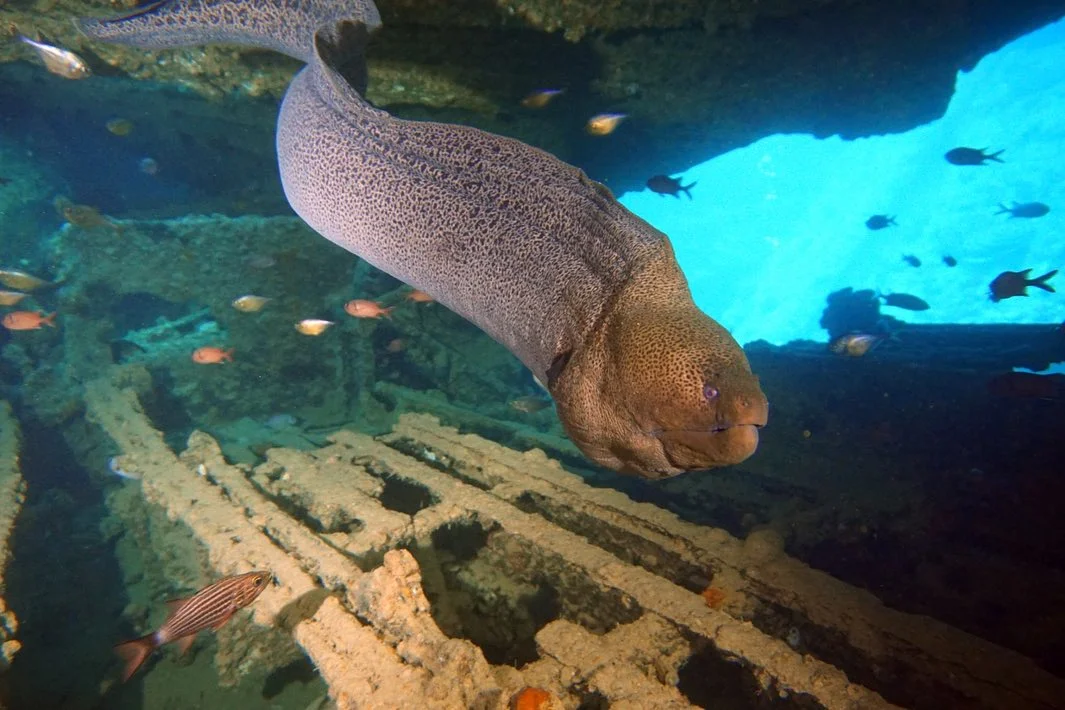
The giant moray is distinctive once you know what to look for:
- Leopard-spotted pattern that fades toward the tail.
- Massive head with a continuous dorsal/caudal/anal fin running from behind the head down the body.
- Open-jaw posture — looks threatening but is simply how they breathe (they pump water over their gills via the mouth because they lack typical fish gill covers).
- Individuals in the 1.5-2.5 m range are common in the Red Sea; 3 m specimens exist but are rarely spotted.
Other Red Sea moray species
The giant moray is the poster child, but the Red Sea hosts over a dozen moray species. Most common encounters:
- Peppered moray — small, dark with fine speckling, found in coral rubble.
- Honeycomb moray — distinctive black hexagonal pattern, large adults.
- Snowflake moray — shallow water, pale body with black spots, happy in rubble zones.
- Geometric moray — dark body with yellow-outlined diamonds, shy and beautiful.
- Whitemouth moray — medium size, recognisable by the bright white mouth lining during open-jaw breathing.
Where to find them
Giant morays are everywhere. Any coral head with a suitable hole at 5-30 m is potential moray habitat. Particularly reliable sites:
Behaviour
Morays are ambush predators. They spend daytime hidden in reef holes with jaws open (breathing), then hunt actively at night. One of the most fascinating behaviours documented in the Red Sea is cooperative hunting with groupers: the grouper signals to the moray (yes, really), the moray flushes prey from reef holes, both eat.
If you leave them alone, they'll leave you alone. Every bite incident I'm aware of — and I've investigated a few — involved a diver reaching into or close to the hole. Morays cannot see well; they strike based on movement and smell. A wiggling hand near their entrance reads as food.
Photography tips
- Macro or mid-range lens; 60mm or 100mm macro works brilliantly.
- Pull your strobes back — close, strong light flattens the head.
- Wait for cleaning behaviour. Cleaner wrasse inside an open mouth is the iconic shot.
- Never block the exit from their hole. Morays get defensive when they can't retreat.
- Night dives produce very different shots — free-swimming morays hunting in the open.
Etiquette
- Do not feed. Hand-fed morays associate divers with food and become genuinely dangerous.
- Stay arm's length at minimum. Their strike distance is the full length of their neck.
- Never put hands inside holes.
- Do not corner them on night dives when they're free-swimming.
Frequently asked questions
Giant morays are not aggressive. Their open-jaw posture is how they breathe, not a threat. Bites occur almost exclusively when divers reach into reef holes — moray vision is poor and they strike at moving prey based on smell and motion. Keep your hands away from their crevices and you are safe.
Giant morays are common across all Red Sea reefs. Particularly reliable sites include Giftun Islands and Carless Reef (Hurghada), Shark Reef and Ras Umm Sid (Sharm El Sheikh), the Thistlegorm cargo holds, and shore-accessible house reefs at Makadi Bay and Sahl Hasheesh.
Giant morays (Gymnothorax javanicus) are the largest moray species, reaching 3 metres and over 30 kg. In the Red Sea, individuals of 1.5 to 2.5 metres are common. Rare specimens exceed 3 metres. Females are typically larger than males.
Yes. Cooperative hunting between giant morays and roving coral groupers is well documented in the Red Sea. The grouper signals to the moray with a distinctive head-shake at a coral hole containing prey, the moray flushes the prey out, and both predators benefit. It is one of the few examples of interspecific hunting cooperation in fish.
Scientific reference: Wikipedia — Giant Moray Eel