How to identify
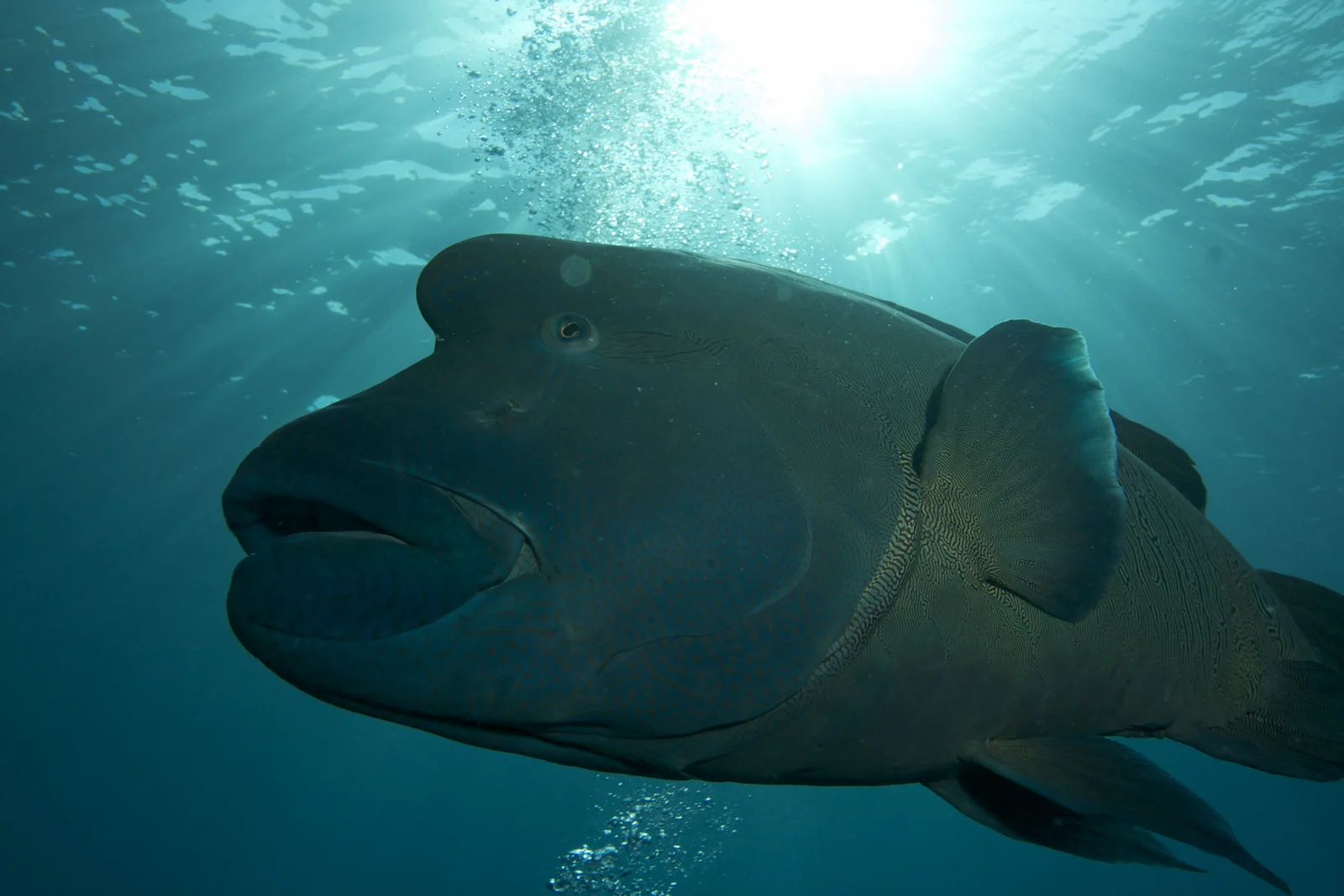
Napoleons are unmistakable:
- Massive bulging forehead that develops on adult males (females and juveniles have a smoother profile).
- Neon-blue lips with paler blue and yellow facial markings.
- Intricate maze-like pattern on the body — blues, greens, yellows depending on light.
- Size: adults commonly 1.5 m; exceptional individuals exceed 2 m.
- Tail: rounded, thick, powerful — they move with slow dignified sweeps, not darting.
Best Red Sea sites
Behaviour
Napoleons are sequential hermaphrodites — born female, with some individuals transforming into males as they age (change triggered by social structure and population pressure). The huge forehead and blue coloration develop post-transition.
They are reef guardians — feeding on hard-shelled prey including crown-of-thorns starfish, crabs, sea urchins and molluscs. Their heavy pharyngeal teeth crush prey with audible crunches you can hear underwater. Crown-of-thorns control alone makes them economically valuable to reef ecosystems.
Individuals at heavily-dived sites develop clear personalities. Ras Umm Sid's resident follows dive groups with calm, almost cat-like curiosity; Shark Reef's Napoleon makes close slow passes, inspects cameras, then moves on.
Conservation status
Listed as Endangered on the IUCN Red List. The global population has collapsed primarily due to overfishing for the Asian live reef food trade, where large adult males command enormous prices in restaurants. They are also targeted for aquarium trade and traditional medicine.
Why they're so vulnerable:
- Slow to mature — sexual maturity at 5-7 years.
- Long-lived — 30+ years, so loss of breeding adults hits populations hard.
- Sex-change dynamics — removing dominant males disrupts female-to-male transition cues.
- Site-fidelity — they don't replace losses through immigration.
Egyptian Red Sea populations remain relatively stable thanks to marine-park enforcement and the absence of live-trade fishing in Egyptian waters. Protection matters.
Diving etiquette
- Do not feed. Even if a Napoleon approaches expectantly, feeding creates dependence and makes them vulnerable.
- Do not touch or grab. Curious does not mean consenting.
- Let them lead the encounter — if they follow, enjoy it; if they don't, don't chase.
- Never pursue into deep water. They have bigger gill volumes than you.
Frequently asked questions
The most reliable sites are Shark Reef at Ras Mohammed and Ras Umm Sid in Sharm El Sheikh, where individuals approach divers closely. Jackson Reef on the Straits of Tiran has multiple large adults. The Thistlegorm wreck has resident large specimens. Hurghada has occasional encounters at Giftun Islands.
Napoleon wrasse are listed Endangered by the IUCN due to overfishing for the Asian live reef food trade, where large adult males command extremely high prices. They mature slowly (5-7 years), live 30+ years, and are sequential hermaphrodites — removing dominant males disrupts the female-to-male transition required for reproduction. Egyptian populations remain relatively stable thanks to marine park protection.
Napoleon wrasse (Cheilinus undulatus) reach 2.3 metres and over 190 kg, making them one of the largest reef fish on Earth. Adults in the Red Sea commonly grow to 1.5 metres. The bulging forehead develops on adult males after sequential sex change from female.
Napoleons feed on hard-shelled prey including crown-of-thorns starfish, crabs, sea urchins, and molluscs. Their heavy pharyngeal teeth crush shells with audible underwater crunches. Crown-of-thorns predation alone makes them ecologically valuable to Red Sea reefs.
Scientific reference: Wikipedia — Napoleon Wrasse