How to recognise a scorpionfish (and tell it from a stonefish)
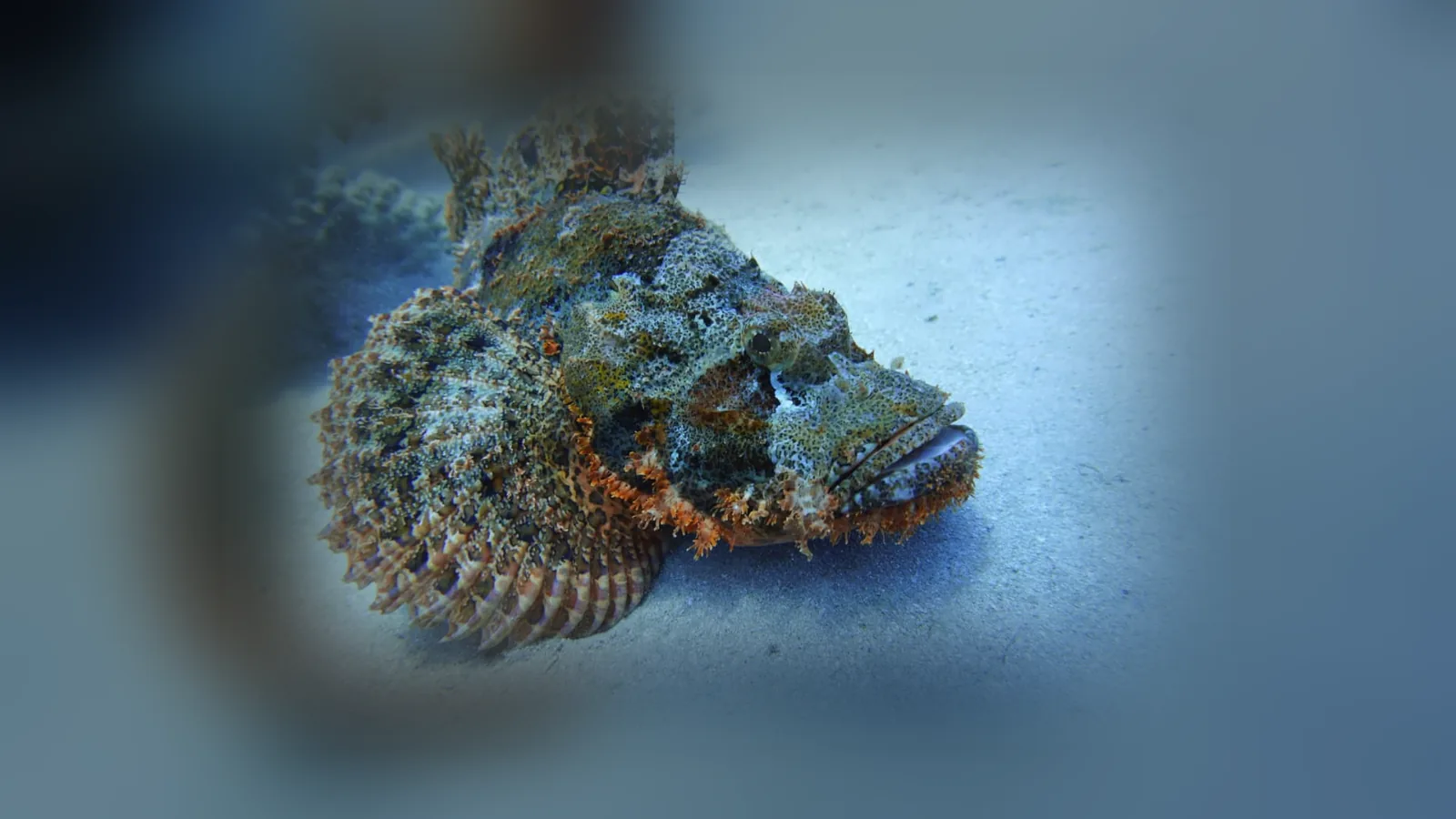
Scorpionfish belong to the family Scorpaenidae — the same broad group as the flamboyant lionfish — and in the Red Sea the most frequently seen are members of the genus Scorpaenopsis. They are built for stillness, not speed, and once you learn the shape they are easy to pick out. Key features:
- Body shape: Stout, deep-headed and slightly flattened, resting on the bottom rather than swimming in the open. A scorpionfish still reads clearly as a fish, with a defined body, tail and fins.
- Colour: Highly variable and superbly camouflaged — mottled reddish-brown, ochre or grey blotched with white and dark patches, often with a darker triangle below the eye. Individuals can subtly shift tone to match their patch of reef.
- Head and eyes: Bony ridges and spines over the head, with eyes set high on distinct bony crests. Fleshy skin flaps and tassels — the "beard" that gives the tassled scorpionfish its name — break up the outline and mimic algae and coral.
- Fins and spines: A row of stiff dorsal spines runs along the back. In life these are usually held folded and unremarkable, which is part of the problem — they only become obvious when the fish is disturbed.
- Size: Modest. The largest Red Sea species, the tassled scorpionfish (Scorpaenopsis oxycephala), reaches about 36 cm; most individuals you meet are smaller.
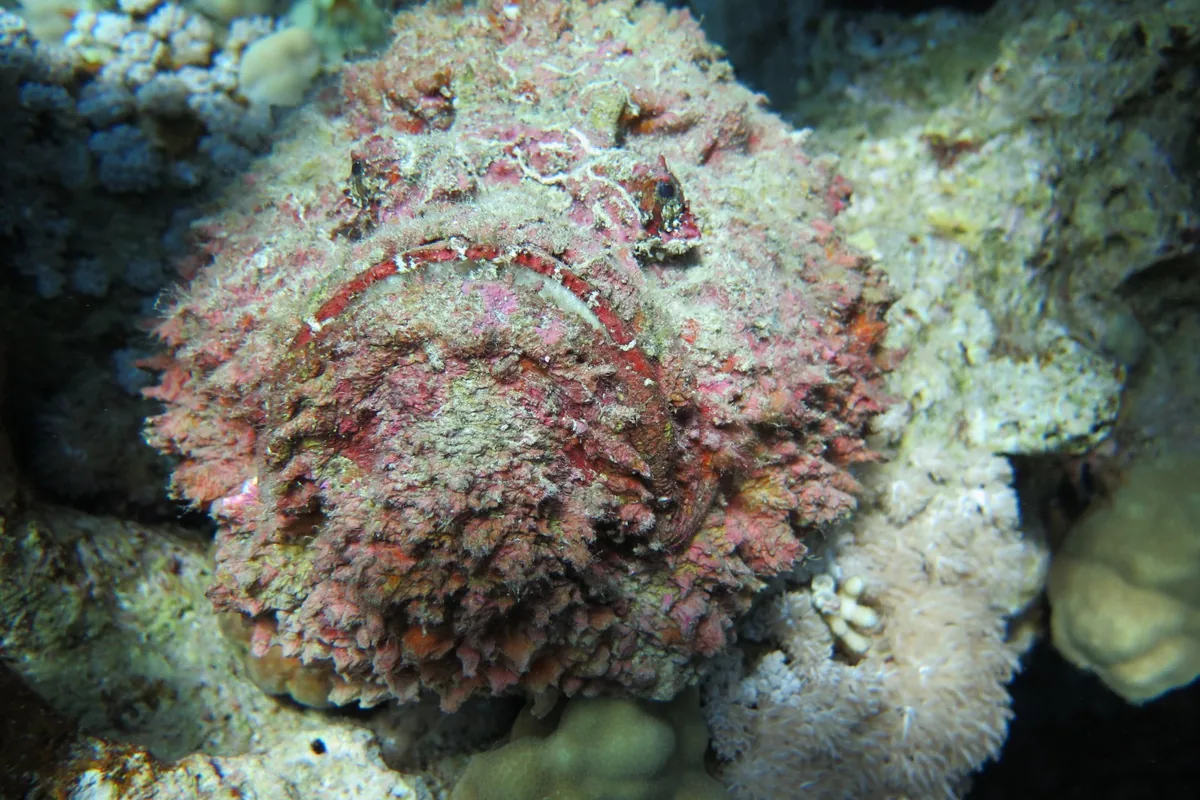
The quickest way to separate a scorpionfish from a stonefish is the old field rule: if it looks like a fish, it is probably a scorpionfish; if it looks like an encrusted rock, think stonefish. A scorpionfish keeps a recognisable fish shape, visible eyes on bony ridges and a forward-set mouth, and usually perches on top of the reef. A reef stonefish has a lumpy, warty, almost rounded body, tiny eyes sunk into the head, a strongly upturned mouth and thicker, shorter spines, and it commonly lies half-buried in sand or rubble. In practice the distinction matters less than the shared conclusion: both are venomous, both stay put, and both should be treated as look-only.
Masters of camouflage — the ambush
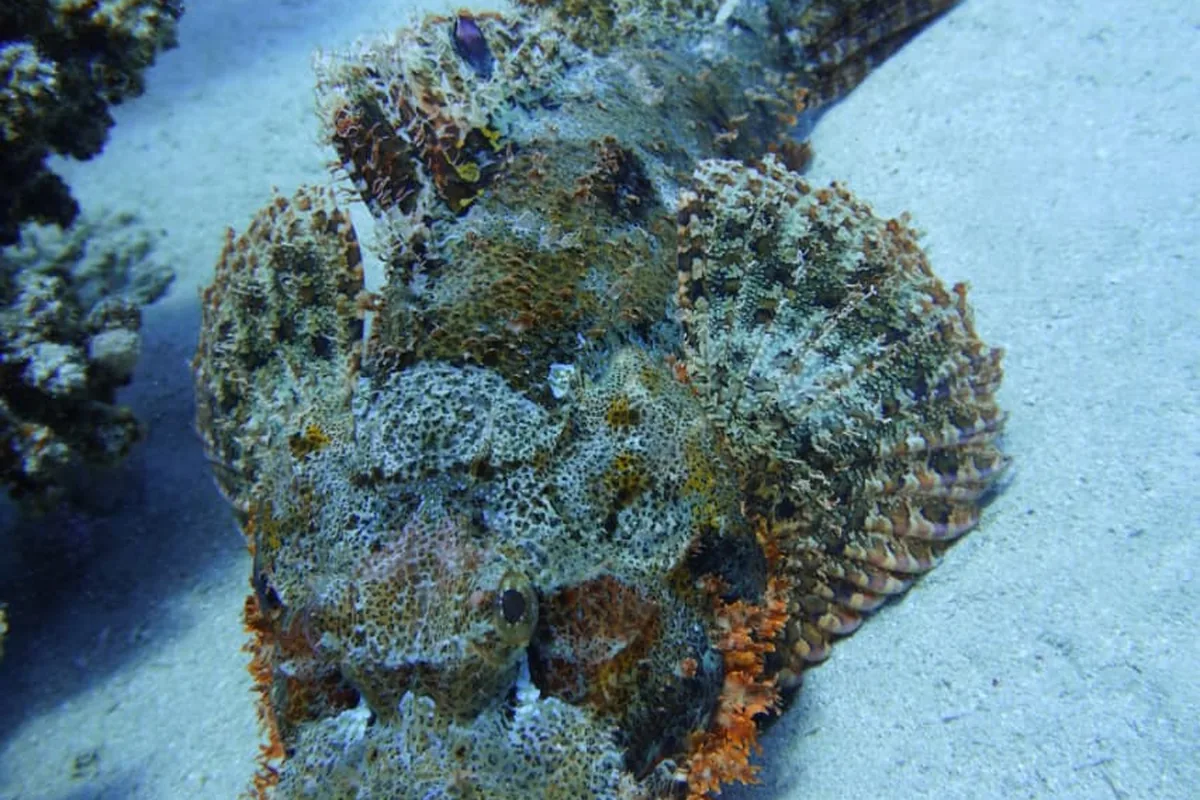
Everything about a scorpionfish is engineered for disappearing. The broken, mottled colouring, the skin tassels that mimic tufts of algae, the way the fish settles into a hollow and stays there — all of it turns a living predator into a piece of reef furniture. Divers routinely finning within a hand's width never see one, and even a good guide will pause, point, and wait for the fish to resolve out of the background before the group finally spots it. That invisibility is the whole hunting strategy.
Scorpionfish are sit-and-wait ambush predators. Rather than pursue prey, the fish holds absolutely still and lets small fish and crustaceans drift within range, then engulfs them with a sudden, explosive expansion of its huge mouth — a strike measured in a fraction of a second, drawing the victim in on a rush of water before it can react. The energy budget is minimal: long stretches of motionless waiting, punctuated by one lightning gulp. This is why a scorpionfish will let a diver approach closely without moving — fleeing would waste the very stillness that keeps it both hidden and fed. It is also why accidental stings happen: the fish trusts its camouflage so completely that it does not swim away from a descending hand or knee, and its defensive spines are its answer to being trodden on.
The reef stonefish, the venom, and diver safety
The scorpionfish family reaches its dangerous extreme in the reef stonefish (Synanceia verrucosa), a Red Sea resident widely described as the most venomous fish in the world. It is usually placed in a closely related family, Synanceiidae (sometimes treated as a subfamily within Scorpaenidae), and it takes the group's disguise to its logical end: a warty, encrusted, stone-like lump that lies motionless on sand or rubble, frequently part-buried, so convincingly rock-like that people and animals step on it without ever seeing a fish.
How the venom works. The stonefish carries its venom in 13 stout dorsal spines, each fed by a pair of venom glands. The spines are stiff and sharp enough to pierce a wetsuit boot or a shoe sole. Crucially, the venom is defensive, not a hunting weapon — the fish never injects prey with it. Envenomation happens only when weight presses down on the fish and drives the spines into the skin: a bare foot in the shallows, a hand placed on a hidden fish, a knee set on the bottom. There is no bite, no strike at a person and no pursuit. A scorpionfish stings the same way, through its dorsal spines, but with far less potent venom — painful, rarely dangerous — whereas the reef stonefish's venom is in a different league.
What a sting feels like. A stonefish envenomation is described in the medical literature as excruciating: intense, throbbing pain that can peak within one to two hours and radiate up the limb, with rapid swelling and redness that may involve the whole arm or leg. In more serious cases there can be whole-body effects — weakness, nausea, faintness, a racing heart, breathing difficulty and, without treatment, more severe complications. Deaths are documented but rare, particularly where prompt care is available. A reef scorpionfish sting is much milder by comparison but still causes severe local pain and swelling and still deserves proper attention.
First aid for a scorpionfish or stonefish sting. The recognised treatment is hot-water immersion: put the injured area in water as hot as can be tolerated without scalding — around 43 to 45 °C — for 30 to 90 minutes, because the venom is a protein that is broken down by heat. Check the temperature carefully, as a numbed limb burns easily, and top up the heat as pain rebounds. Then seek professional medical help urgently, above all for a suspected stonefish sting: the wound may hold broken spine fragments, and a stonefish antivenom exists for severe or whole-body envenomation. This is general information, not medical advice — always get proper medical care after any envenomation.
For a diver, none of this is cause for anxiety. Stonefish and scorpionfish do not seek people out, and every sting on record is the result of contact the person made — almost always by touching or standing on the reef. The entire risk is eliminated by the same habit that protects the reef itself: good buoyancy and hands off the bottom.
Diet and hunting
Scorpionfish and stonefish are carnivores that feed almost entirely on small fish and crustaceans — shrimps, small crabs and any fish careless enough to pass within reach. The hunting method is pure ambush: the fish sits camouflaged and unmoving, sometimes for hours, and relies on prey coming to it. When a target drifts close, the mouth opens explosively and expands, creating a sudden inrush of water that sweeps the prey in whole. The tassled scorpionfish is largely a nocturnal ambush predator, most active as the reef's night shift changes over, though it will take an easy meal at any hour. Because the strike is so fast and the fish so still between meals, this is one of the most energy-efficient predatory lifestyles on the reef — and one of the hardest for prey to guard against.
Where to see them
When to see them
Scorpionfish are present on Egyptian reefs all year, so there is no season to plan around — the limiting factor is never the calendar but your ability to spot a motionless, perfectly camouflaged animal. They rely on stillness rather than movement, which is exactly why they are so easy to swim past, and why a slow, observant dive with a sharp-eyed guide turns up far more of them than a fast one. Stonefish are encountered less often, largely because they are even harder to see against sand and rubble.
Year-round resident Camouflaged — needs a patient eye
Diving and photography etiquette — look, don't touch
Scorpionfish make superb photographic subjects precisely because they hold still, but the same behaviour is what makes them a hazard to careless hands. A few simple rules keep both the diver and the fish safe:
- Never touch the reef or steady yourself on rock. A scorpionfish or stonefish can be sitting on any surface that looks like coral, rock or rubble. Assume every lump could be a fish and keep your hands to yourself.
- Perfect your buoyancy. The single best protection is neutral buoyancy — no kneeling on the bottom, no dropping a knee to steady a photo, no dragging fins across the reef.
- Look before you settle anywhere. On the rare occasions a dive calls for contact with the bottom, inspect the exact spot first and place only a single fingertip on bare, obviously lifeless rock.
- Wear reef-safe footwear in the shallows. On shore entries and reef flats, a solid sole guards against a stonefish spine, which can pierce a thin one.
- Keep your distance for the photo. A wide or macro lens captures the tassels, the mottled skin and the eye without ever needing to crowd or prod the fish. Never nudge it to make it move — a disturbed scorpionfish erects its venomous spines.
Reproduction
Like most scorpionfish, Red Sea Scorpaenopsis are egg-layers that reproduce by external fertilisation, releasing eggs and sperm into the water column. The fertilised eggs and the larvae that hatch from them drift as plankton, dispersing on the currents before the young settle to the reef and adopt the cryptic, bottom-hugging life of the adults. This planktonic early phase helps spread the species widely across reef systems — one reason scorpionfish are found throughout the Indo-Pacific and the Red Sea rather than confined to isolated pockets. Detailed breeding behaviour for individual Red Sea species is not well documented, and the figures here reflect the general scorpaenid pattern rather than site-specific study.
Conservation status
Both the reef scorpionfish and the reef stonefish are currently assessed as Least Concern on the IUCN Red List — the tassled scorpionfish (Scorpaenopsis oxycephala) assessed in 2016, and the reef stonefish (Synanceia verrucosa) assessed in 2018. Both have very wide Indo-Pacific distributions, are not major fishery targets, and show no evidence of significant global decline, which keeps them out of any threat category. As with all reef life, their real long-term security rests on the health of the coral reef itself: warming seas, bleaching and habitat damage are the pressures that matter for a fish whose entire way of life depends on a complex, living reef to hide in.
Related Red Sea species
Divers who enjoy the scorpionfish's cryptic, venom-spined biology often want to read about its relatives and look-alikes on the same reefs:
- Lionfish — the reef's most flamboyant scorpionfish (family Scorpaenidae), armed with the same venomous spines but advertising itself with bold stripes and fan-like fins instead of hiding.
- Crocodilefish — another flattened, superbly camouflaged ambush predator that lies motionless on the bottom and is easy to confuse with a scorpionfish at a glance.
- Masked pufferfish — a very different defence strategy on the same reef, trading camouflage and spine-venom for a toxin in the flesh.
For the wider picture of the reefs where these fish live, see the complete guide to scuba diving in the Red Sea, and for the current-swept walls and coral gardens where a patient eye turns up scorpionfish, the best dive sites in Sharm El Sheikh & Ras Mohammed. To browse the full encyclopedia, visit the Red Sea marine life guides.
Frequently asked questions
A scorpionfish sting is painful but rarely life-threatening. Reef scorpionfish carry venom in their dorsal spines, and a sting causes intense local pain, swelling and redness that usually settles with treatment. The reef stonefish is the exception: it is regarded as the most venomous fish in the world, and a stonefish sting can cause excruciating pain, swelling of the whole limb, and in severe cases dangerous whole-body effects, so it is always treated as a medical emergency. Either way the injury comes from touching, kneeling on or stepping on the fish, never from an attack. Any suspected sting should be treated as serious until a medical professional has assessed it.
The recognised first aid is to immerse the injured area in hot water, as hot as can be tolerated without scalding — around 43 to 45 °C — for 30 to 90 minutes, because the venom is broken down by heat. Check the water temperature carefully, as a numbed limb burns easily. Seek professional medical help urgently, especially for a suspected stonefish sting: the wound may hold spine fragments, the pain can rebound, and a stonefish antivenom exists for severe cases. This is general information, not medical advice — always get proper medical care after any envenomation.
Master your buoyancy and never touch the reef. Both fish are ambush predators that rely on camouflage and do not flee, so the danger is putting a hand, knee or fin where you cannot clearly see the surface. Do not steady yourself on rocks, do not kneel on the bottom, and look before you settle anywhere. Reef-safe footwear helps in the shallows and on shore entries, because a stonefish spine can pierce a thin sole. Treat every lump of rock or rubble as if it could be a fish.
The quickest rule is that a scorpionfish still looks like a fish, while a stonefish looks like an encrusted rock. A scorpionfish has a recognisable fish shape, visible eyes on bony ridges, a forward-set mouth and feathery skin tassels, and it usually rests on top of the reef. A stonefish has a lumpy, warty, rounded body, tiny eyes buried in its head, a strongly upturned mouth and thicker, shorter spines, and it often lies half-buried in sand or rubble. Both are superbly camouflaged, both stay put rather than flee, and both are venomous — so the safe approach is to treat any suspicious lump as either one.
Yes. The reef stonefish (Synanceia verrucosa) is widely regarded as the most venomous fish in the world. Its venom is delivered through 13 stout dorsal spines, each fed by a pair of venom glands, and the spines are stiff enough to pierce a wetsuit boot. The venom is defensive, not a hunting tool — the fish releases it only when something presses down on the spines. Stings are excruciating and can be dangerous, but with prompt hot-water first aid, medical care and, if needed, antivenom, they are rarely fatal.
No. Neither fish chases, bites or attacks people. They are sit-and-wait ambush predators that hunt small fish and crustaceans by staying motionless and striking in a fraction of a second at prey that comes close. Their venom is purely defensive. Every human sting is the result of accidental contact — a hand placed on a hidden fish, a knee on the bottom, or a bare foot in the shallows — never a deliberate act by the fish.
Scorpionfish are present on Egyptian reefs year-round, so there is no season to plan around. They rest on coral, ledges, wrecks and sandy patches from the shallows down to around 40 metres, relying on camouflage rather than movement, which is exactly why they are so easy to swim past. A patient eye — or a good local guide — is the key to spotting them. Stonefish are less common and favour sandy or rubbly bottoms, where they can be even harder to see.