The PADI Open Water course isn't hard, isn't scary, and the Red Sea is probably the best place on earth to do it. But there are decisions that will make your course better or worse — where to do it, how long to take, who to trust. Here's the honest version.
Why the Red Sea is ideal for Open Water
- Warm water. 22-28°C year-round means 3mm wetsuit training — no thermal stress.
- Calm shallow reefs for Open Water sessions. Sites like Makadi Bay and Sahl Hasheesh house reefs allow training directly from shore, with reef depths of 5-8 metres on the entry plateau.
- Visibility typically 20m+. You can see your instructor, your buddy, and the bottom — massively reducing anxiety for first-time divers.
Specific advantages over other dive training destinations
If you're choosing between learning to dive in the Red Sea versus Thailand, the Caribbean, the Mediterranean, or your local quarry, here's the honest comparison. Red Sea visibility consistently exceeds 25m year-round — Thailand averages 15-20m and gets murky during monsoon, the Caribbean averages 20-25m with significant seasonal variation, the Mediterranean rarely exceeds 15m, and quarry training (UK and Northern Europe) typically delivers 3-5m visibility in cold green water.
For a learner, visibility matters enormously. Clear water lets your instructor demonstrate skills clearly, lets you see your buddy without anxiety, and gives you the immediate visual reward that builds confidence. The Red Sea is genuinely the best learning environment among major dive destinations.
Water temperature is the second factor. Red Sea ranges from 21°C in winter to 30°C in summer — meaning year-round trainable conditions with appropriate wetsuit thickness. Thailand and Caribbean are similar. Mediterranean and quarries get cold enough that thermal management becomes another stressor for nervous beginners.
The third factor is reef life. Coral reefs are visually engaging — there's always something interesting in the field of view. Sand-bottom training sites or rocky quarries put students on featureless terrain that magnifies anxiety. Red Sea reef training sites have anthias clouds, parrotfish, butterflyfish, and the occasional turtle providing constant visual stimulation that keeps learning enjoyable.
How the PADI Open Water course is structured
The course has three parts:
- Theory (e-learning): 5 knowledge reviews you complete online, 6-8 hours total.
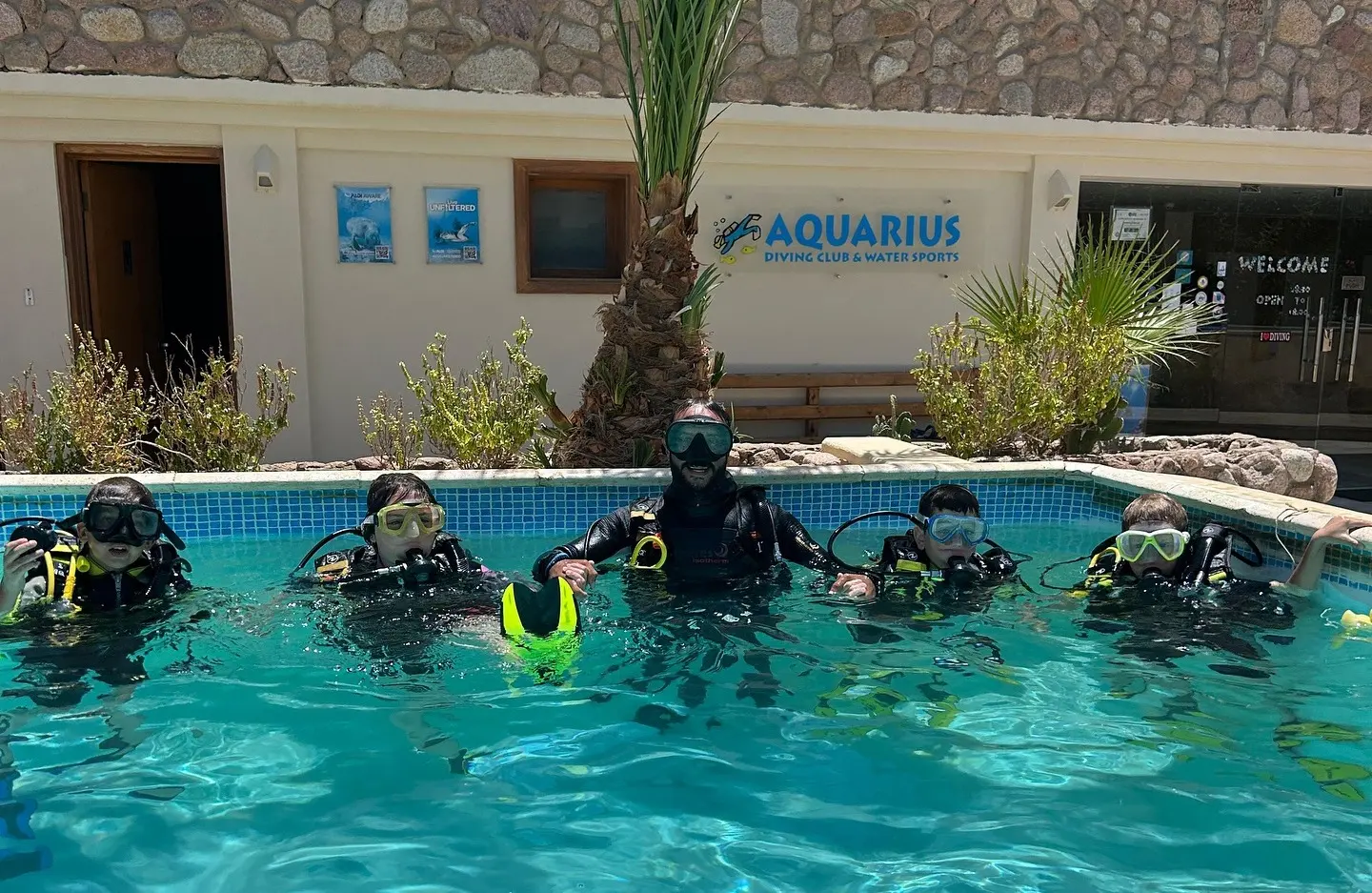
- Confined water sessions: 5 sessions in a pool or sheltered shallow water learning core skills — mask clearing, regulator recovery, buoyancy, emergency ascent.
- Open water dives: 4 dives in the sea where you demonstrate skills and explore a real reef.
How long does it take?
If you complete e-learning before arrival, the in-water portion takes 3 days. Doing everything in-destination takes 4 days.
The 4-day Aquarius schedule (typical)
This is the schedule we use most often for full-course students. Times are flexible based on group size and individual progress.
Day 1 — Theory and confined water start (full day, 9:00-16:00): Morning theory session with instructor — about 3 hours covering modules 1-2-3 of the PADI manual, with knowledge review questions. Afternoon: equipment briefing, then confined water session 1 in our protected shallow training area (Ras Ghamila house reef in Sharm; protected bay in Hurghada). Skills practiced: equipment assembly and disassembly, mask clearing, regulator recovery, basic buoyancy.
Day 2 — Theory continued + confined water 2-3 (full day): Morning theory: modules 4-5, more knowledge reviews. Afternoon confined water sessions covering the longer skills list — alternate air source breathing, controlled emergency swimming ascent (CESA), tired-diver tow, navigation. Most students find day 2 the most demanding because of the cumulative skills load.
Day 3 — Open water dives 1 and 2 (full day, on a boat): First two real ocean dives at protected sites. Skills practiced underwater on a sandy patch, then 20-30 minutes of guided exploration. Most students describe day 3 as the moment "this becomes real diving" — you've practiced everything in a pool-like environment, and now you're actually diving on a coral reef.
Day 4 — Open water dives 3 and 4 + final exam (full day): Final two ocean dives at slightly more challenging sites. Final theory exam (50 multiple choice questions, 75% pass mark — most students pass first time). Certification card processing.
Some students spread this across 5-6 days for a more relaxed pace, especially if combining with non-diving activities. Others compress it into 3 days if they've completed the theory online beforehand (PADI eLearning).
What does it cost?
Open Water course costs in the Red Sea typically range from €350-€500 per person, including e-learning, all equipment, 4 open water dives, manual and certification fees. Packages combining the course with a resort stay often work out 20-30% cheaper than booking separately.
What matters more than price is who your instructor is — ask about instructor-to-student ratios (we cap at 1:4), pool time, and whether your instructor speaks your language comfortably.
Which Red Sea base to choose
Best for beginners: Makadi Bay
Calm sheltered bay, shallow house reef from shore, quieter than Hurghada marina. See Makadi Bay diving.
Best for variety during your course: Hurghada
More sites, more boat trips, busier atmosphere — good if you want to combine your course with sightseeing. See Hurghada dive sites.
Best for luxury: Sahl Hasheesh
Premium resorts, quieter than Hurghada, stunning house reef. See Sahl Hasheesh diving.
Not ideal for Open Water: Sharm El Sheikh
Sharm's iconic sites (Ras Mohammed, Straits of Tiran) require Advanced Open Water because of currents and depth. Do your Open Water elsewhere, then return to Sharm once certified.
What to expect each day
Day 1: Theory + confined water 1-2
Morning: e-learning review, equipment assembly, basic underwater skills in the pool — breathing, regulator recovery, mask clearing, hand signals. Afternoon typically free.
Day 2: Confined water 3-5 + open water 1
Morning: remaining skills in the pool — CESA, buoyancy control, towing. Afternoon: first real open water dive (max 12m), practising skills on a real reef.
Day 3: Open water dives 2-3
Two dives — one covering remaining skills, one mostly exploration. Depths 12-18 metres.
Day 4: Open water dive 4
Final dive, usually a fun dive with just a safety stop test. Certification processed same-day.
Start your PADI Open Water
From €395 all-inclusive. Small groups (max 4 students per instructor). Multi-language instructors.
See Course Options →Medical requirements and the swim test
Two non-negotiable requirements before starting Open Water training:
The medical questionnaire. Every student completes the PADI Medical Questionnaire — a list of yes/no questions about current and past medical conditions. Any "yes" answer requires sign-off from a doctor before you can start the course. Common items that require doctor sign-off: asthma (even childhood asthma), heart conditions, diabetes, recent surgery, ear surgery, certain medications, pregnancy.
The medical isn't a barrier for most people — most "yes" answers result in straightforward sign-off. But you need to handle it before you arrive in Egypt. Get the form from us, see your doctor at home, bring the signed form. Trying to find an English-speaking dive-medicine doctor in Egypt on short notice is a frustrating use of holiday time.
The swim test. Two parts: 200 metres (any stroke, no time limit) and 10 minutes treading water or floating. This isn't a "good swimmer" requirement — many comfortable casual swimmers pass easily. It's a baseline competence requirement. If you can't comfortably swim a length of a 25m pool unsupported, build that skill before you arrive.
Both tests happen on day 1 before any diving begins. We assess discreetly without making a public spectacle of it. About 1 in 50 students fails the swim test and we cancel/refund the course — but most are people who were honest enough to admit beforehand they weren't strong swimmers.
Common fears — and the reality
- "I'll panic underwater." Extremely rare. The course builds your comfort step-by-step in sheltered water first.
- "I can't equalise my ears." 95% of people learn in 5 minutes. If you have a cold, reschedule.
- "I'm not a strong swimmer." You need to swim 200m (any stroke) and tread water 10 minutes. No athletic ability required.
- "Sharks." We see reef sharks maybe once a week and none are dangerous. The whale sharks everyone wants to see are gentle filter-feeders.
Combining the course with a holiday
Most Aquarius Open Water students aren't on dedicated training trips — they're on family or couples holidays where one person wants to learn diving. Here's how to make that work:
10-14 day holiday recommendation: Course on days 3-6 of the trip (after settling in and adjusting to the climate). Days 1-2 for arrival/relaxation. Days 7-14 for actual diving as a newly-certified diver, plus non-diving activities (snorkelling, beach time, day trips).
This sequencing matters. Newly certified divers who try to immediately do challenging dives often have bad experiences. Spend the first 2-3 post-certification days at our shore-based house reef at Ras Ghamila or in protected Hurghada sites, building confidence before tackling boat dives at Tiran or offshore.
Family considerations: The course commits the student to ~30 hours over four days, including evenings for theory review. Make sure your travel companions have alternative activities planned. Aquarius can arrange snorkelling and boat trips for non-divers that work alongside the dive training schedule.
If the student is under 15: PADI offers Junior Open Water (10-14 years old) with depth restrictions. Your child needs to be a reasonably confident swimmer and able to commit to the theory work — Open Water is genuinely a course, not just an activity. Some young students are ready at 10; others aren't ready until 14. Honest self-assessment matters.
What gear to bring vs rent
You don't need to buy any gear before learning to dive. Aquarius provides everything for the course: BCD, regulator, mask, snorkel, fins, weights, tank, wetsuit. Rental gear is well-maintained and serviced regularly.
That said, some students like to bring their own basic equipment for comfort and hygiene reasons:
Worth bringing your own: mask (fit varies enormously between faces — bring a properly fitted mask if you're prone to leaks), wetsuit (long boat days are more comfortable in a wetsuit that fits properly), dive computer (you'll buy one eventually anyway, may as well start with your own).
Not worth bringing for first-time students: BCD, regulator, fins. These are heavy, take up luggage allowance, and rental versions work fine for training. Wait until you've completed at least 20 dives before investing in your own scuba gear — your preferences will be clearer.
If you're going to buy something pre-trip: mask, snorkel, fins, and a basic dive watch or computer. Total cost ~£250-500 for entry-level options.
What comes after Open Water?
- Advanced Open Water: 5 more dives, 2-3 days, opens up deeper sites including the Thistlegorm.
- Rescue Diver: Often called "the best PADI course" — teaches you to handle emergencies.
- Specialty courses: Deep, Wreck, Nitrox, Night, Photography — pick what interests you.
Related: For the complete PADI certification pathway through Divemaster and beyond, see our PADI Pathway guide.
Frequently asked questions
How long does the PADI Open Water course take in the Red Sea?
If you complete the e-learning theory before arrival, the in-water portion takes 3 days. Completing everything on-destination takes 4 days. The course consists of 6-8 hours of online theory, 5 confined-water skill sessions, and 4 open-water dives.
How much does PADI Open Water cost in the Red Sea?
Typical Open Water course prices in the Red Sea range from €350-€500, including e-learning, all equipment rental, 4 open-water dives, course materials, and certification fees.
Is the Red Sea good for beginners?
Yes — the Red Sea is one of the best beginner destinations globally. Warm water (22-28°C year-round), excellent visibility (typically 20m+), calm sheltered bays with reef accessible from shore, and a dense concentration of certified training operations make it ideal.
Which Red Sea destination is best for beginners?
Makadi Bay and Sahl Hasheesh are best for beginners due to calm sheltered bays and shore-accessible house reefs. Hurghada is a strong alternative with more site variety. Sharm El Sheikh is less ideal because its iconic sites require Advanced certification.