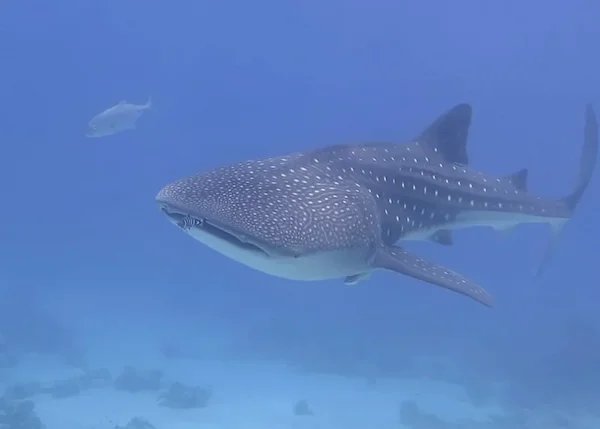
Whale sharks are the Red Sea's most requested animal — and the most misunderstood. The internet is full of photos showing divers swimming right up to them, but the reality is these are seasonal, sensitive animals requiring specific timing and respectful behaviour. This guide covers what's real, what's rare, and what you need to do to give yourself the best chance.
About the whale shark
Whale sharks are the planet's largest fish. Adults typically reach around 12 metres, but the species grows considerably larger — to roughly 18 metres (the largest reliably measured individual was about 18.8 metres) and an estimated 20+ tonnes. Despite the name, they're sharks (not whales) — but harmless filter-feeders that strain plankton and tiny fish through gill rakers. Their distinctive spot pattern is unique to each individual, like a fingerprint, which researchers use for photo-ID population tracking.
They're long-lived (probably 70-100+ years), slow to mature (around 25 years), and give birth to live young — making them slow to recover from population loss. The IUCN classifies them as Endangered, which is why responsible encounters matter.
The biology that drives encounters
Whale sharks (Rhincodon typus) are filter feeders, the largest fish in the ocean — adults regularly reach 8-10 metres, with confirmed individuals over 12m. They feed on plankton, fish eggs, small fish, and crustaceans, processing thousands of litres of water per hour through specialised gill rakers. Despite the size, they are completely harmless to humans — the largest mouth in the fish kingdom is sieving copepods.
Whale sharks are ovoviviparous — they give birth to live young, hatched from eggs that develop inside the mother. A single litter can contain 300+ pups. Sexual maturity comes late (around 25-30 years), and individuals can live 70-100+ years. This life history makes them vulnerable: late maturity plus low juvenile survival rates plus high site fidelity makes any population pressure (fishing, boat strikes, plastic ingestion) very slow to recover from.
The Red Sea whale shark population is part of a wider Indo-Pacific stock. Individual sharks have unique spot patterns on their flanks — like fingerprints — which researchers use to identify and track them. The Marine Megafauna Foundation maintains a global photo-ID database (Sharkbook) that anyone can contribute photos to. Several sharks photographed in the Red Sea have been re-sighted in the Maldives and Mozambique, hundreds of kilometres apart.
Why they show up where they do
Whale shark distribution follows plankton density. The Red Sea's spring bloom — driven by upwelling, water mixing, and increasing daylight hours — concentrates plankton in specific areas, particularly offshore reefs north of Hurghada (Sha'ab El Erg) and along the southern Egyptian coast (Marsa Alam, southern liveaboard routes).
The same plankton that attracts whale sharks also attracts other filter feeders — manta rays, mobula rays — and the small fish schools that draw bigger predators. A whale-shark-active week is usually a marine-life-rich week generally.
Climate change is shifting these patterns. Some Red Sea operators report seasonal arrivals starting earlier than they did a decade ago. The science isn't settled but it's a topic worth watching — your operator's local knowledge of current-year patterns is more reliable than a static seasonal calendar.
Red Sea whale shark seasons
The Red Sea has one clear whale shark season, driven by summer plankton availability.
Main season: May to August (peak June–July)
This is the reliable window. Whale sharks follow the plankton blooms that intensify as water temperatures climb through spring into summer, and sightings peak in June and July. Offshore Hurghada (Giftun Islands, Sha'ab Abu Nuhas), Ras Mohammed, and the southern Red Sea around Marsa Alam and Elphinstone all produce encounters during these months.
Outside the main season
Sightings do occur outside May–August but they are one-off encounters rather than predictable. We log a handful of autumn sightings every year, usually on liveaboard trips to offshore reefs, but we would never book a trip specifically hoping for a whale shark outside the main season.
Honest caveat: whale sharks are always a lottery. Even in peak July, you can have a perfect week of diving without seeing one. Book a Red Sea trip because the diving is world-class — a whale shark encounter is a bonus, never a guarantee.
Best sites for encounters
- Giftun Islands (Hurghada): Our most reliable area — see Hurghada dive sites guide.
- Abu Nuhas & Sha'ab Ali (north of Hurghada): Offshore pelagic routes.
- Ras Mohammed & Jackson Reef (Sharm El Sheikh): Regular peak-season sightings — see Sharm dive sites guide.
- Elphinstone & Daedalus (southern Red Sea): Liveaboard-only but the most reliable in the country.
- Marsa Alam coast: Shore-based encounters possible at Marsa Shouna and Marsa Nakari.
How they behave in the Red Sea
Red Sea whale sharks are typically solitary travellers moving along plankton-rich current lines, often right at or near the surface where light penetrates and plankton concentrates. They're unusually relaxed around boats and snorkelers — but they can and will dive if harassed.
Typical encounter depths are 0-10 metres, which means snorkelers have just as good a chance as scuba divers.
Responsible encounter rules
- Maintain 3+ metres distance at all times. Closer than that, the shark is likely to dive.
- Never touch. Their protective mucus layer can be stripped by contact, leading to infection.
- Approach from the side, never in front. Blocking the feeding path causes them to turn away.
- No flash photography. Flashes disorient them and may stress feeding behaviour.
- Stay horizontal. Vertical splashing and kicking is unnatural and disturbing.
- Move as slowly as possible. If the shark turns toward you, stop moving and let it pass.
"The divers who get the best whale shark encounters are the ones who do the least. Stop kicking. Stop chasing. Hang in the current and let them come to you."
What to do during an encounter
If you're lucky enough to see a whale shark on a Red Sea dive, here's how to handle it well — for the shark's benefit and your own.
The first 5 seconds
Stop swimming. Stop kicking. Hold position in the water column. Whale sharks generally ignore divers but they spook if multiple bubble-blowing things move toward them aggressively. Your job is to be a stationary observer the shark passes near.
Signal your group with whatever signal you've agreed beforehand (bell on tank, the shark hand-signal). Don't shout into your regulator — the muffled sound startles other divers without communicating anything useful.
Approach (or don't)
The Egyptian Chamber for Diving and Watersports (CDWS) and the Marine Megafauna Foundation publish encounter guidelines. Summary:
- Maintain at least 3 metres distance from the shark. Closer than this and you risk physical contact, which damages the shark's protective mucus coating.
- Never approach from directly in front. The shark will alter course or dive, ending the encounter for everyone.
- Never touch. Beyond the mucus damage, touching causes the shark to associate humans with disturbance. Multiple touches across multiple encounters affects population behaviour.
- Don't ride. Whale shark riding (yes, this used to happen) is now banned globally and most operators will end your trip if attempted.
- Don't block its path. If you're in the shark's swimming line, move sideways. Let it pass.
- Limit time per encounter. CDWS guidelines suggest 90 seconds per diver per encounter, then move away to allow other divers their time.
If multiple boats are present
Sha'ab El Erg's Dolphin House attracts up to 15 boats during peak summer days. Whale shark sightings here can become circus-like with multiple groups racing toward the same animal. Aquarius and other quality operators avoid this — we'll ascend rather than join a chaotic encounter. The shark deserves better, and your photos will be better at a quieter site anyway.
The encounter is shorter than you think
Most whale shark encounters last 1-3 minutes from "shark sighted" to "shark out of visual range." This feels much shorter than the videos you've seen on YouTube. Don't waste it fumbling with cameras or signalling your group. Watch first. Photograph if you must, but watch first.
Conservation status and what's at stake
Whale sharks are listed as Endangered by the IUCN Red List as of 2016. The global population has decreased by approximately 50% over the past 75 years, driven by:
- Bycatch and fisheries pressure in regions outside the Red Sea (particularly southeast Asian waters).
- Boat strikes in heavily-trafficked dive sites worldwide. The Red Sea Sha'ab El Erg site has seen multiple recorded boat strikes; some surviving sharks carry visible propeller scars.
- Plastic ingestion — filter feeders are particularly vulnerable to microplastic accumulation.
- Climate-driven habitat shifts as plankton bloom timing changes.
The Red Sea population is relatively well-protected by Egyptian fisheries laws and by the careful behaviour of the established dive industry. Aquarius supports conservation through HEPCA mooring systems (which prevent anchor damage to reefs) and by training our guides to enforce encounter guidelines. Your role as a visiting diver is to choose operators who do this work seriously, and to behave correctly during your own encounters.
If you photograph a whale shark, consider uploading the image (with location, date, and sex if visible) to Sharkbook.ai. Citizen science contributions are genuinely valuable for tracking individual sharks and understanding population dynamics.
Photography tips
- Wide angle only. These animals are huge; you'll never fit one in a macro frame.
- Shoot up toward the surface. The silhouette against the light is more dramatic than a side-on shot.
- No strobes at close range. Rely on available light — the Red Sea has plenty.
- Anticipate the face. A head-on shot as the shark approaches is the money shot — but from the side, never blocking the path.
Plan your whale shark trip
Our Hurghada and Sharm bases run targeted whale shark trips during peak seasons.
Book a Whale Shark Trip →What's happening in 2026
2026 has begun promisingly — offshore sightings at Giftun started early in April, slightly ahead of typical timing. Current plankton readings suggest a strong main season. We'll be updating this article through the peak months with real sighting reports from our guides.
To plan your trip around the season, see Best Time to Dive the Red Sea.
Related: For the complete picture of all shark species in the Red Sea, see our Shark Diving in the Red Sea hub guide.
Frequently asked questions
When is whale shark season in the Red Sea?
The main whale shark season in the Red Sea runs May to August, driven by summer plankton blooms. Peak months are June and July. Sightings are occasionally recorded outside this window but are far less reliable. Best sites are offshore Hurghada (Giftun area), Ras Mohammed in Sharm, and liveaboard destinations around Elphinstone and Daedalus in the southern Red Sea.
Can I swim with whale sharks in Egypt?
Yes, whale shark encounters are legal in Egyptian waters, but responsible interaction is essential. Maintain at least 3 metres distance, never touch, approach from the side, avoid flash photography, and let the shark control the encounter.
Where in the Red Sea can I see whale sharks?
The most reliable dive sites are Giftun Islands and Sha’ab Abu Nuhas (from Hurghada), Ras Mohammed and Jackson Reef (from Sharm El Sheikh), and Elphinstone and Daedalus in the southern Red Sea (accessible by liveaboard).
Do you need to be scuba certified to see whale sharks?
No — whale sharks typically feed at 0-10 metres depth where plankton concentrates, so snorkelers have equal or better chances than scuba divers. Most of our best Red Sea whale shark encounters happen during surface intervals between dives.