After 30 years of taking divers out on Red Sea boats — and watching the booking landscape shift from travel agents to apps — here is the honest, no-spin guide to how to book a Red Sea diving trip. We'll explain exactly how each platform works, what it costs the operator (and therefore you), where the platforms genuinely shine, and why booking direct with the dive centre is usually the best-value, most flexible choice for Hurghada and Sharm dive booking. No platform-bashing — just the economics, laid out plainly.
The two ways to book Red Sea diving
Strip away the logos and there are really only two booking channels:
- Online Travel Agents (OTAs) and marketplaces — PADI Travel, Viator, GetYourGuide, Tripadvisor (Experiences), Klook and similar. You browse and pay on the platform; the platform passes the booking to the dive centre and takes a cut.
- Direct with the dive centre — the operator's own website, reservation page, email, phone or WhatsApp. You deal with the people who actually run the boats.
Both can get you on a boat. The difference is in the price you pay, the flexibility you get, who answers your questions, and where your money goes. Let's break each one down.
The economics of platform commission — what it really costs
This is the part most booking guides skip, so let's be clear. OTAs and activity marketplaces run on a commission model: the platform collects the full retail price from you, keeps its commission, and pays the operator the net amount. Across the tours-and-activities industry, that commission typically runs about 20–30% of the booking value.[1]
To make it concrete: on a booking where you pay £100, the operator commonly receives around £70–75 after a typical 20–30% commission — the platform keeps the rest.[2] That gap doesn't vanish. It lands in one of two places:
- It's added to the retail price — so the diver pays more for the same dive; or
- It comes out of the operator's margin — squeezing a small, independent centre's ability to invest in boats, guides and safety.
Either way, that commission is money that could have gone toward a keener price for you, a group discount, or staying with the local operator. By contrast, the only fee on a typical direct booking is the operator's online card-processing charge — usually in the region of 1–8%, far below platform commission.[3]
One more wrinkle worth understanding: platforms often expect price parity — i.e. operators shouldn't publicly advertise a lower headline price on their own site than on the platform. (In hospitality this is formalised as "rate parity," and the EU and several countries — France, Germany, Italy, Austria, Belgium — have restricted the most aggressive versions of it as anti-competitive.)[4] The practical upshot for you: the list price may look similar across channels, but booking direct is where an operator can actually move — bundling extra dives, waiving fees, honouring a group rate, or being flexible on dates — because they're not handing 20–30% to a middleman.
PADI Travel — the dive-specific marketplace
PADI Travel
PADI Travel is the dive industry's own marketplace, focused mainly on liveaboards and dive-resort packages rather than single day-boat dives. It deals directly with each liveaboard and resort and markets a "best price at the time of booking" guarantee — if a lower public price appears within 24 hours, they'll match it and add a voucher.[5]
On the operator side, the model is a little different from the big general OTAs. PADI pays dive professionals a 5% referral commission when their divers book a course, dive, liveaboard or resort through a PADI booking platform.[6] And for centres that want to sell on their own website, PADI's direct-booking widget charges no marketplace commission — only a small service charge (around 4.9%) to cover card-processing fees.[6] That direct-widget rate is a useful benchmark for how low the "real" cost of taking a booking can be once a 20–30% intermediary commission is removed.
Good for
- Comparing liveaboards and resort packages worldwide
- Dive-specific filters (certification level, dive count, routes)
- A familiar, dive-focused brand and price guarantee
Watch out for
- Built around liveaboards/resorts, not local day-boat diving
- You're still booking through an intermediary, not the centre
- Tailoring the dive plan or adding courses is harder than a direct chat
Viator & Tripadvisor Experiences
Viator (a Tripadvisor company)
Viator is one of the largest activity marketplaces in the world and is owned by Tripadvisor. In fact, when you book a tour through Tripadvisor Experiences, it's processed through Viator's booking engine — so a Tripadvisor experience carries the same Viator commission.[7]
Viator's supplier commission is typically around 20%, commonly reported at 25%, and rising toward ~30% for operators who opt into its paid "Accelerate" promoted-placement program.[1][8] (Note: the ~8% figure sometimes seen for Viator is the affiliate commission paid to people who refer bookings — not the supplier rate.[8]) Viator's strength is undeniable reach and a deep bank of traveller reviews, which makes it a powerful discovery tool. Its weakness, from a value standpoint, is that the ~20–30% it earns is cost that the operator must absorb or price in.
Good for
- Discovering operators and reading lots of reviews
- One-stop planning alongside non-diving excursions
- Centralised buyer protection and dispute handling
Watch out for
- ~20–30% operator commission baked into the economics
- Fixed listings — little room to tailor your dive plan
- Questions routed through the platform, not the centre directly
GetYourGuide
GetYourGuide
GetYourGuide is Viator's main rival in the tours-and-activities space, with a polished app and a big marketing engine. Its commission to suppliers is a percentage of the retail price, typically ranging from about 20% up to 30%, varying by country, activity type and the booking volume an operator brings in — high-volume partners can sometimes negotiate lower, while smaller or newer suppliers tend to start at the higher end.[9][1] GetYourGuide itself describes the commission as the fee that funds its platform, tools and marketing.[9]
As a "GetYourGuide diving" discovery channel it works well for travellers who live in the app and want everything in one basket. But the same logic applies: that 20–30% is a real cost, and it's one you sidestep entirely by booking the centre direct.
Klook
Klook
Klook is especially strong with travellers from Asian markets. Its operator commission is generally reported in the ~15–25% range and is negotiated rather than publicly fixed.[1][3] If you're booking from a region where Klook is dominant it can be a convenient discovery and payment channel — but, as with the others, it's an intermediary taking a commission the operator must cover.
Platform vs direct — side by side
Here's the honest comparison across the dimensions that actually affect your trip. "Platform" here means the general activity OTAs (Viator, GetYourGuide, Klook, Tripadvisor); PADI Travel sits closer to the platform column for liveaboards/resorts but with the nuances noted above.
| What matters | Booking via a platform | Booking direct with the dive centre |
|---|---|---|
| Price & fees | ~20–30% operator commission, priced in or absorbed | No third-party commission; only ~1–8% card processing |
| Best-value potential | Limited by the fixed listing & commission | Most room for keen pricing, bundles & group rates |
| Flexibility (tailor the dive plan) | Low — you buy a packaged listing | High — build the trip around your level & dates |
| Changes & rescheduling | Via platform rules & forms | A quick WhatsApp/email to the centre |
| Real-time contact | Through the platform's messaging | Direct line to the people running the boat |
| Group discounts | Rarely surfaced in a listing | Easy to arrange in conversation (ask for 3+) |
| Cancellation | Platform policy (often free up to a cut-off) | Free cancellation with a reputable operator |
| Buyer protection | Centralised dispute handling — reassuring for first-timers | Your protection is the operator's reputation & reviews |
| Discovery / comparison | Excellent — reviews, photos, one place to compare | You need to find & vet the operator first |
| Supports the local operator | A large share of your money leaves the local economy | Money stays with the people who run your dives |
When a platform genuinely makes sense
We're not here to trash the platforms — they do real, useful jobs. A platform is the right tool when:
- You're still in discovery mode. Browsing Viator, GetYourGuide or Tripadvisor is a fast way to see who operates in Hurghada or Sharm, compare options and read a large volume of reviews. This is the platforms' biggest strength — and it's free to use as a research tool.
- You want one basket for a whole trip. If you're bundling a dive day alongside a desert safari, a snorkelling cruise and airport transfers from one app, the convenience can outweigh the commission for you.
- You value third-party buyer protection. For a first booking with an operator you don't yet know, the platform's centralised payment protection and dispute process is genuine peace of mind.
- You're booking a complex liveaboard far from home. For liveaboards and dive-resort packages, a dive-specific marketplace like PADI Travel can simplify comparing routes, boats and certification requirements.
The smart move many experienced divers make is the "billboard effect": use the platform to discover and vet an operator — read the reviews, check the ratings, shortlist — then contact that operator directly to book. You get the platform's research value and the direct channel's price and flexibility.[3]
Why — and how — to book direct
For most divers, on most Red Sea trips, booking direct with the dive centre is the best-value, most flexible choice. Here's the case, honestly stated, from both sides of the boat.
Why it's better for you, the diver
- Best price potential. No 20–30% commission means the operator has the room to offer their keenest rate, bundle extra dives, or honour a group discount — value that a fixed platform listing simply can't.
- Tailor the dive plan. A direct conversation lets you match dives to your certification and experience, slot in a course (try-dive, Open Water, Advanced), pick wreck vs reef days, and plan around tides and your hotel schedule. See our new divers page if you're starting out.
- Real-time contact, before and during. A direct WhatsApp or email line means quick answers on pickup times, what's included, and changes — from the people actually running your boat, not a ticketing queue.
- Easier changes. Weather moves, flights shift, plans change. Rescheduling is a quick message to the centre rather than navigating a platform's change rules.
- Group rates & loyalty. Parties of three or more should always ask for a group price — it's a conversation, not a checkbox. And a centre that "owns" your booking can look after you on repeat visits.
- Free cancellation. With a reputable operator, direct booking comes with free cancellation, so reserving early to lock in your dates and boat carries little downside.
Why it's better for the operator (and why that helps you too)
- They keep the full value of the sale instead of paying 20–30% away — which funds better boats, guides and safety, and keeps prices competitive.
- They own the customer relationship — so they can answer your questions, tailor your trip, and take care of you as a returning guest rather than an anonymous platform booking.
- It keeps money in the local economy. For a small, independent Egyptian dive centre, direct booking means more of your money stays with the local crew and community rather than a large international intermediary.
Cancellation & buyer protection — the honest comparison
This is where many divers assume platforms are clearly safer. The reality is more balanced.
Platforms offer a layer of standardised buyer protection: centralised payment handling, a documented cancellation policy (often free up to a stated cut-off), and a dispute process if something goes wrong. For a first-time traveller booking an unknown operator, that's real reassurance and a legitimate reason to use them.
A reputable dive centre, however, offers its own protections that are often more generous and personal: a clear free-cancellation policy, written confirmation by email or WhatsApp, transparent pricing with no platform mark-up, and — crucially — a real person who answers before, during and after your trip. At Aquarius, free cancellation is standard on direct bookings, so booking early to secure your dates carries little risk.
The key is vetting the operator. Look for a recognised credential like PADI 5-Star status, a long operating history, a large body of independent reviews, and clear, responsive communication. Once an operator passes that bar, a direct booking is both safe and better value. Use the platforms' reviews to do the vetting — then book direct.
Your Red Sea dive booking checklist
Whichever channel you choose, run through this before you pay:
- Vet the operator — PADI 5-Star or equivalent, years in operation, plenty of independent reviews.
- Confirm what's included — dives, equipment, guide, hotel transfer, lunch and drinks. (At Aquarius, soft drinks and free hotel pickup are included; equipment and lunch are clearly priced options.)
- Check the cancellation terms — free cancellation and any cut-off time.
- Match dives to your level — be honest about certification and recent experience; ask which sites suit you.
- Ask about group rates — always, for parties of three or more.
- Get it in writing — a confirmation by email or WhatsApp with dates, prices and inclusions.
- Compare the all-in price — not just the headline number; factor fees, extras and exchange rates.
- Keep a direct line — make sure you can reach the centre quickly if plans change.
Booking direct with Aquarius
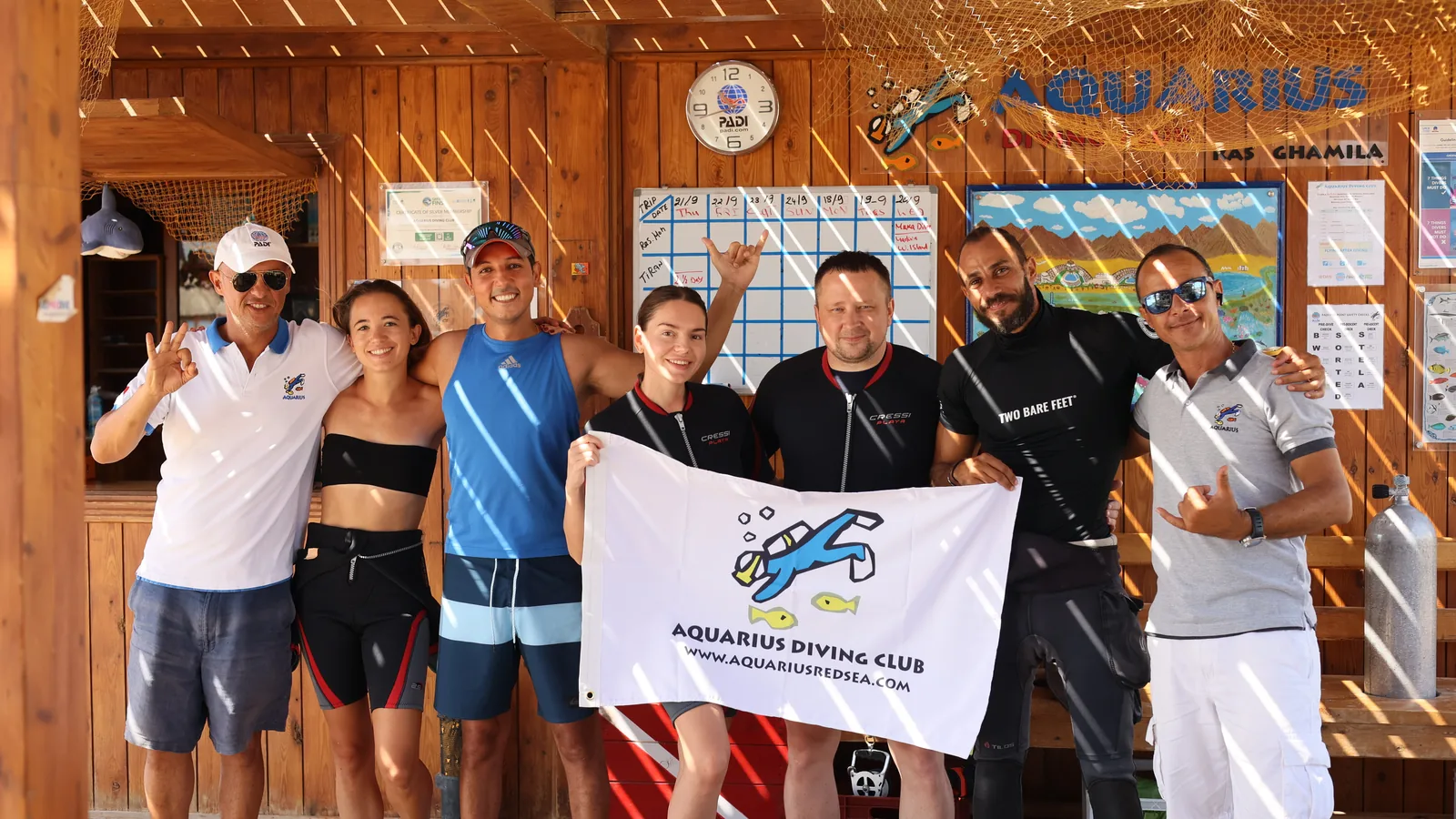
Aquarius is a PADI 5-Star Resort & IDC operating across the Egyptian Red Sea for 30+ years, with bases in Hurghada, Sharm El Sheikh, Makadi Bay and Sahl Hasheesh. Booking direct with us means no platform commission, a real instructor to plan your trip, group rates on request, and free cancellation:
- Hurghada — our largest base; daily diving to dozens of reefs and wrecks. Reserve on the Hurghada reservation page.
- Sharm El Sheikh — Ras Mohammed & Tiran day boats; Sharm daily diving.
- Makadi Bay and Sahl Hasheesh — quieter resort areas with day boats to the Hurghada-region sites.
- New to diving? Start with our new divers guide, then tell us your dates.
Tell us your dates, your certification level and how many divers are in your party, and we'll build the trip with you — directly, at the best price we can offer, with nothing lost to a middleman.
Plan your Red Sea dive trip — direct
No commission, no fixed listing, free cancellation. Send us your dates and level and we'll plan it with you.
Reserve direct →Sources & references
- SambaHQ — Tour OTA Commission Rates 2026: Viator, GYG, Klook & More (Viator 20–30%, typ. 25%; GetYourGuide 20–30%; Klook 15–25%; Tripadvisor via Viator).
- Regiondo — Viator vs GetYourGuide: commission ranges & operator payout.
- Bokun — The Tour Operator's Guide to OTA Bookings (2026) (commission ranges; direct-booking fees ~1–8%; the "billboard effect").
- SiteMinder — Rate parity explained & EU/national restrictions on parity clauses.
- PADI Travel — Best Price Guarantee.
- PADI Pros — 5% referral commission & the PADI Adventures direct-booking widget (no marketplace commission; ~4.9% card-processing service charge).
- SambaHQ / Bokun (above) — Tripadvisor experiences are sold through Viator's booking engine at Viator's commission rate.
- Oreate AI — Understanding Viator's commission rates (20–30%; Accelerate; the ~8% figure is the affiliate rate, not supplier rate).
- GetYourGuide — Supplier Terms & Regiondo — GetYourGuide commission ~20–30% by location/activity/volume.
Commission figures are industry-reported typical ranges; exact rates are negotiated per operator and not publicly fixed, and they change over time. Verified June 2026.