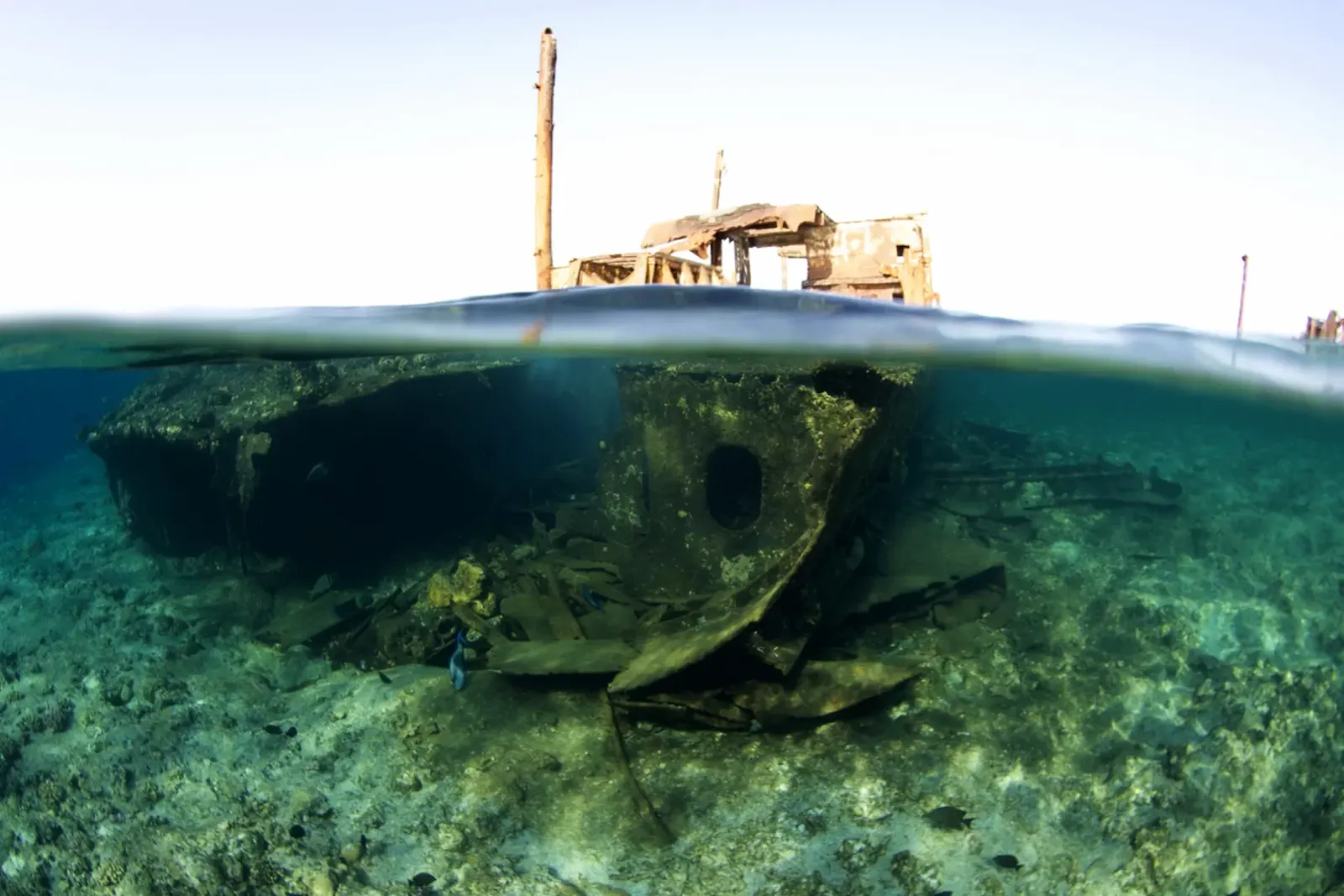
If you only have one boat day in Sharm, spend it at Tiran. And if you're lucky with conditions, Jackson Reef should be one of your dives. It's the headline reef of the Tiran group — fast drift, dramatic walls, and the only Sharm site where schooling hammerheads are a realistic seasonal possibility. The Lara wreck visible at the surface adds an iconic visual reference to a dive site that already feels different from anywhere else in Sharm.
Where Jackson sits in the Tiran group
The Strait of Tiran is the narrow strip of sea between the Sinai Peninsula and Tiran Island (Saudi Arabian territory). Four reefs sit perpendicular to the coast across the strait, each named after a 19th-century British naval surveyor:
- Thomas Reef — third from the north, smallest, drift dives along its sides.
- Woodhouse Reef — long and narrow, no shelter for boats, exclusively a drift dive site.
- Gordon Reef — the southernmost; distinctive triangular shape with a Panamanian freighter wreck (the Loullia) visible above water on its south side.
- Jackson Reef — the most northerly. Roughly oval. The Lara wreck visible above water on its north tip.
The reefs sit in deep water — past the immediate fringing reefs, the seabed drops below 700 metres. This deep-water setting is what makes Tiran a step up from Sharm's local sites: pelagic species pass through, currents are stronger, walls are more dramatic, and visibility is consistently better.
A standard Aquarius Tiran day usually does two of the four reefs depending on conditions and current direction. Jackson is the most popular afternoon dive when conditions allow — the boat will moor on the calm southern side, divers descend, and either drift the eastern wall or explore the back (north) side.
The site at a glance
Jackson Reef has superb wall diving around its entire perimeter. The walls drop vertically from a fringing reef plate (just below the surface) to past 40 metres, with prolific coral growth on every face — soft corals, table corals, sea fans, anthias clouds. The reef itself is large enough that complete exploration on a single dive is impossible — you pick a section based on conditions and current direction.
The "back" of the reef (north side) drops into the open Strait of Tiran where it meets the deeper water of the Gulf of Aqaba. This is where pelagic action concentrates — and where divers go looking for the hammerheads.
The Jackson Drift
The Jackson Drift is the headline dive — one of the most exhilarating drift dives in the Egyptian Red Sea. Conditions vary wildly with current strength, but at its best, the dive is a high-speed slide along a vertical wall covered in soft coral and patrolled by schooling reef fish.
Standard plan:
- Boat positioning: The boat anchors or moors on the calm south side of the reef. Divers don't enter the water until the dive plan is set and the pickup point agreed.
- Negative entry: Roll-in or giant-stride with no air in the BCD. Drop fast to avoid being swept off the reef before you've descended.
- Wall arrival: Reach the wall at 20-25m. The current immediately catches you. There's no turning back without significant effort.
- The drift: Carried along the eastern wall at 18-25m. Soft coral cover is dense — purple, pink, orange. Anthias clouds part as you pass through them. The sense of speed is real; you'll cover several hundred metres in 15-20 minutes.
- Approaching the corner: Where the eastern wall meets the back wall, current can change direction unpredictably. Stay aware of where your group is. Some operators avoid this corner; others use it deliberately to access the back side for hammerhead-hunting.
- SMB and ascent: Deploy DSMB before ascending. The boat is doing live pickups in open water — they need to see your marker. Surface, signal, climb back aboard.
What makes this dive unusual is the speed. You're not swimming; you're being conveyed. It feels like flying along the wall. Divers either love this or hate it — it's not a relaxing dive, and if you don't enjoy strong currents you should ask the guide for an alternative plan.
Hammerheads — when, where, and the truth
Jackson is the Sharm site most associated with hammerhead sharks. The story is true but the expectations need calibration.
The truth:
- Season: August, September, and early October are the peak months. The summer thermocline brings cooler water shallow enough that scalloped hammerheads can comfortably patrol at recreational depths.
- Location: The back (north) side of the reef, looking out into the blue past the dropoff. Divers position at the edge of the wall at 25-30m and watch the open water to the north.
- Behaviour: Hammerheads are timid and easily spooked. Loud bubbles, erratic movement, or chasing them all guarantee they'll vanish. Stay low against the wall, breathe slowly, watch quietly.
- Frequency: Even in peak season, sightings happen on maybe 1 in 4-5 dives. They are not guaranteed. Some weeks deliver multiple encounters; some weeks deliver none.
If hammerheads are your top priority, you have better odds at Daedalus Reef on a southern liveaboard — but for divers based in Sharm, Jackson is the most realistic shot. Multiple Aquarius dives per day during peak season, on the back wall in good conditions, give the best chance.
What you might also see in the same blue water at the back wall: eagle rays, occasional tuna and jacks, the rare whale shark in summer, and grey reef sharks patrolling the dropoff.
The Lara wreck
At the northern tip of Jackson Reef, the rusted superstructure of a ship is visible above the waterline — the Lara, a Cypriot refrigerated cargo ship that ran aground on Jackson in the 1980s. The crew were rescued but the cargo was lost.
Most of the Lara was salvaged or has corroded away over four decades. What remains is largely above water — a small section of bow visible from passing boats, with scattered debris in the very shallow water below. There is no significant submerged wreck to dive. Divers occasionally spot rusted metal fragments and chain in 3-5m at the very top of the reef during the safety stop, but the Lara is more a topside curiosity than an underwater feature.
That said, the Lara is the iconic visual marker of Jackson Reef. If you've seen the photo of "a wreck on a coral reef in the middle of the sea" associated with Sharm or Tiran, that's the Lara. Many operators time the boat positioning so divers can see it during the surface interval.
Three ways to dive Jackson
Conditions dictate which version of Jackson you get on any given day. Aquarius guides assess current and weather before splashing and adjust accordingly.
Option 1: South-side mooring dive (calm conditions)
The boat moors on the calm southern side of the reef. Divers descend along the wall to 20-25m and explore at their own pace. No drift. This is the version Open Water divers can join in calm conditions. Coral is excellent, but you miss the dramatic drift element.
Option 2: Eastern wall drift (moderate current)
The classic Jackson dive. Negative entry, wall at 20-25m, drift north along the eastern wall, deploy SMB at the corner, live pickup. About 35-45 minutes of bottom time depending on gas and depth. AOW required. The most consistently rewarding version of the dive for the average AOW visitor.
Option 3: Back wall drop (strong current, AOW+ with experience)
The serious version. Drop on the back (north) side of the reef, reach the dropoff at 25-30m, and look out into the blue for 15-20 minutes hoping for hammerheads or other pelagics. Then drift back along the wall. Higher gas consumption, deeper profile, requires confidence in strong current. Aquarius runs this only with experienced divers in good conditions.
Common mistakes
- Booking Jackson as your first AOW dive of the trip. The current is real, the depth is real, and a fresh AOW with 5 logged dives will struggle. Build experience on Sharm's local sites first — Ras Ghamila, Ras Nasrani — before tackling Tiran.
- Treating Jackson like a reef-tour dive. It's a current dive. Hovering pretty over coral heads doesn't work here. Plan for the drift; don't fight it.
- Underestimating gas consumption. The combination of depth, current, and excitement burns gas faster than typical reef diving. Watch your SPG. Plan to be on the boat with 50 bar minimum.
- Going hammerhead-hunting in winter. Hammerheads are summer animals at Jackson. December-March dives at the back wall are still beautiful, but hammerhead expectations should be zero.
- Trying to swim against the drift to "see something better." Once you're in the drift, the dive is over the moment you fight it. Burn gas, get tired, miss the rest of the dive. Accept the drift.
- Forgetting your DSMB. Live boat pickups require divers to be visible at the surface. No DSMB is unsafe at Jackson. Most operators (us included) provide one — but bring your own if you have a preference.
How to book
Aquarius runs Jackson Reef as part of our daily Tiran boat trips from the Coral Sea Imperial marina in Sharm. Standard package includes:
- Two boat dives across two Tiran reefs (Jackson is one of them when conditions allow)
- 12L tank, weights, weight belt
- Soft drinks, fees and taxes
- Optional lunch on board (£8/day)
- Optional equipment rental (£30/day)
- Free transfers within Sharm El Sheikh
Pickup typically 7:30-8:00 AM, return mid-afternoon. AOW certification required for the drift versions of Jackson; OWD acceptable for the south-side mooring dive in calm conditions.
Related: For the complete species profile of scalloped hammerheads, see our dedicated Scalloped Hammerhead Shark guide. For all Red Sea shark species and sites, see our Shark Diving in the Red Sea hub.
Frequently asked questions
When is the best time to see hammerheads at Jackson Reef?
August, September and early October are peak months for hammerhead encounters at Jackson Reef. Schools of scalloped hammerheads gather at the back of the reef in the blue, typically at 25-35 metres. Sightings are never guaranteed — they require diving deep at the back side of the reef in good conditions. June and July also see occasional sightings.
What level of diver can dive Jackson Reef?
Advanced Open Water is the practical minimum. Jackson is a high-current site — the famous Jackson Drift is Sharm's fastest drift dive. Open Water divers can dive the sheltered south side in calm conditions, but the dramatic drift dives along the east and back walls require AOW or higher and confidence in current.
Is the Lara wreck still visible at Jackson Reef?
Remains of the Cypriot freighter Lara, which ran aground on Jackson Reef in the 1980s, are still visible above the waterline at the northern tip of the reef. The wreck is largely surface-level — divers occasionally spot scattered debris and metal fragments in shallow water at the very top of the reef, but there is no significant submerged wreck to dive.
How do you get to Jackson Reef?
Jackson Reef is in the Strait of Tiran, about 45-60 minutes by boat from Sharm El Sheikh marinas. Aquarius runs full-day boat trips from our Coral Sea Imperial base — typically two dives across two of the four Tiran reefs (Thomas, Woodhouse, Gordon, Jackson) with Jackson often featured as the highlight.