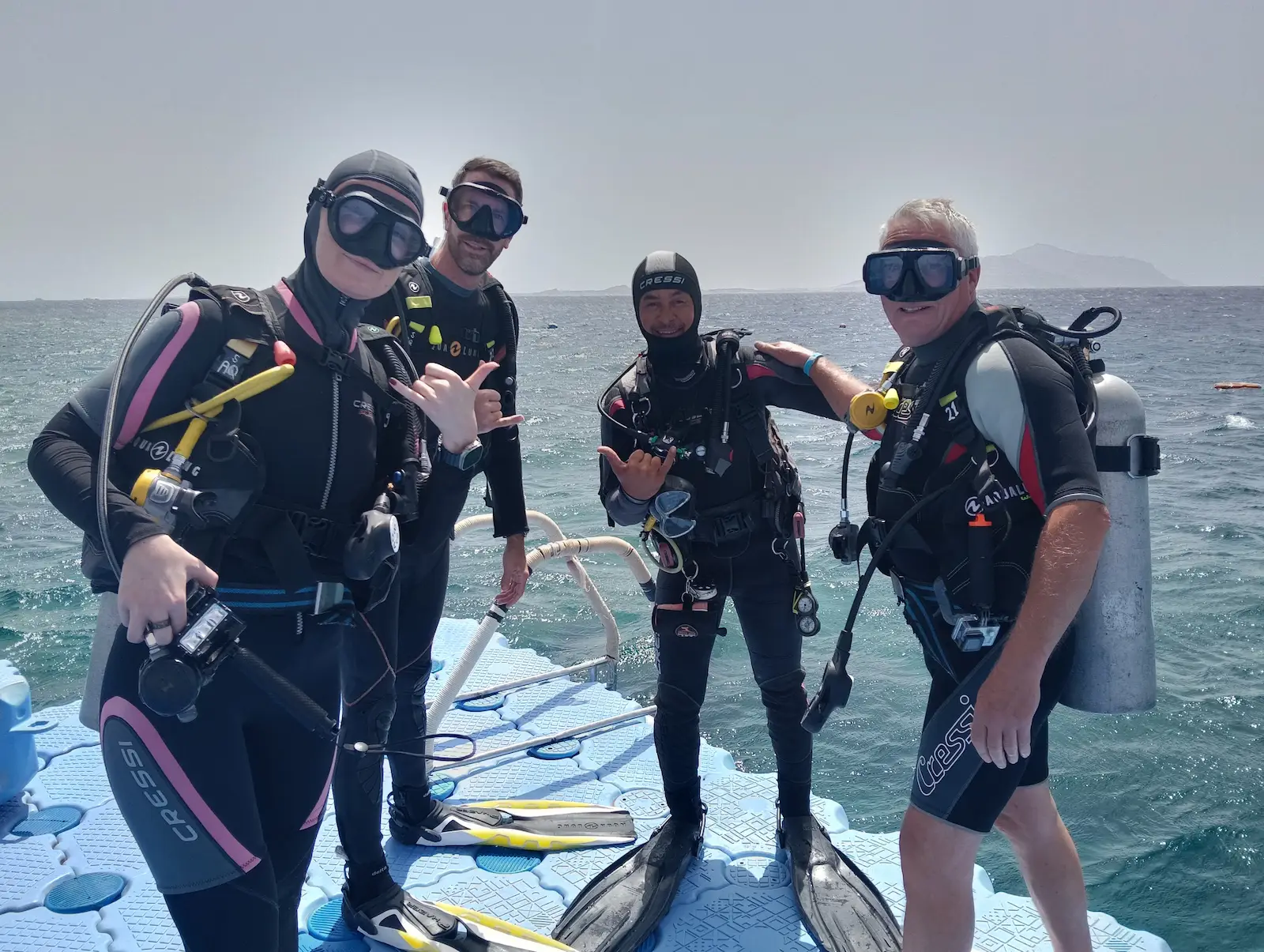
Every dive operation has a "house reef" — and Aquarius's is Ras Ghamila. If you stay with us in Sharm, this is the dive you'll do most. It's the warm-up dive on day one, the refresher after a long flight, the night dive during a quiet evening, and the third dive after two morning trips out to the Tiran reefs. It's also one of the most genuinely beautiful local dive sites in Sharm — and we'd argue for the best site in the area for night diving.
Why this is our house reef
Aquarius Sharm operates from the Coral Sea Imperial Resort, which sits at the very northern end of the Sharm hotel strip. Walk out of our base, head north for two minutes along the beach, and you're at the Ras Ghamila entry point. No boat. No transfer. Just walk in, kit up, and dive.
This is genuinely unusual. Most Sharm dive operators run boat-only operations from Naama Bay or the southern marinas, meaning every dive requires a 30-90 minute boat trip out and back. We have that option too — daily boats to Ras Mohammed and Tiran from the Coral Sea Imperial marina. But for divers who want to maximise dive time and minimise transit, our Ras Ghamila house reef is a major operational advantage.
What this looks like in practice:
- Two shore dives in a day: Pre-breakfast and pre-lunch. Standard package.
- The optional third dive: After a morning of two boat dives at Tiran or Ras Mohammed, you can come back to base for an afternoon shore dive at Ras Ghamila — without the surface interval needing to fit a third boat trip.
- Night dives: Walk to the entry point at dusk, dive, walk back. No boat scheduling, no extra transfer cost.
- Refreshers: Divers who haven't dived in 12+ months use our house reef for a skills refresher before joining the harder boat trips. It's controlled, shallow, and there's a perfect sandy area for hovering practice.
The site at a glance
Ras Ghamila ("Beautiful Cape" in Arabic) is the most northerly of Sharm's local dive sites — directly opposite Gordon Reef across the Strait of Tiran. The site separates a shallow sandy lagoon from the open sea, with a long fringing reef wall and an extensive sandy plateau extending north toward Aqaba.
The dive is normally done as a drift in a northerly direction, with the current pushing divers toward the Enterprise Passage — a navigable channel between Sharm and Tiran Island, marked at its southern end (atop Gordon Reef) by a red beacon and at its northern end (over Ras Ghamila's plateau edge) by a green beacon. The green beacon is the visual end-of-dive marker for the standard drift.
Currents at Ras Ghamila are generally mild to moderate, and the site is sheltered enough for beginner divers in calm conditions. In strong wind or rough seas the site can be unworkable from shore — on those days we'll switch the day's plan to boat dives in more sheltered locations.
The topography — wall, plateau, sea fan forest
Three distinct zones make up the dive:
The reef wall (5-12m)
From the shore entry, the reef drops in a series of small ledges to about 12 metres. This is the shallow zone — colourful hard corals, anthias clouds, and the chance to spot reef-dwelling species like crocodile fish hidden in the sand patches. Open Water trainees stay in this zone. Photographers love it for macro subjects.
The plateau (14-22m)
Past the wall edge, a wide sandy plateau extends offshore for at least 100 metres. The plateau is dotted with porites coral heads, scattered table corals (Acropora) and isolated coral pinnacles. The bottom of the plateau slopes from 14m at its inner edge to 22m at its outer edge before another drop into deeper water. This is where most of the dive happens.
The sea fan forest (18-26m)
The deep edge of the plateau holds Ras Ghamila's signature feature: the largest concentration of gorgonian sea fans of any Sharm local site. Dozens of them, some over 2 metres tall, all oriented perpendicular to the prevailing current. They're stunning, especially with sun streaming down through the water. The fans support a small ecosystem of their own — gobies, pygmy seahorses (with patience), and feeding crinoids.
Photographers should plan to spend most of their bottom time in this zone. Wide-angle works for the fan forest as a whole; macro for the inhabitants.
The drift dive — Conrad to Enterprise Passage
The standard Ras Ghamila drift dive starts immediately at the end of the Conrad Resort property and ends at the green beacon marking the Enterprise Passage. About a 600-metre drift north, depending on current strength.
Entry: Walk in from the small beach area, wading out until deep enough to drop the BCD weight on. We typically use a giant stride from a small rock platform if the water is calm; otherwise a beach-shuffle entry.
Descent: Drop to about 5-8m on the reef wall, swim to the wall edge at 12m. Check current direction. If the current is running north (the usual direction toward Aqaba), simply turn right and let it carry you.
The drift: Mid-water along the plateau edge at 18-22m, with the wall to your right. The dive becomes a slow visual procession — sea fans appearing every 15-20 metres, table corals scattered in between, the occasional schooling fish drifting past in formation. Stay aware of your gas — Ras Ghamila is shallow, but a 60-minute dive at 20m still uses air faster than reef-top puttering.
Looking out into the blue: Currents at the plateau edge sometimes bring schools of black snappers around the corner. Keep an occasional eye on the deep water — barracuda, grouper, eagle rays, and (in summer) whale sharks have all been recorded here. None are common, but Ras Ghamila is one of the better Sharm local sites for chance pelagic encounters.
Exit: Surface near the green beacon, signal the boat (if boat-supported) or swim back to shore. Most Aquarius shore dives at Ras Ghamila are bookended by either a return swim or a short jeep pickup at the Enterprise Passage end.
What you'll see
Sea fans (gorgonians). The signature feature. Multiple species including the large red-orange Annella mollis. Don't touch — they're slow-growing colonial animals that take decades to recover from damage.
Feathertail stingrays. Resident and reliable. They patrol the plateau's sandy areas and can be approached slowly — keep low to the bottom and don't shadow them with your bubbles.
Black snappers. Schools at the plateau corner near the Enterprise Passage. The schools rotate slowly in formation; experienced divers approach from outside the school's path and let it pass over them.
Barracuda and grouper. Larger pelagic fish patrol the deeper plateau edge.
Crocodile fish. Sand-camouflaged on the plateau, especially under or near table corals. They look like a piece of the seabed until you're a metre away.
Cornet fish. Long thin predators that hide behind larger fish to ambush prey. Worth watching — they hunt in slow patient stalks.
Octopus and Spanish dancers. Mostly nocturnal — see them on the night dive (next section).
The "old wreck" rumour. Some local guides believe a very old wreck lies beneath the plateau, completely encased in coral over centuries — visible only as oddly-angled coral mounds that don't fit the surrounding topography. Whether true or not, it's a fun thing to look for.
The night dive
Ras Ghamila as a night dive is one of the highlights of any Sharm trip. Aquarius runs night dives here regularly — they're easy because the entry point is two minutes from base, the depth profile is forgiving, and the marine life genuinely changes after dark.
What changes at night:
- Octopuses emerge from daytime hiding spots and hunt actively. The plateau at night is one of the better places in Sharm to watch hunting octopus behaviour.
- Spanish dancers (large red nudibranchs, Hexabranchus sanguineus) come out and feed. Sometimes you see them swimming in the open mid-water with their characteristic flowing motion.
- Free-swimming morays hunt at night — a different sight from the daytime stationary moray hiding in a hole.
- Lionfish spread out and ambush prey actively rather than hovering near coral heads.
- Crustaceans emerge from cracks in the reef — slipper lobsters, decorator crabs, hermit crabs of every size.
- Bioluminescence: wave your hand in front of you with the torch off and you'll see plankton glow at every disturbed point. Magical for first-time night divers.
Night dive technique: bring a primary torch and a backup. Don't shine your light directly into anyone's mask. When you find something interesting, illuminate it from the side, not behind — direct light from behind blinds nocturnal eyes and the animal will flee.
Training, refreshers, and check-out dives
Ras Ghamila is the site we use for most of our pool-out training work. The shallow zone (5-12m) has a perfect sandy patch with light current, ideal for the kneeling and skills-demonstration phases of Open Water training. Discover Scuba programs (the pre-certification "try diving" experience) also happen here.
For divers returning after a long break, we run a 30-40 minute refresher dive at Ras Ghamila before scheduling any deeper boat trips. Standard refresher covers: BCD inflate/deflate, mask removal/replacement, regulator recovery, weight check, and a buoyancy-control swim. We charge less than a normal day-dive for the refresher, and it's mandatory for divers whose last dive was over 12 months ago.
Check-out dives — for visiting AOW divers we don't know yet — happen here too. We watch trim, gas consumption, buoyancy, and basic awareness on a low-stakes 18m dive before clearing the diver for the harder Tiran or Ras Mohammed boats.
Common mistakes
- Treating Ras Ghamila as "just a check-out dive." The sea fan forest is genuinely world-class. Bring your camera. Plan a real dive.
- Skipping the night dive. Many divers rush through their three or four days in Sharm doing only boat trips. Doing one night dive at Ras Ghamila is worth at least one boat dive — the marine life is genuinely different.
- Diving in a 3mm wetsuit in winter. Sharm winters drop the water to 22°C. Standing in shallow water during the entry/exit at Ras Ghamila gets cold faster than boat diving where you're in and out of the water more efficiently. A 5mm makes a huge difference.
- Drifting past the green beacon. The Enterprise Passage opens to the strait. Go past the green beacon and you're heading toward open water — possibly into shipping lane currents. Surface at the beacon, not after it.
- Touching the sea fans. They look sturdy. They're not. Even brushing them with a fin damages decades of growth. Keep distance.
- Diving Ras Ghamila and skipping Tiran. The opposite mistake — too many divers stay shore-based all week. Mix shore and boat dives. The Tiran reefs (Jackson, Woodhouse, Gordon, Thomas) are 30 minutes by boat and worth the trip.
Frequently asked questions
What level of diver can dive Ras Ghamila?
Ras Ghamila is suitable for all certification levels from Open Water upwards. The reef wall stops at 12 metres before the plateau drops to 14-26m. Beginner divers stay shallow on the wall; experienced divers explore the deeper plateau and can drift to Enterprise Passage. The site is also used for Discover Scuba and Open Water training dives.
Is Ras Ghamila a shore dive or boat dive?
Both. Aquarius primarily runs Ras Ghamila as a shore dive from our Coral Sea Imperial base — divers walk in from the beach. The site is also accessible by boat as part of multi-site day trips. Shore diving here means easy logistics, repeat dives in a single day, and night dives without boat scheduling.
What will I see at Ras Ghamila?
The site is famous for its dense gorgonian sea fan forest — the highest concentration of any Sharm El Sheikh local site. Expect Porites coral colonies, table corals, feathertail stingrays, barracuda, grouper, schools of black snappers, octopus on night dives, and occasional eagle rays. Whale sharks have been recorded passing the site in summer.
Can I do night dives at Ras Ghamila?
Yes. Aquarius runs scheduled night dives at Ras Ghamila as part of our standard offerings. The shallow plateau is excellent for night life — Spanish dancers, octopuses, hunting morays, free-swimming lionfish. Night-dive-specific certification is recommended (PADI Adventure Diver or Night Diver specialty).