Where to see them
When to see them
Bluespotted ribbontail rays are year-round residents of every Red Sea reef — there is no migration. They are easiest to find by day, sheltering motionless under ledges; on night dives you may catch them actively foraging out on the open sand.
Year-round resident Sheltered by day · forages on sand at night
Identification
The bluespotted ribbontail ray is one of the easiest reef animals to identify — even snorkellers recognise it. The combination of features is unique among Red Sea rays:
- Disc: Oval to rounded, flattened, with broadly rounded outer corners — not the angular diamond shape of many other stingrays. Disc width reaches about 35 cm; total length including the tail is up to roughly 70–80 cm, and weight up to about 5 kg.
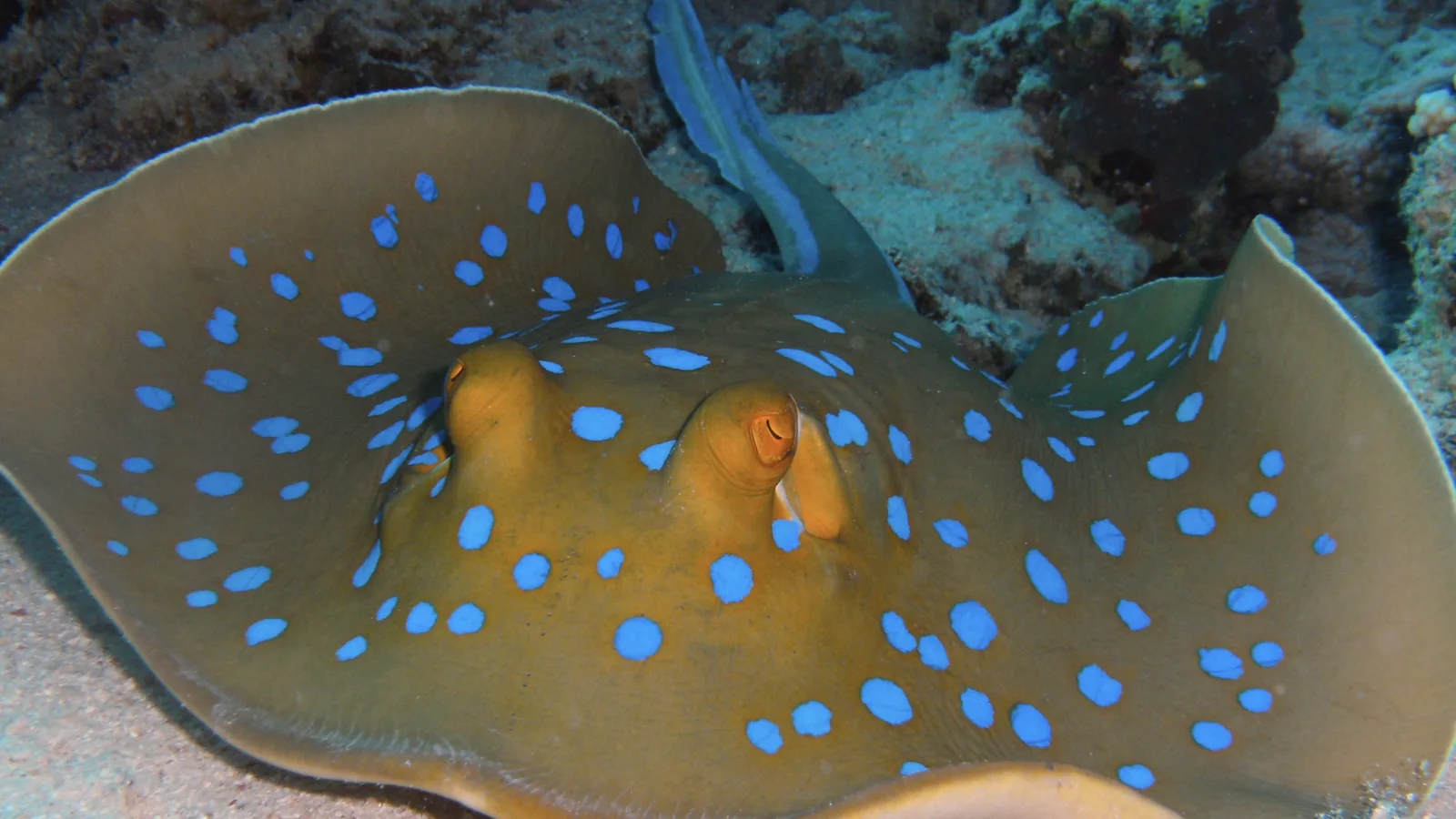
- Colour and spots: A yellow-brown, olive or grey-brown disc covered in numerous bright, almost neon-blue circular spots. The underside (belly) is white and the large protruding eyes are bright yellow.
- The "ribbon" tail: A relatively short, stout tail carrying two blue stripes, one along each side — the feature that gives the "ribbontail" name and the surest way to separate it from look-alikes.
- Venomous spines: One or two (usually two) serrated venomous spines near the middle-to-end of the tail. These are the only dangerous part of the animal.
- Snout: Bluntly rounded, with slender nostrils; the mouth on the underside contains flattened plates of small teeth for crushing shelled prey.
Newborns are miniature versions of the adults, around 13–14 cm across at birth, already showing the blue spots and striped tail. There is no dramatic colour change with age, and the sexes look essentially alike (males mature at around 20–21 cm disc width).
Bluespotted ribbontail ray vs bluespotted stingray — don't confuse them
Two superficially similar blue-spotted rays occur in the Indo-Pacific and are constantly mixed up, including in dive logs and stock photos. Knowing the difference makes you a sharper observer:
| Feature | Taeniura lymma (bluespotted ribbontail ray) | Neotrygon kuhlii (bluespotted / Kuhl's maskray) |
|---|---|---|
| Family | Dasyatidae (whiptail stingrays) | Dasyatidae (whiptail stingrays) |
| Disc shape | Rounded, oval, smooth-edged | More angular, diamond / rhomboid |
| Tail | Short and stout, with two blue side-stripes | Longer, whip-like, banded near the tip |
| Typical resting spot | Under coral ledges and table corals | Often partly buried in open sand |
| Spots | Bright, large, vivid neon-blue | Smaller, often less vivid blue spots |
| Red Sea status | The common "blue-spotted ray" divers photograph here | Present in the wider Indo-Pacific; far less the iconic Red Sea reef ray |
For practical Red Sea diving: the small, vividly-spotted ray tucked under a coral table with a ribbon-striped tail is reliably Taeniura lymma. The genus name Taeniura itself means "ribbon-tail."
Habitat and range
The bluespotted ribbontail ray is a coral-reef-associated species of shallow water. It is found from the intertidal zone down to about 30 m, with most sightings far shallower — on sandy patches, coral-rubble margins, seagrass beds, and the undercut ledges and caves of the reef itself.
Its range spans the tropical Indian and western Pacific Oceans: from the Red Sea and East Africa (south to South Africa), around the rim of the Indian Ocean and the Arabian Peninsula, through Southeast Asia, north to southern Japan and south to northern Australia. It is notably common throughout the Red Sea, which sits at the north-western edge of its range. (It is comparatively rare in the Persian Gulf and Gulf of Oman.)
Unlike many stingrays, Taeniura lymma does not habitually lie buried in the open sand. Its day-time strategy is to shelter — alone — inside a cave or under a coral ledge or table, frequently with only the tail visible. This sheltering behaviour, rather than burying, is exactly why divers so often see the blue-striped tail before they see the ray.
Behaviour
The behaviour of the bluespotted ribbontail ray is shaped by the tide and the day–night cycle:
- By day — sheltering: Individuals rest motionless under ledges, table corals, and inside small caves. They are largely solitary while sheltering.
- Tidal feeding: As the tide rises, small groups move out together onto shallow sandy flats to forage, retreating back to the reef as the tide falls. Foraging peaks around dusk, dawn and at night.
- Foraging method: The ray cruises low over the sand and excavates feeding pits — using jets of water and its disc — to expose buried invertebrates, located by electroreception (see below).
- Defence — flight, not fight: Its first response to a threat is to flee, often at speed in a zigzag pattern. The venomous tail spine is strictly a last-resort defence, used only when the animal is cornered, grabbed, or trodden on. It does not "attack" divers.
Diet and electroreception
Diet: The bluespotted ribbontail ray is a benthic predator of small bottom-dwelling animals — molluscs (including bivalves), polychaete worms, shrimps, crabs, and small bony fishes. Hard-shelled prey is crushed between flattened plates of teeth on the underside of the disc.
Electroreception — hunting the invisible: Rays and sharks share a remarkable sixth sense. The underside of the ray's disc is studded with jelly-filled pores called the ampullae of Lorenzini, which detect the minute electrical fields generated by the muscles and nerves of living animals. This lets the ray locate prey that is completely hidden beneath the sand — a buried crab or worm betrays itself by its own bioelectric signature. The ray homes in on the source, then excavates it. Electroreception, combined with a keen sense of smell, makes the sandy flats a fully-stocked larder even in the dark.
Reproduction
The bluespotted ribbontail ray is aplacental viviparous (sometimes called ovoviviparous): the young develop inside the mother and are born live. Embryos are nourished first by their yolk supply and then by nutrient-rich "uterine milk" (histotroph) secreted by the mother — there is no placenta.
Litters are small — up to about seven pups — after a gestation period reported between roughly four and twelve months. Pups are born fully formed at around 13–14 cm disc width and are independent from birth. This low reproductive output, typical of rays, is part of why the species is sensitive to fishing pressure: populations recover slowly when depleted.
Conservation status
The IUCN Red List assesses Taeniura lymma as Least Concern (assessed 2020, published 2021). It is widespread and remains common on healthy reefs like those of the Egyptian Red Sea, so it is not currently threatened — but, like many inshore rays, it still faces pressures across parts of its range:
- Fisheries: Caught both as a target species and as retained bycatch in the intensive artisanal and commercial inshore fisheries that operate across much of the Indo-Pacific.
- Habitat degradation: Widespread destruction and decline of the shallow coral-reef and inshore habitats it depends on.
- The aquarium trade: Its spectacular appearance makes it a sought-after marine-aquarium animal — but it is notoriously difficult to keep, frequently refusing food and surviving poorly in captivity, so demand drives ongoing wild collection.
A note on sources: you may occasionally see this ray listed as Near Threatened, but the current IUCN assessment (2020/2021) is Least Concern. Either way, the message for divers is the same: observe without touching, never harass or feed the rays, and support reef-protection and responsible operators. There is no case for handling or chasing these animals for a photograph.
Diving with bluespotted ribbontail rays in the Red Sea
Encounters are common and entirely benign when handled with normal reef etiquette. Where and how to find them:
- Search the sand–reef margin. Scan the sandy patches and rubble at the base of the reef and the shaded space under table corals and ledges — that blue-striped tail is often the giveaway.
- House reefs and shallow training sites at all seven Aquarius bases — Sahl Hasheesh, Sharm, Hurghada and Makadi Bay — are reliable. Many divers see their first ribbontail ray on a check-out or training dive.
- Night dives reveal their foraging behaviour out on the open sand, when they are most active.
- Keep neutral buoyancy. The most likely way to provoke a ray is to drop onto the sand or a ledge where one is resting — control your depth and your fins.
Diver etiquette and the venom question
The bluespotted ribbontail ray is not a threat to a careful diver, but it deserves respect — both for its own welfare and for the spine on its tail.
- Never corner it. Always leave the ray an open escape route. A ray that can flee will flee; a ray that feels trapped is the only one that may use its spine.
- Never reach under a ledge without looking. As with lionfish and moray eels, the classic accident is a hand placed blindly into a crevice where an animal is sheltering.
- Do not touch, handle, ride, or feed. Touching stresses the animal and risks the venomous spine; feeding alters natural behaviour. Handling for a photo is never acceptable.
- Watch where you settle. Don't kneel or fin down onto sand or ledges — a resting ray may be right there.
- Photography: The ray is a superb subject. Approach slowly and low, keep your distance, and let it tolerate the camera — never push gear toward it. Side-on shots capture the striped tail; gentle over-the-shoulder angles show the spotted disc against the sand. Move on before the animal becomes agitated.
If a sting does occur
Stingray spines deliver a protein-based, heat-labile venom, so the first aid is the same hot-water protocol used for lionfish and other venomous fish. Two things make stingray wounds distinct, though: the spine is serrated and can cause a deep, ragged puncture, and fragments often break off in the wound.
Stingray Sting First Aid
Standard protocol from DAN (Divers Alert Network) and emergency-medicine literature:
- Get the diver out of the water safely and control any bleeding with firm direct pressure — a stingray spine can cut deep.
- Irrigate and clean the wound with fresh or clean water. Remove obvious surface spine fragments, but do not dig for deeply embedded pieces — leave those for medical removal.
- Immerse the affected area in hot water at 40–45 °C (104–113 °F) — as hot as can be tolerated without scalding — for 30 to 90 minutes. Heat denatures the venom proteins and is the single most effective pain relief. Test the temperature on an unaffected person first; the casualty's pain perception is unreliable.
- Pain relief: over-the-counter ibuprofen or paracetamol in addition to the hot-water immersion.
- Always seek medical follow-up. Stingray wounds are prone to retained spine fragments and to infection; a tetanus check is essential. Watch for spreading redness or swelling over 48–72 hours.
- Treat as an emergency if the wound is to the chest, abdomen, neck or a large blood vessel, if bleeding cannot be controlled, or if there are signs of an allergic/systemic reaction — go straight to hospital.
For context on the actual risk: the bluespotted ribbontail ray's venom is not regarded as lethal to a healthy adult, and unprovoked stings on divers are very rare because the animal flees. Serious stingray injuries almost always involve the mechanical force of the spine — for example, the rare tragic cases where a spine has struck a major blood vessel or organ — not the venom itself. Treat the spine with the same caution you would any sharp, venom-tipped object: look, don't touch, and never handle the animal.
Related species in the Red Sea
The Red Sea hosts several other rays and shovel-nosed relatives a diver may encounter on or near the sand:
- Reef manta ray (Mobula alfredi) — a giant, harmless filter-feeder of the open water and cleaning stations; a completely different ecology from the little bottom-dwelling ribbontail, but the Red Sea's most spectacular ray encounter.
- Bluespotted stingray / Kuhl's maskray (Neotrygon kuhlii) — the angular-disced, longer-tailed look-alike discussed above; rests partly buried in sand.
- Honeycomb / reticulate whipray (Himantura uarnak) — a much larger sand-dwelling stingray with a very long whip tail and a fine honeycomb pattern.
- Torpedo / electric rays (Torpedo spp.) — rounded rays that stun prey with electric organs rather than a spine; encountered on sandy bottoms.
The general rule for all of them is the same as for the bluespotted ribbontail ray: observe, photograph from a respectful distance, and never touch any animal or reach into any space you cannot see into.
For more on Red Sea marine life and trip planning, see our Shark Diving in the Red Sea hub guide and the full Marine Life Encyclopedia.
Frequently asked questions
No. It is a shy, retiring animal whose instinct is to flee, usually in a fast zigzag. It does not pursue or attack divers. The venomous tail spine is purely defensive and is only used if the ray is cornered, grabbed, or trodden on. Give it space and the encounter stays calm.
Venomous — it delivers venom through one or two serrated spines on the tail when threatened (poisonous would mean toxic to eat). The venom is protein-based and the sting is very painful, but it is not considered lethal to a healthy adult. The main hazard is the deep puncture the serrated spine can cause, plus infection — which is why a sting always needs hot-water first aid and medical follow-up.
The vivid blue spots are thought to be aposematic — a warning signal advertising that the animal is armed with venomous spines, much as bright colours warn predators off other dangerous reef species. The bold pattern may also serve in species recognition. Whatever its exact function, it makes the ray one of the most instantly recognisable animals on the reef.
Less than most stingrays. Unlike the maskray and many sand-dwelling rays, Taeniura lymma usually shelters under coral ledges, table corals and in small caves by day rather than lying buried in open sand — often with just its blue-striped tail showing. It does excavate pits in the sand while feeding, but resting buried is not its typical behaviour.
Small for a stingray. The disc reaches about 35 cm wide; total length including the tail is up to roughly 70–80 cm, and weight up to about 5 kg. Newborns are around 13–14 cm across. Most individuals you see on the reef are well under the maximum size.
Year-round, on sandy patches and under coral ledges at almost any Red Sea reef from about 4 to 18 m. They are easiest to spot by day, resting in the shade of a coral table or overhang; on night dives you can watch them foraging out on the open sand. House reefs and shallow training sites at all seven Aquarius bases are very reliable.
No — they are two different species that are frequently confused. The bluespotted ribbontail ray (Taeniura lymma) has a rounded disc and a short tail with two blue side-stripes, and shelters under ledges. The bluespotted stingray, or Kuhl's maskray (Neotrygon kuhlii), has a more diamond-shaped disc and a longer whip-like tail, and tends to rest buried in sand. The iconic Red Sea reef ray is Taeniura lymma.
The IUCN lists the bluespotted ribbontail ray as Least Concern (assessed 2020, published 2021) — not endangered. It remains common on healthy Red Sea reefs, though across its wider range it faces pressure from inshore fishing, coral-reef habitat loss, and collection for the aquarium trade. (Some sources still repeat an older "Near Threatened" figure; the current listing is Least Concern.)