Where to see them
When to see them
Manta encounters in the Egyptian Red Sea peak May–November, driven by plankton blooms that fuel feeding aggregations at cleaning stations. Outside that window sightings are possible but unpredictable.
Peak: May–November Driven by plankton blooms
Two species, one family
For decades both manta species were lumped together as a single species Manta birostris. In 2009, taxonomic work confirmed they are distinct species, and in 2018 both were reclassified into the genus Mobula based on phylogenetic analysis. The Egyptian Red Sea has both:
| Feature | Reef Manta (M. alfredi) | Oceanic Manta (M. birostris) |
|---|---|---|
| Max wingspan | ~5 m | ~7 m (largest ray species) |
| Habitat | Shallow coastal reefs | Open ocean, offshore reefs |
| Behaviour | Strong site fidelity to cleaning stations | Wide-ranging, less predictable |
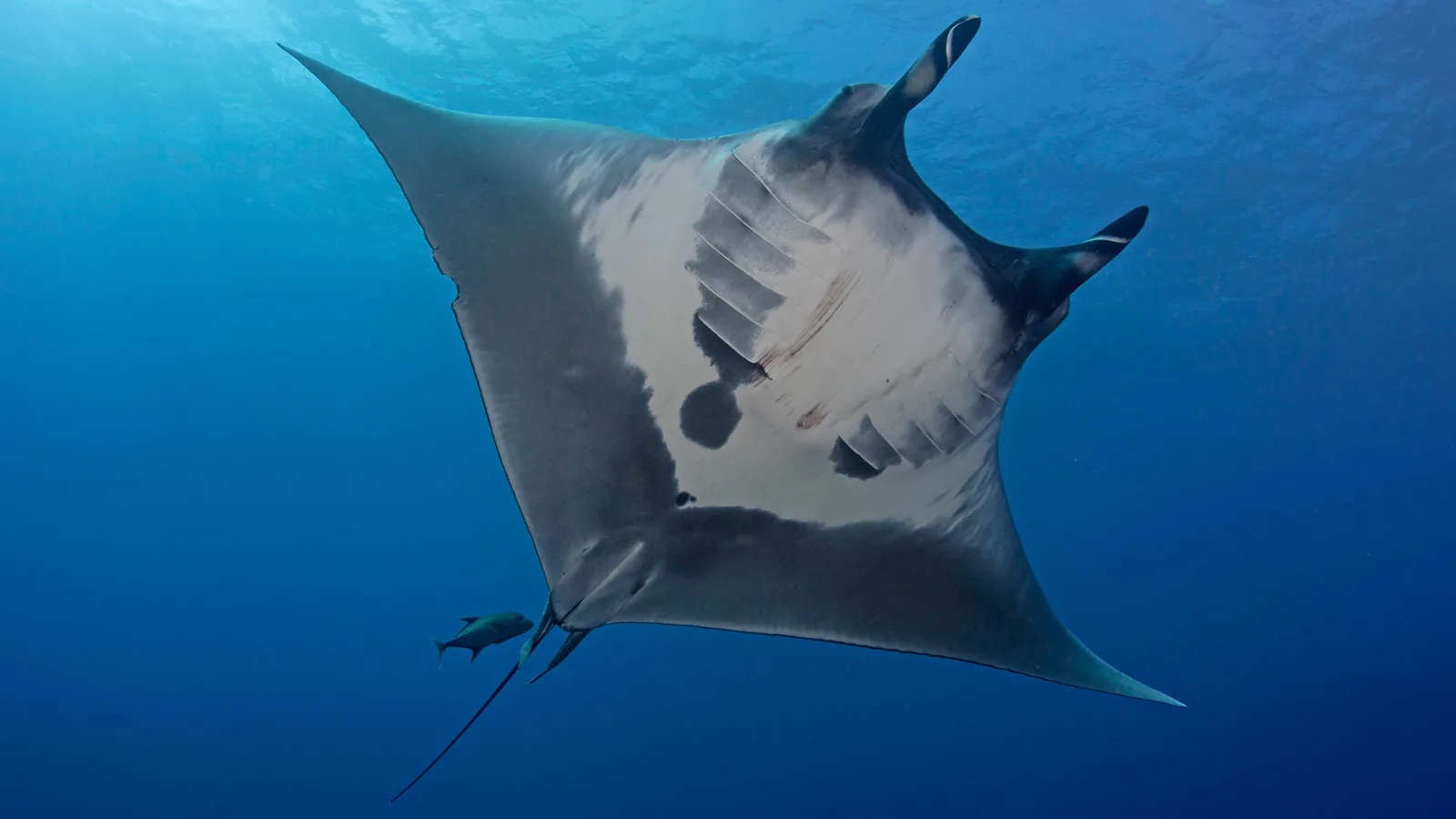
| Dorsal markings | Gradual dark-to-light transition | Sharp T-shape between white shoulder patches |
| Ventral markings | Spots below gills, between gills | Spots clustered below gills only |
| Red Sea distribution | Mainland coast Hurghada→Marsa Alam (shallower) | Offshore reefs (Brothers, Daedalus, Sharm sites) |
| IUCN status | Vulnerable | Endangered (since 2019) |
In practical terms, the manta you're most likely to encounter on an Egyptian Red Sea dive trip is the oceanic manta — counter-intuitive, since "reef manta" sounds more appropriate for a reef diving destination. The reef manta exists in the Red Sea but in lower numbers and at sites less frequented by liveaboards.
How to identify a manta ray
Distinguishing the two species requires close observation:
Top (dorsal) surface:
- Oceanic manta: Dark on the back with two sharply defined white shoulder patches. The line between dark and white is sharp, and the two white patches form a clear T-shape across the shoulders.
- Reef manta: Dark fading more gradually into the lighter shoulder areas. No sharp T-shape — the transition looks blended rather than stamped.
Underside (ventral) surface: Both species have spot patterns that are individually unique (like fingerprints — used for photo-ID). Oceanic mantas have spots clustered below the gill area; reef mantas have spots both below and between the gills.
Size: An adult manta with a 6 m+ wingspan is overwhelmingly likely to be an oceanic. Wingspan up to 4 m suggests reef manta.
Mouth: Both have terminal mouths (at the front of the body) with paddle-like cephalic fins on either side that funnel plankton-rich water into the mouth during feeding. The cephalic fins curl up tightly when not feeding.
Biology & ecology
Mantas are extraordinary animals. A few facts worth knowing:
- Filter feeders: Both species feed exclusively on zooplankton — copepods, krill, fish eggs, small shrimp. Despite their enormous size, they have no predatory equipment whatsoever.
- Brain-to-body ratio: Mantas have the largest brain of any fish species relative to body size. They are demonstrably intelligent — capable of mirror self-recognition (the only known fish that pass this test), problem-solving, and behavioural learning.
- Reproduction: Both species give birth to live pups (ovoviviparous). Gestation is 10-13 months. Females typically produce one pup every 2-3 years, occasionally two. This is the lowest reproductive rate of any elasmobranch and the core driver of their conservation vulnerability.
- Maturity: Female mantas reach reproductive maturity around 8-10 years old; males slightly earlier. They can live 40+ years in the wild.
- Cleaning stations: Mantas visit specific reef stations where small cleaner fish (wrasses) remove parasites from their skin, mouth and gills. Reef mantas in particular return repeatedly to the same stations, which is why they are easier to "find" in their core habitats.
- Migration: Both species are highly migratory. Satellite-tagged individuals have travelled thousands of kilometres.
Behaviour and what to expect
Manta encounters on Red Sea dives typically take one of these forms:
- The fly-by: A single manta cruises past the reef wall at some distance (10-30 m). The encounter lasts 30 seconds to a minute. Take pictures; you may not see another all week.
- The cleaning station visit: A manta hangs near the reef while cleaner fish work over its skin. The animal moves slowly, may circle, and can be observed for 5-15 minutes. Stay back, do not approach, let the manta dictate proximity.
- The barrel-roll feeder: Rare but spectacular. A feeding manta back-flips through plankton-rich water, mouth wide open, looping repeatedly through the same patch. Looks like underwater dance.
Mantas are typically curious of divers but not approachable in a "swim up to them" sense. The right approach: be still, be quiet, let the manta come to you. Vertical bubbles often deter them; slow horizontal breathing keeps them comfortable.
Diving with mantas — practical guide
If you're planning a trip specifically to encounter mantas in the Red Sea:
Best strategy: liveaboard
The most reliable single approach is a Brothers/Daedalus/Elphinstone summer liveaboard (typically July-August departure). 7-day itineraries from Hurghada or Marsa Alam visit Daedalus on the third or fourth day, with 3-4 dives at the site giving multiple chances. Our Xplorer Aquarius liveaboard fleet covers this route.
Day-boat opportunity: Sharm El Sheikh
The 2022 study found Sharm El Sheikh records the highest individual manta count in the Red Sea — surprising for a day-boat destination. Day boats from our Sharm base regularly visit Shark Reef and Yolanda where many of those sightings occurred. There's no "manta-targeted" Sharm day trip per se — but every Ras Mohammed day trip carries a small but real chance.
Skill level
Manta encounters in the Red Sea typically happen at 5-25 m depth. Recreational diver levels are sufficient (Open Water for shallow, AOWD for the deeper sites). The challenge is not depth — it's stillness and patience. Holding position, controlling buoyancy without fin movement, and not chasing the animal are the relevant skills.
Conservation
Manta rays are among the most threatened large marine animals on Earth. The threats are multiple:
- Gill-plate trade: Mantas' gill plates (the modified gill rakers that filter plankton from water) are dried and traded into Asian markets for use in traditional remedies. This is the primary commercial driver of manta fishing globally.
- Bycatch: Mantas are large, slow, and prone to entanglement in longlines, gillnets and purse seines targeted at other species (especially tuna).
- Habitat degradation: Coral reef loss and coastal development reduce the cleaning station habitats that reef mantas in particular depend on.
- Slow reproductive rate: One pup every 2-3 years cannot replace populations lost to fishing pressure.
Both species are listed under CITES Appendix II (since 2014), which regulates international trade in their parts. Local protection varies — Egypt has marine parks at offshore sites where commercial fishing is prohibited, which provides some protection. Indonesia, the Maldives, the Philippines and Mexico have implemented full manta-protected zones in their waters.
What divers can do
- Photograph the underside. Spot patterns are unique to individuals. Submit photos to citizen-science platforms (Manta Trust, MantaMatcher) — your photo may help track an individual across multiple sightings, adding to scientific understanding of movement and population.
- Don't touch, chase or interrupt. Mantas displaced from cleaning stations or feeding patches abandon them. Habitats matter more than individual encounters.
- Choose operators with strict no-touch policies. Aquarius briefings cover manta etiquette on every relevant dive.
- Don't buy gill plates or manta products in Asian markets. The supply chains all connect.
Photographing mantas — quick guide
Mantas are demanding subjects for photographers — the encounter is usually brief, the lighting often poor, and the animal is large enough that close framing is hard:
- Lens: Wide-angle (fisheye 8-15 mm full frame or rectilinear 10-17 mm). Macro lenses are useless — the manta won't fit in the frame.
- Strobes: On, dialled for the distance. Wide-angle strobes set to medium power, aimed slightly outward to avoid backscatter from plankton.
- Settings: ISO 400-1600, shutter 1/125-1/250, aperture f/8-f/11. The white belly creates exposure challenges — meter for the brightest area.
- Capture the underside: The unique spot pattern photo from below contributes to citizen-science manta-ID databases. Even an imperfect shot has scientific value.
- Position: Stay below and let the manta swim over you. Mantas tolerate divers below them more than alongside.
Related Red Sea rays and mobulids
The manta family belongs to the mobulids — devil rays. The Red Sea also hosts:
- Spinetail devil ray (Mobula mobular) — similar but smaller (up to 3 m wingspan); occasionally seen at offshore reefs.
- Spotted eagle ray (Aetobatus narinari) — a separate family. Common along reef drop-offs throughout the Red Sea.
- Feathertail stingray (Pastinachus sephen) — large, distinctive bottom-dwelling stingray.
For the full picture of pelagic encounters across the Red Sea, including manta-adjacent species like sharks and turtles, see our Shark Diving in the Red Sea hub guide. For venomous-fish identification and safety (lionfish, scorpionfish), see our Lionfish species guide.
Frequently asked questions
No. Touching damages the protective mucus layer on the manta's skin, exposing it to infection. Even brief, gentle contact stresses the animal. All reputable operators including Aquarius enforce a no-touch policy on every dive.
No. Mantas are filter-feeding rays with no stinger (the tail spine of stingrays is absent in mantas). They are entirely harmless to divers.
Yes — both species are highly mobile. The 2022 ID study found multinational connectivity: individuals photographed in Egypt have also been photographed in Saudi Arabia, Israel, Sudan and Jordan. Egypt is part of a larger Red Sea manta network rather than a destination population.
Oceanic mantas can reach 7 m wingspan globally — the largest ray species on Earth. Red Sea oceanic mantas observed are typically 4-6 m wingspan. Reef mantas in Egypt are typically 3-4 m wingspan, smaller than the oceanic species.
Honestly — not really, compared to the Maldives or Mexico. Sightings happen, but they are not predictable enough to make manta-focused trips reliable. If mantas are the primary goal, the Maldives delivers far better odds (see our Egypt vs Maldives comparison). If you're already coming to the Red Sea for other reasons (wrecks, hammerheads, oceanic whitetips) and an unexpected manta encounter would be a bonus, you're more likely to be pleasantly surprised.
The southern Red Sea offshore reefs — Daedalus, Brothers Islands and Elphinstone — offer the most reliable manta encounters. Typically reached via 5–7 day liveaboards from Hurghada or Port Ghalib.
As of 2017, DNA evidence reclassified all manta rays into the genus Mobula. Two species visit the Red Sea: the Reef Manta (Mobula alfredi, up to 5 m wingspan, IUCN Vulnerable) and the Giant Oceanic Manta (Mobula birostris, up to 7 m, IUCN Endangered).
Peak sightings run May–November, driven by plankton blooms. Summer (June–August) brings the most reliable encounters at cleaning stations.
No, never. Touching damages their protective mucus layer. Keep at least 3 metres distance, never block their swim path, and stay below them.