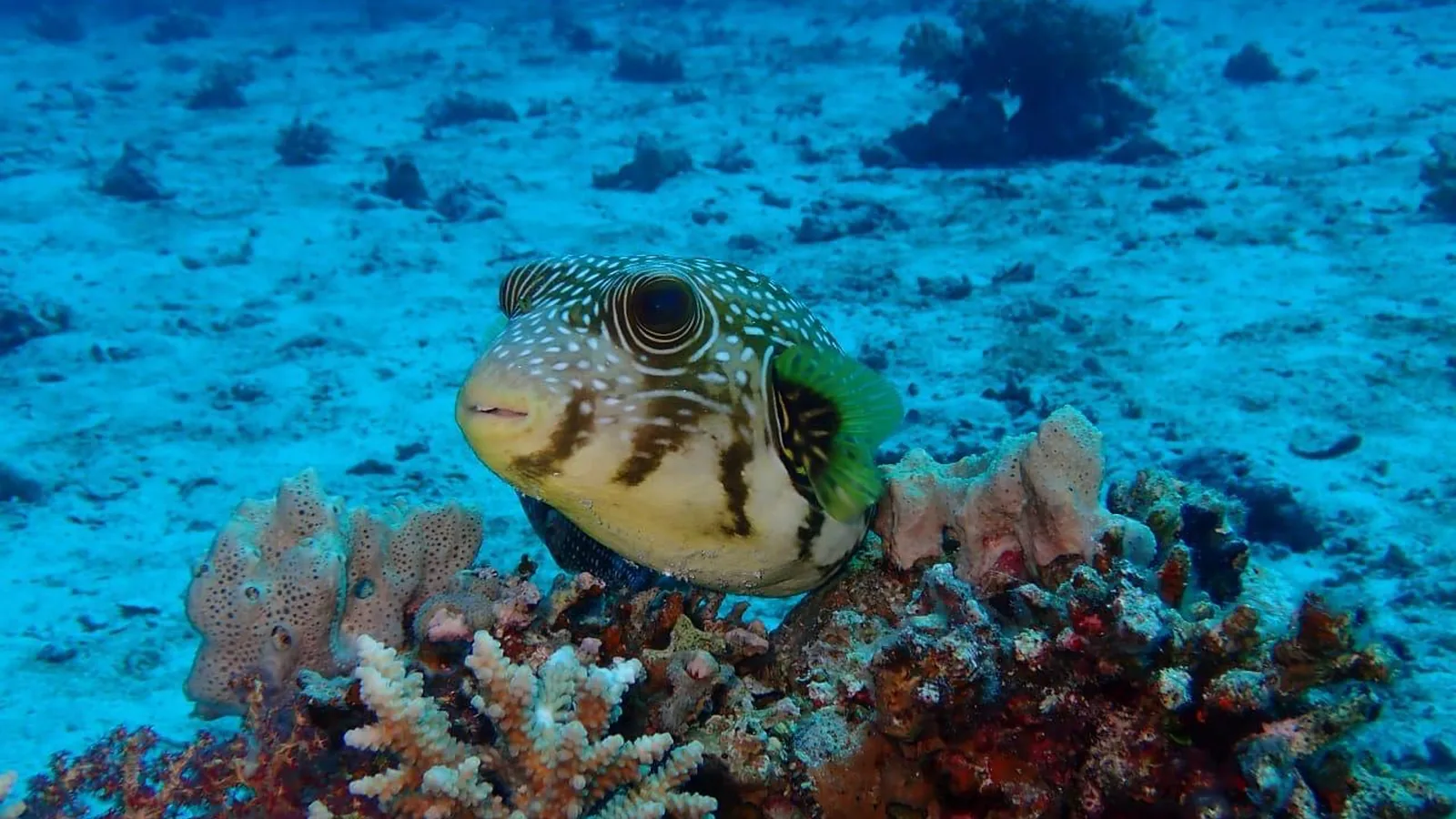
Quick answer What is the masked pufferfish?
The masked pufferfish (Arothron diadematus, described by Eduard Rüppell in 1829) is a medium-sized pufferfish endemic to the Red Sea and its adjacent waters in the Gulf of Aden. It is named for the dark "mask" that crosses its eyes, set against an olive-green to grey body. It reaches about 30 cm, lives on coral reefs from the surface to roughly 20 m, and feeds on hard reef invertebrates using a tough, beak-like set of fused teeth. It is harmless to observe but, like other puffers, is poisonous to eat. The IUCN lists it as Least Concern.
How to identify a masked pufferfish
This is one of the more straightforward Red Sea fishes to name underwater, because the mask does the work:
- The mask: a dark band runs across the eyes — the feature that gives the fish its name. The same dark colouring typically wraps around the bases of the pectoral fins and outlines the mouth, giving the face a distinctly "painted" look. Some divers nickname it the "panda puffer" for the same reason.
- Body colour: olive-green to pale grey overall, usually plain rather than spotted, sometimes with a lighter belly.
- Shape and size: the classic puffer build — a rounded, slightly boxy body, small fins, and a blunt face. Adults grow to about 30 cm.
- Movement: slow and deliberate, sculling with the pectoral and dorsal fins rather than the tail. Puffers are not fast swimmers, which makes them relaxed photographic subjects.
Telling it apart from the white-spotted puffer
The species most likely to cause confusion is the white-spotted puffer (Arothron hispidus), which also occurs in the Red Sea but ranges far more widely across the whole Indo-Pacific. The differences are clear once you know them: the white-spotted puffer is larger (to roughly 50 cm), is covered in pale spots, and shows concentric light-and-dark lines radiating around the eyes and pectoral fins rather than a single solid dark mask. If the fish has a clean dark band across the eyes and a plain greenish body, it is the masked puffer; if it is bigger and peppered with spots and rings, it is the white-spotted puffer.
Where & when to see them
Because the masked pufferfish is a resident, non-migratory reef fish, it is around all year — there is no "season" to time. It favours coral-rich fringing reefs and reef slopes, and is most often seen in the upper part of the water column, from the shallows down to about 20 m. That puts it comfortably within the range of every recreational dive and most snorkelling, so it is a species beginners encounter early.
Resident year-round Shallow reefs, surface–20 m
It is usually solitary, patrolling a stretch of reef on its own, though individuals gather into loose groups during the breeding period. Look for it cruising over hard coral, hovering near overhangs, or working methodically across an encrusted patch of reef. Across the Red Sea it is recorded from Egypt south through Sudan, Eritrea, Saudi Arabia and Yemen, so it is a dependable sight throughout the Egyptian dive regions from Hurghada to the far south.
Behaviour & diet
The masked pufferfish is a hard-prey specialist. Puffers of the genus Arothron have four fused teeth that form a strong, beak-like plate — essentially a built-in nutcracker — which they use to crush and scrape hard, encrusting and shelled organisms: coral, molluscs, crustaceans, sponges and other reef invertebrates. This crushing diet explains the fish's unhurried, deliberate way of moving: it does not need speed to catch its food, so it conserves energy and grazes the reef at a slow pace.
Its slow swimming is possible precisely because it has a powerful defence and does not rely on a fast escape — which leads to the two features every puffer is famous for.
The inflation defence
When a puffer feels threatened it can rapidly swallow water (or air at the surface) into a highly elastic stomach, ballooning into a round, hard-to-bite shape several times its normal size. This is a genuine stress response, not a party trick, and it costs the animal energy and oxygen. A wild puffer should never be chased, cornered or handled to make it inflate — doing so stresses and can harm the fish. A relaxed puffer left alone will simply keep grazing.
Tetrodotoxin — toxic to eat, harmless to watch
The masked pufferfish, like most puffers, contains tetrodotoxin (TTX), one of the most potent natural neurotoxins known — gram for gram, far more toxic than cyanide, and with no antidote. The toxin is produced by bacteria the fish accumulates and is concentrated mainly in the internal organs and skin. Crucially for divers, this is a poison, not a venom: the fish has no sting, no spine and no barb, and it is only dangerous if eaten. A puffer poses no threat whatsoever to a diver who simply observes it from a respectful distance. The practical takeaways are clear — never handle a puffer (the skin carries toxin), and never eat a Red Sea pufferfish, however it is prepared. This is the same reason puffers are not a meaningful local food fish and face little fishing pressure.
Diving & photography etiquette
Masked puffers are appealing subjects — large-eyed, characterful and slow enough to frame easily — which makes good etiquette especially worth stating:
- Do not chase or force inflation. Making a puffer puff up for a photo is stressful and harmful to the animal. A calm, naturally swimming puffer is also a far better picture.
- Keep your distance and let it set the pace. Approach slowly and obliquely; if the fish turns away or stops grazing, you are too close. Hover, don't pursue.
- Never touch. Beyond stressing the fish, the skin carries toxin — another reason the no-touch rule applies, as it does to all reef life.
- Mind your buoyancy. Puffers graze on living coral; a stray fin or knee on the reef does lasting damage. Good trim keeps you and the reef intact.
- For photographers: a head-on or three-quarter angle showcases the mask and the eyes. Slow, steady positioning beats any attempt to "pose" the fish.
Conservation status
The masked pufferfish is assessed as Least Concern on the IUCN Red List (assessment dated 2011). It is common throughout its Red Sea range and is not a significant target for fisheries, in part because its tetrodotoxin makes it toxic to eat. That is reassuring, but it carries a caveat unique to endemics: because the species lives only in the Red Sea and Gulf of Aden, its entire global population depends on the health of this single body of water. Reef degradation, coral bleaching and coastal development are therefore the relevant long-term pressures, and protecting Red Sea reefs protects the masked puffer along with everything else that lives on them.
Related Red Sea reef fish
The masked puffer shares its reefs with other distinctive characters worth learning to recognise:
- Lionfish — a venomous, fan-finned ambush predator and a key species for divers to identify and respect.
- Crocodilefish — a flattened, superbly camouflaged ambush hunter that lies still on the bottom.
- Napoleon wrasse — the giant, curious reef wrasse, another Red Sea favourite.
For the wider picture of what lives on these reefs, browse the full Red Sea Marine Life Encyclopedia, or see what an Egyptian reef day looks like in practice with daily diving from Hurghada.
Frequently asked questions
Effectively, yes. Arothron diadematus is a Red Sea endemic — its range is centred on the Red Sea and extends to the adjacent Gulf of Aden, but it is found essentially nowhere else. That makes it one of the species divers can reliably "tick off" in Egypt. It is closely related to the wide-ranging Indo-Pacific blackspotted puffer (Arothron nigropunctatus), which some authors treat it as a regional form of.
The masked puffer has a clean dark band across the eyes and a plain olive-grey body, and grows to about 30 cm. The white-spotted puffer (Arothron hispidus) is larger (to about 50 cm), is covered in pale spots, and shows concentric light-and-dark lines radiating around the eyes and pectoral fins rather than a solid mask.
No. It has no sting, spine or barb and is not aggressive — it is completely safe to watch. Its tetrodotoxin is a poison only relevant if the fish is eaten. The single firm rule is: never handle it (the skin carries toxin) and never eat a Red Sea puffer.
Never. Inflation is a stress defence that costs the animal energy and can harm it. Chasing or handling a puffer to force it to inflate is poor practice. A calm, naturally swimming puffer also makes a much better photograph.
Hard reef food. Using fused, beak-like teeth, puffers of the genus Arothron crush and scrape coral, molluscs, crustaceans, sponges and other encrusting invertebrates — which is why the masked puffer moves so slowly and deliberately as it grazes the reef.
No — the IUCN lists the masked pufferfish as Least Concern (assessed 2011). It is common across its range and faces little fishing pressure. As a Red Sea endemic, though, its whole population relies on the health of this one sea, so reef protection remains important.