Where to see them
When to see them
Crocodilefish are year-round residents of every Red Sea reef — there is no migration. They are present on the sand all day; the challenge is never the season, it is spotting them.
Year-round resident Daytime sit-and-wait ambusher
Identification
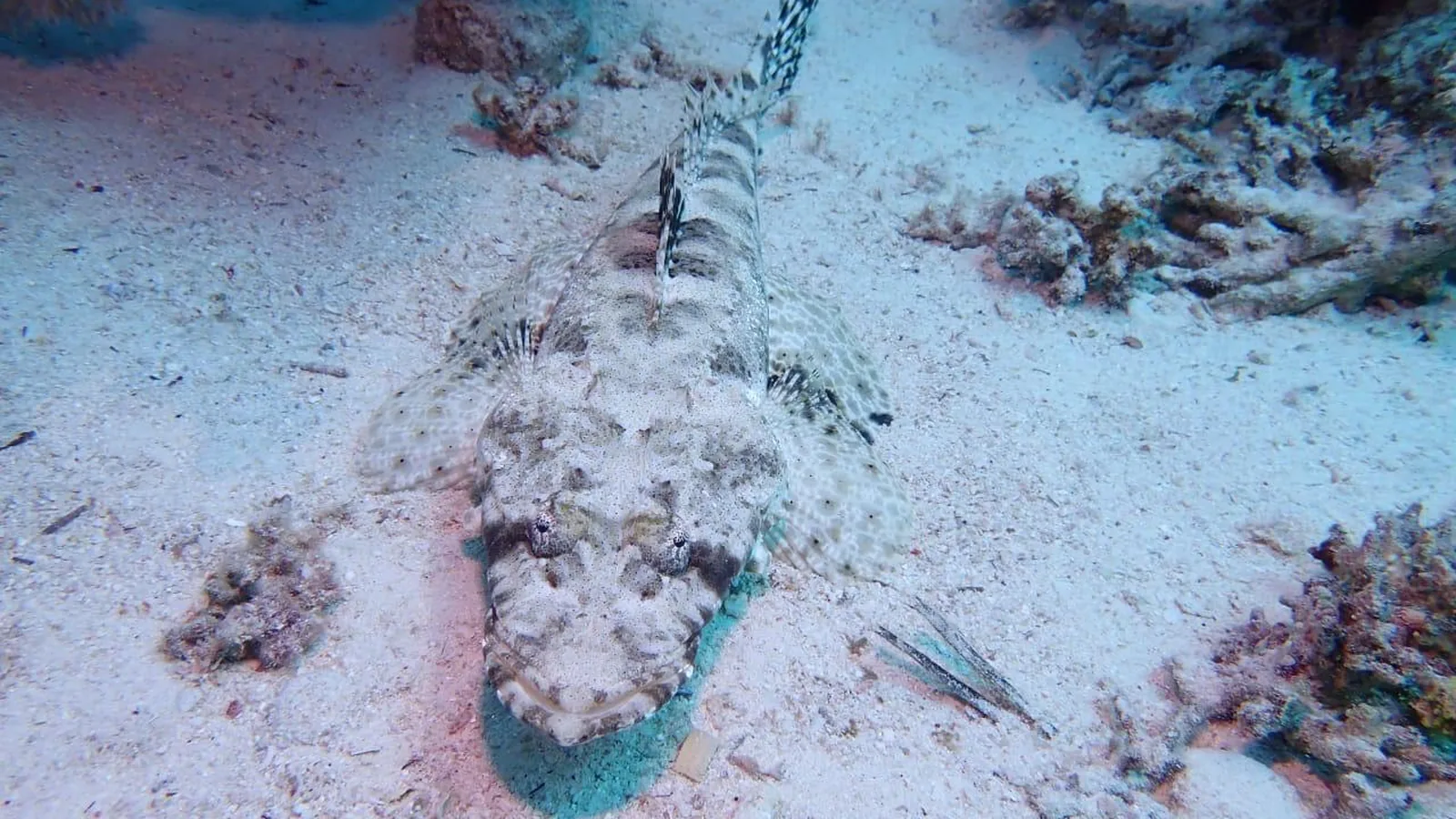
Once you have seen a crocodilefish, you never mistake one for anything else — but the first one is genuinely hard to find, because the whole animal is built to be missed. Key features:
- Body shape: Long, elongate, and strongly flattened from top to bottom (dorsoventrally). The fish lies pressed flat against the bottom rather than standing up off it — quite unlike a normal reef fish.
- The head: Broad, flat, and tapering to a wide snout that genuinely resembles a crocodile's head viewed from above — the source of the common name. The species name longiceps ("long head") describes exactly this.
- The eyes and the lappet: The give-away. Each eye carries a small skin tentacle and, crucially, an ornate iris lappet — a fringed, lace-like flap that hangs over the pupil and breaks up its dark outline. Spotting that fringed eye is usually how a diver first realises they are looking at a fish, not sand.
- Colour: Mottled brown to greenish on top, fading to whitish underneath, with darker blotches and bands — including 3 or 4 dark bands across the tail (caudal) fin. The pattern matches sand and rubble almost perfectly.
- Nuchal spines: Around 5 small spines on the nape behind the head (a flathead-family trait), and roughly 9 dorsal fin spines followed by soft rays. These are not a stinging hazard to divers but reinforce that this is a member of the scorpionfish-related flathead group.
- Size: Typically around 50 cm; the largest individuals reach a maximum of about 70 cm. Most Red Sea sightings are 40–60 cm.
There is no dramatic colour change with age — juveniles look like small versions of adults. The single most useful identification tip on a dive is to stop looking for a "fish shape" and start looking for a straight-edged shadow on the sand and a fringed eye.
Camouflage and ambush behaviour
The crocodilefish is a textbook sit-and-wait ambush predator. Almost everything about it is an adaptation to being invisible on an open seabed and then striking faster than the eye can follow.
- Lie-in-wait hunting: The fish settles motionless on sand, rubble or rock, often partly nestled into the substrate, and simply waits. When a small fish or crustacean strays within range, it engulfs the prey with a sudden lunge of its wide mouth.
- Disruptive eye camouflage: The iris lappet is the most sophisticated part of the disguise. A dark, round eye is one of the few cues that betrays a hidden animal; the fringed lappet shatters that outline so the eye reads as just more mottled texture.
- Pattern matching: The mottled brown-green body, pale belly and broken banding let the fish dissolve into sand-and-rubble backgrounds. It does not actively change colour like an octopus, but its base pattern is a close match for the habitats it chooses.
- Confidence in disguise: Crocodilefish rely so completely on camouflage that they rarely flee. They will hold position while a diver approaches closely — they are "used to hiding in plain sight," and that stillness is the behaviour, not tameness.
This is the same broad survival strategy used by lionfish, scorpionfish and stonefish, but the crocodilefish's stretched-out, flat-on-the-sand body plan and fringed eyes make it unique among them. (For the venomous end of that spectrum, see our lionfish species guide.)
Habitat and range
Crocodilefish are bottom-dwelling (demersal), reef-associated, and non-migratory. They are found near coral reefs rather than on them — on the open sand, coral rubble and rocky patches that surround and separate reef structure, and sometimes in seagrass.
Depth: They favour shallow water. FishBase and the IUCN give a typical depth range of 1 to 15 metres; some sources report occasional individuals deeper. For divers, this means crocodilefish are very much a shallow-to-mid reef encounter — exactly the depths where most recreational diving and snorkelling happen.
Distribution: The species ranges across the western Indian Ocean — from the northern Red Sea and the Gulf of Aqaba south to South Africa (KwaZulu-Natal) and across to Madagascar and the Seychelles. Notably, it is also a Lessepsian migrant: since the late 1980s it has spread through the Suez Canal into the eastern Mediterranean, one of many Red Sea species now establishing there.
Why it's the "Indian Ocean crocodilefish": The name distinguishes Papilloculiceps longiceps from the similar-looking Pacific crocodilefish (Cymbacephalus beauforti) of the wider Indo-Pacific. In the Red Sea, the crocodilefish you see is reliably Papilloculiceps longiceps — the sole member of its genus.
Diet and biology
Diet: Crocodilefish are carnivorous ambush predators. Their diet is dominated by small fishes and crustaceans, with shrimps, worms and other small bottom-dwelling invertebrates also taken. FishBase places them at a high trophic level (~4.0), confirming a primarily fish-eating (piscivorous) lifestyle. They are opportunists — anything small enough that wanders within striking range of that wide mouth is fair game.
Reproduction: Like many flatheads, the crocodilefish is reported to be a protandrous hermaphrodite — individuals can begin life as males and later change to female. Eggs and larvae are pelagic (drifting in open water) before young settle to the bottom. Detailed life-history data for the species in the wild remains limited.
Lifespan and growth: Precise wild lifespan figures are not well documented for this species. As a relatively large, slow-moving benthic predator it is assessed as having moderate-to-high vulnerability to fishing pressure where it is targeted, though it is mainly of interest to subsistence rather than commercial fisheries.
How to spot — and photograph — a crocodilefish
Because the season is irrelevant and the fish is present year-round, the entire game with crocodilefish is detection. A few field-tested tips:
- Search the sand, not the reef. Crocodilefish are on the open bottom. Slow your pace over flat sandy and rubble areas, especially at the edges of the reef and around coral heads, instead of scanning the wall.
- Look for the wrong shape. Train your eye for a long, straight-edged "log" or an unexpectedly crocodile-shaped head outline on the sand — the body breaks the natural ripple pattern even when the colour matches.
- Find the eye. The fringed iris lappet is the most reliable tell. Once you spot one fringed eye, the whole fish resolves around it.
- Approach low and slow. They tolerate a close, calm approach — but a fast, looming silhouette can still spook one off the sand. Move deliberately and keep your fins up off the bottom.
- Photography: The fish's confidence makes it a gift. A side-on or slightly-above angle shows the full crocodile profile; a macro frame of the fringed eye is the signature crocodilefish shot. Use a low position and watch your buoyancy so you never have to brace a hand on the sand. Avoid repeated strobe blasts at very close range and never reposition the fish for a photo.
Many divers see their first crocodilefish only when a guide points one out — they will swim straight over a dozen before their eye is calibrated. Once it is, you start finding them on most sandy dives.
Related and confused species in the Red Sea
The crocodilefish is one of several camouflaged, bottom-hugging ambush fish in the Red Sea. Knowing the differences helps both with identification and with safety:
- Stonefish (Synanceia verrucosa) — compact, lumpy, and the most venomous fish on Earth. Unlike the long, flat crocodilefish, the stonefish looks like an encrusted rock. Its sting is a genuine medical emergency. Never confuse "harmless flathead" with "rock that might be a stonefish."
- Devil scorpionfish (Scorpaenopsis diabolus) — a heavily camouflaged, venomous ambush predator, chunkier than the crocodilefish and usually perched among coral rubble rather than stretched out on open sand.
- Lionfish (Pterois miles) — the showy, venomous cousin in the wider scorpionfish group; the opposite camouflage strategy (warning display rather than concealment). See the lionfish guide.
- Giant moray (Gymnothorax javanicus) — not a flathead, but another reef ambusher divers meet on the same sites; it lives in the reef rather than on the sand. See the moray eel guide.
The unifying rule for every one of these fish is identical: look, photograph, and never put a hand or knee on a surface without confirming nothing is on it.
Diver etiquette and tips
For divers encountering crocodilefish in the Red Sea:
- Never touch the fish. It is harmless, but touching stresses it, can damage its protective slime coat, and sets a bad precedent for the diver behind you.
- Keep your buoyancy off the bottom. The single biggest harm divers do on sandy sites is settling, kneeling or finning into the substrate — which damages habitat and can disturb hidden crocodilefish, stonefish and rays. Stay neutrally buoyant and trimmed flat.
- Give it space to stay put. The whole point of a crocodilefish encounter is that the fish does not flee. Approach slowly and let it hold position; a spooked fish bolting off the sand is a missed photo for everyone.
- Don't excavate or "stage" it. Never fan sand off a fish or move it for a better shot. Photograph it exactly as you find it.
- Mind your hands near the bottom. Even though the crocodilefish itself is not a sting risk, the same sand may hold stonefish or rays. Looking before you touch is a habit that protects you from the genuinely dangerous neighbours.
- Point it out — gently. Crocodilefish are a brilliant "find" to share with a buddy. Signal, don't grab; let everyone enjoy the same calm encounter.
For more on Red Sea marine life and trip planning, see our Shark Diving in the Red Sea hub guide and the full Marine Life Encyclopedia.
Conservation
The crocodilefish is classified as Least Concern on the IUCN Red List (assessed 2017). It is widespread across the western Indian Ocean and the Red Sea, populations are not known to be declining significantly, and it is not a major target of commercial fishing.
The realistic long-term pressure on the species is habitat rather than direct exploitation: crocodilefish depend on healthy sand, rubble and seagrass beds adjacent to living reef. Protecting Red Sea reef and seagrass habitat — and diving it responsibly, with good buoyancy and no contact — is the most useful thing visitors can do for this and every other bottom-dwelling species.
Frequently asked questions
Because of its head. Viewed from above, the broad, flat, tapering head with its wide mouth and protruding eyes genuinely resembles a crocodile's. The scientific species name longiceps means "long head," describing the same feature. It has nothing to do with reptiles — it is a bony fish in the flathead family.
It is an iris lappet — a lace-like flap of tissue that hangs over the pupil. Its purpose is camouflage: it breaks up the dark, round outline of the eye, which is one of the few features that would otherwise reveal a motionless, well-hidden ambush predator. It is also the diver's best clue for finding the fish in the first place.
No. Crocodilefish are harmless to humans and never aggressive — they hold still and let you approach. They do have small dorsal and nape spines (a flathead-family trait), so the universal rule applies: don't touch and don't settle on the bottom. There is no need to fear them; just respect them.
Shape and posture. The crocodilefish is long, flat and stretched out along the sand with an obvious crocodile-like head and fringed eyes. The stonefish (Synanceia verrucosa) is short, lumpy and rock-like, usually wedged among coral rubble — and it is highly venomous. If you are unsure what a camouflaged lump is, the safe assumption is always "don't touch it."
Shallow — typically 1 to 15 metres according to FishBase and the IUCN, with occasional individuals reported deeper. That puts them squarely in normal recreational diving and even snorkelling range, on the sand and rubble beside the reef.
Small fish and crustaceans, plus shrimps, worms and other bottom-dwelling invertebrates. They are sit-and-wait ambush predators: they lie motionless and engulf prey that strays within range of their wide mouth, rather than chasing it down.
Yes — because they favour shallow sand and rubble from about 1 metre down, attentive snorkellers in calm, clear lagoons can find them. The catch is the same as for divers: they are extremely well camouflaged, so you have to scan the sand patiently and look for the fringed eye or the long, straight body outline.