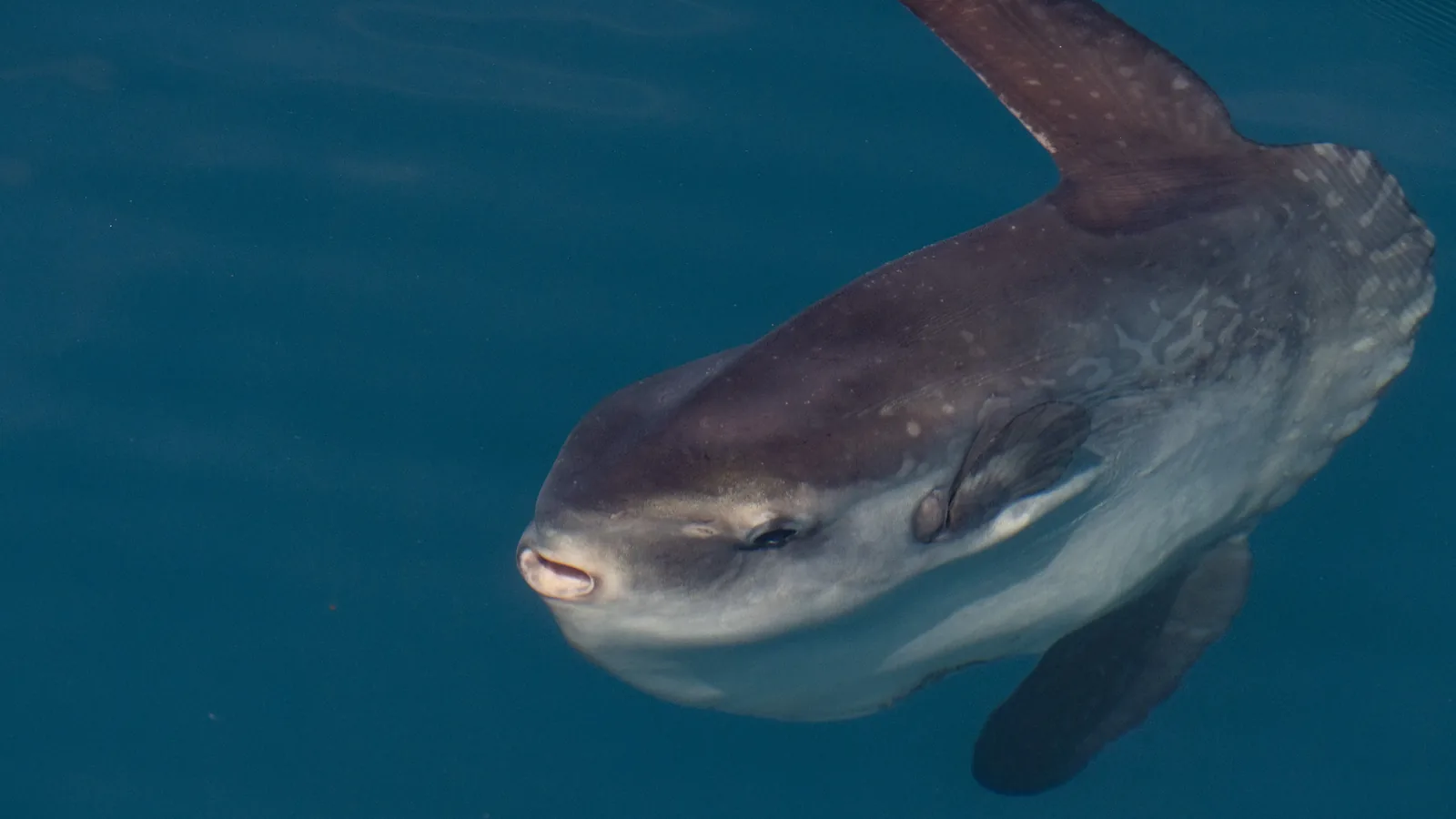
How to recognise a mola mola
There is no mistaking an ocean sunfish once it drifts into view. A few defining features:
- Body shape: Tall, flattened from side to side, and abruptly truncated at the rear — like a huge fish head with the back half cut away. This unusual outline is instantly recognisable.
- No true tail: The caudal fin never develops normally. Instead of a tail the mola has a rounded, frilly rudder called a clavus, which it uses to steer while the fins do the propelling.
- Fins: A single tall dorsal fin and a matching anal fin, which it beats in an alternating sculling motion. From dorsal tip to anal tip a large sunfish can span roughly 2.5 to 3 m.
- Skin and colour: Rough, silvery-grey skin, often with a mottled pattern. It can lighten or darken its tone, so shade varies between individuals.
- Size: Commonly around 1.8 m long and 250 to 1,000 kg; large fish reach about 3 m and exceptionally exceed 2,000 kg, making it one of the heaviest bony fish alive.
Behaviour and the surface basking
The behaviour that gives the ocean sunfish its name is its habit of basking at the surface, frequently lying flat on one side as if sunbathing. This is not distress. The mola is a deep, cold-water forager that descends hundreds of metres to feed, and lying at the warm surface is thought to help it rewarm afterwards. Basking also serves a second purpose: with its flank exposed, seabirds pick parasites from its skin, complementing the cleaning it receives at depth, where reef fish and wrasses tend to it at cleaning stations.
As a swimmer the mola is famously feeble — it drifts on the current and sculls slowly with its fins rather than powering along — yet it is capable of the odd surprising breach. For divers, this makes for a gentle, unhurried encounter: a sunfish rarely rushes off unless startled, and will often hang almost motionless while it is being cleaned.
Diet
The ocean sunfish feeds mainly on gelatinous zooplankton — jellyfish, salps, siphonophores and comb jellies. Long assumed to be a jellyfish specialist, it is now known from DNA diet studies to eat a broader menu that also includes small fish, squid, crustaceans and other zooplankton. It takes this soft prey with a small, beak-like mouth. There is nothing about the mola's feeding that concerns a diver: it has no interest in, and no equipment for, biting anything larger than a jelly.
Where and when you might see one in the Red Sea
Be honest with expectations: in the Egyptian Red Sea the mola mola is a rare, unpredictable visitor, not a resident. It is not a fish anyone can promise on a dive. That said, encounters do happen, and the documented records give a sense of where a lucky diver might cross paths with one.
As for season, there is no reliable window to plan around. Encounters are opportunistic and down to luck on any dive of the year. Cooler water that brings more jellyfish into an area may nudge the odds slightly upward, but a sunfish sighting is best treated as a chance gift rather than something a calendar month can deliver.
Rare, unpredictable visitor Opportunistic sightings only
Diving with a sunfish — etiquette
An ocean sunfish is completely harmless, but it is shy and sensitive, and the difference between a long, memorable encounter and a fleeting glimpse comes down to how the diver behaves:
- Approach slowly and low. Keep a calm, unhurried profile and stay beneath the fish rather than looming over it. Let the sunfish decide how close it is comfortable being.
- Never chase or crowd it. Pursuing a mola, or several divers pressing in at once, will end the moment fast. Give it room and let it set the pace.
- Mind your bubbles. Sudden movements and a burst of exhaled bubbles startle sunfish easily and send them diving back into deep water. Move deliberately and breathe smoothly.
- Let a cleaning station do its work. A mola hanging quietly to be cleaned is at its most approachable — hover at a respectful distance and enjoy the show without interrupting the reef fish tending to it.
A record-breaking breeder
For all its vulnerability, the ocean sunfish is among the most fecund of all vertebrates. A single large female may carry hundreds of millions of eggs at once — a staggering figure unmatched by almost any other animal. The species also grows remarkably fast: one captive individual is recorded to have gained roughly 0.82 kg a day. That enormous reproductive output, however, does not shield the mola from the pressures it faces at sea.
Conservation status
The ocean sunfish is listed as Vulnerable on the IUCN Red List, with a declining population trend. The principal threat is bycatch: sunfish are caught unintentionally in fishing nets and on longlines set for other species, and mortality from this incidental capture is significant across much of the mola's range. Its huge egg output is not enough to offset those losses, which is why a fish so widespread and prolific nonetheless carries a threatened status. Encountering one on a dive is a reminder of how much of the open ocean's giant, gentle life passes by unseen — and how much of it is under quiet pressure.
Related Red Sea giants
Divers captivated by the ocean sunfish's scale and strangeness often want to read about the Red Sea's other large, charismatic species:
- Manta ray — another vast, gentle plankton feeder that glides through open water and visits cleaning stations.
- Whale shark — the largest fish of all, a filter feeder that, like the mola, is an unpredictable open-water encounter.
- Green turtle — a placid reef resident, easier to find than a sunfish and equally beloved by divers.
For the region's apex predators, see the guides to the oceanic whitetip shark and the scalloped hammerhead, and for another giant of the blue, the manta ray. To browse the full encyclopedia, visit the Red Sea marine life guides.
Frequently asked questions
Yes, but it is rare and unpredictable — the ocean sunfish is an occasional visitor to Egyptian waters, not a resident. Encounters have been documented off Marsa Alam near Elphinstone, on liveaboards, and in the Gulf of Aqaba at Abu Galum. The footage on this page is a lucky Hurghada sighting around Giftun Island. Divers most often see one basking at the surface or hanging at a cleaning station.
It is one of the heaviest bony fish in the world. Commonly around 1.8 m long and 250 to 1,000 kg, large individuals reach about 3 m and can exceed 2,000 kg. Fin tip to fin tip, a big mola spans roughly 2.5 to 3 m. The related bump-head sunfish (Mola alexandrini) holds the absolute weight record.
That basking is where the name sunfish comes from. The mola is a deep, cold-water forager, and lying flat at the warm surface is thought to help it rewarm after cold dives. It also lets seabirds pick parasites from the exposed skin, alongside the cleaning that reef fish provide at depth. A sunfish on its side at the surface is behaving normally, not in trouble.
Mainly gelatinous zooplankton — jellyfish, salps, siphonophores and comb jellies. DNA diet studies show the menu is broader, also including small fish, squid and crustaceans. It has a small, beak-like mouth for soft prey and poses no threat to divers.
Not at all. It is a slow, gentle drifter with a tiny mouth built for jellyfish. The only care needed is on the diver's side — sunfish are shy and easily startled, so approach slowly and low, never chase or crowd it, and let it set the pace. Sudden moves or bubbles send it back to deep water.
There is no reliable season. Because the mola is only an occasional visitor, sightings are opportunistic and down to luck on any dive of the year. Cooler water that brings more jellyfish may make an encounter marginally more likely, but seeing one is a chance event rather than something a calendar can promise.