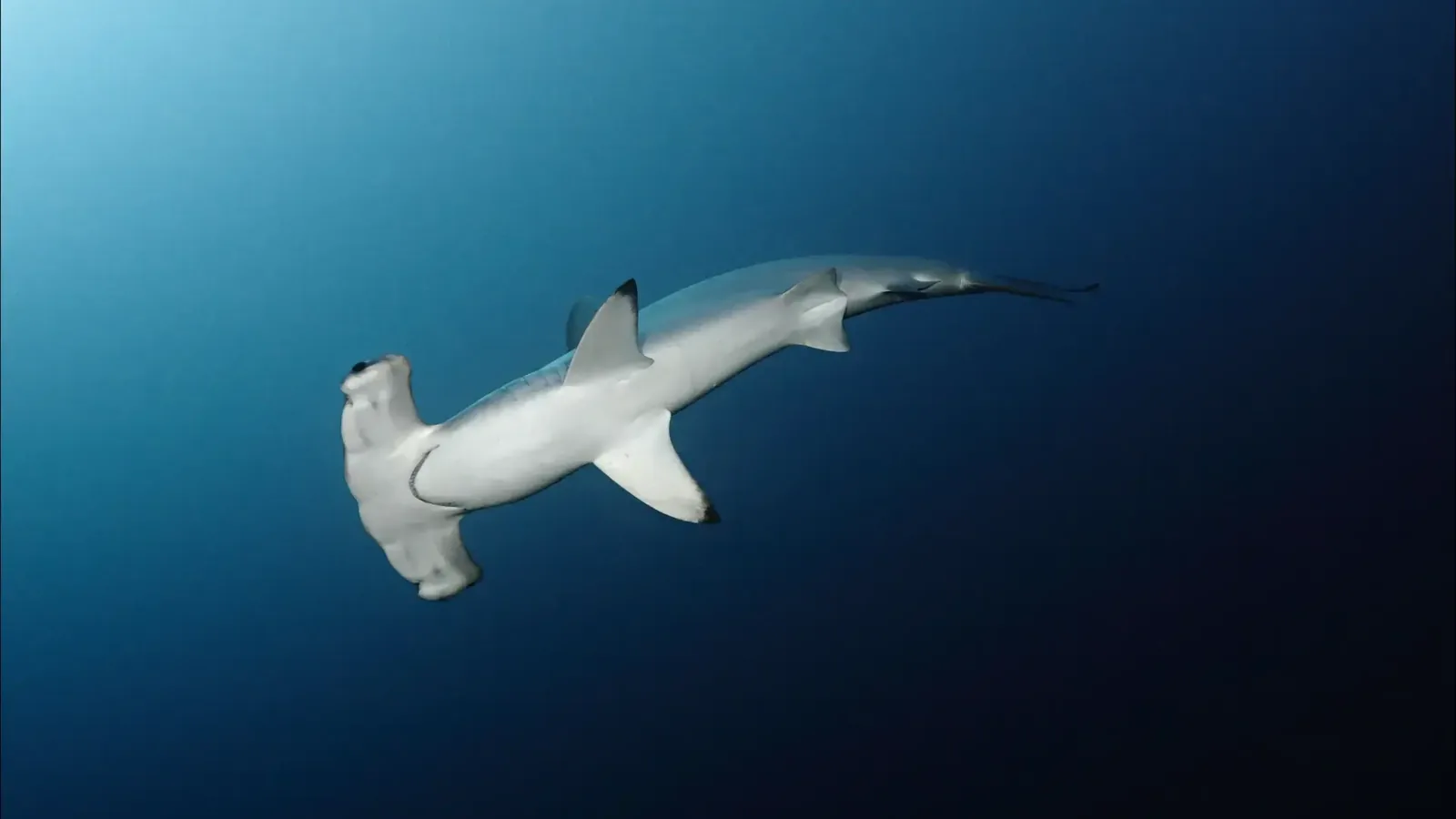
Where to see hammerheads in the Red Sea
Hammerhead encounters in the Red Sea are concentrated at a small number of specific sites where geography forces nutrient-rich currents upward against deep walls and exposed pinnacles. These are the four sites that matter:
When to see them
The Red Sea hammerhead window varies between north and south. At Jackson Reef in Tiran (northern Red Sea), aggregations are most reliably observed from August through September, with extension into early October. July is typically the start of the season and June can produce occasional sightings. At the offshore central Red Sea sites — the Brothers, Daedalus, Elphinstone — the season runs earlier, peaking from May through July.
Jackson Reef (northern Red Sea) seasonality. Central Red Sea sites — Brothers, Daedalus, Elphinstone — peak May–July.
Within the peak window, three factors influence sighting odds at Jackson:
- Sea conditions: Jackson sits in an exposed position at the northern entrance to the Straits of Tiran. The "back of Jackson" dive — where the hammerheads are — is the unsheltered side, fully exposed to swell and current. When the wind is up, the dive simply does not run. This is the single biggest factor in whether you encounter hammerheads on a given week.
- Time of day: Both early-morning and afternoon dives produce sightings. Local guides report consistent late-afternoon (around 15:00) encounters in addition to the more commonly-promoted dawn timing. Mid-day mid-water visibility is usually fine — the bigger constraint is competition from other operators arriving at the mooring.
- Current direction: A flowing current along the reef wall draws the schools closer to the visible plateau edge. Slack water often means hammerheads stay farther out in the blue, beyond useful sighting range.
For wider Red Sea seasonality, see our month-by-month dive calendar.
How to identify a scalloped hammerhead
Three hammerhead species have been recorded in the Red Sea, but only one schools and appears reliably: the scalloped hammerhead (Sphyrna lewini). The defining feature is in the name — the front edge of the "hammer" (technically the cephalofoil) has three distinct notches on each side, giving it a scalloped appearance.
| Scalloped (likely) | Great (very rare) | Smooth (extremely rare) | |
|---|---|---|---|
| Scientific | S. lewini | S. mokarran | S. zygaena |
| Front of hammer | Scalloped — 3 notches | Almost flat with central notch | Smooth, no notches |
| Size | 3–4 m typical | 4–6 m | 2.5–3.5 m |
| Schools? | Yes — main reason for fame | Solitary | Small groups |
| First dorsal fin | Tall, falcate, rear-curved | Very tall, almost vertical | Moderate height |
If you saw a school, you saw scalloped. Solitary hammerheads can be either — close photo identification of the head shape settles it.
Behaviour and what to expect
Scalloped hammerheads in the Red Sea are shy of divers. This is the defining behavioural fact that drives every encounter strategy. They will:
- Turn away if you face them head-on or swim toward them.
- Spook from exhaled bubbles rising directly toward them — they associate the sound with predators.
- Stay between 25 and 45 metres during daylight, rarely coming shallower.
- Form loose schools of 5 to 30 individuals at Jackson Reef during peak season — almost all female adults. Larger schools (50+) historically reported at Brothers and Daedalus in the central Red Sea.
- Hunt at dusk and night in open water, returning to the reef edges at dawn.
Biology & ecology
Understanding a few key biological facts makes Jackson Reef hammerhead encounters more meaningful — and explains why the Red Sea aggregation matters globally.
The cephalofoil — why the hammer shape
The hammerhead's distinctive "hammer" is properly called the cephalofoil. It is not decorative — it is a sophisticated sensory and hydrodynamic structure. Spread across this widened head are an enhanced array of electroreceptors (the ampullae of Lorenzini) which detect the weak electrical fields of buried prey, broadly spaced eyes giving wider binocular vision than any other shark, and a hydrodynamic foil that acts like an aircraft wing — improving manoeuvrability and reducing drag when turning. Researchers have shown that the wide "eye-bulb" tips of the cephalofoil function similarly to aircraft winglets.
Diet
Scalloped hammerheads are generalist piscivores. The diet across global populations includes bony fish (sardines, mackerel, smaller reef fish), cephalopods (squid and octopus — often the dominant component), stingrays (which the cephalofoil is particularly suited to detect and pin), crustaceans, and occasionally smaller sharks. They hunt mostly at dusk and during the night in open water; the day-time schooling at sites like Jackson Reef is restful behaviour, not hunting.
Reproduction and lifespan
Scalloped hammerheads are viviparous — they give birth to live young, with a placental connection during the 10–11 month gestation. Litters of 16–22 pups, each 42–55 cm at birth. Maturity is slow: males at around 10 years, females at 15. They live 20–35 years. This slow life history is precisely why fishing pressure has been so devastating — populations cannot replace themselves at the rate they are being killed.
Movement and migration
Scalloped hammerheads are highly migratory. Satellite tagging of individuals from the Galapagos has tracked single sharks travelling nearly 6,000 km in seven months. The Red Sea population's movements are less well-studied, but the seasonal aggregations at Jackson and the southern Red Sea sites suggest similar movement patterns — they arrive, school, then disperse to deeper or further waters. The Jackson aggregations are predominantly adult females, which is itself unusual and interesting to researchers — the function may be related to thermoregulation, parasite cleaning, or reproductive readiness.
Diving Jackson Reef for hammerheads — practical guide
Jackson Reef is the northernmost of the four Tiran pinnacles, sitting in the northern entrance of the Strait of Tiran. The hammerhead dive happens at the back (north) side of the reef, in open blue water rather than along a coral plateau. The remains of the Cypriot freighter Lara, which ran aground in November 1982 and was largely salvaged for scrap in the mid-1990s, sit at the very top of the reef and are partly visible above the waterline — a useful surface landmark when you arrive. The salvaged hull dropped into deep water (45 m+) below, in the domain of technical divers only.
- Sea-condition check: The captain assesses sea state at the mooring. If swell or wind is significant, the back-of-Jackson dive is replaced with a more sheltered alternative — usually a drift along the south or west walls. Do not be disappointed if the dive moves; trying to dive Jackson in bad weather is how people get hurt.
- Boat travel time: 45–60 minutes from Sharm El Sheikh marinas (Travco or Naama Bay area, depending on operator).
- Negative entry from the boat: Drop in close to the moorings on the north-east corner. Descend immediately — no surface swim. The dive plan typically targets 25–35 m depending on conditions, with maximum 40 m for properly trained AOWD+ divers.
- Position out into the blue: Hammerheads at Jackson are not on the reef plateau — they cruise in open water roughly 30–50 m off the reef wall at 25–40 m depth. Hover horizontally facing out into the blue, with the wall as your reference point. Stay neutrally buoyant. Group tight.
- Patience and stillness: The first 15–20 minutes are the highest-probability window. Schools tend to pass through in waves rather than continuously, and a passing school may appear and disappear within 60 seconds. Minimise bubbles, move slowly. Hammerheads spook from rising bubbles directly beneath them — they associate the sound with predators.
- Ascent profile: When your no-deco limit approaches, drift along the wall toward the south of the reef. Beyond a security line marker between 16 m and 27 m, current can pick up suddenly and pull divers into the open water — stay attentive on the way back. Finish the dive on Jackson's stunning shallow coral garden, which has its own reputation as Tiran's prettiest reef top.
- Surface and reposition: Most trips run two dives at Tiran; the second dive after a full surface interval is typically a sheltered drift along a different Tiran reef (often Gordon, Thomas or Woodhouse) rather than another hammerhead-targeted blue-water dive.
Skill level required
This is not a beginner dive. Honest minimum requirements:
- AOWD certification — mandatory for 30 m + depths.
- Deep speciality recommended — and you'll use what you learned: gas management at depth, decompression awareness, narcosis tolerance.
- Nitrox (EAN32 or EAN36) highly advised — extends bottom time by 25–40% at 30 m, which is the difference between a 12-minute hammerhead window and a 20-minute one. Aquarius offers Nitrox courses at all bases.
- Strong buoyancy — non-negotiable. Hammerheads spook from divers who can't hold a static position.
- Recent diving experience — if your last dive was three years ago, do a refresher day on Sharm's Ras Ghamila house reef before Jackson.
For divers who don't yet meet these standards, the right pathway is to come to Sharm a few days early, complete AOWD plus Nitrox via the Sharm continuing-education page, then book Jackson on day five or six. Our PADI pathway guide walks through every certification level.
Conservation
Scalloped hammerheads were declared Critically Endangered by the IUCN in 2019 after global populations fell by an estimated 80% over three generations (72.3 years for this species). The species is heavily targeted for the shark-fin trade, both directly by industrial longlining and as bycatch from tuna fisheries. Egypt's marine parks and the absence of commercial pelagic longlining in Egyptian waters make the Red Sea one of the last reliable places on Earth to see them in aggregation.
Jackson Reef itself was designated an Important Shark and Ray Area (ISRA) in 2023 based on multi-year citizen-science data from divers — the recreational diving community is literally part of the conservation evidence base. Between January 2021 and August 2023, divers logged 28 separate scalloped-hammerhead sighting instances at Jackson, of which 68% were group aggregations and three were schools of 15+ individuals.
What divers can do
- Choose operators that enforce no-feed, no-touch protocols — the dive economy that protects them is built on respectful interactions, not staged ones. Aquarius enforces strict no-feed and no-chase rules on every Tiran trip.
- Log and report sightings. Apps like eOceans and Divelogger feed citizen-science databases. Photos with GPS-tagged dates strengthen the scientific case for continued protected-area status.
- Report to HEPCA — the Hurghada Environmental Protection and Conservation Association maintains a Red Sea marine species database for the Egyptian Red Sea.
- Don't buy shark products — fins, teeth, jaws — anywhere. The supply chains converge globally. Egyptian souvenir markets occasionally sell shark teeth: avoid.
- Stay calm in the water. Spooked hammerheads have associated divers with threat. Every group that holds position and lets the sharks pass adds positive evidence that recreational diving doesn't disturb them.
- Spread the word that they are not dangerous to divers — irrational fear undermines conservation. Hammerheads being shy of divers is the entire reason this article exists.
- Support PADI AWARE shark conservation — your dive operator can run the AWARE Shark Conservation specialty course alongside any Tiran dive package.
Photographing hammerheads — quick guide
If you're bringing a camera, here is the gear and approach reality from running this dive year after year:
- Lens choice: Wide-angle (10–17 mm rectilinear or 8–15 mm fisheye on full-frame; equivalent on crop). The sharks are at 30–50 m distance through hazy water — telephoto and zoom don't help; you need light-gathering width.
- Strobes: Off, or aimed wide and dialled down. Strobes flash close-up are useless at this distance — turn them off entirely, or use a very wide spread for the near-foreground reef edge only.
- ISO & aperture: Push ISO higher than you would for reef work (ISO 800–3200 on a modern sensor). Water column at 30 m absorbs light heavily. Open aperture (f/4–f/5.6).
- Shooting position: Be already in position when the sharks appear. There is no "wait for them then frame" — they're gone in 30 seconds. Pre-set, hover, fire.
- Forget the perfect shot: Even professional shooters return from successful Jackson dives with mostly blurry, distant frames. The dive is the experience; one keeper image is a great day.
For general gear care after a salty Tiran trip, see our scuba gear salt-water care guide.
Related Red Sea sharks
If hammerheads are on your list, these other shark guides probably are too:
- Shark Diving in the Red Sea — Where and When — the complete hub guide covering every shark species and site.
- Oceanic Whitetip Shark — autumn pelagic at Elphinstone and the Brothers.
- Reef Sharks of the Red Sea — whitetip, blacktip and grey reef sharks you'll see on almost any dive.
- Whale Shark — Complete Red Sea Guide — summer plankton-feeders, gentle giants.
Frequently asked questions
At Jackson Reef in Tiran (day boats from Sharm), hammerhead aggregations are most reliably observed August–September, extending into early October. July marks the start of the season. At the offshore liveaboard sites further south — the Brothers, Daedalus, Elphinstone — the season is earlier, peaking May–July. Sea conditions are the biggest single factor in whether the back-of-Jackson dive runs on a given day.
The most accessible site is Jackson Reef in the Straits of Tiran, 45–60 minutes by day boat from Sharm El Sheikh. Liveaboard sites include Big Brother and Small Brother islands, Daedalus Reef, and Elphinstone. All require Advanced Open Water certification because the sharks are typically encountered in open water at 25 to 40 metres.
No. Scalloped hammerheads are shy of divers — they actively swim away if directly approached. There has never been a recorded fatal scuba incident involving a hammerhead in the Red Sea. The technique is to descend deep at the back of the reef, stay still in mid-water facing the blue, and let the sharks pass.
Sightings are never guaranteed. At Jackson Reef in peak season (August–September), sighting probability is approximately 30–50% on a single dive when sea conditions allow the dive to run, rising to 70–80% across a week of attempts. At the Brothers/Daedalus on a peak-season liveaboard week (May–July): roughly 70–85%. Calm seas, current direction and competition from other dive groups all influence the odds.
You will encounter the scalloped hammerhead (Sphyrna lewini), identified by the three notches on each side of the front edge of the "hammer". Great hammerheads (S. mokarran) and smooth hammerheads (S. zygaena) have been recorded but are extremely rare. Scalloped is the species that forms the schools at Jackson Reef — designated an Important Shark and Ray Area (ISRA) as the northernmost confirmed aggregation site for the species in the Red Sea.
Scientific reference: Wikipedia — Scalloped Hammerhead