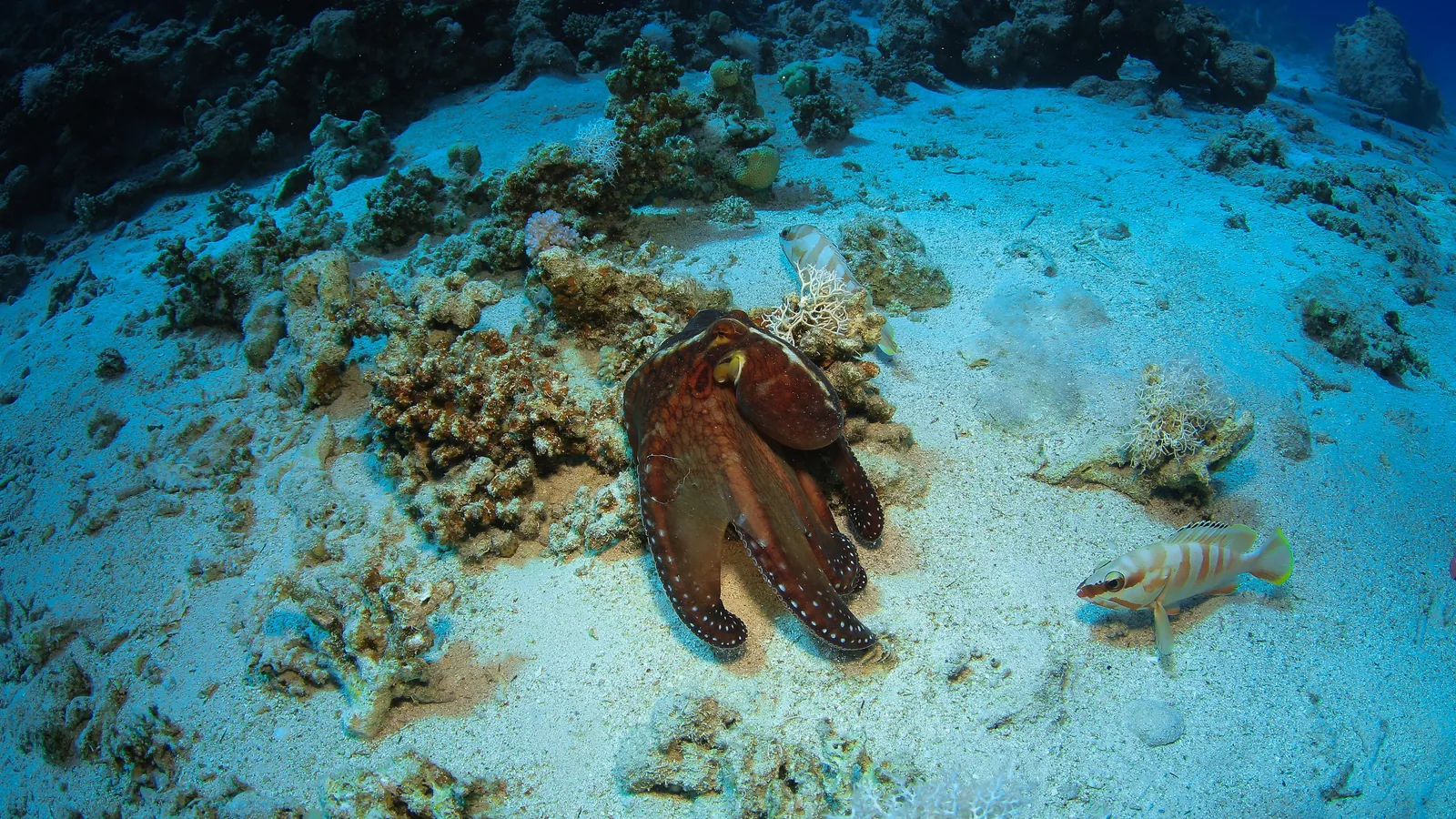
Identifying a reef octopus
An octopus is unmistakable once you see past its disguise: a soft, boneless body, eight arms lined with suckers, large expressive eyes, and a parrot-like beak hidden at the centre of the arms. There is no internal or external shell — the only hard part is that beak — which is why an octopus can pour its entire body through a gap barely wider than its eye.
Telling the two common Red Sea species apart comes down to colour, behaviour and time of day:
- Big blue / day octopus (Octopus cyanea): The reef's daytime octopus. Its mantle reaches roughly 16 cm and its arms grow to about 80 cm or more, giving a full span close to a metre. Colour is endlessly variable — mottled browns, rusts and blues that shift to match coral and sand. Look for it moving openly over the reef in the morning or late afternoon.
- White-spotted / night octopus (Callistoctopus macropus): The reef's after-dark octopus. When active or alarmed it flushes a deep reddish-brown peppered with bright white spots, with a notably long first pair of arms. It hunts among coral branches at night and shelters in sand, rubble or rock by day.
In the field, the simplest clue is often the company it keeps and the mess it leaves. A neat midden of cracked crab and shell fragments outside a hole is a reliable sign of an octopus den.
The astonishing camouflage
Octopus are perhaps the finest camouflage artists in the sea, and the day octopus is among the fastest known. Two systems work together:
- Colour — chromatophores. The skin is packed with thousands of tiny pigment sacs called chromatophores, each ringed by muscles and wired directly to the nervous system. Expanding or contracting them shifts the visible colour almost instantly, layered with reflective cells beneath that add blues, silvers and greens.
- Texture — papillae. Small muscular bumps called papillae let the skin go from glass-smooth to spiky in an instant, mimicking the rough texture of coral, rock or algae as well as their colour.
The effect is staggeringly quick: in Octopus cyanea, a complete change of colour and pattern can take just one to three seconds, and one researcher recorded a single individual altering its appearance around 1,000 times in seven hours. The day octopus also performs a hunting trick known as the "passing cloud" — a dark band of colour that rolls across its body like a moving shadow, which appears to startle nearby crabs into bolting from cover and into reach.
A surprisingly clever mollusc
Octopus are generally regarded as the most intelligent of all invertebrates, with large and unusually organised nervous systems. A striking feature is how distributed that intelligence is: a great deal of the neural tissue lies in the arms, so each arm can taste, touch and react with considerable independence. Octopus also have three hearts and blue, copper-based blood.
In controlled studies, octopus have solved mazes and puzzles, opened jars and containers to reach food, distinguished shapes and patterns, and even learned faster after watching another octopus solve the same task. Some species show genuine tool use — most famously the veined octopus, documented collecting and carrying coconut-shell halves to assemble into portable shelters, a behaviour that implies a degree of planning rare among invertebrates. On the reef, the day octopus shows its problem-solving in practical ways: excavating and barricading a den, and joining roving groupers and goatfish in cooperative hunts, where each predator flushes prey toward the other.
Where to find them in the Red Sea
Octopus turn up across the Egyptian Red Sea wherever there is structure to hide in — coral heads, rocky overhangs, walls and rubble fields. They are not tied to a handful of named sites the way some pelagic species are; instead, a sharp-eyed guide can find them on a typical house reef or boat dive.
When to see them
Octopus are present in the Egyptian Red Sea throughout the year — there is no real "octopus season." What changes is the time of day. The day octopus is, as its name suggests, diurnal, with activity peaking at dawn and dusk; the night octopus is strictly nocturnal. So the practical advice is to pick the dive, not the month: a sunrise or late-afternoon dive for the day species, a dusk or night dive for the white-spotted species.
Present year-round Time of day matters more than season
Behaviour, hunting and defence
An octopus is an ambush-and-stalk predator. It hunts crabs, shrimp, snails, clams and small fish, gliding over the reef and exploring crevices with its arms, often pouncing in a parachute of webbed arms to trap prey beneath it. Crabs are subdued with a bite of venomous saliva and crushed with the beak; hard-shelled molluscs may be drilled and pre-digested. The day octopus spends a sizeable share of daylight foraging and can roam tens of metres from its den, carrying larger meals home to eat in safety.
Defence is mostly about not being found in the first place — camouflage and a hidden den. When that fails, an octopus has a deep toolkit: it can flatten and pour into a crack, release a cloud of dark ink to mask its escape, and jet away rapidly by forcing water through its funnel. Some species, the white-spotted octopus among them, flush a more intense colour when threatened — a "deimatic" display that can make the animal look bigger or more alarming to a would-be predator. Natural predators include large fish, moray eels, sharks and marine mammals.
A short, single-shot life
For all their sophistication, reef octopus live fast and briefly. The day octopus generally lives only about 12 to 15 months after settling out of its larval stage, reaching maturity at roughly 10 to 12 months and growing at an almost explosive rate along the way.
Octopus are semelparous — they reproduce once, and then they die. After mating, the female retreats to a den and lays a very large clutch of small eggs (estimates for Octopus cyanea run into the hundreds of thousands). She then guards and tends them tirelessly, fanning fresh water over them and keeping them clean, and crucially she stops eating. Around the time the eggs hatch — roughly two months later — the spent female dies. The male, too, dies within a few months of mating. This once-only life history, governed by hormonal changes after breeding, is why a healthy octopus you watch on the reef is, by nature, near the end of a very short story.
Diving and photography etiquette
Octopus reward calm, slow divers and punish pushy ones by vanishing. A few simple principles:
- Never pull an octopus from its den or handle it. It is stressful for the animal, can damage it, and the beak and venomous saliva mean a defensive bite is possible. Watching is the whole point — let it stay where it feels safe.
- Approach low and slow. Settle your buoyancy, keep your distance, and let the octopus get used to you. Many will resume hunting or watching you back if you do not crowd them.
- Mind your light. On night dives, avoid pinning a bright beam directly on a night octopus for long; a softer, off-centre light lets you watch its natural colours and behaviour.
- Look, don't rearrange. Do not move rocks, shells or the den's barricade to get a better shot — the octopus built it for protection.
- Photography: a wide-to-mid lens captures the animal in its reef setting; a gentle approach and patience beat chasing. The most natural images come from an octopus that has decided you are harmless.
Conservation status
The big blue day octopus (Octopus cyanea) is assessed as Least Concern on the IUCN Red List, reflecting a wide Indo-Pacific range that stretches from the Red Sea and East Africa to Hawaii. The white-spotted octopus (Callistoctopus macropus) is likewise listed as Least Concern. Neither is considered globally threatened at present.
That said, octopus are heavily fished for food in many parts of the world, and as short-lived, single-breeding animals their populations are sensitive to fishing pressure, habitat loss and warming, prey-poor reefs. Healthy coral reefs — the crevices, rubble and abundant crabs and shellfish that octopus depend on — are the foundation of stable populations, which makes reef protection the single most useful thing for their future.
Related Red Sea reef life
The octopus shares the reef's nooks and rubble with other ambush hunters and den-dwellers worth knowing:
- The moray eel — a crevice predator that often shares the same kind of habitat and is itself a hazard to octopus.
- The crocodilefish — another master of camouflage, lying motionless on the bottom in plain sight.
- Venomous reef fish such as the lionfish and scorpionfish, where careful spotting and a no-touch habit matter most.
For more of the creatures you can meet on a single Egyptian reef, browse the full Red Sea marine life encyclopedia.
Frequently asked questions
Not to a diver who only observes them. The reef octopus of the Red Sea are shy and will retreat or ink rather than confront you. They do have a sharp beak and venomous saliva for subduing prey, so they should never be handled or pulled from a den. The famously dangerous blue-ringed octopus does not live in the Red Sea — it is an Indo-Pacific species.
The big blue, or day, octopus (Octopus cyanea). Unlike most octopus it is active in daylight, especially at dawn and dusk, hunting openly over coral and rubble. The white-spotted octopus (Callistoctopus macropus) is the species you are more likely to meet on a dusk or night dive.
Its skin contains thousands of pigment cells (chromatophores) wired straight to the nervous system, plus muscular bumps (papillae) that change skin texture. In the day octopus a full colour-and-pattern change can take only one to three seconds — one was recorded changing its look around 1,000 times in seven hours.
Most reef octopus are short-lived. The day octopus typically lives only about 12 to 15 months. They breed once and then die: the female lays a huge clutch of eggs, guards them without eating, and dies around the time they hatch some two months later.
Yes. Octopus are considered the most intelligent invertebrates, with large nervous systems — much of it distributed through the arms. They solve puzzles, open containers, learn by observation, and some species use tools, such as the veined octopus carrying coconut shells for shelter.
Look for movement, a pair of eyes watching from a crevice, or a neat pile of empty crab and shell fragments outside a hole — the tell-tale midden of an octopus den. A guide who knows the reef makes a huge difference, since octopus rely so heavily on camouflage.