Quick answer
In one line
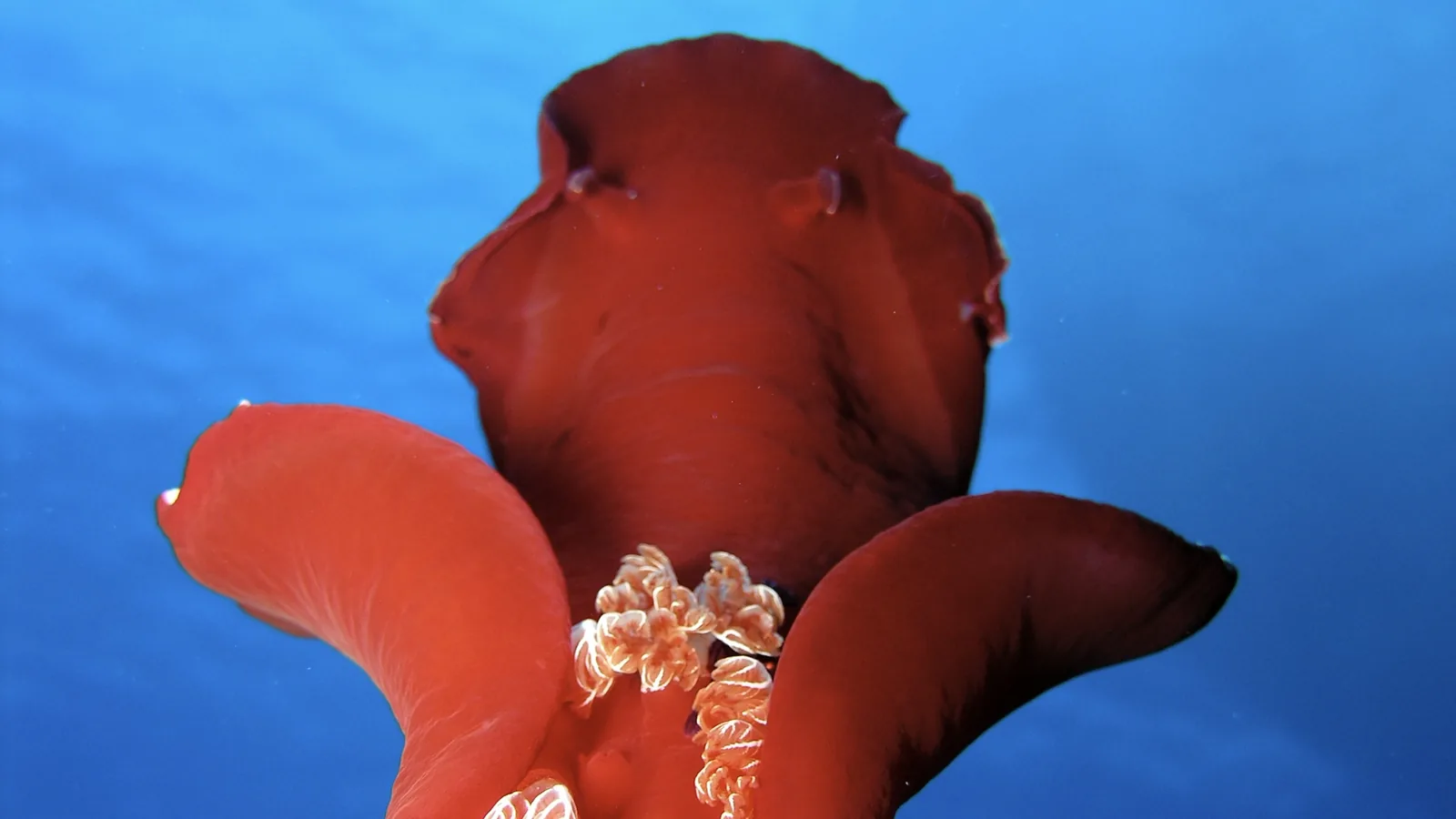
The Spanish dancer (Hexabranchus sanguineus) is the Red Sea's giant red nudibranch — a mostly nocturnal, sponge-eating sea slug, up to about 40 cm, famous for the rare moments it lifts off the reef and "dances" through open water. Look for it on night dives over sponge-rich reef; never touch it.
How to identify a Spanish dancer
Few Red Sea animals are mistaken for anything else once you have seen one. The defining features:
- Size: Enormous for a nudibranch. Adults are commonly around 25 cm and reach roughly 40 cm in the Red Sea — among the largest sea slugs in the world. A red slug the length of a forearm is almost certainly this species.
- Colour: Deep blood-red, often mottled with paler whites, oranges and pinks. The intensity is a warning signal (aposematism), advertising that the animal is chemically defended. The scientific name reflects it: sanguineus means "blood-coloured".
- Body shape: A soft, flattened, oval body with broad, frilly mantle edges. When crawling, those edges are usually curled upward, forming a raised rim around the animal.
- Rhinophores: A pair of retractable, club-shaped sensory horns at the front, used to "smell" the water and home in on sponge prey.
- Gills: A tuft of feathery gills toward the rear. The genus name Hexabranchus literally means "six gills" — the gill plumes are inserted in the body as six separate, contractile units.
The famous "dance"
The Spanish dancer earns its name from a behaviour that most divers never get to see. For the great majority of its life it crawls slowly across the reef on a muscular foot, like any other sea slug. But when it is sufficiently disturbed — or sometimes for reasons that are hard to pin down — it can release its grip on the bottom, unfold the curled edges of its mantle, and swim.
The motion is a series of rhythmic undulations: the broad red mantle flaps ripple and flex, propelling the animal through open water in slow, flowing pulses. The effect is unmistakable — the swirling crimson folds look exactly like the skirts of a flamenco dancer, which is where the common name comes from.
Swimming is generally understood as an escape response. It also has a defensive bonus: a flexing, brightly-coloured red animal in mid-water broadcasts its warning colouration far more effectively than one tucked against the reef. Because these episodes are usually brief and unpredictable, a free-swimming Spanish dancer is one of the most sought-after sightings in Red Sea diving — and a difficult, prized subject for underwater photographers.
Where and when to see one
The Spanish dancer is a true Red Sea resident, distributed widely across the Indo-Pacific from East Africa and the Red Sea to French Polynesia, Japan and Australia. In Egypt it occurs on reefs throughout the diving regions, with sponge-rich walls, coral-rubble slopes and sheltered reef structure being the most productive habitat. It is recorded from as shallow as about 1 m down to roughly 50 m, but tends to favour shallower water.
Timing matters more than place. This is primarily a nocturnal animal: during daylight it usually stays hidden under ledges and inside crevices, and daytime sightings of an active individual are uncommon. The reliable way to find one is a night dive, when it emerges to feed and, occasionally, to swim.
Possible year-round Best on night dives
Diet — a sponge specialist
The Spanish dancer is a carnivore with a narrow menu: it eats sponges. It locates them by scent using its rhinophores, then rasps away sponge tissue with a toothed, ribbon-like feeding organ called the radula. Encrusting sponges make up the bulk of the diet, and across its range the species has been recorded feeding on a wide variety of sponges — studies report at least 11 genera spanning multiple orders, with sponges of the family Halichondriidae frequently cited as a staple.
This diet is not just nutrition — it is also the source of the animal's chemical defence (below). Sea slugs of this kind are masters of recycling the chemistry of their prey, and the Spanish dancer is one of the best-studied examples.
The red rose — its egg ribbon
One of the most beautiful sights on a Red Sea night dive is the Spanish dancer's egg mass. As a hermaphrodite, the animal lays a long, ruffled ribbon of eggs that it coils into a loose spiral, frequently described as a "rose" or "coiled rosette". The ribbon ranges from bright red to pink, echoing the colour of the adult, and is often found attached to the reef even when the parent is nowhere in sight.
The eggs are chemically protected too. Compounds the adult acquires from its sponge diet are deposited into the egg ribbon, giving the otherwise defenceless eggs a powerful toxin shield against predators — in fact these defensive chemicals have been measured at their highest concentration in the egg masses. Development is temperature-dependent: in studies the eggs hatched in around 6 days at 27 °C and up to about 12 days at 22 °C.
A tiny passenger — the emperor shrimp
Look closely at a Spanish dancer and you may spot a hitchhiker. The emperor shrimp (Periclimenes imperator) is a small, brightly-marked shrimp that commonly lives on Hexabranchus sanguineus in a commensal relationship. The shrimp gains free transport across the reef and a measure of protection by riding a chemically-defended host, while it picks at debris and parasites on the slug's surface — a living clean-up service. Finding the host is often the easiest way to find this particular shrimp, and the pairing is a favourite of macro photographers.
Defence — borrowed chemistry
The Spanish dancer has no shell, no spines and no sting, yet it is far from defenceless. It sequesters a suite of toxic compounds — trisoxazole macrolides, including the well-studied kabiramides — from the sponges it eats, and concentrates them in its body and especially its egg ribbons. These molecules disrupt the cytoskeleton of cells and act as a potent feeding deterrent, making the slug and its eggs unpalatable or harmful to would-be predators.
For divers the practical point is simple: the toxins are a defence against being eaten, not a venom or a sting, so the animal poses no threat to a hands-off observer. But it should never be touched — handling stresses the animal, can damage its surface, and contact with defensive chemicals is best avoided entirely.
Diving and photography etiquette
The Spanish dancer is delicate and almost entirely a night-dive subject, so a few habits protect both the animal and the encounter:
- Never handle it. Do not lift, prod or "encourage" it to swim. Forcing the dance harms the animal and is the mark of an inexperienced diver. The natural behaviour, when it happens, is worth far more.
- Mind your light at night. Keep your torch beam off the animal except when actually looking or shooting, and avoid pinning it in a constant spotlight. Strong continuous light stresses nocturnal species.
- Control your buoyancy and your fins. Hover off the reef; do not steady yourself by gripping coral. A reef hook or a single finger on bare rock is acceptable — sponge, coral and the animal itself are not.
- Leave the egg ribbon untouched. The red "rose" is a developing clutch; admire and photograph it in place.
- Photographers: a wide-to-standard macro setup works well, since adults are large. Use restrained, angled strobe lighting to bring out the red without harsh backscatter, and keep focus light brief. Look for the emperor shrimp as a second subject on the same animal.
Spanish dancer vs other Red Sea nudibranchs
"Nudibranch" covers a huge family of sea slugs, and the Spanish dancer is one specific, exceptional member of it. The contrast with the typical reef nudibranch is stark:
| Feature | Spanish dancer (H. sanguineus) | Typical reef nudibranch |
|---|---|---|
| Size | Up to ~40 cm (a giant) | ~1–5 cm |
| Activity | Mainly nocturnal; hides by day | Often active by day on the reef |
| Swimming | Can free-swim by flexing its mantle | Almost always crawling only |
| Colour | Deep blood-red | Hugely varied (blues, yellows, candy-stripes) |
| Companion | Often hosts the emperor shrimp | Usually none |
| Diet | Sponges | Sponges, hydroids, bryozoans, other slugs — varies by species |
For the wider world of small, colourful sea slugs — the candy-striped Chromodoris and the rest — and where macro divers find them, see the Red Sea Nudibranchs guide. For another reef hunter best found after dark, the moray eel guide covers a classic night-dive companion, and the lionfish is another species that comes alive at night — see the Lionfish species guide for safe identification.
Frequently asked questions
It is a large, deep-red nudibranch (sea slug), Hexabranchus sanguineus, found across the Indo-Pacific and throughout the Red Sea. It is one of the biggest nudibranchs in the world — commonly around 25 cm and reaching about 40 cm in the Red Sea — and is named for the way it appears to dance when it swims.
Yes. It is a Red Sea resident and a classic night-dive sighting. By day it hides under ledges, so most encounters happen after dark on sponge-rich reefs from Hurghada south.
Mostly it crawls; swimming is mainly an escape response. It unfolds its mantle edges and propels itself off the bottom with rhythmic undulations, which also displays its red warning colouration. Episodes are brief and unpredictable, which makes a swimming individual a prized sighting.
It is chemically defended but harmless to a hands-off diver. It stores toxic macrolides (including kabiramides) from the sponges it eats and passes them into its tissues and eggs as a feeding deterrent — not a venom or sting. Never handle it.
They are among the largest sea slugs, commonly about 25 cm and reaching roughly 40 cm in the Red Sea. A red slug the length of a forearm is almost certainly this species.
That is its egg ribbon — a long, ruffled clutch of eggs coiled into a red-to-pink spiral, often described as a rose. It is chemically protected, like the adult, and is frequently seen on the reef even when the parent has moved on.
The Spanish dancer is one specific giant species — up to ~40 cm, mainly nocturnal, able to free-swim, and host to the emperor shrimp. Most other Red Sea nudibranchs are small (1–5 cm) and crawl over the reef by day. See the Red Sea Nudibranchs guide for the wider family.