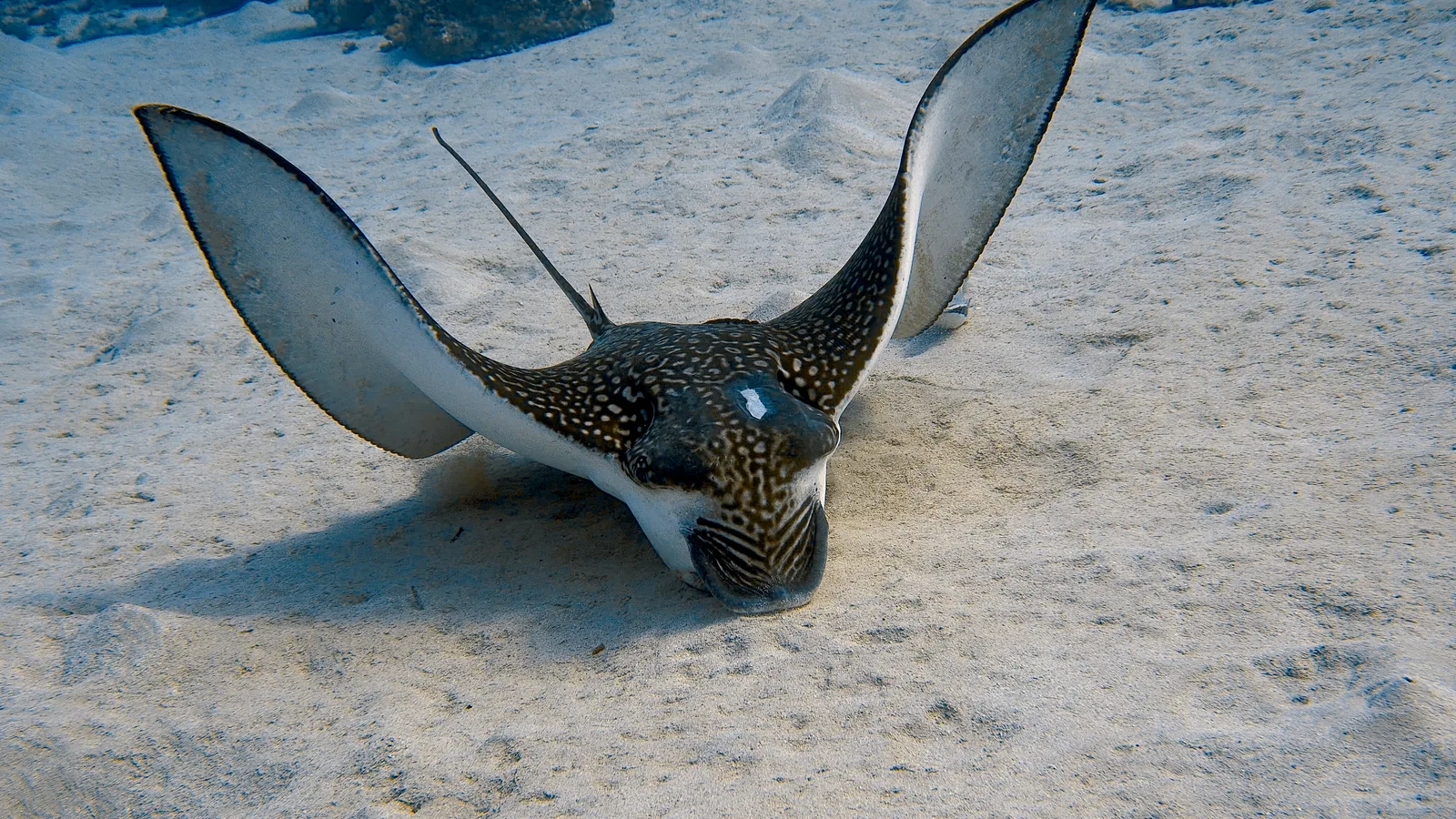
Quick Answer Spotted eagle ray in the Red Sea
Yes, spotted eagle rays live in the Egyptian Red Sea, and the correct current name for them is Aetobatus ocellatus (the ocellated eagle ray) rather than the older A. narinari. They are seen along reef drop-offs and over sandy plateaus throughout the year — in regions such as Hurghada there is a chance on almost any dive, any month — though no single dive can promise one. They are shy, harmless if left alone, and listed as Endangered.
How to identify a spotted eagle ray
Once you have seen one, a spotted eagle ray is hard to confuse with anything else in the Red Sea:
- Dark, white-spotted disc: The broad, diamond-shaped "wings" (the pectoral disc) are dark — greenish, grey or almost black on top — and scattered with pale white spots and rings. The pattern of spots is unique to each individual, like a fingerprint.
- Pointed duck-bill snout: The front of the head tapers into a flat, rounded, duck-like snout (the subrostral lobe). This is a feeding tool — it is used to dig and probe the sand — and it instantly separates eagle rays from the round-winged mantas and the flat, disc-shaped bottom-dwelling stingrays.
- Long whip-like tail: The tail is far longer than the body — total length can be several times the disc width — and carries one or more venomous spines near its base (usually one or two, occasionally more). The tail trails behind like a streamer as the ray glides.
- Wingspan: Large adults exceed 3 metres across the wings and can weigh over 200 kg, but most Red Sea sightings are smaller animals around 1 to 2 metres.
- "Flight" in the water: Eagle rays swim by flapping their wings in slow, deliberate beats, looking remarkably like a bird in flight — which is exactly how they earned the name.
The name confusion — narinari or ocellatus?
This is one of the genuinely messy corners of ray taxonomy, and it is worth being honest about because most sources are not consistent.
For a long time, every spotted eagle ray on Earth — Atlantic, Indo-Pacific and eastern Pacific alike — was treated as a single, very widespread species: Aetobatus narinari. In 2010, a study by White and colleagues used morphology, genetics and parasite data to show that this "one species" was really several. After the split:
| Species | Common name | Range |
|---|---|---|
| Aetobatus narinari | Spotted eagle ray (sensu stricto) | Atlantic Ocean only |
| Aetobatus ocellatus | Ocellated eagle ray | Indo-West Pacific, incl. East Africa & the Red Sea |
| Aetobatus laticeps | Pacific white-spotted eagle ray | Eastern Pacific Ocean |
Because the Red Sea sits at the far western edge of the Indo-West Pacific, its eagle rays belong to Aetobatus ocellatus. The two are very similar to the eye — the main published differences are that A. ocellatus tends to be darker on top, with a relatively longer tail and a longer stinging spine — so divers, field guides and even many dive operators still call the Red Sea animal "spotted eagle ray" and label it A. narinari. Both common name and older scientific name are still in everyday use; the current scientific name for a Red Sea individual is A. ocellatus. (Several eagle rays were even moved into their own family, Aetobatidae, by recent genetic work.)
Where to see them in the Red Sea
Eagle rays are creatures of the edge — they like the boundary between reef and open water, and the open sand near a reef. Typical places to look in the Egyptian Red Sea:
When to see them
Unlike plankton-driven species such as the manta, the spotted eagle ray is not strongly seasonal in the Egyptian Red Sea — in regions like Hurghada it is effectively a year-round resident, with a chance of an encounter on almost any dive in any month. That said, encounters are never guaranteed: an eagle ray is a single animal moving through a large area, so seeing one is a matter of being in the right place at the right moment. Across a week of diving the odds are good; on a single dive they are a happy bonus.
Year-round resident Sightings possible any month
Diet and foraging
The spotted eagle ray is a specialist shellfish hunter. Its diet is built around hard-shelled and buried prey:
- Molluscs: gastropods (snails) and bivalves (clams, cockles) are a mainstay — the ray's plate-like crushing teeth are adapted to break shells.
- Crustaceans and worms: crabs, shrimp and marine worms dug out of the sand.
- Octopuses and small fish: taken opportunistically.
To find buried prey, an eagle ray flaps slowly over the bottom and uses its flexible duck-bill snout to root through the sediment, often leaving a small plume of disturbed sand. This bottom-rooting is one of the easiest ways to recognise eagle-ray feeding behaviour underwater.
Behaviour and what to expect
Eagle-ray encounters on Red Sea dives usually take one of these forms:
- The fly-by: A single ray glides past in open water, beating its wings unhurriedly. The encounter is often brief — keep your eyes on the blue and you may catch it before it disappears.
- The forager: A ray sweeping low over sand, pausing to dig. These animals are absorbed in feeding and can sometimes be watched for longer, from a respectful distance.
- The loose group: Eagle rays are usually seen alone, but they are not strictly solitary — they occasionally travel in loose aggregations, and in some parts of the world gather in larger numbers over rich feeding grounds or along migration routes. In the Red Sea, small groups are seen far less often than singles.
They are also famous for breaching — leaping clear of the surface, sometimes more than once. Why they do it is still debated; suggested reasons include shedding parasites, escaping predators, and courtship. Divers rarely witness this, but boat crews sometimes do.
Eagle rays are shy. They are highly sensitive to erratic movement and noisy bubbles, and the usual outcome of a clumsy approach is a ray accelerating away with surprising speed. The animal almost always controls the distance — chasing one is futile as well as harmful.
Diving and photography etiquette
Eagle rays reward calm, unobtrusive divers and punish pushy ones by leaving. A few simple rules apply:
- Do not chase. An eagle ray will outpace you every time, and a chased animal is a stressed animal. Hold position and let it come into view on its own line.
- Stay still and breathe slowly. Minimise fin movement and vertical bubble streams; both spook rays. Good buoyancy is the single most useful skill for ray encounters.
- Keep your distance from the tail. The venomous spines are defensive, near the base of the tail. Never position yourself to corner the animal, and never attempt to touch or ride it.
- Photograph, don't pursue. A wide-angle lens and a patient wait beat a fast swim. If the ray is foraging, approach low and slow along the sand rather than from above.
- Leave the bottom alone. Foraging rays depend on undisturbed sand and shellfish beds — anchor good buoyancy and avoid kicking up the seabed.
Telling it apart from other Red Sea rays
The Red Sea has several rays that newer divers mix up. The spotted eagle ray is distinct from both:
- vs. the bluespotted ribbontail ray: The ribbontail is a small, flat, disc-shaped stingray that rests on the bottom, sandy-brown with bright electric-blue spots and a short tail. The eagle ray is large, dark, free-swimming in open water, has a pointed duck-bill snout and a very long tail. Different family, completely different behaviour.
- vs. the manta ray: Mantas are far larger, with rounded "wing" tips, paddle-like cephalic fins flanking a wide front-facing mouth, and they filter-feed on plankton in mid-water. The eagle ray is smaller, with angular wings, a pointed snout, and it feeds on shellfish off the bottom. A manta has no long stinging tail; the eagle ray does.
Conservation
The ocellated eagle ray is in trouble across much of its range. The IUCN Red List classifies Aetobatus ocellatus as Endangered (assessed 6 July 2023), uplisted from a 2016 assessment of Vulnerable. The driver is fishing pressure: across the Indo-West Pacific the species is caught in coastal target and bycatch fisheries — trawls, longlines and gillnets — and inferred population declines reach roughly 50 to 79 percent over three generations (about 39 years).
The deeper problem is the ray's life history. Like other large rays it is slow-growing, late to mature, and produces only a few pups after a gestation of more than a year — so populations recover very slowly once depleted. Egypt's network of marine-park reefs, where commercial fishing is restricted, offers some refuge for the Red Sea population, and the eagle ray is more often a tourism asset alive than a catch.
What divers can do
- Keep encounters low-impact. No touching, no chasing, no cornering — a ray that abandons a feeding or cleaning area loses more than a photo opportunity is worth.
- Photograph the spot pattern. Each ray's spots are unique; clear photographs can contribute to citizen-science identification efforts that track individuals and movements.
- Report sightings to your dive guide. Local logs of where and when eagle rays appear help operators brief respectfully and help build a picture of the local population.
- Choose operators with clear no-touch wildlife policies and support marine-park protections.
For more on the Red Sea's reef life and where to find it, see the Marine Life Encyclopedia, and for the dive sites where eagle rays cruise the walls around Hurghada, see the Hurghada dive sites guide and the best dive sites in Hurghada hub.
Frequently asked questions
No — they are different families and look completely different. The bluespotted ribbontail ray is a small, flat stingray that rests on the bottom, sandy-coloured with electric-blue spots. The spotted eagle ray is a large, dark, white-spotted ray that swims freely in open water with a long tail and a pointed duck-bill snout.
Because the species was split in 2010. The name A. narinari is now reserved for the Atlantic population, while the Indo-West Pacific form — including all Red Sea animals — is A. ocellatus. Many resources have not updated and still use the older name, but A. ocellatus is the current scientific name for a Red Sea spotted eagle ray.
It can, but only defensively. Eagle rays carry one or more venomous spines near the base of the tail and use them if cornered, grabbed or stepped on. A diver who keeps a respectful distance and never tries to touch or chase the animal is in no danger — eagle rays are shy and prefer to glide away.
Large adults can exceed 3 metres across the wings and weigh more than 200 kg, with a tail that makes the total length several metres. Most individuals divers meet in the Red Sea are smaller, around 1 to 2 metres in wingspan.
There is no strong season — the spotted eagle ray is a year-round resident in regions such as Hurghada, so a sighting is possible on any dive in any month. Encounters are unpredictable on a single dive but likely across a full week of diving.
Yes. The ocellated eagle ray (Aetobatus ocellatus) is listed as Endangered on the IUCN Red List, assessed in 2023 after population declines driven by coastal fishing across its Indo-West Pacific range. Its slow growth and low reproductive rate make it slow to recover.