Where to find them on the reef
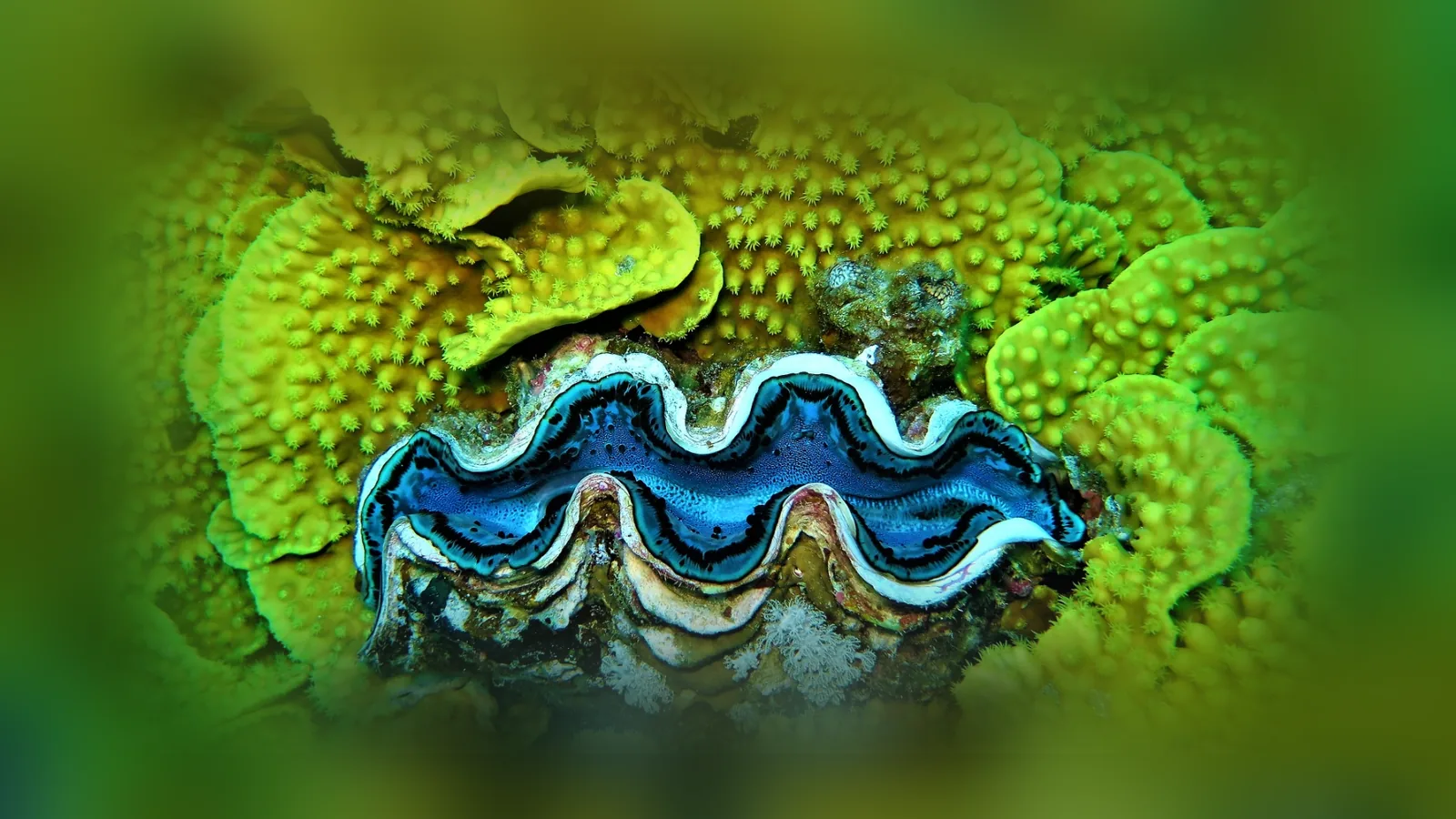
Giant clams are creatures of light, so they live where the light is: the shallow, sunlit parts of the reef rather than the deep. On an Egyptian dive or snorkel you meet them cemented into hard coral, mantle turned upward, most often in the first ten metres.
When to see them
A giant clam is fixed in place for life, so there is no season to plan around — the same individual sits on the same reef year after year, decade after decade. What changes is only the light and your dive plan. Clams show their mantles most fully in bright, calm, midday conditions, when the sun is high and the algae inside them are working hardest. Overcast water or a heavy shadow will see a clam draw its mantle in.
Year-round resident Best in bright midday light
How to recognise a giant clam
Once seen, a giant clam is unmistakable — a thick, ridged shell with a soft, vividly coloured mantle filling the gap between the two valves. The key features:
- The mantle: The living tissue exposed between the shell lips is the animal's most striking feature — a rippling sheet of iridescent blue, turquoise, green, gold or brown, often speckled and patterned, and no two are alike. This is the part packed with the clam's photosynthetic algae.
- The shell: Heavy, roughly triangular or fan-shaped, with strong radiating ribs. The fluted giant clam carries distinctive leaf-like scales (scutes) that stand up along those ribs; the small giant clam's shell is more tightly fitted into the reef.
- The set of the animal: Giant clams sit hinge-down and mantle-up, wedged into or resting on the coral so the mantle faces the sun. A clam lying loose on open sand is unusual.
- Size: Red Sea giant clams are the smaller members of the family. The common Tridacna maxima is usually 20–35 cm along the shell; the fluted giant clam reaches about 40 cm. The metre-plus true giant clam of coral-triangle fame does not occur here.
- Two siphons: Look closely and you can see the inhalant siphon (a fringed opening drawing water in) and the smooth, raised exhalant siphon that jets it back out.
The three giant clams of the Red Sea
Divers often assume "giant clam" means one animal. In the Red Sea it means three, all in the genus Tridacna:
- Tridacna maxima — the small giant clam. By far the most common, making up roughly nine in ten of the giant clams surveyed on Red Sea reefs. It is the colourful clam wedged into shallow coral that most divers photograph, and despite the name "small" it still reaches about 35 cm.
- Tridacna squamosa — the fluted giant clam. Less common but widespread, it is named for the striking leaf-like flanges along its shell. It grows a little larger, to around 40 cm, and ranges onto deeper reef slopes than T. maxima.
- Tridacna squamosina — the Red Sea endemic. Found nowhere else on the planet, this species was only re-described as distinct in 2005 and is exceptionally rare — a recent basin-wide survey found just a handful of individuals at a single southern reef. It resembles the fluted clam but has a more asymmetrical shell with deep triangular folds. Long overharvest has driven it to the brink, and it has been proposed for endangered listing.
One clarification worth keeping straight: the truly enormous Tridacna gigas, the world's largest living bivalve at over a metre and 200 kg, is an Indo-Pacific animal and does not live in the Red Sea. The Red Sea's clams are the modest, jewel-mantled cousins — impressive, but measured in centimetres rather than metres.
The algae partnership — a clam that farms sunlight
The heart of what makes a giant clam remarkable is invisible: a partnership with algae. Living inside the clam's fleshy mantle are countless single-celled algae called zooxanthellae (of the family Symbiodiniaceae) — the same kind of algae that power reef-building corals. They photosynthesise using sunlight, and pass most of the sugars they make to the clam. In return, the clam provides the algae with a safe, well-lit home and a steady supply of the inorganic nutrients they need. It is one of the most complete plant-animal partnerships in the sea: an animal that feeds itself largely by gardening.
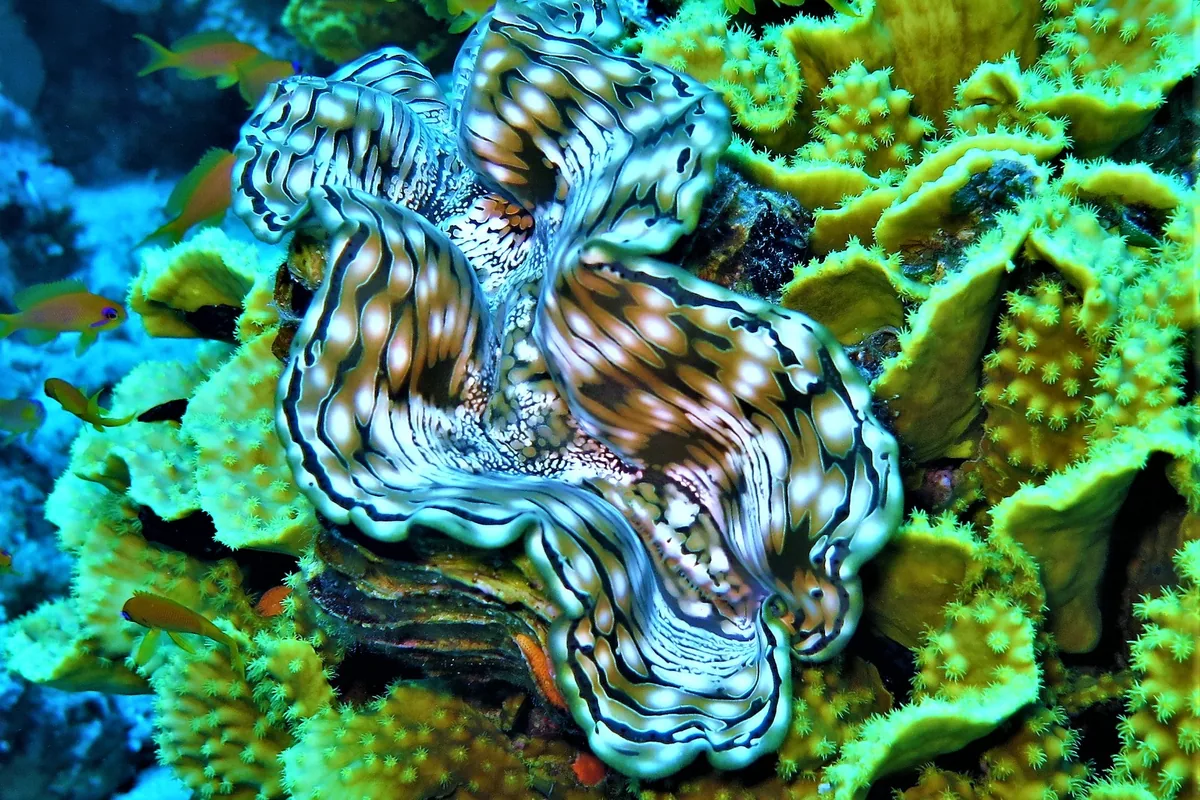
This is why a giant clam behaves the way it does. Because its algae need light, the clam lives in the shallows, opens its shell during the day, and spreads its enormous mantle upward toward the sun like a solar panel. The mantle is hypertrophied — grown far larger than an ordinary clam's — precisely to hold more algae and catch more light.
The mantle's electric colours are part of the machinery too. Packed into the outer mantle are specialised cells called iridocytes, each holding stacks of microscopic reflective platelets. These platelets scatter the wavelengths of light the algae use for photosynthesis deep into the tissue, spreading useful light to algae that would otherwise sit in shade, while reflecting away wavelengths that could overheat or damage the animal. The dazzling blues, greens and golds are, in effect, a combined sunscreen and lighting rig for a farm of algae — which is why the colours vary so much from clam to clam, and why they glow most vividly in strong light.
How they feed and sense light
Photosynthesis supplies most of a giant clam's energy, but not all of it. Like every bivalve, a giant clam is also a filter feeder. It draws seawater in through an incurrent (inhalant) siphon, sieves out plankton and fine organic particles across its gills, and expels the filtered water through a raised excurrent (exhalant) siphon. In doing so it also cleans the water passing over the reef — one reason giant clams are valued as living filters.
For an animal cemented in one spot, defence is everything, and here giant clams have a genuine surprise: they can sense light and shadow. Hundreds to several thousand tiny pinhole eyes line the rim of the mantle. Each is a very simple light detector rather than an image-forming eye, but together they let the clam register a sudden darkening — the shadow of a fish, a bird, or a diver passing overhead. When that shadow falls, the clam responds with a defensive withdrawal: it pulls its soft mantle inward and slowly draws its valves partly shut, protecting the vulnerable tissue until the threat moves on. That slow "flinch" as your shadow crosses a clam is the animal seeing you — proof that even a shellfish sunk in the coral is paying attention to the world above it.
The "man-eating clam" — a myth to retire
Few reef animals carry a reputation so at odds with the facts. For generations, adventure stories cast the giant clam as a "man-eating" trap that could clamp onto a diver's arm or leg and hold them under — an image cemented by Jules Verne's Twenty Thousand Leagues Under the Sea and repeated seriously enough that an old US Navy diving manual once offered advice on escaping one.
It is folklore. A giant clam closes its shell far too slowly to trap anyone: the movement is a gradual, seconds-long defensive adduction of the valves, not a snap, leaving ample time for a limb to be withdrawn. There has never been a documented human death caused by a giant clam. The animal has no interest in — and no mechanism for — catching prey larger than plankton; its food arrives through photosynthesis and filter feeding. The genus name Tridacna, from the Greek for "three bites", refers to how large the meat is to eat, not to anything the clam does to a person. In short: a giant clam is one of the safest large animals a diver will ever meet.
Watching and photographing giant clams
Giant clams are wonderful, patient photographic subjects — but only if left untouched:
- Never touch, poke or "test" a clam. A prodded clam clamps its mantle in and closes, which stresses it, interrupts its algae's photosynthesis, and hides the very colours you came to see. The mantle can take time to re-emerge.
- Approach slowly and cast no shadow. Because the clam senses shadow, drifting in low and from the side keeps the mantle open; sweeping directly overhead makes it withdraw. Move gently and give it a moment to settle.
- Shoot the mantle detail. A macro or close-focus lens captures the iridescent patterning and the two siphons; a little side light brings out the electric blues and greens that flat, straight-on light washes away.
- Mind your fins and buoyancy. Giant clams live on the shallow reef top where careless finning does the most damage. Stay neutrally buoyant, keep clear of the coral, and never rest a hand or knee near a clam.
Reproduction and a life measured in decades
Giant clams have an unusual sex life. They are protandric hermaphrodites: an individual first matures as a male, after a couple of years and a modest size, then becomes a functioning hermaphrodite carrying both eggs and sperm once it is larger (in Tridacna maxima, at around 15 cm). Fixed in place, they cannot pair off, so they reproduce by broadcast spawning — releasing gametes straight into the water for external fertilisation, often in reef-wide bursts triggered by moon, temperature and chemical cues. To avoid fertilising itself, a hermaphroditic clam releases its sperm first and its eggs a little later.
The fertilised eggs become tiny free-swimming larvae that drift with the plankton for a week or two before settling onto the reef and beginning to build a shell. Crucially, a young clam is not born with its algae — each new generation must acquire its zooxanthellae afresh from the surrounding water. Those that survive the perilous larval stage settle into a very long life: giant clams are among the longest-lived animals on the reef — the largest species pass a century and even the small giant clam lives for many decades, meaning many of the clams on a Red Sea reef today were already there long before the first divers arrived.
Conservation and CITES
That combination of slow growth, late maturity and a fixed, easily collected adult makes giant clams highly vulnerable to overharvesting — and they have been harvested hard. Around the world they are taken for their large adductor muscle, prized as food; for their heavy, ornamental shells; and for the marine-aquarium trade, where Tridacna maxima's colourful mantle makes it a target. Because a spawning clam cannot simply move away or breed faster, populations recover slowly once thinned.
For that reason, every giant clam species is listed on CITES Appendix II, which regulates their international trade. Collection has been banned in parts of the Red Sea since the early 2000s. The situation is most serious for the Red Sea endemic Tridacna squamosina, whose long history of harvest has left it exceptionally rare and prompted a proposal to list it as endangered.
On the reef, giant clams earn their keep many times over. They are described as ecosystem engineers: their algae are primary producers feeding the reef food web, their bodies filter and clean the water, and their thick shells add structure and hard-carbonate material to the reef, contributing to its calcium-carbonate budget and providing surfaces and shelter for other animals. Protecting them costs a diver nothing — look, photograph, and never touch or buy a clam shell, and these century-old sunlight farmers will still be gracing the shallows for the divers who come after.
Related Red Sea reef life
Giant clams belong to the same slow, jewelled world of Red Sea invertebrates and reef residents that reward a diver who looks closely:
- Nudibranchs — the reef's other living jewels, sea slugs in extravagant colours grazing the shallow coral.
- Octopus — a mollusc cousin at the opposite extreme of the family: mobile, shell-less and famously intelligent.
- Red Sea anemonefish — another master of partnership, living safely among the stinging tentacles of a host anemone.
To read more about the reef's smaller residents, see the guides to the Red Sea nudibranch, the Red Sea octopus and the Red Sea anemonefish. For the bigger picture of diving the region, see the complete guide to scuba diving the Red Sea, and to browse the full encyclopedia, visit the Red Sea marine life guides.
Frequently asked questions
No. The man-eating clam is a myth, kept alive by Jules Verne and an old US Navy diving manual, but a giant clam closes its shell far too slowly to trap anyone, and there has never been a recorded human death by clam. When a shadow passes, the clam simply withdraws its mantle and draws its valves partly closed over several seconds — a defensive reflex, not a snap. Divers should admire giant clams without touching them: a handled clam clamps shut, stops photosynthesising and is stressed by the contact.
In two ways. Like other clams it filter-feeds, drawing plankton-rich water in through an incurrent siphon and expelling it through an excurrent siphon. But most of its energy comes from farming sunlight: millions of single-celled algae called zooxanthellae live inside its fleshy mantle, photosynthesise, and pass sugars to the clam. In return the clam gives the algae shelter and nutrients and spreads its mantle toward the light, which is why giant clams sit gaping open in the brightest, shallowest parts of the reef.
The electric blues, greens and golds come from special cells called iridocytes packed into the outer mantle. Their stacks of tiny reflective platelets scatter the wavelengths the clam's algae use for photosynthesis deep into the tissue, while reflecting away wavelengths that could overheat or damage it. The colour is a sunscreen and a light-management system for the clam's algal partners, not decoration — and because the arrangement varies from animal to animal, no two giant clams look quite alike.
Yes, in a simple form. Hundreds to several thousand tiny pinhole eyes line the rim of a giant clam's mantle. They cannot form a detailed picture, but they detect changes in light — so when a diver's shadow or a passing fish crosses the clam, it senses the darkening and pulls its mantle in as a defence. This is the slow flinch divers notice when they swim too close.
The Red Sea's giant clams are the smaller members of the family. The most common, Tridacna maxima, usually reaches about 20 to 35 cm, and the fluted giant clam, Tridacna squamosa, grows to around 40 cm. The true giant clam, Tridacna gigas, which can pass a metre in length and weigh over 200 kg, lives in the Indo-Pacific and is not found in the Red Sea. Giant clams are also remarkably long-lived: the largest species pass a century, and the small giant clam lives for many decades on the reef.
Three species occur here. Tridacna maxima is by far the most common and is found across shallow Egyptian reefs, wedged into the coral with its colourful mantle showing. The fluted giant clam, Tridacna squamosa, is less common and recognised by the leaf-like flanges on its shell. The third, Tridacna squamosina, is found nowhere else on Earth but the Red Sea and is now exceptionally rare. All live on shallow reef tops and slopes rather than in the deep, so a relaxed shallow reef or the last part of a dive is the best place to look.
Yes. Every giant clam is listed on CITES Appendix II, which regulates international trade, because the family has been heavily overharvested for its meat, its shells and the aquarium trade. Slow growth and late breeding make them slow to recover, and the Red Sea endemic Tridacna squamosina has declined to the point of being proposed for endangered status. The rules for divers are simple: never touch or stand on a clam, never buy clam-shell souvenirs, and keep fins clear of the shallow reef where they live.