Where to see them
When to see them
Anemonefish are year-round residents of every Red Sea reef — they never migrate and a family stays with the same anemone for life. Sightings are consistent in every month; breeding (and the most defensive behaviour) peaks in the warmer months.
Year-round resident Breeding peaks in warmer months
Not Nemo — the Red Sea has its own clownfish
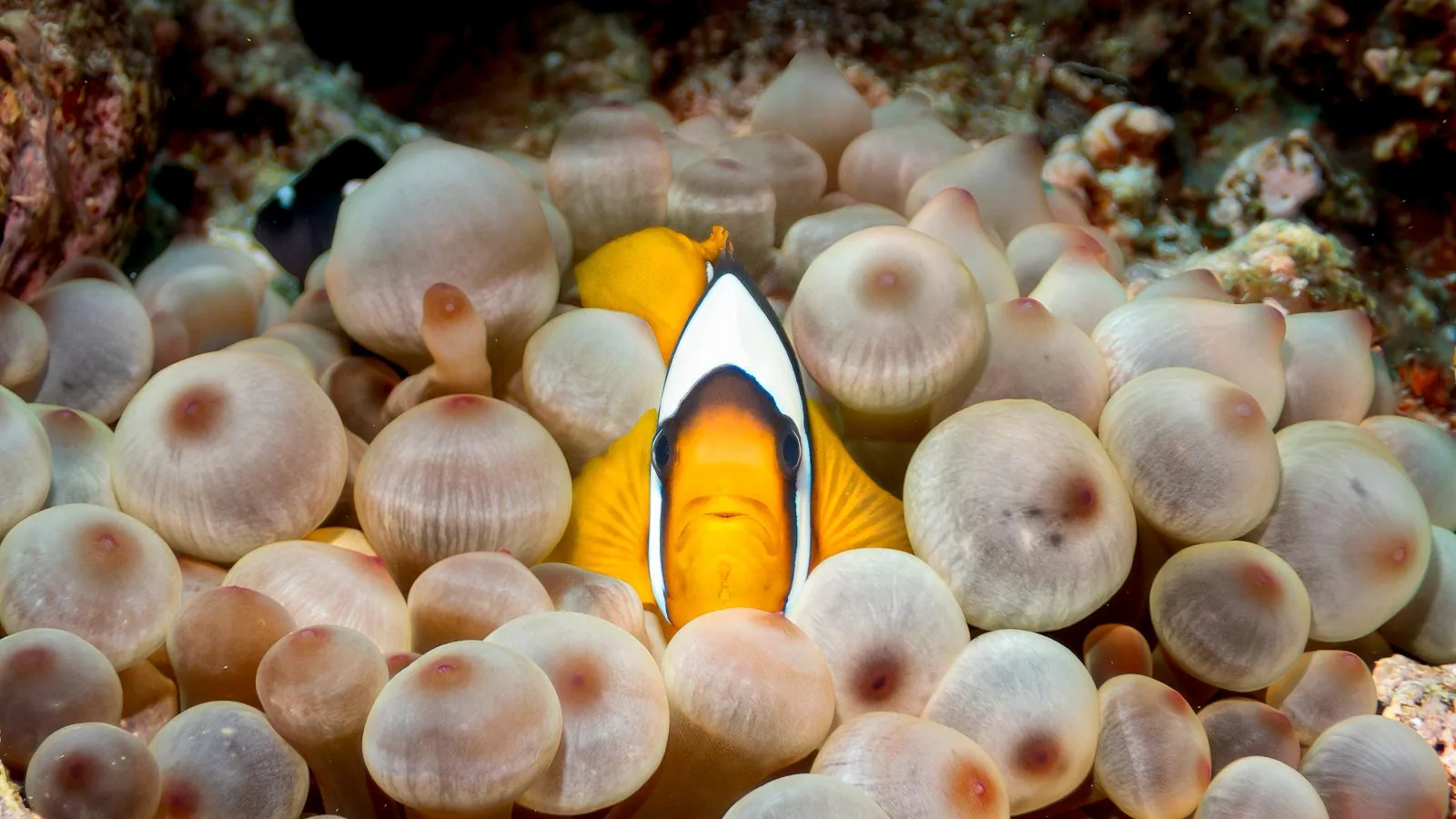
The clownfish everyone pictures — bright orange with three crisp white bands — is Amphiprion ocellaris, the false clown anemonefish of the Indo-Pacific and Australia, made famous as "Nemo." That species does not live in the Red Sea. The clownfish on your Red Sea reef is a different animal: Amphiprion bicinctus, the two-banded anemonefish, and it is the only anemonefish species found here. Knowing the difference is part of diving the Red Sea well — you are seeing a regional speciality, not the cartoon.
| Feature | Amphiprion bicinctus (Red Sea) | Amphiprion ocellaris ("Nemo") |
|---|---|---|
| White bars | Two (head + mid-body), black-edged | Three, broad and bold |
| Body colour | Yellow-orange to dark brown | Bright orange |
| Tail | Yellow | White-and-orange |
| Native range | Red Sea, Gulf of Aden, Socotra, Chagos, W Indian Ocean | Indo-Pacific, SE Asia, N Australia |
| In the Red Sea? | Yes — the only anemonefish here | No — not present |
| Max size | 14 cm (female) | ~11 cm |
One more name to know: divers sometimes loosely call A. bicinctus "the two-band clownfish." Either name is correct. The "two bands" are the giveaway — count the white bars and you will always know you are looking at the Red Sea's own species.
Identification
Anemonefish are unmistakable once you know what to look for, and in the Red Sea there is only one species to learn:
- Body: Stocky, oval, laterally compressed. Females reach about 14 cm; breeding males are smaller, around 10 cm; juveniles smaller still.
- Colour: Yellow-orange through to a deep chocolate-brown. The body often darkens with age and varies between individuals and anemones — the darkest, biggest fish on an anemone is usually the dominant female.
- The two bars: Two vertical white bars, each thinly edged in black. The first sits just behind the head and is the wider of the two; the second runs from below the dorsal fin down the flank. Two bars — not three — is the key field mark.
- Tail: A clean yellow caudal fin, which helps separate it from look-alikes elsewhere in its range.
- Fins: 9–10 dorsal spines and 15–17 soft dorsal rays; 2 anal spines and 13–14 anal soft rays. Fins are rounded and the swimming style is the characteristic waddling "clownfish wobble."
- Where it is: Almost always within darting distance of a sea anemone. A clownfish away from its anemone is a rare and brief sight.
Juveniles look like small adults — there is no dramatic colour change with age, though the body tone shifts darker as a fish grows and rises in rank. The biggest visible difference between individuals on one anemone is size, and that size order is the social order (see below).
The anemone partnership — a textbook mutualism
The anemonefish–anemone relationship is one of the most famous mutualisms in the sea: both partners genuinely benefit. The anemone's tentacles are armed with microscopic stinging capsules (nematocysts) that fire on contact, killing or deterring most fish. The anemonefish lives inside this defended space — and pays the anemone back.
What each partner gives
- The anemone gives the fish: a fortress. Predators that would happily eat a small, slow, brightly coloured fish cannot follow it into the stinging tentacles. The anemone is shelter, nursery and home for life.
- The fish gives the anemone: protection from its own predators (notably butterflyfish that nibble anemone tentacles), which the clownfish chases off aggressively; improved water circulation and oxygenation as it fans and wriggles among the tentacles; removal of debris and parasites; and nutrients from its waste and dropped food scraps that help feed the anemone.
Why the fish isn't stung
This is the part that fascinates everyone. The anemonefish is protected by its mucus coat. It is not born immune — it acquires the protection through an acclimation period: a fish moving into a new anemone touches the tentacles briefly and repeatedly, flinching back at first, and over a span of hours to days its mucus chemistry changes until the anemone no longer treats it as prey.
Recent research has uncovered the likely mechanism. The firing of a nematocyst is partly triggered by certain sugars (sialic acids, a type of N-acetylated sugar) on a touching surface. Anemonefish appear to lower the level of sialic acids in their skin mucus — in effect removing the chemical "password" that tells the anemone to fire. The fish becomes chemically invisible to the trigger. Pull a fish out of its anemone for too long and it loses this protection and must re-acclimate from scratch. It is one of the most elegant pieces of chemistry on the reef, and you are watching it happen every time you see a clownfish dive into its host.
The host anemones of the Red Sea
Amphiprion bicinctus is a generalist — it can partner with several anemone species rather than just one, which is part of why it is so widespread. In the Red Sea it associates with five host anemone species:
- Bulb-tip anemone (Entacmaea quadricolor) — the most common host; recognisable by its bulb-tipped tentacles.
- Magnificent / Ritteri anemone (Heteractis magnifica, also called Radianthus magnifica) — a large, spectacular open anemone often on reef tops.
- Leathery / sebae anemone (Heteractis crispa).
- Beaded / aurora anemone (Heteractis aurora).
- Gigantic / carpet anemone (Stichodactyla gigantea).
Sex change and the anemone hierarchy
Every host anemone is a tiny, strictly ordered society. Look closely and you will usually see fish of clearly different sizes sharing one anemone — that size order is the social order, and it governs one of the most remarkable life histories on the reef.
Anemonefish are protandrous sequential hermaphrodites — "protandrous" means male-first. Each group typically contains:
- One dominant female — the largest fish on the anemone, and the only breeding female.
- One breeding male — the second-largest, her mate.
- A queue of smaller non-breeders — sexually immature juveniles, each suppressed by the fish above it, waiting their turn.
Here is the twist. If the dominant female dies or is removed, the social order rearranges within days: the breeding male changes sex and becomes the new female, and the largest non-breeder matures into the new breeding male. Field experiments on Amphiprion bicinctus specifically showed that female-typical behaviour begins in the transitioning male shortly after the dominant female is removed.
Crucially, sex change here is socially controlled, not simply triggered by reaching a certain age or size — it is the removal of the dominant female that flips the switch. And it only runs one way: a fish that becomes female stays female. This "size-based queue for breeding" is why the fish tolerate a strict pecking order: every subordinate is, in effect, an heir waiting in line. It is also why you should never take a clownfish from the reef — removing the dominant female destabilises the entire family.
Behaviour — bold for their size
For a fish under 14 cm, anemonefish are astonishingly fearless. Their confidence comes from the same source as their survival: they are never far from an impenetrable home.
- Territorial: They defend the anemone and a small area around it against intruders — other clownfish, anemone-nibbling butterflyfish, and, yes, divers. The dominant female is the boldest.
- Nipping divers: A bold female may dart out and "attack" a hand, mask, or dive computer that crowds her anemone. The nip is harmless — a faint pinch on bare skin, nothing through a wetsuit — and it is pure bluff. Back off and it stops instantly.
- Never leaves home: Anemonefish rarely stray more than a metre or two from their host. If startled, they dive straight into the tentacles.
- The "wobble": The waddling, rocking swimming motion is characteristic. Among the tentacles, the fish wriggles and rubs constantly — partly maintaining its protective mucus, partly oxygenating the anemone.
- Vocal: Anemonefish produce clicking and popping sounds, used in aggression and to maintain the dominance hierarchy — sometimes audible to divers very close to an active anemone.
Breeding and parental care
Anemonefish are monogamous and pair for the breeding season. The pair clears a patch of bare rock right at the base of the anemone and the female lays a clutch of demersal (bottom-attached) eggs there, often coaxing the anemone's tentacles to extend over the nest as a living, stinging canopy.
The male is the primary caregiver: he guards the eggs against intruders and constantly fans and mouths them to keep them clean and oxygenated until they hatch. Larvae then drift in the open water as plankton for a couple of weeks before settling onto a reef and seeking out an anemone of their own — the riskiest chapter of an anemonefish's life, and the one that connects reefs to one another.
Diet
Anemonefish are omnivores. Amphiprion bicinctus feeds mainly on zooplankton picked from the water column just above and around its anemone — copepods, larvae and other tiny drifting animals — supplemented by benthic algae and the occasional scrap. Because the anemone keeps them safe, they can feed out in the open current in a way few small reef fish dare, darting back to the tentacles at any sign of danger. Uneaten food and waste that falls into the anemone also helps feed the host, tightening the partnership further.
Range and habitat
Amphiprion bicinctus is found in the Red Sea, the Gulf of Aden to Socotra, the Chagos Archipelago, and the wider western Indian Ocean (roughly 31°N to 7°S). In the Red Sea it is common and can be locally abundant — it is by far the easiest anemonefish to encounter here because it is the only one.
It lives wherever its host anemones grow: reef flats, coral gardens, slopes and lagoons, in clear, reef-associated water from about 1 to 30 metres deep. That very shallow range is good news for divers and snorkellers alike — you do not need to go deep to find one, and they are often the first reef fish a try-dive guest watches up close.
Conservation
Globally, Amphiprion bicinctus is classified as Least Concern by the IUCN (assessed 2010). It is widespread, common, and collected for the marine-aquarium trade, but there is no evidence of population decline from harvesting, and its range overlaps several marine reserves.
But there is a serious local warning. The anemonefish's fate is welded to its anemone's, and anemones bleach in the heat just as corals do — expelling the symbiotic algae (zooxanthellae) they depend on. A 2023 marine heatwave in the central Red Sea, studied by a Boston University-led team and published in npj Biodiversity (2025), peaked at around 22 degree-heating-weeks and caused 100% of monitored host anemones to bleach, followed by the death of 66–94% of those anemones and 94–100% of the resident clownfish across three surveyed reefs. Of 168 fish counted before the event, only seven remained months later — a local population collapse. The species as a whole remains Least Concern, but this is a stark illustration that "common" is not the same as "safe": warming seas threaten the anemone partnership that the entire species is built on. Red Sea reef conservation — protecting the corals and anemones from heat stress, pollution and damage — protects the clownfish with them.
Diving with anemonefish — etiquette and photography tips
Anemonefish are one of the great pleasures of Red Sea diving: easy to find, full of character, and a perfect subject to slow down and watch. A few notes:
- Give the anemone space. A metre is plenty. Crowd it and the female will charge and nip — harmless, but it stresses the fish and ruins the behaviour you came to watch.
- Watch your buoyancy and your fins. Host anemones sit on the reef where fin-kicks and dragging gear do real damage. A bleached or broken anemone means a homeless clownfish. Hover, don't kneel.
- Never touch the anemone. You will get a mild sting on bare skin, and worse, you can damage the very home the fish depends on. Look, never handle.
- Never take a clownfish. Removing the dominant female collapses the whole family's breeding hierarchy, and the aquarium fish you would be tempted by is better admired here, on the reef.
- Photography: Anemonefish are a superb first macro subject because they stay put. Get low and shoot slightly upward against the anemone's colour. Pre-focus on the anemone and wait for the fish to "wobble" into frame rather than chasing it — patience beats pursuit every time. The dominant female, being boldest, will often pose for you out of sheer territorial confidence.
- Beginners and snorkellers: Because they live as shallow as 1 m, anemonefish are a guaranteed highlight of a first dive, a Discover Scuba session, or even a snorkel — ask your guide to point out an anemone and just hover and watch.
Related and reef-mate species in the Red Sea
The anemonefish belongs to the large damselfish family (Pomacentridae) — combative little reef fish you will see all around the same coral:
- Domino / three-spot damsel (Dascyllus trimaculatus) — juveniles also shelter in anemones alongside anemonefish, jet-black with white spots; a frequent anemone room-mate.
- Sergeant majors (Abudefduf spp.) — striped damselfish that swarm the reef tops and aggressively guard their own egg patches.
- Chromis (Chromis spp.) — clouds of small damselfish hovering above coral heads, feeding on plankton just as anemonefish do.
And among the predators and giants of the same reefs, divers love the Napoleon wrasse, the venomous but manageable lionfish, the resident moray eels, and the gentle green turtles grazing the seagrass nearby.
For more on Red Sea marine life and trip planning, see our best time to dive the Red Sea guide and browse the full marine life encyclopedia.
Frequently asked questions
No. "Nemo" is Amphiprion ocellaris, the false clown anemonefish of the Indo-Pacific, with three bold white bands. The Red Sea has its own species — Amphiprion bicinctus, the two-banded anemonefish — yellow-orange to brown with just two white black-edged bars and a yellow tail. It is the only anemonefish native to the Red Sea, so every clownfish you see diving in Egypt is this one.
Its mucus coat protects it. The fish isn't born immune — it acquires protection by touching the tentacles briefly and repeatedly over hours to days (acclimation). Research suggests it lowers the level of sialic acids in its mucus, and because those sugars help trigger the anemone's stinging cells to fire, the fish becomes chemically "invisible" to the trigger. Remove it from the anemone too long and it must re-acclimate.
Yes. They are protandrous (male-first) sequential hermaphrodites. Each anemone holds a dominant female, a breeding male, and smaller non-breeders. If the female dies, the breeding male changes sex to become the new female and the largest junior matures into the new male. The change is socially triggered by the female's removal — and it is permanent; a fish that becomes female never reverts.
It might nip — and it's harmless. A bold female may dart out and pinch a hand, mask or dive computer if you crowd her anemone. From a fish under 14 cm it cannot break skin through a wetsuit and feels like a faint pinch on bare skin. It is a territorial bluff that stops the moment you back off. Give the anemone a metre of space and enjoy the show.
Two white black-edged bars — the head bar is the wider one — plus a yellow tail. Females are the largest at around 14 cm; breeding males are smaller (~10 cm); juveniles smaller still. The biggest, often darkest fish on an anemone is the dominant female.
Amphiprion bicinctus is a generalist that partners with five host anemones in the Red Sea: the bulb-tip anemone (Entacmaea quadricolor, the most common), the magnificent anemone (Heteractis magnifica / Radianthus magnifica), the leathery anemone (Heteractis crispa), the beaded anemone (Heteractis aurora) and the gigantic carpet anemone (Stichodactyla gigantea).
The species is listed Least Concern by the IUCN — widespread and common. But it is completely dependent on its host anemone, and anemones bleach in marine heatwaves. A 2023 central-Red-Sea heatwave bleached 100% of monitored anemones and killed up to 94–100% of the resident clownfish on surveyed reefs. "Common" isn't "safe": warming seas are the real long-term threat, which is why protecting the reef protects the clownfish.
Easily. Anemonefish live as shallow as 1 m and never leave their anemone, so they are one of the most reliable sightings for first-time divers, Discover Scuba guests and snorkellers. Every Aquarius house reef has resident anemones — ask your guide to point one out and simply hover and watch.