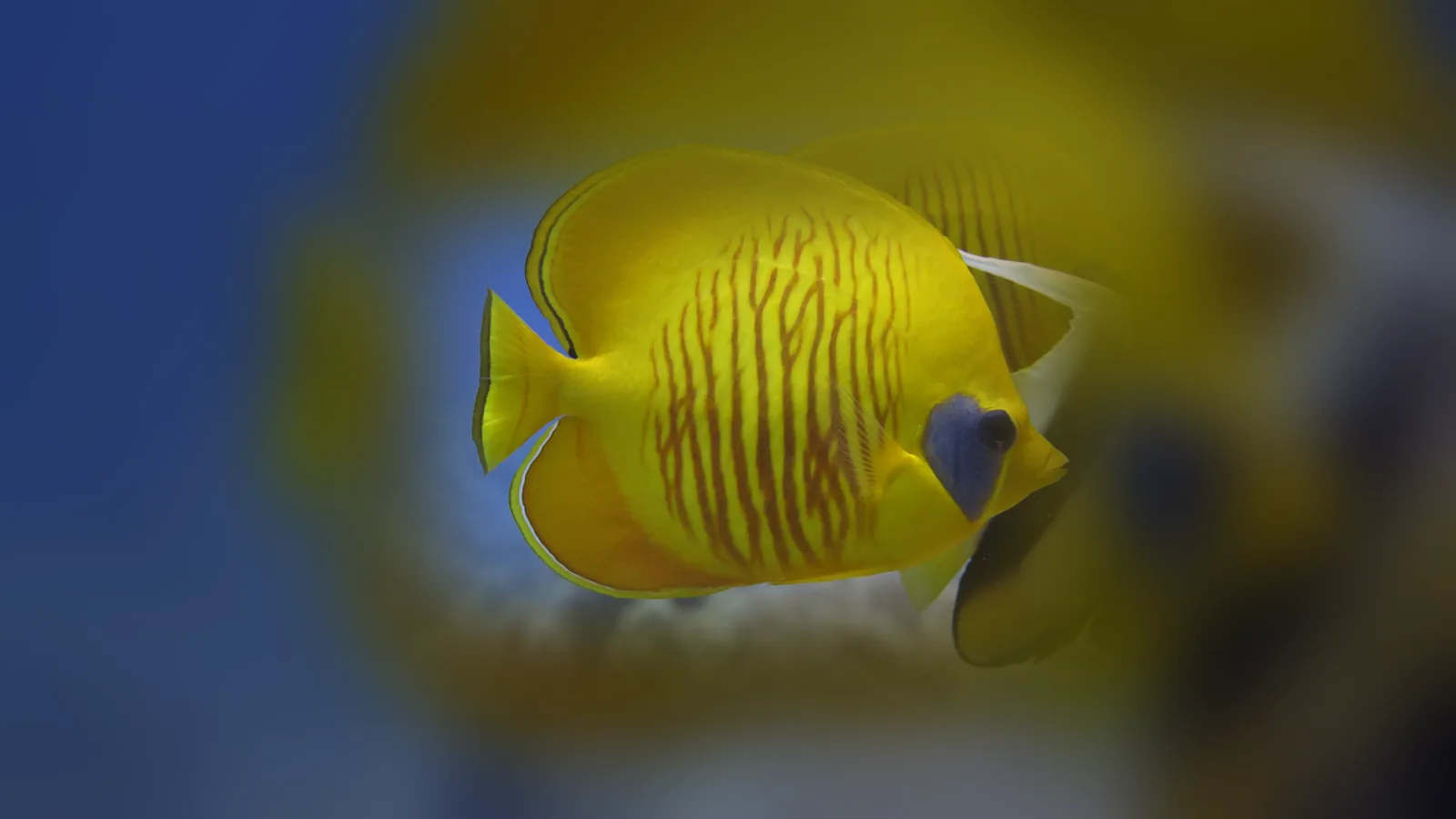
A Red Sea signature fish
If you want a single species that says "you are diving the Red Sea," the masked butterflyfish is a strong candidate. Chaetodon semilarvatus is a near-endemic of the Red Sea and the Gulf of Aden — the overwhelming majority of its entire world range lies inside the Red Sea, with only scattered records extending east along the Arabian coast toward Oman. That narrow distribution is why it is so closely associated with Egyptian diving: a golden butterflyfish with a blue-grey mask, drifting in a pair over the coral, is a sight you can reliably enjoy here and struggle to find anywhere else on the planet.
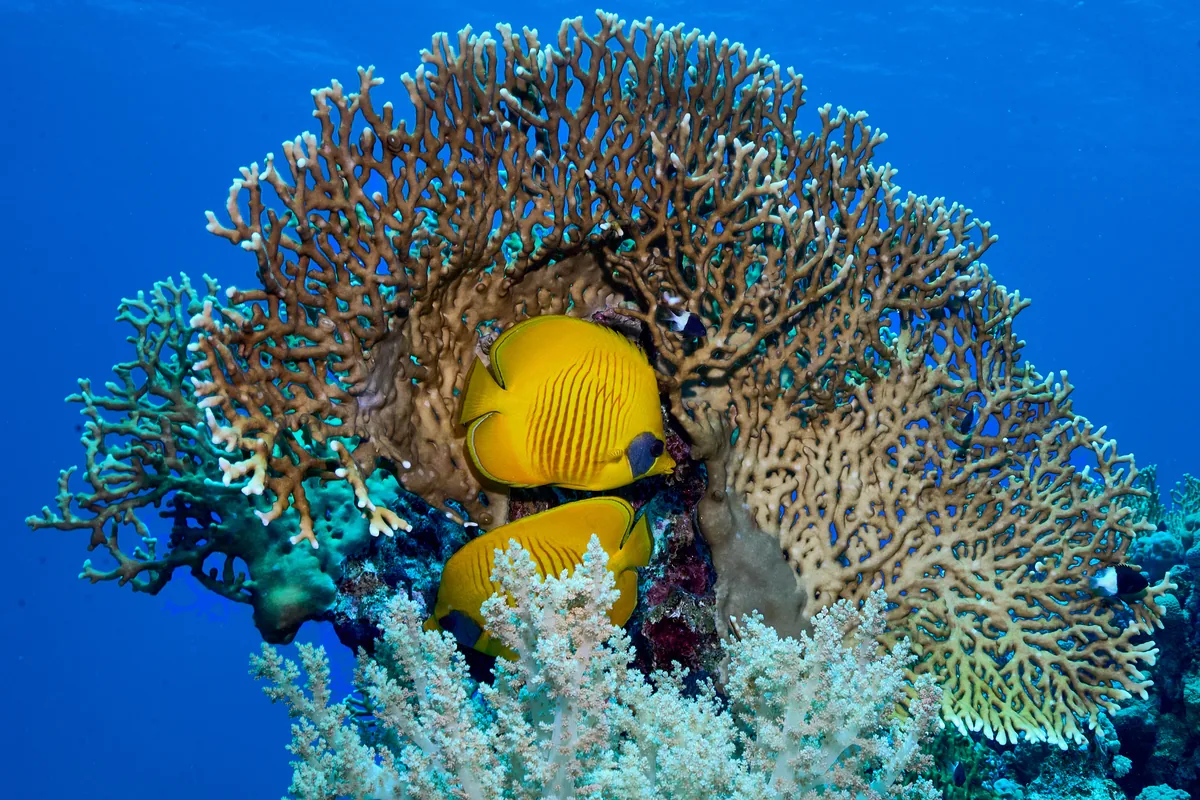
It is also one of the easiest reef fish to actually watch. Many butterflyfishes are restless, flitting from coral head to coral head and rarely holding still. The masked butterflyfish is calmer and more approachable, often hanging almost motionless in the open or under an overhang, which makes it a gift for divers and photographers alike. Within the Red Sea you will meet it across the whole coastline, from the coral gardens off Hurghada and Makadi Bay to the walls of Sharm El Sheikh and Ras Mohammed.
When to see them
Masked butterflyfish are present in the Red Sea all year, so there is no narrow "season" to plan around. They are resident reef fish tied to living coral rather than migratory visitors, which means water conditions matter more than the calendar month — warm, clear summer water simply makes them easier to enjoy on a long, relaxed dive. On practically any dive or snorkel over healthy coral, at any time of year, a pair or a small group is one of the more dependable sightings you will make.
Year-round resident Reliable on any healthy coral reef
How to recognise a masked butterflyfish
Few reef fish are quicker to name once you know the marks. Look for:
- Colour: A vivid, uniform golden-yellow across the whole body and fins — brighter and more saturated than most of its relatives, with no bold blocks of black or white.
- Fine vertical lines: About a dozen thin, close-set orange-to-reddish lines run down the flanks, giving the yellow a delicate pin-striped texture.
- The mask: A soft, diffuse blue-grey patch sits over and behind the eye. This is the key mark — most butterflyfishes disguise the eye behind a crisp black bar, but this species blurs it under a smoky "mask," which is exactly where the names masked and bluecheek come from.
- Shape and size: A tall, rounded, disc-shaped body typical of butterflyfishes. It is one of the larger members of the family, reaching about 23 cm, with most adults around 15 cm.
- Company as a clue: If you are looking at two identical golden fish moving as one, or a small cluster loafing under a coral table, you are almost certainly watching masked butterflyfish — they are rarely alone.
The only real look-alike is its close relative the Arabian, or blackfin, butterflyfish (Chaetodon melapterus), which shares the golden body and fine lines but carries obvious dark markings on the rear body, tail and fins. Inside the Red Sea, an all-golden butterflyfish with a blue-grey mask and no black is the masked butterflyfish.
Lifelong pairs and the table-coral siesta
The masked butterflyfish has two habits that make it a pleasure to watch. The first is its devotion to a partner. This is a monogamous species that forms long-term — often lifelong — pair bonds, a trait shared by only a handful of reef fish. A bonded pair swims, feeds and rests together, frequently mirroring each other's turns so precisely that they look like a single fish reflected in a mirror. They hold and patrol a shared stretch of reef, and a solitary individual is very much the exception.
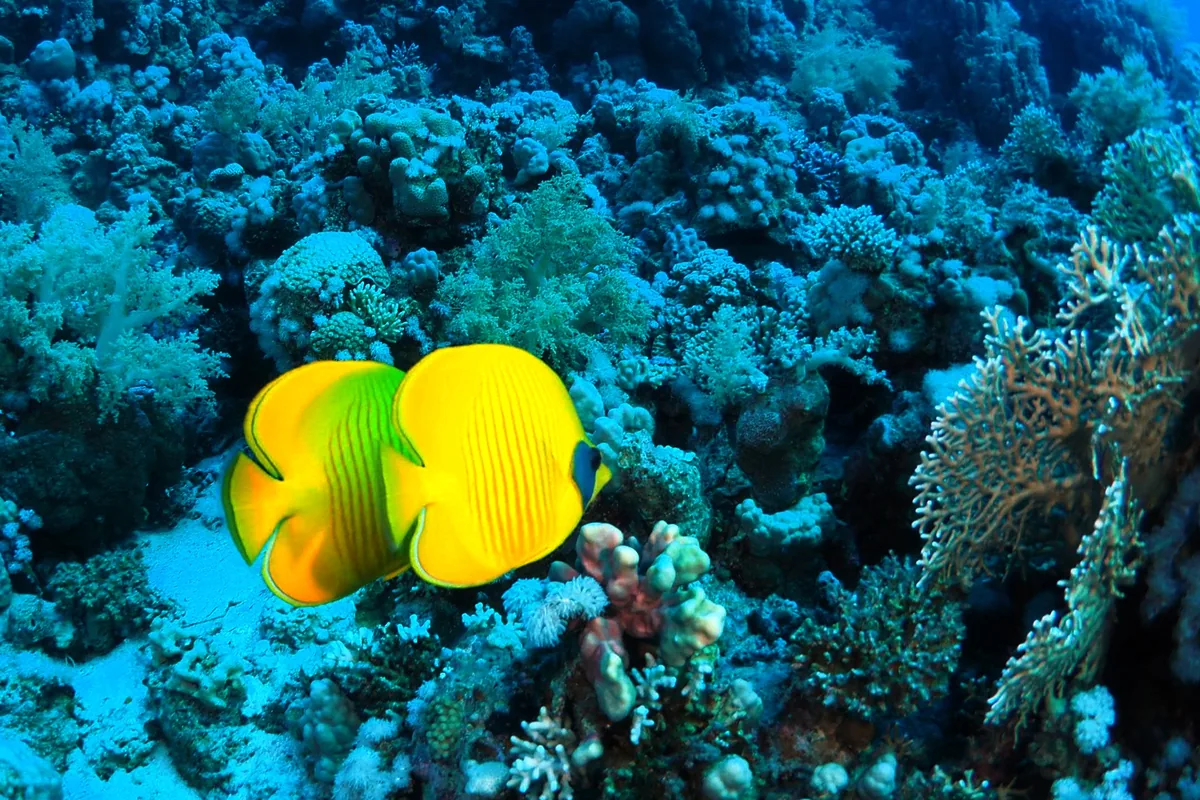
The second habit is the midday rest. Through the brightest part of the day, masked butterflyfish often gather in the shade beneath the ledges of table Acropora corals, hovering almost motionless for long stretches. Several pairs may share the same overhang, so a single big coral table can shelter a loose group of golden fish waiting out the sun. They become noticeably more active around dusk and into the night, when much of their feeding is done — so the quiet daytime huddle under a coral table is one of the most dependable ways to find them.
They are not aggressive fish, and their main defence is avoidance. A wary individual will sometimes turn side-on to a threat, presenting one flat golden flank and tucking the masked eye away — a posture thought to make it harder for a predator to judge which end is the head. Around divers they are usually relaxed, allowing a slow, calm approach that many other reef fish will not.
What masked butterflyfish eat
Masked butterflyfish are corallivores at heart. Their diet is built mainly around coral polyps, supplemented by small bottom-living invertebrates and plankton plucked from the water and the reef surface. The narrow, slightly extended snout typical of butterflyfishes lets them reach into crevices and pick delicately at individual polyps rather than biting off chunks of coral.
Because coral tissue is not a rich food, they have to eat often — grazing steadily through the day and continuing into the night. Their feeding is gentle and spread thinly across many different coral heads, so on a healthy reef it does no lasting damage; it is simply part of the constant, low-level cropping that keeps a reef community in balance. The flip side is that a fish so dependent on coral is also a quiet indicator of reef health: where the coral thrives, so do the butterflyfish.
Pairing and reproduction
The bonded pair is the centre of this species' life, and it is also the centre of its breeding. Masked butterflyfish are oviparous — egg-layers — and it is the established pair that spawns together rather than fish gathering in large mixed groups. Partners rise a little way off the reef and release eggs and sperm into the water, where fertilisation happens externally.
The fertilised eggs are buoyant and drift away as part of the plankton. The young hatch into tiny larvae that spend a period adrift in the open water before settling back onto a reef and taking on the golden colours of an adult. This planktonic drifting stage helps the species spread its young along the Red Sea's coastline, while the lifelong pair bond keeps the adults anchored to a familiar patch of reef year after year. There is no single spawning "season" that a diver needs to time — pairs are a constant feature of the reef throughout the year.
Watching and photographing them
Few reef fish reward patience as reliably as the masked butterflyfish. A few pointers make the most of an encounter:
- Move slowly and let the pair settle. These are calm fish; a relaxed, unhurried approach usually lets you get close, whereas chasing sends a pair skittering under the nearest coral.
- Work the coral tables. The shaded space under a plate of Acropora is where daytime groups gather — the single most reliable place to find several fish holding still together.
- Frame the pair, not just the fish. Two masked butterflyfish moving in unison make a far stronger image than one, and they naturally line up side by side for you.
- Protect the reef while you shoot. Stay neutrally buoyant and keep fins and gauges off the coral — the healthy hard coral these fish depend on is fragile, and it is also the backdrop that makes the photograph.
- Snorkellers get them too. Because they favour shallow, coral-rich water, masked butterflyfish are one of the golden highlights of a Red Sea snorkel, not only a scuba sighting.
Conservation status
The masked butterflyfish is listed as Least Concern on the IUCN Red List (assessed 2010). It is common and widespread across its Red Sea and Gulf of Aden range, is not a significant target of fisheries, and shows no evidence of a meaningful decline, so it sits comfortably outside any global threat category. It does appear in the marine-aquarium trade, but that pressure is not considered a threat at the population level.
The real long-term question for the species has nothing to do with any direct threat and everything to do with the reef beneath it. As a coral-eating fish tied to living hard coral, the masked butterflyfish is only ever as secure as the reefs it depends on. Coral bleaching and reef degradation are the concerns worth watching — which is one more reason that gentle, low-impact diving and snorkelling, and healthy Red Sea reefs, matter for this golden little resident.
Related Red Sea reef fish
Divers charmed by the masked butterflyfish often want to meet the Red Sea's other small reef characters — several of which, like the butterflyfish itself, are regional near-endemics found in few other places:
- Red Sea anemonefish (Amphiprion bicinctus) — the region's own clownfish, another Red Sea and Gulf of Aden near-endemic tied to a single patch of reef.
- Masked pufferfish (Arothron diadematus) — a Red Sea near-endemic that shares both the "masked" name and the golden fish's reef-loving habits.
- Lionfish — the reef's most ornate ambush predator, and a fixture of the same coral heads the butterflyfish patrols.
Read the companion guides to the Red Sea anemonefish and the masked pufferfish, meet the reef's showiest hunter in the lionfish guide, and for the bigger picture of diving these coral reefs see the complete guide to scuba diving the Red Sea. To browse the full encyclopedia, visit the Red Sea marine life guides.
Frequently asked questions
It is one of the easiest reef fish in the Red Sea to name. Look for a deep, disc-shaped body of bright golden-yellow crossed by about a dozen fine orange-to-red vertical lines, and a soft blue-grey mask smudged over and behind the eye. Most butterflyfishes hide the eye behind a hard black bar; the masked butterflyfish instead wears this diffuse blue-grey patch, which gives it both of its common names, masked and bluecheek.
The species is a near-endemic of the Red Sea and Gulf of Aden, with only scattered records extending east along the Arabian coast toward Oman. In practice the overwhelming majority of the world's masked butterflyfish live in the Red Sea, which is exactly why it is treated as one of the region's signature reef fish. A diver is far more likely to meet this species here than anywhere else on Earth.
They are monogamous and form long-term, often lifelong, pair bonds, which is unusual among reef fish. A bonded pair typically swims and feeds side by side and defends a shared patch of reef, so a lone masked butterflyfish is the exception rather than the rule. Seeing two together, mirroring each other's movements, is the normal picture.
They feed mainly on coral polyps, along with small bottom-living invertebrates and plankton picked from the reef. Because coral tissue is low in nutrients, they graze often through the day and into the night. Their feeding is gentle and spread across many coral heads, so it does no lasting harm to a healthy reef.
By day they often gather in the shade beneath the ledges of table Acropora corals, hovering almost motionless for long spells and sometimes forming loose groups of several fish. The overhang gives shelter from the sun and from passing predators. They become more active feeders around dusk and into the night, so the midday huddle under a coral table is one of the most reliable ways to find them.
It is listed as Least Concern on the IUCN Red List, assessed in 2010. It is common and widespread across its Red Sea and Gulf of Aden range with no evidence of a significant decline. Like all corallivorous reef fish it depends on healthy coral, so the main long-term concern for the species is the condition of the reefs themselves rather than any direct threat.
There is no season to plan around. The masked butterflyfish is a year-round resident seen on reefs throughout the Egyptian Red Sea, from Hurghada and Makadi Bay to Sharm El Sheikh. It favours coral-rich slopes and lagoons in the first few metres down to about twenty metres, so almost any reef dive or snorkel over living coral is a good chance to find a pair.