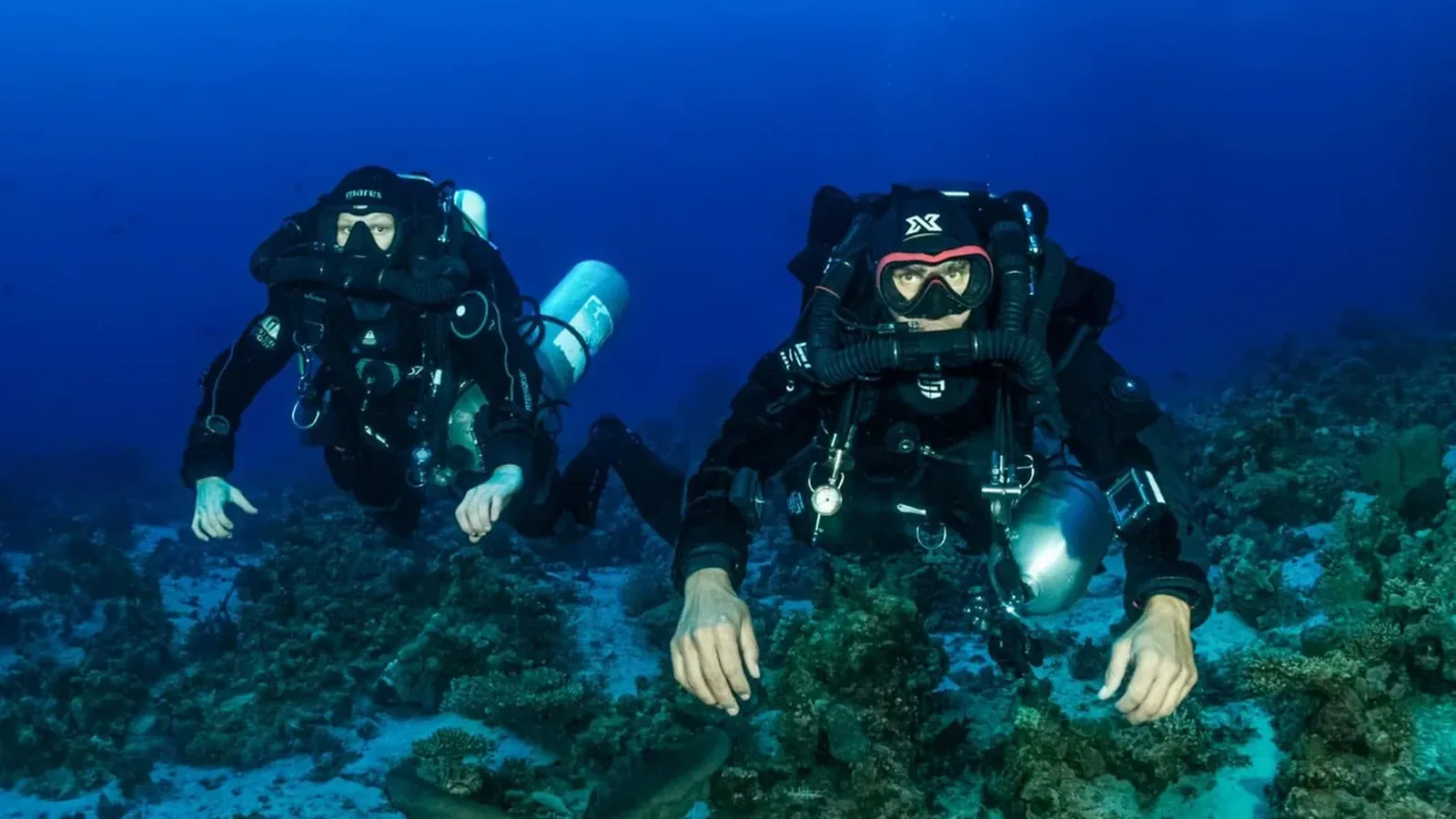
Technical diving opens the parts of the ocean that recreational diving deliberately leaves alone — deeper wrecks, longer bottom times, caves, and the twilight walls below forty metres. It is not simply "deep diving": it is a disciplined approach to planning, breathing gas and equipment that lets a diver accept a ceiling of mandatory decompression and still surface safely. This guide explains what technical diving is, how it differs from recreational diving, the gases and equipment involved, the training ladder that leads there, and where it is practised in the Egyptian Red Sea.
What is technical diving?
Recreational scuba diving is built around one simple safety rule: stay within the no-stop limits so that a direct ascent to the surface is always available. Technical diving begins where that rule ends. The widely used working definition is diving that goes beyond the normal limits of recreational diving — past the roughly 40-metre (130-foot) recreational depth ceiling, beyond the no-decompression limits so that staged decompression becomes mandatory, into overhead environments such as wrecks and caves where a direct ascent is impossible, or using breathing gases other than air and standard nitrox. A dive that commits a diver to stopping on the way up, or that places a physical or virtual ceiling between the diver and the surface, is a technical dive.
Because the surface is no longer an immediate escape, every technical dive is planned in detail before anyone enters the water: the depth and time, the gases to be breathed on the way down, along the bottom and during the ascent, the decompression schedule, and the response to foreseeable failures. The reward is access — the deeper reaches of a wreck, the base of a wall, bottom times long enough to explore properly — in exchange for accepting that planning, equipment and discipline, not luck, are what bring the diver home.
How technical diving differs from recreational diving
The clearest difference is the ceiling. A recreational diver can, in principle, ascend straight to the surface at any point in the dive. A technical diver often cannot: either a decompression obligation has built up, or an overhead blocks the way. That single change ripples through everything else.
- Depth: recreational diving is capped near 40 metres; technical dives routinely go deeper, which is where mixed gases become necessary.
- Gas: recreational divers breathe air or nitrox; technical divers may breathe helium-based blends on the bottom and oxygen-rich mixes for decompression.
- Equipment: recreational kit is built around a single cylinder; technical kit is built around redundancy, with duplicate gas supplies and backups for every critical component.
- Planning: recreational dives are flexible and computer-led within no-stop limits; technical dives follow a written plan with decompression schedules and contingency gas.
- Training and mindset: recreational courses teach a diver to enjoy the reef safely; technical courses train a diver to manage failures calmly while carrying a decompression obligation.
None of this makes technical diving "better" than recreational diving. It is a different activity with different goals, risks and rewards — and most technical divers happily do plenty of relaxed reef diving too.
Decompression and dive planning
Every breath underwater is pressurised, and the body steadily absorbs inert gas — nitrogen, and helium if it is in the mix — in proportion to depth and time. Ascend slowly enough and that gas comes back out through the lungs harmlessly. Ascend too fast, or after absorbing too much, and it can form bubbles: decompression sickness.
Recreational diving avoids a mandatory stop by staying inside the no-stop (no-decompression) limits — the maximum time that can be spent at a given depth while still ascending directly. Those limits shrink quickly with depth: very roughly an hour in the shallows around 18 metres, falling to only a handful of minutes near 40 metres, with the exact figures depending on the dive table or computer and its settings. Technical divers deliberately exceed these limits, which means they take on a decompression obligation — a series of staged stops, at progressively shallower depths, that must be completed before surfacing.
A technical dive is therefore planned as a run-time: a minute-by-minute schedule of descent, bottom time, gas switches and decompression stops, produced by desktop software or a dive computer running a decompression algorithm. Modern planning tools let the diver tune how conservative the schedule is, usually through "gradient factors" — a pair of numbers that pad the theoretical limits with an extra safety margin. The take-away for a newcomer is simple: in technical diving, the ascent is the dive. The time spent going up, stopping and off-gassing is often far longer than the time spent on the bottom, and it is not optional.
Breathing gases: nitrox, trimix and oxygen
Air is about 21 percent oxygen and 79 percent nitrogen, and it serves recreational diving well. Go deeper and longer, though, and two problems appear: nitrogen becomes narcotic — the familiar "narcosis" that dulls judgement at depth — and as pressure rises every gas becomes denser and harder to breathe. Technical diving solves both with helium, and manages the whole picture with careful gas planning.
- Nitrox (enriched air) simply raises the oxygen fraction above 21 percent. It does not let a diver go deeper — in fact extra oxygen lowers the safe depth limit — but it reduces inert-gas loading and is widely used as a decompression gas.
- Trimix adds helium to the blend, giving a three-gas mixture of oxygen, helium and nitrogen. Helium is light and far less narcotic than nitrogen, so replacing some nitrogen with helium keeps a diver clear-headed and keeps the gas breathable at depth. Divers describe this with "equivalent narcotic depth" — the shallower depth at which air would feel the same — and choose the helium content so the narcotic load stays manageable.
- Oxygen is the limiting gas going down. Its partial pressure — the oxygen fraction multiplied by the surrounding pressure — rises with depth, and above a certain level it becomes toxic. Technical divers plan each gas to a maximum operating depth (MOD): the depth at which its oxygen partial pressure reaches a chosen ceiling, commonly around 1.4 bar for gas breathed on the bottom and up to about 1.6 bar for decompression gas breathed briefly at shallow stops. Because air alone reaches that bottom limit at roughly 56 metres, deeper dives must reduce the oxygen fraction and make up the difference with helium.
- Decompression gases run the other way: on the ascent, divers switch to oxygen-rich mixes — anything from 50 percent nitrox to pure oxygen at the shallowest stops. The richer the oxygen, the faster the inert gas leaves the body, shortening the required stops.
Getting these numbers right — and labelling every cylinder so the correct gas is breathed at the correct depth — is a core technical skill, drilled in training, not an afterthought.
Equipment and redundancy
The governing principle of technical equipment is redundancy: because the diver cannot simply surface, every life-support function must have a backup.
- Twinset (back-mounted doubles): two cylinders joined by a manifold with two first-stage regulators, so a single regulator failure still leaves a working gas supply. This is the classic back-mounted technical configuration.
- Sidemount: cylinders worn one on each side rather than on the back. It gives the same redundancy, is kinder on the body out of the water, and is favoured for wrecks and caves because the profile is slimmer and each cylinder is fully visible and can be shut off independently.
- Stage and decompression cylinders: additional cylinders clipped to the harness carrying travel gas, extra bottom gas, or the oxygen-rich decompression mixes, switched during the dive according to the plan.
- Closed-circuit rebreathers (CCR): rather than venting every exhaled breath, a rebreather recycles the diver's gas — a scrubber removes carbon dioxide while the unit adds a little oxygen to hold a target partial pressure. The result is dramatically longer gas duration, near-silent diving, warm and moist breathing gas, and efficient decompression — at the cost of far greater complexity and a demanding maintenance and training regime.
Around these sit the rest of the technical kit: a wing and backplate for stable buoyancy and lift, two cutting tools, redundant dive computers or backup tables, a reel and surface marker buoy for signalling a decompression ascent, and a drysuit on cooler or longer dives. The standardisation of this gear — so that any trained team member can locate any critical item in an emergency — is itself part of the discipline.
The technical training ladder
Technical diving is taught step by step, and the major agencies — TDI, PADI (through its TecRec programme) and IANTD among them — follow broadly the same progression even where the course names differ. Each step is a multi-day, skills-first course: buoyancy, trim, propulsion, gas planning and, above all, the calm handling of failures are drilled far more than any single "deep" dive.
A representative open-circuit ladder runs:
- Intro to Tech — the bridge from recreational diving. It introduces technical equipment, refines trim and buoyancy to a fine standard, and teaches team procedures, with no decompression obligation yet.
- Advanced Nitrox — using richer nitrox and multiple cylinders, and the foundation of gas planning.
- Decompression Procedures — the first planned staged-decompression dives, typically to around 45 metres. These last two are often taught together as one combined course.
- Extended Range — extending air (or light helium mixes) and staged decompression toward about 55 metres.
- Trimix — adding helium for depths beyond roughly 60 metres, where narcosis and gas density make air unsuitable.
PADI's TecRec route expresses the same idea as Tec 40, Tec 45 and Tec 50 — progressively deeper staged-decompression dives — followed by its Tec Trimix courses. Closed-circuit rebreather training runs as a parallel branch, with its own graded courses from entry-level air-diluent diving up through mixed-gas CCR. Prerequisites tighten at each step — a mix of minimum age (18), a set number of logged dives, prior certifications and a recent dive medical — so the exact requirements are worth confirming with an instructor before enrolling. For the recreational foundation that comes first, see the PADI pathway from Open Water to Divemaster.
Is technical diving for you?
Technical diving rewards preparation and temperament more than daring. The divers who thrive in it tend to share a few things:
- Solid recreational experience: a comfortable, current diver with a meaningful number of logged dives, typically holding Advanced Open Water and a Deep specialty, is the usual starting point.
- Excellent buoyancy and trim: the ability to hold a stop to within a metre, hover motionless and fin without stirring the bottom — because technical skills are layered on top of flawless watermanship.
- Physical and medical fitness: longer dives, heavier equipment and the physiological stress of decompression demand genuine fitness and a clean dive medical.
- The right mindset: methodical, honest about limits, willing to call a dive, and comfortable with checklists, drills and conservatism. Technical diving has no place for ego.
Anyone unsure is best served by building recreational experience first — more dives, better buoyancy, a Deep course — and then being assessed honestly by a technical instructor, who can say plainly whether a diver is ready or what to work on first.
Technical diving in the Egyptian Red Sea
The Egyptian Red Sea is one of the world's great technical-diving arenas, and Hurghada is a natural base for it: sheltered year-round conditions, warm water, deep offshore reefs and a concentration of historic wrecks all within reach.
- The SS Thistlegorm, a British WWII supply ship sunk on 6 October 1941 in the Strait of Gubal, lies at roughly 16 to 32 metres with holds still full of wartime cargo. Much of it is within advanced recreational range, but its depth, penetration and frequent current make it a classic objective for technical training and practice.
- The reef of Abu Nuhas, a few hours north of Hurghada, holds a cluster of wrecks — the Giannis D, Carnatic, Chrisoula K and Kimon M — spread from shallow water down past 30 metres, a superb setting for staged wreck and decompression diving.
- Further offshore, the Brothers Islands, Daedalus and Elphinstone rise from very deep water as sheer walls. Their reefs are spectacular for advanced recreational divers, but their depths run far beyond the recreational limit — the Brothers' wrecks, the Numidia and the Aida, descend from the shallows to well past 60 metres — making them genuinely technical terrain, usually reached by liveaboard.
- The record books underline the point: in 2014, Egyptian technical diver Ahmed Gabr set the Guinness World Record for the deepest scuba dive — 332.35 metres — off Dahab on Egypt's Sinai coast, a feat that still stands.
Warm, clear, current-swept and deep, the Egyptian Red Sea offers the full range of technical objectives — deep reefs, deep wrecks and extended-range exploration — from a single, accessible coastline. For the wider picture of the region's diving, see the complete guide to scuba diving the Red Sea, and for the famous shore dives of the Sinai coast, the Dahab Blue Hole and Canyon guide.
How to get started
The sensible first move is honest self-assessment and a conversation with a reputable technical academy. Look for an instructor who dives what they teach, trains in small groups, insists on buoyancy and trim before depth, and is candid about whether a diver is ready. From there the path is incremental: an Intro to Tech or equivalent to confirm the foundations, then Advanced Nitrox and Decompression Procedures, building logged experience between courses, before committing to extended-range, trimix or rebreather training. Rushing the ladder is the one guaranteed mistake; depth is earned one well-drilled step at a time.
Start your technical journey in Hurghada
Double Wing Tek is the Red Sea's technical-diving academy in Hurghada, led by world-record holder Ahmed Gabr — open-circuit and rebreather courses, mixed gas on site, and the deep wrecks and walls on the doorstep. Learn more at doublewingtek.com.
Explore Double Wing Tek →Related: For the recreational foundation that comes first, see the PADI Open Water course guide, and for planning when to visit, the month-by-month best time to dive the Red Sea.
Frequently asked questions
What is technical diving?
Technical diving is scuba diving that goes beyond the limits of recreational diving. That means diving deeper than the roughly 40-metre recreational ceiling, exceeding the no-decompression limits so that staged decompression stops become mandatory, entering overhead environments such as wrecks and caves, or breathing gas mixtures other than air and standard nitrox. Because a direct ascent to the surface is no longer always possible, every technical dive is planned in detail in advance.
How is technical diving different from recreational diving?
The key difference is the ceiling. A recreational diver can ascend directly to the surface at any time; a technical diver often cannot, because of a decompression obligation or an overhead environment. Technical diving also uses redundant equipment with duplicate gas supplies, often mixed breathing gases such as trimix, and a detailed written dive plan rather than the flexible, computer-led profiles of recreational diving.
Do I need to learn trimix to start technical diving?
No. Technical training is a step-by-step ladder. Most divers begin with an entry-level course such as Intro to Tech, then Advanced Nitrox and Decompression Procedures, which cover staged decompression to around 45 metres on nitrox and oxygen. Trimix, which adds helium for deeper dives, comes later in the progression once the foundational skills are solid.
How many dives do I need before starting technical training?
Requirements vary by agency and course, but technical training expects solid recreational experience first. Entry-level technical courses typically ask for an Advanced Open Water certification, a Deep specialty or equivalent, a minimum age of 18, a number of logged dives, and a recent dive medical. Excellent buoyancy and trim matter more than any single number, so confirm the exact prerequisites with a technical instructor.
Is technical diving dangerous?
Technical diving carries higher risk than recreational diving because the surface is not always immediately reachable. It manages that risk through training, redundant equipment, conservative planning and disciplined procedures. The divers who do it safely are methodical, honest about their limits and willing to call a dive. It is not an activity for cutting corners or diving beyond your training.
Where can you go technical diving in the Egyptian Red Sea?
The Egyptian Red Sea offers deep wrecks and deep offshore reefs ideal for technical diving. From Hurghada, the SS Thistlegorm (about 16 to 32 metres) and the reef wrecks of Abu Nuhas are classic objectives, while the offshore Brothers Islands, Daedalus and Elphinstone drop far below recreational depth and are usually reached by liveaboard. In 2014 Egyptian diver Ahmed Gabr set the world record for the deepest scuba dive, 332.35 metres, off Dahab.
How long does it take to become a trimix or rebreather diver?
There is no fixed timeline, because each step requires experience built between courses rather than a quick sequence of classes. A diver typically spends months progressing from an entry-level technical course through Advanced Nitrox, Decompression Procedures and extended-range diving before trimix, logging dives at each stage. Closed-circuit rebreather training is a separate, equally demanding path with its own graded courses.