
Everyone remembers their first breath underwater. Not the paperwork, not the theory, not the wetsuit wrestling — the single moment they knelt in shallow water, put their face under for the first time, and breathed, against every instinct they had. Most blogs about learning to dive hand you a checklist: three days, five skills, eighteen metres. This isn't that. This is what it actually feels like, moment by moment — the nerves, the first breath, the skills people dread and why they turn out easy, the awkward parts nobody mentions, and the strange, lasting calm you bring back up with you. If you've ever wondered whether you could do it, read this first.
Before you start: the nerves everyone feels
Almost everyone arrives for their first day a little nervous, and almost everyone is nervous about the wrong thing. The imagination goes to sharks, to being deep, to running out of air. The reality is much smaller and gentler: you'll spend your first hours in water shallow enough to stand up in, learning to breathe.
It helps to kill the biggest myth early: you do not need to be an athlete or a powerful swimmer. Learning to dive asks for comfort in water, not fitness. There's a basic swim — 200 metres in any stroke with no time limit, or 300 metres with mask, fins and snorkel — and a ten-minute float. No clock, no style marks. It's a check that water doesn't panic you, nothing more. Diving itself is famously undemanding physically: done well, it's slow, still and calm. If you can relax in a swimming pool, you have the raw material.
Wondering whether to snorkel or take the plunge into scuba? The honest comparison in snorkeling vs scuba diving is a good place to weigh it up. And for the practical side — how many days, how much it costs, where to do it — the PADI Open Water course guide is the companion to this one.
The theory — and the one golden rule
Before you get wet, there's some theory. These days most of it is done online, at your own pace, before you even arrive — short chapters and videos on how pressure, air and your body interact underwater. It sounds dry; it's actually the part that makes everything click, because it answers the question your nervous system keeps asking: why is this safe?
You'll learn a handful of simple ideas that turn diving from magic into mechanics: that air is denser the deeper you go, that your ears need "equalising" as you descend — a gentle pinch of the nose and blow, or a swallow, started at the very surface and topped up every metre or so, always gently and never forced — and that you plan your depth and time so your body offgasses safely. But if you remember one thing from the whole course, it's the golden rule, repeated until it's reflex: breathe continuously and never hold your breath. Slow breath in, slow breath out, always. Everything else is detail; that one habit is the heart of safe diving.
The course itself has a simple, unhurried shape. First the online theory; then a handful of sessions in shallow, pool-like confined water, where every skill is learned and repeated until it feels second nature; then four dives in the open sea, where you put it all together and the certification is earned. Most people complete the in-water part over three or four days — there is no rush, and no going deep until you're ready.
The reassuring truth underneath all the theory is that modern recreational diving is a slow, methodical, deeply rehearsed activity. Nothing happens fast. For the bigger picture of where and how people dive, the complete guide to scuba diving the Red Sea sets the scene.
The first breath
Then comes the moment the whole course pivots on. You're standing or kneeling in shallow, warm, pool-like water — the "confined water" where every skill is first learned. The regulator is in your mouth. Your instructor gives the signal to lower your face and take a breath.
And here your body rebels. Fifty thousand years of instinct scream that you do not inhale with your face underwater. There's a pause — every diver has it — a half-second of surely not. And then you breathe in, and you hear it: a slow, mechanical hiss, cool dry air filling your lungs, completely normal, completely calm. You breathe out and watch your bubbles wobble up to the surface. You breathe again. It works. It just... works.
That's the moment. For most people the fear doesn't fade slowly — it drops away almost at once, replaced by a kind of stunned delight. You're kneeling underwater, breathing, looking around, and some part of your brain is quietly losing its mind at how ordinary it feels. Instructors watch for the exact second it happens: the shoulders come down, the eyes go wide behind the mask, and a stream of bubbles turns into something that's obviously a laugh.
The "scary" skills, and why they aren't
Once you're breathing, the confined-water sessions build a small set of core skills. Beginners dread two or three of them by name. Here's what they actually feel like — and why they're built to reassure you, not test you.
Clearing your mask
This is the one people fear most: letting a little water into your mask on purpose, then pushing it back out. It sounds awful and feels strange exactly once. You tilt your head back slightly, press the top of the mask, and breathe out through your nose — and the water simply rolls out the bottom, pushed by your own breath. The first time, the cool water on your face makes you flinch. By the third time, it's a shrug. And now a leaky mask on a real dive is a non-event, not an emergency. That's the whole point: you practise the thing you're afraid of until it's boring.
Finding your regulator
You'll learn to take the regulator out of your mouth and put it back — and to sweep your arm and find it if it's ever knocked loose. It feels vulnerable the first time and trivial the fifth. Underneath the drill is a simple promise the course is making you: if something comes out of your mouth, you know exactly how to get it back. That knowledge is what lets you relax.
Sharing air
You'll practise breathing from your buddy's spare regulator, and them from yours. It's the buddy system made real — the reason you never dive alone. Far from being frightening, most people find it oddly reassuring: you finish it knowing that even in the rare event someone has a problem, there's a calm, rehearsed answer you've both done a dozen times.
The "what if I run out" skill
You'll also do a slow, controlled swim to the surface breathing out gently the whole way — the answer to the fear every beginner has. You'll almost certainly never need it. Doing it once, calmly, in shallow water, quietly deletes the worry from the back of your mind for good.
Finding neutral — the flying feeling
If the first breath is the moment that hooks you emotionally, neutral buoyancy is the one that hooks you for life. It's the skill of balancing the air in your lungs and buoyancy jacket so that you neither sink nor float — you simply hang, weightless, in mid-water.
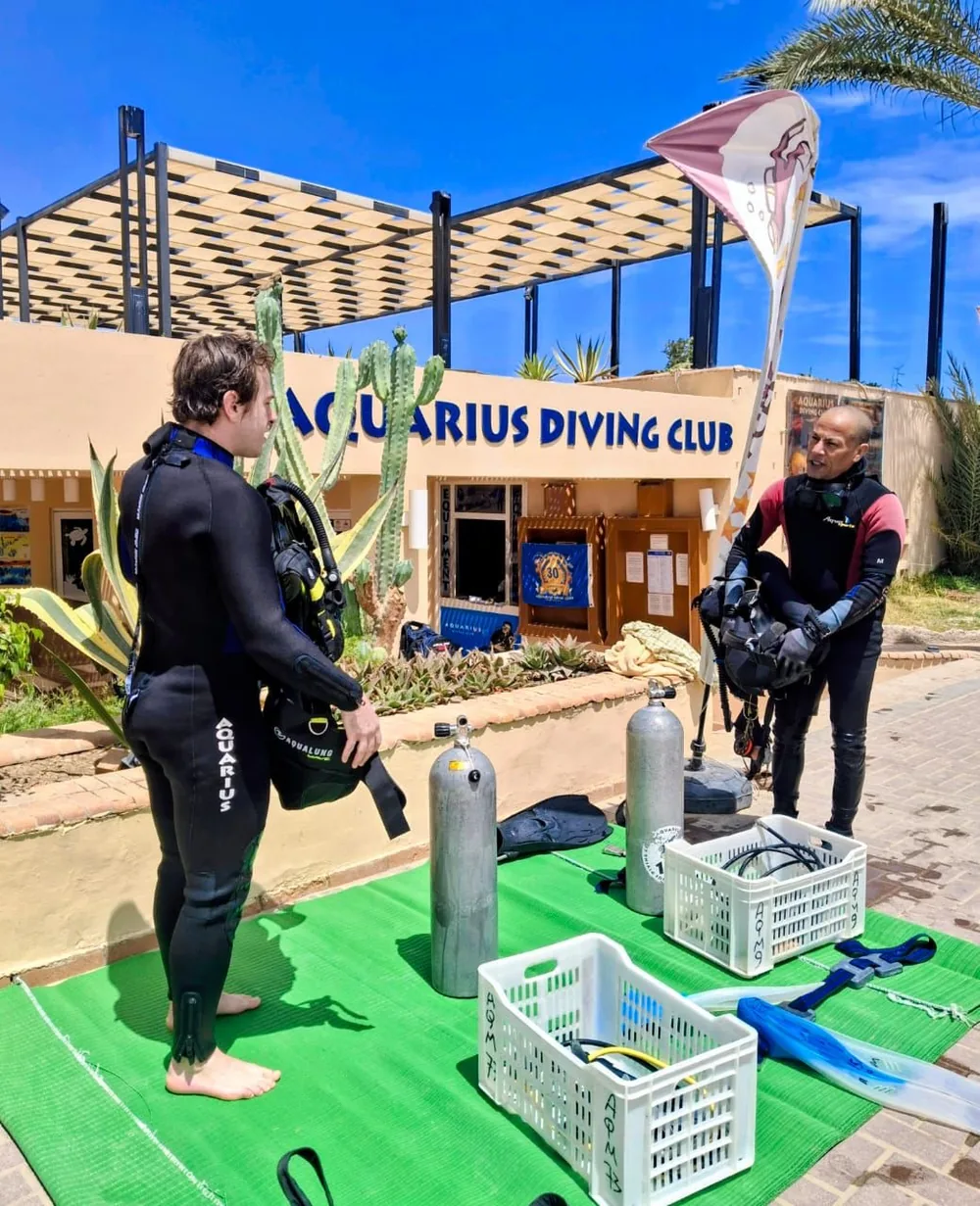
On land the scuba kit — a mask and fins, a wetsuit, a buoyancy jacket (the BCD), a cylinder of air, a few weights and the regulator you breathe from — is heavy and awkward; you'll clump about feeling like an overloaded turtle. The instant you're underwater and neutrally buoyant, all of that vanishes. The weight is gone. A tiny breath in and you drift up; a slow breath out and you sink, gently, controlled entirely by your own lungs. Divers reach for the same word every time: flying. Hovering motionless over a reef, moving only when you choose to, is as close to weightless flight as most people will ever come — and it's the feeling that turns a person who "tried diving once" into a diver.
Your first real dives
After the confined-water skills come the four open-water dives — the real thing, in the sea, usually spread across two days, where the certification is earned. This is where a warm, clear, gentle location matters enormously, because your first descent into open water is a genuinely emotional moment and it's far easier when the water is 26°C and you can see thirty metres.
You descend slowly down a line or a gentle slope, equalising your ears as you go, the surface light stretching and rippling above you. And then the reef resolves out of the blue: coral, and colour, and fish that don't particularly care that you're there. The skills you rehearsed in the shallows you now repeat here, calmly, and in between them you're simply diving — finning slowly, breathing slowly, watching. Most people surface from their first open-water dive unable to stop talking. For where and when the water is at its best, see the best time to dive the Red Sea.
The bits nobody warns you about
Every honest diver will admit there are small, unglamorous realities the brochures skip. None of them matter, and knowing them in advance makes the first day smoother:
- The wetsuit is a wrestling match. Getting into a snug wetsuit, slightly damp, is an undignified two-minute struggle for everyone. You will not look elegant. Nobody does.
- You spit in your mask. The classic anti-fog trick really is a bit of saliva rubbed around the lens and rinsed. It's gross, it's traditional, and it works.
- The regulator tastes faintly of rubber for the first few breaths, and you'll dribble a little. Within a dive you stop noticing entirely.
- Your ears set the pace, not your nerve. You equalise from the very surface and keep topping up every metre or so; if an ear won't clear, you stop, rise a little, and try again gently — forcing it is the one thing you never do. Descending is a patient business, and that's normal.
- You'll have mask marks on your face and salt in your hair afterwards, and you genuinely won't care.
- You'll be tired and hungry in the best way. Diving is calm, but the sun, sea and concentration add up — the post-dive appetite is real.
None of this is a warning. It's the texture of the thing — and every diver remembers it fondly.
What changes in you
Here's the part that genuinely surprises people. Learning to dive changes something in how you are, not just what you can do.
Underwater, panic is the one real enemy, and the whole practice is built to defeat it with slowness: slow breathing, slow movement, deliberate calm. Spend a few days training your body to stay serene while doing something that once frightened you, and a little of that follows you back to the surface. Divers talk about the "diver's calm" — a slower breath, a steadier response to small stresses — and it's real. You also come away with something concrete: an entry-level certification, such as PADI Open Water Diver, that lets you dive with a buddy to 18 metres anywhere in the world, for life. Two thirds of the planet is underwater, and you've just been handed the key.
Most people don't stop there. Once the gear disappears and the reef takes over, the natural next step is to go deeper and see more — the path from Open Water to Divemaster maps where it leads.
Is it for you?
A few honest checks, because diving should be joyful, not forced:
- Age: children can start young — entry-level training begins at 10 years old (with shallower depth limits for the youngest), and there's no upper age limit at all. Plenty of people learn in their 50s, 60s and beyond.
- Swimming: comfort in water, yes; competitive strokes, no. The basic swim and float are gentle.
- Health: you'll fill in a short standard medical questionnaire. Most people tick every box "no" and are cleared on the spot; a "yes" doesn't disqualify you — it simply means a doctor should sign off first. Conditions that call for that include asthma and heart or lung problems, or being 45-plus with risk factors like high blood pressure or smoking; anyone pregnant should wait. It's a sensible safety screen, not a hurdle for the healthy.
- Nerves: being nervous is not a reason not to dive — it's the normal starting point. The course is designed around it.
If you're specifically worried about safety rather than the feel of it, that deserves its own honest answer — and a good instructor will happily talk you through every "what if" before you ever get in the water.
Where to start
You can begin in one of two ways. A taster dive (often called Discover Scuba Diving) gives you that first-breath moment and one supervised dive, with no commitment — the perfect way to find out if you love it. Or you can go straight for the full Open Water certification, the three-to-four-day course that makes you a diver for life. Many people do the taster on holiday, fall for it, and come back for the full course.
The Red Sea is one of the finest classrooms in the world for it: warm water year-round, superb visibility, calm sheltered bays for training, and an abundance of patient, multilingual instructors. Aquarius teaches the full PADI pathway — from a first taster dive to Open Water and beyond — across its Red Sea centres, in small groups, at your pace. Start your Learn to Dive journey, tell the team you're brand new, and the first breath will be waiting.
Frequently asked questions
What does breathing underwater for the first time feel like?
Strange, then wonderful. Every instinct tells you not to inhale with your face in the water, so the first breath through a regulator takes a small act of trust. Once you take it and hear the calm hiss of air, the fear usually dissolves within a minute or two, replaced by a kind of quiet amazement that you can simply stay down there and breathe. Almost every diver remembers that first breath for the rest of their life.
Is learning to scuba dive scary?
There are a few moments of nerves — the first breath, the first time you flood and clear your mask — but the course is deliberately built to move slowly, in shallow, pool-like water, with an instructor beside you the whole time. Each skill is broken down and practised until it feels routine before you go any deeper. Most people are surprised by how quickly the nerves turn into calm.
Do you have to be a strong swimmer to learn to dive?
No. You need to be comfortable in water, not athletic. The entry-level course asks you to swim 200 metres (any stroke, no time limit) or 300 metres with mask, fins and snorkel, and to float or tread water for 10 minutes. There is no speed, no clock and no style requirement — it is a basic comfort check, not a fitness test.
What is the hardest part of learning to dive?
For most people it is mental, not physical — trusting that you can breathe with water around your face, and the first mask-clearing skill where you let a little water in and blow it back out. Neither is actually difficult; both feel odd the first time and easy by the third. Equalising your ears on the way down is the other thing beginners think about, and it is simply a matter of doing it early and often.
How long before it feels natural?
Usually faster than people expect — often within the first confined-water session. The first breath is the big hurdle; after that, each skill practised in shallow water builds confidence, and by the open-water dives most beginners are relaxed enough to stop thinking about the gear and start watching the reef. Genuine, effortless comfort keeps growing over your first ten to twenty dives.
What certification do you get, and does it expire?
The entry-level course (such as PADI Open Water Diver) certifies you to dive with a buddy to 18 metres anywhere in the world, and the certification does not expire. If you have a long break from diving, a short refresher is recommended to shake off the rust, but the card itself is for life.