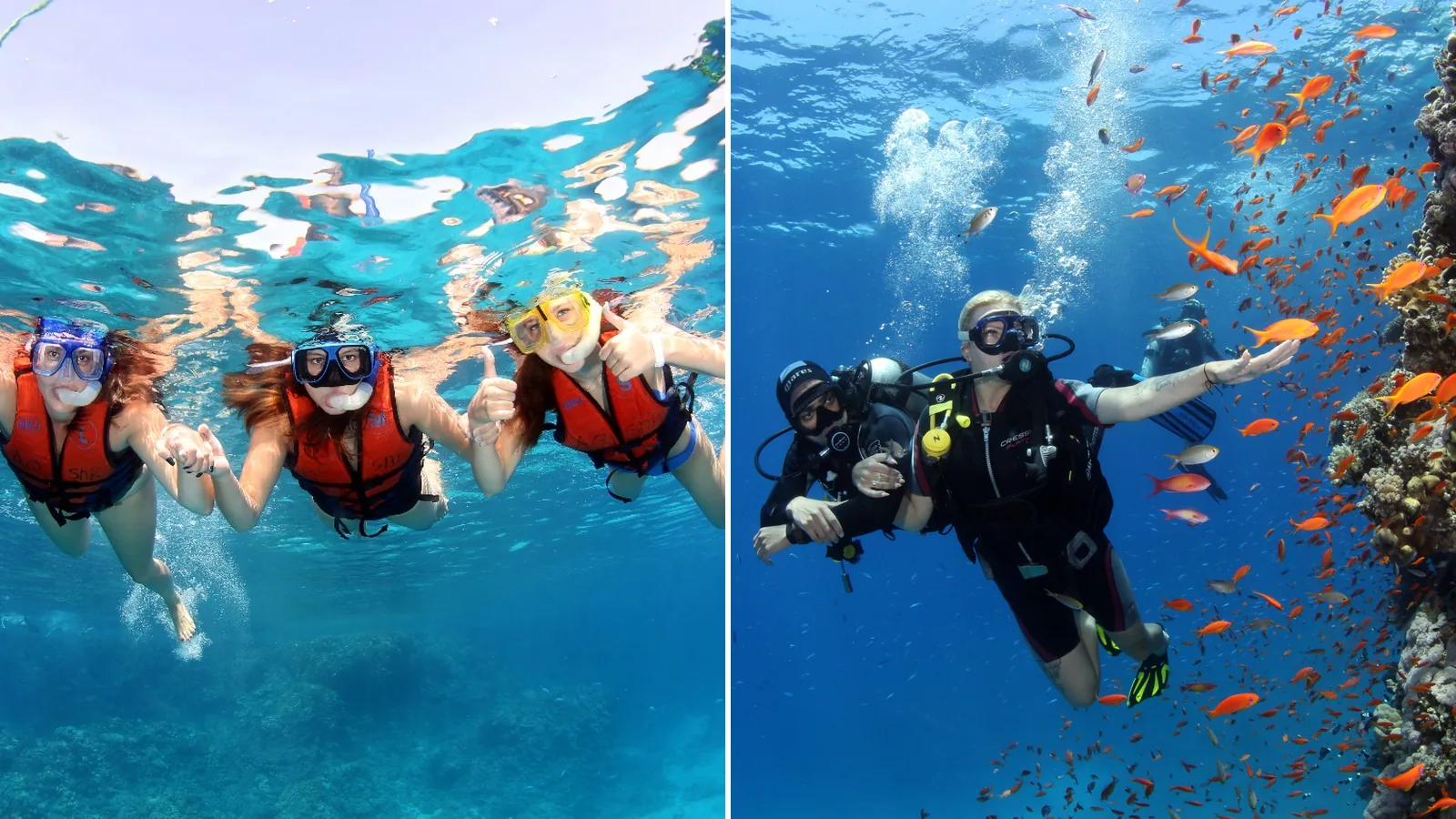
It's the question almost every Red Sea first-timer asks before booking: should I snorkel, or should I learn to dive? After 30 years of running boats out of Hurghada and Sharm El Sheikh, here is the honest answer — they're not rivals, they answer different questions, and the right choice depends on who's travelling, what you want to see, and how far you want to take it. This guide compares the two side by side, tells you what you'll actually see at each, and shows the simplest ways to start.
The quick difference
In one sentence: snorkeling is looking down at the reef from the surface; scuba diving is going down into it.
Snorkeling means floating face-down on the surface with a mask, snorkel and fins, breathing through the tube while you watch the reef below. You stay at the top of the water column. Scuba diving means carrying a tank of air on your back so you can breathe underwater and stay down — getting eye-to-eye with the coral, the fish, and everything that lives below the surface. Both are wonderful in the Red Sea, which has some of the clearest, warmest, most colourful water on Earth. Many visitors do both in the same week.
| Snorkeling | Scuba diving | |
|---|---|---|
| Where you are | Surface, looking down | Underwater, in the reef |
| Typical depth seen | Reef top, ~1–5 m | 5–18 m (try-dive to 12 m); deeper when trained |
| Experience needed | None | None for a try-dive; a course to dive independently |
| Minimum age | None | 8 (pool taster) / 10 (try-dive & junior course) |
| Must you swim? | No — a buoyancy vest keeps you afloat | Yes, to certify: 200 m swim + 10 min float |
| Best for | Families, kids, non-swimmers, casual reef-watching | Getting close to marine life, wrecks, the full reef |
| Gear | Mask, snorkel, fins, vest | Mask, fins, wetsuit, tank, regulator, BCD |
What you see snorkeling
Don't underestimate Red Sea snorkeling — it is far from a consolation prize. The region's reefs rise almost to the surface, so the busiest, most colourful zone of the reef is exactly the part a snorkeler floats over. In the top few metres you'll see:
- Hard and soft corals in reds, oranges, purples and golds, often within touching distance below you (don't touch — look only).
- Reef fish in clouds — clownfish in their anemones, parrotfish grazing the coral, sergeant majors, butterflyfish, angelfish and shoals of glassfish.
- Visibility that regularly exceeds 30 metres in protected areas such as the Giftun Islands, so you see the reef clearly even from the surface.
- Wild spinner dolphins on dedicated dolphin trips to reefs like Shaab El Erg (the "Dolphin House") — pods visit daily in season, and you watch from the surface (you may not chase or touch them; it's the law).
- The occasional turtle or ray drifting up into the shallows.
What snorkeling can't show you: the reef wall and its caves and overhangs, the deeper coral gardens, wreck interiors, and the larger animals that tend to stay below 10 metres. For all of that, you need to go down. (More on the marine life in our spinner dolphin and green turtle guides.)
What you see scuba diving
Scuba diving opens up everything below the surface. As a beginner diving to 12–18 metres you'll drift along reef walls and through coral gardens, hovering weightless beside the same fish a snorkeler sees from above — but now at their level — plus the animals that live deeper:
- Moray eels tucked into the reef, groupers, Napoleon wrasse (a Red Sea favourite), lionfish, and bigger schools of fusiliers and snapper.
- Green and hawksbill turtles feeding on the reef, and rays gliding over sandy patches.
- Reef structure you simply can't appreciate from the top — swim-throughs, drop-offs, and overhangs full of glassfish.
As you gain experience and training, the Red Sea keeps giving: world-class wrecks such as the WWII cargo ship SS Thistlegorm, with its motorbikes, trucks and rifles still in the holds; shallower local wrecks like the El Mina off Hurghada; and on advanced offshore trips, sharks and pelagic life. Snorkelers can sometimes look down on a shallow wreck's outline, but only divers swim its decks. That ever-changing menu — reef to wall to wreck to blue water — is why people who try diving tend to keep doing it.
Choose snorkeling if…
Snorkeling suits you if…
- You're travelling with young children or a mixed-age group.
- You're a nervous beginner or not a confident swimmer — a vest keeps you afloat.
- You want a relaxed, low-commitment way to see the reef.
- You have limited time and want to be in the water within minutes.
- You'd rather stay at the surface and breathe normally.
- You have an ear, sinus or medical issue that rules out diving (snorkeling has far fewer restrictions).
Great snorkel days out
- A boat trip to the Giftun Islands or Orange Bay.
- A dolphin-watching snorkel trip (Dolphin House / Shaab El Erg).
- Your hotel's own house reef, straight off the beach.
- A combined snorkel + try-dive day to sample both.
Choose scuba diving if…
Scuba diving suits you if…
- You want to get close to the reef and the marine life, not look down from above.
- You're curious about wrecks, walls and deeper coral gardens.
- You're comfortable in the water and happy to breathe through a regulator.
- You'd like a new skill you can use anywhere in the world.
- You're age 10 or older (8 for a shallow pool taster).
Ways to start diving
- Bubblemaker — kids 8+, first breaths in a pool.
- Discover Scuba Diving — a no-experience try-dive, age 10+.
- PADI Open Water Diver — the full beginner certification.
- Already certified? Jump straight onto our daily diving boats.
Families, kids & nervous beginners
This is where the choice matters most, so here's the practical truth.
Snorkeling has no minimum age and no swim requirement. Toddlers to grandparents can join — the key is a properly fitted buoyancy (snorkel) vest, which lets you float comfortably face-down without effort. The Red Sea's high salt content makes the water more buoyant than fresh water, so most people float easily, but a vest is still the right call for children and anyone who isn't a strong swimmer. Stay with a guide or buddy and start in calm, shallow water. That's it — which is why snorkeling is the default family activity.
Scuba diving has clear age tiers with PADI, designed around children's development:
| Program | Min age | Max depth | What it is |
|---|---|---|---|
| Bubblemaker | 8 | Shallower than 2 m | First breaths in a pool, with a PADI Pro |
| Discover Scuba Diving | 10 | 12 m (open-water dive) | Guided try-dive, no certification |
| Junior Open Water Diver | 10 | 12 m (ages 10–11) / 18 m (12–14) | Full certification, adapted for kids |
| Open Water Diver | 15 | 18 m | The standard beginner certification |
Note the safeguards: divers aged 10–11 are capped at 12 metres and must dive with a PADI professional or a certified parent/guardian; ages 12–14 may go to 18 metres with a certified adult. At 15, a Junior Open Water Diver automatically becomes a full Open Water Diver. If your child is younger than 10 but desperate to "scuba," the Bubblemaker pool experience (from age 8) is the answer — otherwise the whole family can snorkel together with no age limit at all.
What a try-dive (Discover Scuba Diving) involves
PADI Discover Scuba Diving
If diving tempts you but you're not ready to commit to a course, Discover Scuba Diving is the perfect bridge. It is a guided experience, not a class, and no prior experience is needed. Here's how a typical session runs:
- Briefing & basics. Your instructor explains how the gear works and teaches a few simple safety skills.
- Confined-water start. You take your first breaths in shallow, pool-like water — calm and clear, to a maximum of about 6 metres — until you feel comfortable.
- Your first open-water dive (optional). With your instructor beside you the entire time, you venture onto the reef to a maximum of 12 metres and meet the marine life up close.
You don't have to go deep, and you can end the dive any time. You won't be certified afterwards, but if you love it (most people do), the next step is the full Open Water Diver course — and you should begin it within 12 months of your try-dive. See our new divers page for first-timer options.
From try-dive to certified: the Open Water path
Loved your try-dive and want to dive independently — without an instructor holding your hand, anywhere in the world? That's what the PADI Open Water Diver certification is for. It's the most popular entry-level diving qualification on the planet, and the Red Sea — warm, calm and clear — is one of the best places to earn it.
PADI Open Water Diver
The course has three parts: knowledge development (theory you can do online before you arrive), confined-water skills practice, and four open-water training dives on the reef. Two water skills are required before you certify:
- A 200-metre swim (or 300 metres in mask, fins and snorkel) — any stroke, no time limit.
- A 10-minute float or tread, using any method you like.
You'll also complete a short medical questionnaire; if it flags a condition, a doctor signs you off as fit to dive. Once certified, you can dive to 18 metres with a buddy, rent gear, and join dive trips worldwide. From there the ladder continues — Advanced Open Water, specialties, all the way to professional ratings — as mapped in our Open Water to Divemaster pathway guide.
Water, temperature & conditions
The Red Sea is unusually friendly to beginners doing either activity. It's warm, salty (so you float more easily), and famously clear.
| Season | Water temp | Typical exposure suit |
|---|---|---|
| Summer (Jun–Aug) | ~28–30 °C | Rash guard / 3 mm shorty; snorkelers often just swimwear |
| Spring & autumn (Mar–May, Sep–Nov) | ~23–25 °C | 3–5 mm wetsuit for diving |
| Winter (Dec–Feb) | ~21–23 °C (lows near 20 °C) | 5 mm wetsuit for diving; a thin suit for long snorkels |
Practical takeaway: in summer many snorkelers are comfortable in just swimwear or a rash guard, while divers (who stay still and go deeper, losing heat faster) want at least a thin wetsuit once the water dips below about 26 °C. We provide wetsuits and all dive gear — just bring swimwear, a towel and sunscreen. For a month-by-month breakdown of conditions and marine-life seasons, see our best time to dive the Red Sea guide.
Where to snorkel & dive in the Red Sea
From our Hurghada and Sharm El Sheikh bases, the same boats and reefs serve both snorkelers and divers — you can be on a trip together and split into groups in the water.
- Hotel house reefs — many resorts have a reef right off the beach, ideal for easy, repeat snorkeling and shore dives.
- Giftun Islands & Orange Bay (Hurghada) — protected, shallow, 30 m-plus visibility; a classic snorkel-boat day that's also a gentle dive site.
- Dolphin House / Shaab El Erg (Hurghada) — wild spinner dolphins at the surface for snorkelers; reef diving alongside.
- Ras Mohammed & Tiran (Sharm El Sheikh) — spectacular walls and coral for divers, with shallow reef tops snorkelers can enjoy from the boat.
See our best dive sites in Hurghada and best dive sites in Sharm El Sheikh guides for the full picture, or browse all our water activities.
How to start with Aquarius
Aquarius is a PADI 5-Star Resort & IDC that's been welcoming first-timers to the Egyptian Red Sea for 30+ years. Whichever way you lean, here's the easy first step:
- Just want to snorkel? Join a reef or dolphin boat day — see water activities (or snorkeling in Sharm).
- Want to try diving? Book a Discover Scuba Diving session — no experience, instructor at your side.
- Ready to get certified? Start the PADI Open Water Diver course; our new divers page lays out the options.
- Bringing the family? Tell us everyone's ages and we'll build a day that works for all of them — snorkelers, Bubblemaker kids and divers on the same boat.
Still torn? Message us with who's coming and what you'd love to see, and we'll recommend the right mix — honestly, with no pressure.
Plan your Red Sea water day
Snorkel, try-dive, or get certified — tell us who's travelling and your dates, and we'll match you to the right boat and the right activity.
Contact Aquarius →