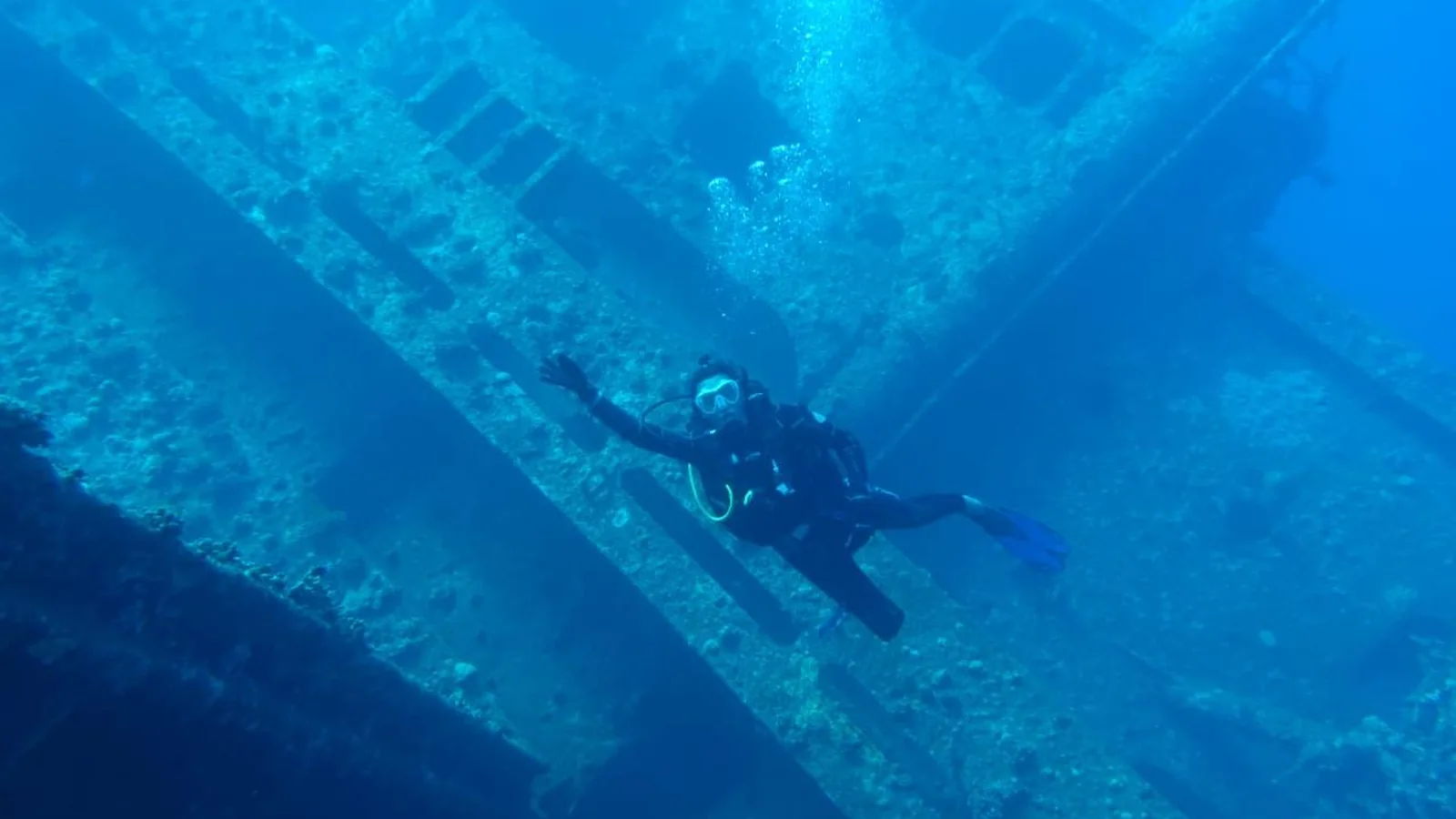
No reef in the Red Sea has sunk more ships than Abu Nuhas. It lies low and almost invisible at the edge of the shipping lane on the north side of the Strait of Gubal, and for more than 150 years captains running for the Gulf of Suez have driven straight into it. The toll is a single reef carrying four diveable wrecks from four different decades — a ship's graveyard you can explore on two dives in one day. For wreck divers based in Hurghada, it's the headline trip after the Thistlegorm.
The reef — why so many ships sank here
Sha'ab Abu Nuhas is a triangular coral reef lying northwest of Shadwan Island, on the northern edge of the Strait of Gubal where the Gulf of Suez funnels into the open Red Sea. The problem, from a navigator's point of view, is that the reef tops out just below the surface and barely shows. It also sits right in the middle of one of the world's busiest tanker and freighter routes — every ship heading to or from the Suez Canal threads this strait.
For more than a century, a hidden reef, a crowded shipping channel and the occasional helmsman cutting a corner have added up to wreck after wreck — at least seven are recorded here. Even the name remembers it: Abu Nuhas means roughly "father of copper", after the copper cargo of the Carnatic, which sank in 1869 and earned the reef its "copper reef" nickname more than a century before the modern cargo ships joined her on the bottom.
Four of those wrecks sit close together along the northern face of the reef and have become the classic Abu Nuhas dive: the Giannis D, the Carnatic, the Chrisoula K and the Kimon M. They lie in a rough line at depths between about 4 and 32 metres, which is why a single trip can comfortably cover two of them.
The site at a glance
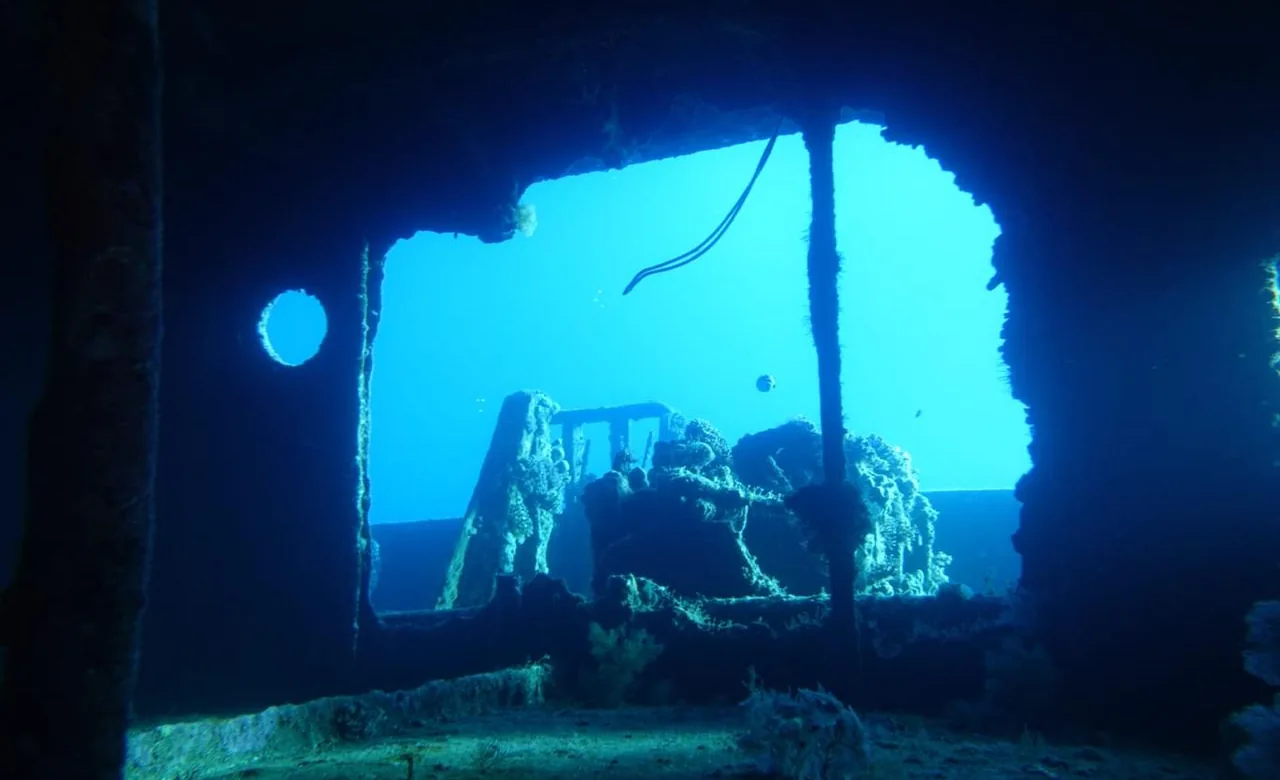
All four main wrecks lie on the northern side of the reef — the side that faces the open sea and the prevailing wind. That geography defines the diving. The south side, where boats moor, is calm; the moment you cross to the wrecks you can meet swell, surge and current. Visibility on the wrecks is typically 15-30 metres, very good for wreck diving, helped by the open-water position away from the harbour silt that plagues sites like the El Mina.
Conditions caveat: Abu Nuhas can be a rough surface. Because the wrecks face the wind, trips here are weather-dependent — a blowy day can cancel the crossing or push the group to the more sheltered Giannis D and Carnatic instead of the exposed Kimon M. Current ranges from mild to strong with the tide, and the deeper wrecks catch more of it. None of this is a problem with a competent guide and the right certification; it just means Abu Nuhas rewards divers who are comfortable in moving water.
How a day usually runs: two dives on two different wrecks, plus a shallow reef or mast section for the safety stop. The classic pairing is the Giannis D first (deeper, more dramatic) and the Carnatic second (shallower, atmospheric), but the order flexes with conditions and what the rest of the boat wants to see.
The Giannis D (1983) — the iconic one
If Abu Nuhas has a poster wreck, it's the Giannis D — the most photographed of the four and the one most divers come for.
She was launched in Japan in 1969 as the Shoyo Maru, a 99-metre general cargo ship, and changed hands and names over the years — sailing as the Markos before her final Greek owners renamed her Giannis D. In April 1983 she loaded a cargo of sawn softwood at Rijeka (in modern Croatia), bound for Jeddah and then Hodeidah in Yemen — that timber is why she also carries the nickname the "wood wreck". In the small hours of 19 April, with the helm apparently unattended, she ran onto the north-western corner of the reef at full speed. The hull tore open, the holds flooded, and the captain ordered the crew off as she settled. Everyone was rescued; there was no loss of life.
Today she lies on her port side, tilted at an angle so steep the whole wreck looks as if it were frozen mid-collapse. She broke into three: the stern is the highlight — bridge, funnel, masts and engine room are remarkably intact — while the midships is shattered and the bow sits apart, around 18 metres. The masts and their distinctive A-frame derricks lean off the deck towards the light, the shallowest reaching to about 6 metres, which makes them a natural, photogenic spot to hang a safety stop.
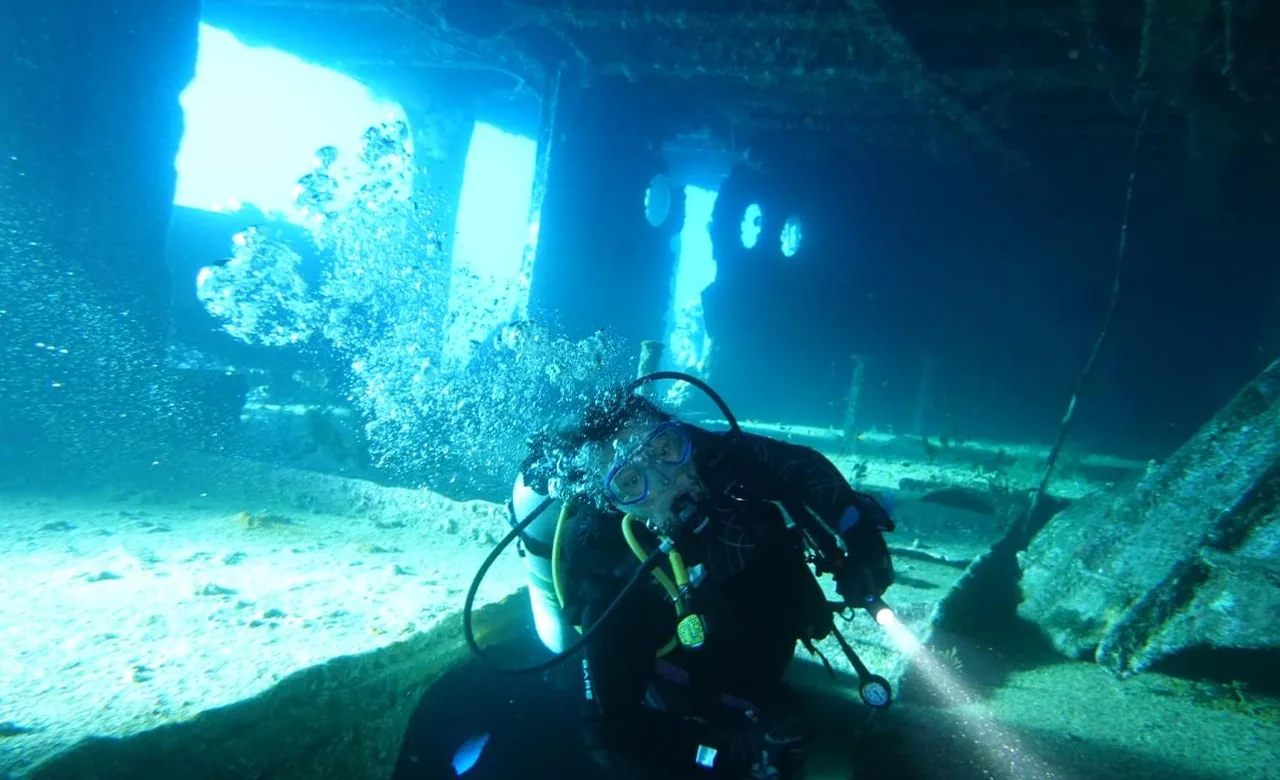
The tilted angle of the deck and superstructure is the signature visual — swimming along the sloped bridge with the mast pointing off into the blue is one of the most recognisable images in Red Sea diving. For trained wreck divers the stern offers genuinely good penetration: you can pass through the bridge and into the engine room and accommodation spaces, with the engine room (around 13m) a particular favourite, full of machinery and clouds of glassfish. As always, overhead environments need a guide, a light and proper training.
The Carnatic (1869) — the oldest and most atmospheric
The Carnatic is the grande dame of Abu Nuhas — by far the oldest wreck on the reef and, for many divers, the most beautiful.
She was a British P&O passenger and mail steamer built in London by Samuda Brothers in 1862-63, one of the first generation of composite ships that married an iron frame to a wooden hull and carried sail as well as steam. On the night of 12 September 1869, bound from Suez towards Bombay with passengers, mail, cotton, copper plates and a reported £40,000 in gold, she struck the reef. Convinced she was safe and that rescue was on its way, the captain kept everyone aboard for some 34 hours rather than landing them. Then, just as the order to abandon ship was finally given, the hull broke in two and went down in moments — 31 people were lost. A helmet diver recovered most of the gold and hundreds of copper plates soon afterwards, and it is that copper cargo that gave the reef its name.
More than 150 years underwater have turned the Carnatic into something closer to a living coral sculpture than a ship. The wooden planking is long gone, leaving the iron ribs and frame standing in an open lattice that the light pours straight through — divers consistently rate her the most atmospheric wreck on the reef. The skeleton is heavily encrusted with soft corals and swarms with glassfish and anthias, and because the structure is so open you swim through the ribs rather than into a confined space.
She lies on her port side between roughly 18 and 27 metres. Among the wreckage divers still find scattered relics of the cargo — most famously the rounded green glass of old wine and soda bottles, which is why she also answers to the "wine wreck". It is a gentler, shallower dive than the Giannis D, and paired with it makes the perfect second dive of an Abu Nuhas day.
The Chrisoula K — the "tile wreck" (1981)
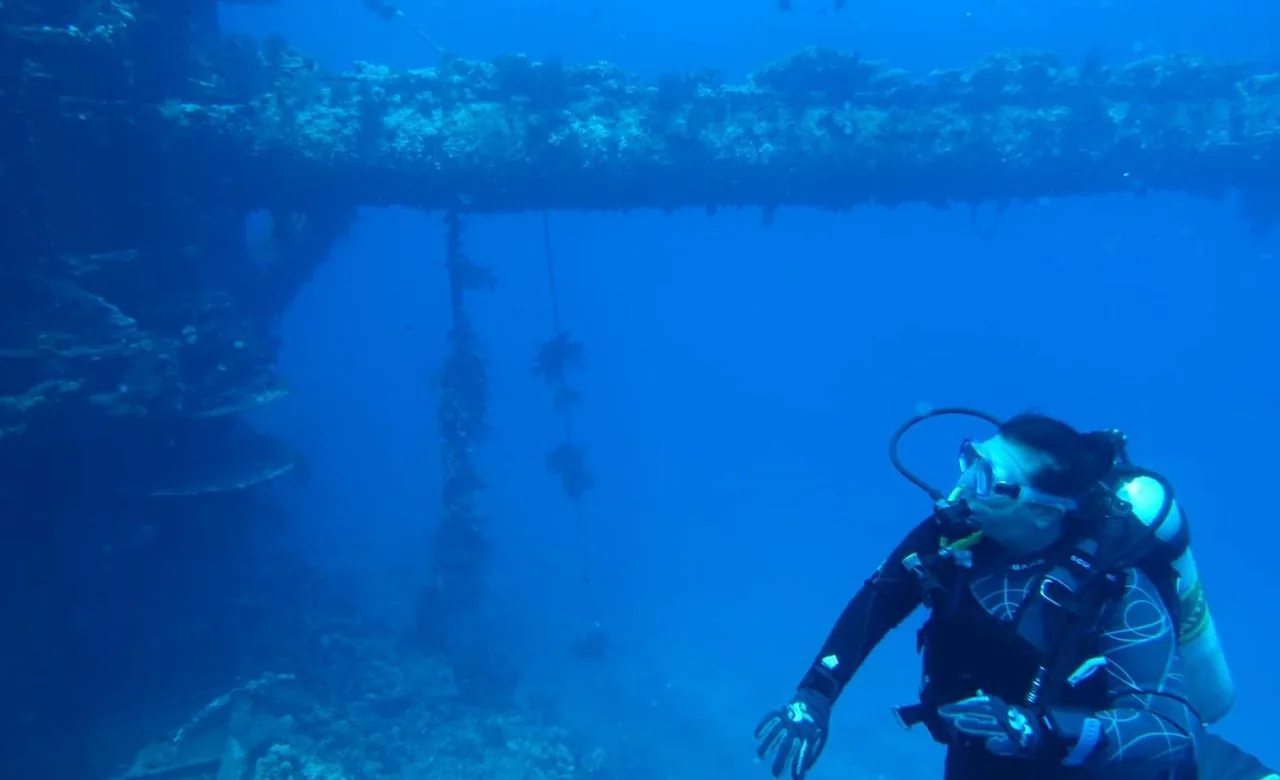
The third wreck is best known by its cargo and its nickname. The Chrisoula K — universally called the "tile wreck" — was a German-built, Greek-owned cargo ship of around 98 metres that drove onto the north-eastern corner of Abu Nuhas in 1981 with a hold full of Italian floor tiles bound for Jeddah. The crew was rescued; the ship was lost. Today those cargo holds still lie stacked with tiles, neatly palleted in places, and gliding over them is the unmistakable signature of this dive.
The wreck runs from a bow that rises close to the surface down a sloping deck to a stern and engine room at around 26-27 metres. The engine room and cargo holds make for some of the most accessible recreational penetration on the reef — large, relatively open spaces that experienced divers can pass through with a guide and a light.
The identity question, honestly: the "tile wreck" has a long-running identity debate. Many sources call it the Chrisoula K; others argue the wreck on the reef is actually the Marcus, with the Chrisoula K's main body lying separately in deeper water. The evidence is genuinely mixed and the question has never been settled to everyone's satisfaction. We mention it not to confuse you but because honesty about what's known is part of good wreck diving — the dive is excellent whatever name you log it under.
The Kimon M — the "lentil wreck" (1978)
The deepest and least visited of the four is the Kimon M, the "lentil wreck". She was a German-built cargo ship of around 106 metres that drove onto the north-eastern corner of the reef at full speed in December 1978, bound from Turkey to Bombay with some 4,500 tonnes of bagged lentils in her holds. A passing ship took off the crew. Like her neighbours before and since, she was undone by the same hidden reef in the same crowded shipping lane.
She lies on her starboard side, the deepest point of the wreck reaching around 32 metres — making her the deepest of the Abu Nuhas wrecks and the one most firmly in Advanced territory. The midships has largely collapsed over the decades, but the stern and the big intact engine remain impressive, and her exposed position means she catches the current — which is exactly why she is the most fish-rich of the four.
Because she sits deeper and more exposed than the Giannis D or Carnatic, the Kimon M is the first wreck dropped from the plan when the surface is rough. When conditions allow, though, she repays the effort: resident schools of batfish hang in the blue off the stern, and hunting trevally and jacks sweep past in the current. It's a more serious dive than the others — and a quietly satisfying one for divers who want depth, fish and a wreck more or less to themselves.
Marine life on the wrecks
Abu Nuhas is not just a history lesson — decades underwater have turned each hull into a thriving artificial reef, and the wrecks teem with life. Because the reef sits in open water away from the harbour, the fish life is dense and the corals on the older wrecks are spectacular.
Glassfish and anthias: Every wreck shimmers with them. Massive schools shelter in the Giannis D's engine room, the Carnatic's open ribs and the Chrisoula K's holds, parting and reforming around divers in the classic wreck-diving spectacle.
Batfish and trevally: The Kimon M is famous for its resident batfish hovering off the stern, with hunting trevally and jacks patrolling the current. These are the photogenic predator-and-school scenes wreck divers travel for.
Lionfish, scorpionfish and moray eels: Tucked into the metal of all four wrecks. Look without touching and watch where you put your hands — scorpionfish in particular are masters of camouflage on a rusty hull.
Soft and hard corals: The Carnatic's iron skeleton is the standout, draped in colourful soft corals after more than 150 years. The reef itself around the wrecks carries healthy hard coral and the usual Red Sea cast of butterflyfish, bannerfish and fusiliers.
Reef regulars and the occasional larger visitor: Napoleon wrasse, parrotfish and the odd turtle work the reef edges, and in deeper water jacks and — occasionally — a reef shark pass through. Nothing is guaranteed, but Abu Nuhas's open-water position makes the blue worth watching.
How Abu Nuhas is dived
There are two ways to reach the reef, and they suit different divers.
Day boat from Hurghada
The most common option for divers based in or around Hurghada. It's a long day — roughly two to two-and-a-half hours of cruising each way — but it gets you two dives on two of the famous wrecks. Expect the deeper, more dramatic wreck first (often the Giannis D) and a shallower second dive (often the Carnatic), with a reef section for the safety stop. Because the journey is long and the north face is exposed, day trips run when the sea cooperates and aim for the most sheltered pairing if it's blowing.
Liveaboard
For wreck-focused divers, a northern Red Sea liveaboard is the better way to dive Abu Nuhas. Liveaboards routinely combine it with the Thistlegorm and the wrecks of the Strait of Gubal, and — crucially — they can dive the reef early in the morning or late in the day, before and after the day boats arrive, when conditions are calmest and the wrecks are quietest. If diving all four wrecks across multiple days is your goal, this is how to do it.
Skill and gear
For most of Abu Nuhas, plan on Advanced Open Water certification — the wrecks sit between roughly 24 and 32 metres and there can be current. The shallow upper sections (the Giannis D mast, the Carnatic at 18-27m) can be enjoyed by newer divers with a guide and good conditions, but any wreck penetration and the deeper Kimon M call for AOW and ideally the PADI Wreck Diver specialty. A dive light is genuinely useful for the engine rooms and holds, and good buoyancy is essential — silt inside a wreck goes up fast and doesn't come back down.
| Wreck | Sank | Depth | Known for |
|---|---|---|---|
| Giannis D | 1983 | 4-27 m | Dramatic tilt, swim-through stern & engine room |
| Carnatic | 1869 | 18-27 m | Oldest wreck, coral-draped open ribs, "wine wreck" |
| Chrisoula K | 1981 | 4-27 m | Floor-tile cargo, accessible penetration |
| Kimon M | 1978 | ~15-32 m | Deepest, batfish & trevally, "lentil wreck" |
For divers weighing Abu Nuhas against the region's other icon, see our Thistlegorm guide — the Thistlegorm is the single most famous wreck in the Red Sea, while Abu Nuhas gives you the variety of four ships from four eras on one reef. Many divers do both. If wrecks are your reason to visit, our Salem Express and El Mina guides round out Egypt's wreck story, and the complete Red Sea diving guide puts it all in context.
Diving the graveyard responsibly
These wrecks are war graves in one case and historic sites in all of them — the Carnatic took 31 lives, and every hull is a fragile time capsule. Treat them accordingly.
- Take nothing. The wine bottles on the Carnatic, the tiles on the Chrisoula K, anything on any wreck — leave it where it lies. Removing artefacts is both illegal and the fastest way to strip these sites of what makes them special.
- Mind your buoyancy inside. Silt-out is the real danger of wreck penetration. A single careless fin kick in an engine room can drop visibility to zero. Stay neutral, fin carefully, and only enter overheads you're trained for.
- Don't over-reach on depth. The Kimon M's 32 metres and any deep penetration are not the place to push your limits. Dive your training and your gas plan, not the wreck's maximum depth.
- Respect the conditions. If the guide cancels the Kimon M or reorders the dives because of wind and current, that's good seamanship, not caution for its own sake. The north face is exposed for a reason.
- Watch the corals. The Carnatic in particular is more coral than steel now. Keep hands, fins and gauges off the encrusted structure.
How to book
Aquarius Hurghada runs wreck-diving trips to Abu Nuhas when conditions allow, as part of our daily diving programme. A typical Abu Nuhas day covers two of the wrecks plus a reef safety stop, with guide, tanks, weights, soft drinks and lunch on board; equipment rental is available for divers without their own. Because the reef is a long way out on an exposed face, we plan these trips around the forecast and brief the wrecks' history before every descent.
Requirements: Advanced Open Water certification or equivalent (SSI, BSAC, CMAS** etc.) is recommended, with a logbook showing recent diving. If it's been a while since your last dive, we'll set up a refresher on our house reef first, and if you'd like to dive the wrecks more confidently we can add the PADI Wreck Diver specialty. Honest preparation, not bureaucracy — Abu Nuhas rewards divers who arrive ready.
Frequently asked questions
What is Abu Nuhas?
Abu Nuhas (Sha'ab Abu Nuhas) is a triangular coral reef on the north side of the Strait of Gubal, northwest of Shadwan Island and offshore from Hurghada. Because it projects into a busy shipping lane it has wrecked more ships than any other reef in the Red Sea, earning the nickname the 'ships' graveyard'. Four wrecks — the Giannis D, Carnatic, Chrisoula K and Kimon M — lie on its northern face and form one of Egypt's most famous wreck-diving sites.
What certification do I need to dive Abu Nuhas?
PADI Advanced Open Water (or equivalent) is recommended for most of Abu Nuhas, because the wrecks bottom out between roughly 24 and 32 metres and the site can have current. The shallow upper sections — the Giannis D mast and the Carnatic at 18-27m — can be enjoyed by newer divers with a guide and good conditions, but the deeper Kimon M and any wreck penetration call for Advanced certification and ideally the PADI Wreck Diver specialty.
How do you dive the Abu Nuhas wrecks from Hurghada?
Abu Nuhas is dived as a long day-boat trip from Hurghada (roughly 2 to 2.5 hours each way) or, more comfortably, on a northern Red Sea liveaboard. A typical day gives two dives on two different wrecks plus a reef safety stop. Because the wrecks sit on the exposed north side of the reef, trips run when sea and wind conditions allow.
Which is the best Abu Nuhas wreck to dive?
The Giannis D is the crowd favourite — a dramatically tilted, photogenic 1983 cargo ship with swim-through engine room and bridge. The Carnatic (1869) is the most atmospheric and historic, an open lattice hull draped in soft coral. The Chrisoula K ('tile wreck') is the best for easy penetration over its tile cargo, and the Kimon M ('lentil wreck') is the deepest and most fish-rich. Most divers rate the Giannis D and Carnatic as the two must-dives.
Can you penetrate the Abu Nuhas wrecks?
Yes — the Giannis D (engine room, bridge, accommodation), the Chrisoula K (cargo holds and engine room) and parts of the Kimon M offer recreational swim-throughs for divers with appropriate training. The Carnatic's collapsed wooden hull is more of a swim-around than a penetration. All overhead environments need a guide, a light, awareness of silt-out, and ideally the PADI Wreck Diver course.
Why is it called Abu Nuhas?
Abu Nuhas translates roughly as 'father of copper'. The name comes from the copper sheeting and copper plates carried by the SS Carnatic, which sank here in 1869 — some of that cargo was salvaged and washed onto the reef, giving it the 'copper reef' name long before the modern cargo ships were lost.