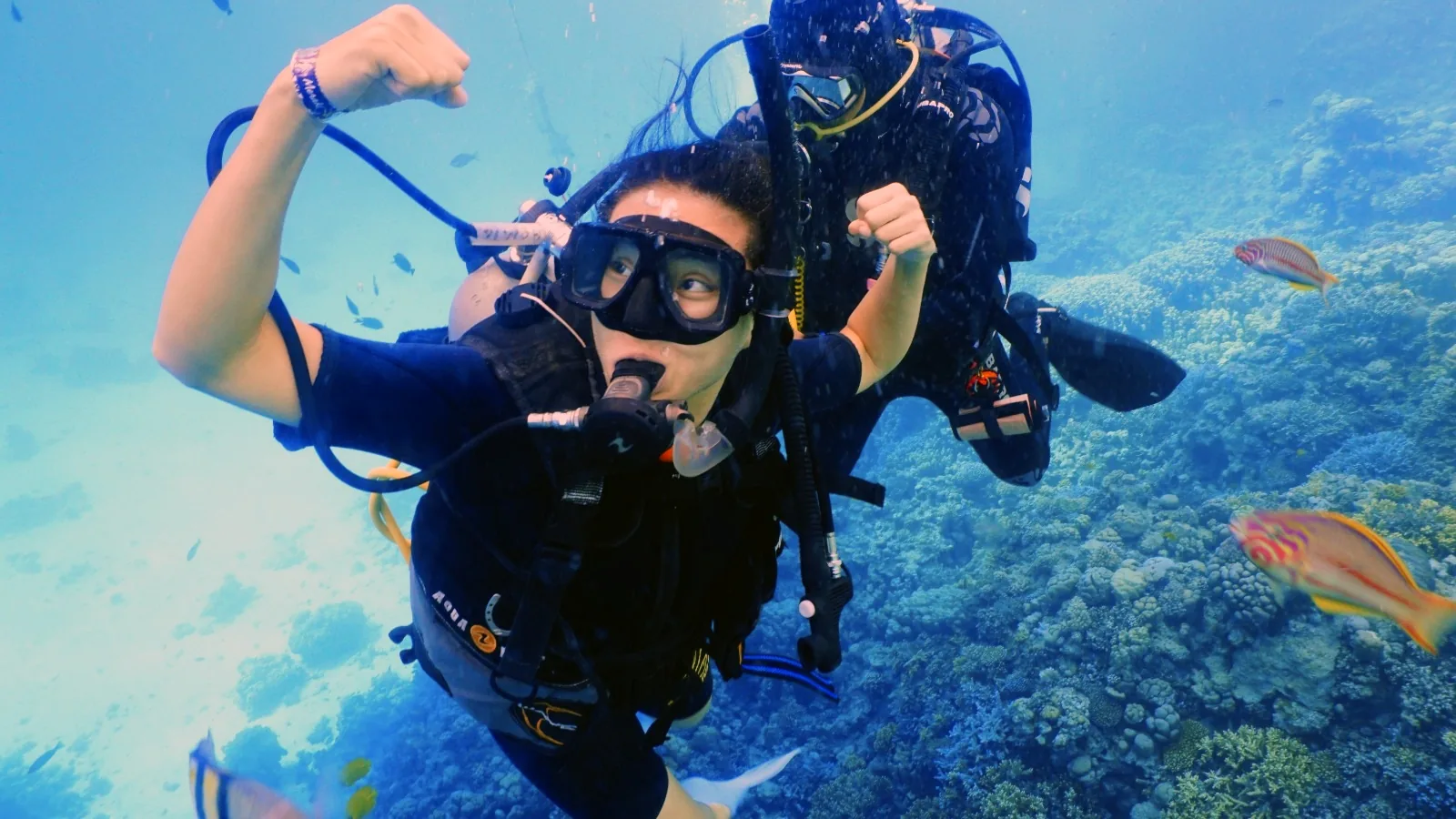
Most healthy people, across a surprisingly wide range of ages and fitness levels, can learn to scuba dive — and the warm, calm, shallow reefs of the Red Sea are one of the gentlest places in the world to start. You do not need to be an athlete or a competitive swimmer. But "most people can" is not "everyone, every day": a heavy cold, an uncontrolled heart condition, a current seizure disorder, or a pregnancy genuinely means not today. This guide walks you honestly through the real health and fitness questions so you know what to expect — and it is educational only, not medical advice. The one thing that actually decides is a standardised diver medical questionnaire (ten yes/no questions), backed where needed by a doctor's sign-off. The aim below is to replace vague worry with specifics, so you arrive knowing roughly where you stand. For the bigger picture of where and when to dive, see this complete guide to scuba diving the Red Sea.
The honest truth: this is not just for the super-fit
There is a persistent myth that scuba diving is an extreme sport reserved for athletic, fearless people. It is not — and it is one of several common Red Sea diving myths worth busting. On a normal recreational dive on a sheltered reef, you move slowly, you are weightless, and the environment does most of the work. Every year, people in their 60s and 70s learn to dive, as do nervous first-timers who were convinced they "couldn't". What matters is not peak fitness but a sensible baseline of health, reasonable comfort in water, and honesty about any medical conditions.
Two things are worth holding onto as you read. First, the goal here is to inform you, not to clear or reject you — no article can do that. Second, the real gate is the diver medical questionnaire (covered near the end), so if in doubt, the answer is almost always "ask a doctor", not "give up" — and ideally a doctor who understands diving medicine.
What "fit enough to dive" really means
You do not need to run marathons. What diving asks for is a modest reserve of cardiovascular fitness — enough that an unexpected effort will not overwhelm you. Most of a dive is relaxed, but you may occasionally need to carry gear on land, walk in a wetsuit, climb a boat ladder, swim against a mild current, or help yourself or a buddy in an unlikely emergency. It is those rare, sudden demands, not the routine swimming, that make a basic fitness reserve important.
This matters for safety, not just comfort. Dive-medicine authorities note that among divers over about 35, coronary artery disease becomes the dominant cause of sudden cardiac death underwater, and over-exertion in someone without the fitness for it is a recognised trigger. A useful self-test is simple: can you climb two or three flights of stairs, or walk briskly for several minutes, without becoming exhausted or badly breathless? If yes, you very likely have the everyday fitness a recreational dive needs. If a flight of stairs leaves you struggling, that is a sign to build some general fitness first and to talk to a doctor before booking.
Do you actually need to be able to swim?
This is one of the most common worries, and the honest answer has two halves.
- To become a certified diver (the entry-level Open Water course), you do need basic watermanship. The standard is deliberately modest and is not a speed or style test: swim 200 metres (or 300 metres wearing a mask, fins and snorkel) non-stop, with no time limit and using any stroke you like, and separately float or tread water for 10 minutes using any method. It is about being calm and self-sufficient in water, not athletic. Exact wording varies a little between training agencies.
- To simply try scuba on a supervised "try dive" (often called Discover Scuba Diving), the requirement is far lighter — you need to be comfortable and relaxed in the water rather than a strong swimmer. This is why a holiday try-dive is such a common first step. People who are not confident swimmers can often experience scuba in a pool or shallow, confined water under close professional supervision, though genuine comfort in water still matters and it should be discussed honestly with the instructor beforehand.
If you are anxious about swimming, a try-dive first, then working on basic water confidence, is a completely reasonable path toward full certification later.
Age: from children to your later years
There is no single "diving age", but there are sensible thresholds. The figures below reflect widely used recreational standards and vary slightly between training organisations:
- Children (from 8): pool-based programmes let children as young as 8 breathe underwater in very shallow water — a maximum of around 2 metres — under direct professional supervision.
- From 10: children can try a supervised Discover Scuba experience and begin junior certification, with strict depth limits and a requirement to dive alongside a certified adult or professional. Junior divers aged 10–11 are typically limited to about 12 metres, and 12–14 year-olds to about 18 metres.
- 15 and over: the standard adult certification and its depth limits apply, and junior certifications usually upgrade automatically at 15.
- Older adults: there is no upper age limit. People dive well into their 70s and 80s. What changes with age is not permission but prudence — as you get older, a heart-health check becomes more important. Dive-medicine guidance recommends screening for hidden coronary artery disease as divers pass about 40, and physician evaluation for those over 45 who carry risk factors (such as high blood pressure, high cholesterol, diabetes, smoking or a family history), with more regular review thereafter. Being older is not a barrier; being older with an unchecked heart is the risk.
Ears, sinuses and equalising — and why you never dive with a cold
As you descend, water pressure squeezes the air spaces in your ears and sinuses, and you have to "equalise" them — most people gently pinch the nose and blow, adding a little air to balance the pressure. The vast majority of people learn this quickly. It is one of the first skills taught, and going slowly on descent is the key.
The important honest point is about congestion. If a cold, flu, sinus infection or heavy allergy is blocking your nose and sinuses, you may not be able to equalise, and forcing it risks painful ear or sinus injury (barotrauma). Standard dive-medicine advice is blunt: do not dive with a cold or significant congestion, or when you cannot equalise. It is also unwise to rely on decongestants to "get you down" — they can wear off at depth and leave trapped, expanding air unable to escape on the way up (a "reverse block"), which can be more dangerous than the descent problem. A blocked-up day is a day to skip the dive, not to push through.
Perforated eardrums, grommets and past ear surgery
A few specific ear situations need a doctor's input before you dive:
- A perforated (ruptured) eardrum that has not fully healed, and grommets or ventilation tubes still in place, are treated as a contraindication to diving. They let water reach the middle ear, which can cause infection and a sudden, disorienting rush of vertigo underwater.
- Once a perforation has healed, or grommets have been removed or fallen out and the eardrum has closed, diving is usually possible again after a healing period — but this needs an ENT or dive doctor to confirm the eardrum is sound and the Eustachian tube is working, often a couple of months after healing.
- After eardrum or middle-ear surgery (such as tympanoplasty) or other ear operations, fitness to dive has to be assessed individually by a specialist; some inner-ear procedures rule out diving permanently, while many outer- and middle-ear repairs allow a return once fully healed.
The theme is consistent: healthy, equalising ears are essential, and any history of eardrum damage or ear surgery is a "get it checked" item rather than a guess.
Common health conditions — the nuanced picture
This is where most anxiety lives, so here is the honest, condition-by-condition reality. A recurring theme: many well-controlled conditions are compatible with diving, but the decision belongs to a doctor — ideally one who understands diving medicine.
Asthma
The old blanket rule that "asthmatics can never dive" is out of date. Current dive-medicine guidance is that people with mild, well-controlled asthma may often dive safely, but this needs proper assessment — typically lung-function testing, sometimes with an exercise or provocation test to check that the airways behave under exertion. The particular red flags are asthma triggered by cold, exercise or emotion: UK guidance treats these as a reason not to dive even when the asthma is otherwise well controlled, because all three triggers are present on a dive. UK guidance also asks that a diver has not needed a reliever inhaler in the 48 hours before diving. Frameworks differ by country — some are a little more permissive and focus on current control and normal lung function — so if you have asthma, the path is not "hide it"; it is to be assessed by a physician knowledgeable in both asthma and diving, who can make an individual decision.
Heart health and blood pressure
High blood pressure is one of the most common conditions among divers, and well-controlled hypertension without organ damage is generally compatible with diving. The key issues are that your blood pressure is genuinely under control, that your medication does not cause problematic side effects underwater (some blood-pressure drugs affect exercise tolerance or fluid balance), and that there is no significant damage to the heart or other organs. More serious heart conditions — recent heart attacks, poorly controlled disease, significant coronary artery disease, some rhythm disorders or heart failure — need careful specialist evaluation before diving is considered. Because the heart does real work underwater, and cold water and exertion add to the load, this is an area where a doctor's assessment is genuinely important rather than a formality.
Diabetes
People with diabetes — including those on insulin — do dive, but under a clear framework rather than casually. Established guidance generally expects the diver to be at least 18 (younger only within a special training programme), with well-controlled diabetes, no significant complications, a good understanding of how exercise affects their glucose, and an annual medical review. Around each dive, careful blood-glucose management is central: checking and stabilising glucose in the run-up to the dive (a common target is a blood glucose that is at least 8.3 mmol/L, or 150 mg/dL, and steady or rising before entering the water), carrying fast-acting glucose, diving conservative profiles, and monitoring for hours afterwards. Reasons to hold off include a recent severe "hypo" needing someone else's help, a history of not sensing hypos coming on, poor overall control, or diabetes-related complications. This is very much a "manage it properly, with medical sign-off" condition rather than an automatic no.
Epilepsy and seizures
This is one of the genuinely cautious areas. A seizure underwater is extremely dangerous: the regulator is usually lost and water inhaled, so a fit that would be survivable on land can be fatal at depth. For that reason, active epilepsy is treated as a contraindication to diving. UK guidance sets a widely quoted benchmark: to be considered fit to dive, a person should generally be five years free of seizures and off all anti-epileptic medication — partly because those medications are sedative and can worsen or bring on nitrogen narcosis. Seizures that occurred only during sleep, or a single childhood seizure, may sometimes be looked at individually. National and agency positions vary, and this is firmly a decision for a doctor experienced in diving medicine, not a self-assessment — but a history of epilepsy is not automatically a lifelong ban, and many people who have been seizure-free and off medication for years are cleared.
Pregnancy
This one is a clear, honest "no". Dive-medicine authorities recommend that women do not scuba dive at any stage of pregnancy — and that those who are trying to conceive or think they may be pregnant also avoid it — because the developing baby is not protected from the effects of pressure and decompression, and safe limits simply cannot be established. If someone dived very early on before knowing they were pregnant, that is not on its own a cause for alarm or drastic decisions — but planned diving during a known pregnancy is advised against. Snorkelling at the surface is a gentle alternative for a Red Sea trip.
Anxiety, claustrophobia and mental health
Feeling nervous — even claustrophobic at the thought of a mask and regulator — is extremely common and is usually manageable rather than disqualifying. Training deliberately starts in shallow, controlled water so you can build comfort step by step, and slow breathing, a patient instructor, and going at your own pace do most of the work. The practical move is to tell your instructor honestly beforehand what helps (extra time at the surface, a hand on a stable reference, clear signals) and what does not (rushing or crowding). Many people who were sure they would panic end up diving happily. The honest boundary is severity: a person prone to severe anxiety or panic attacks should not dive until that is well managed, because losing control underwater is genuinely hazardous. A diagnosed mental-health condition that is stable and well controlled is often compatible with diving, but it belongs on the medical form so it can be considered properly.
Antidepressants and other medications
Having to take medication is not automatically a barrier — but two questions matter. First, the underlying condition the medication treats is often the real issue to assess: with depression or anxiety, for example, it is the stability of the condition, not the prescription itself, that counts most. Second, some medications can be a problem underwater. Commonly prescribed antidepressants such as SSRIs are used safely by many divers, but they can cause drowsiness, restlessness or dizziness — especially in the first few weeks or after a dose change — and anyone who feels those effects should not dive until they have settled on a stable, side-effect-free dose. Anything that causes sedation, drowsiness or altered judgement, or that can wear off at depth (decongestants are the classic example), deserves particular caution. The right approach is to declare your medications on the questionnaire and, where relevant, check with a doctor familiar with diving rather than guessing or quietly stopping a medication before a trip.
Migraines
Migraine is common and, for most people who get them, poses little added danger while diving — many frequent migraine sufferers notice no increase in attacks in the water. The concern is specific rather than general: a migraine striking underwater can bring disorientation, visual disturbance or vomiting, which is hazardous at depth, and a migraine after a dive can be hard to tell apart from decompression sickness. Migraines with strong "aura" (neurological symptoms), those triggered by exertion, or attacks that are frequent and poorly controlled warrant an individual assessment. For most people with occasional, well-managed migraines, diving is not ruled out — but it is a sensible thing to mention on the medical form and, if attacks are severe, to discuss with a doctor.
Back, joints and mobility
Interestingly, the hardest part of diving for a bad back or dodgy joints is usually not the dive — it is the moments on land and at the surface: lifting and carrying tanks, climbing boat ladders in heavy gear, and walking in a wetsuit. Underwater, weightlessness often makes people with chronic back or joint pain feel more comfortable, not less. Sensible preparation — good lifting technique, letting crew or a buddy help with tanks, some core and general fitness beforehand — resolves most everyday aches. Where it needs a doctor is when there is a serious or unstable spinal problem, a recent significant injury, or nerve symptoms; diving is typically postponed until a spine is stable and pain is controlled. Reduced mobility on its own is not a barrier — which leads directly to the next point.
Diving with a disability: adaptive diving is real and established
Underwater is one of the few places where a wheelchair user, an amputee or someone with limited mobility can move freely in three dimensions, and adaptive diving has been a formal, well-developed discipline for decades. Dedicated organisations train divers and instructors in adapted techniques and equipment, and a mainstream "adaptive" instructor qualification also exists so that ordinary dive centres can support divers with a wide range of physical and some cognitive disabilities. Adaptive programmes classify divers by how much support they need — from fully independent, to diving with one trained buddy, to diving with a small dedicated team — so the training is matched to the individual rather than one-size-fits-all. People with amputations, spinal-cord injuries, visual impairment, cerebral palsy and many other conditions dive regularly. If you have a disability, the questions are the same practical ones (comfort in water, the underlying medical picture, the right support), and the medical form plus a chat with a dive centre experienced in adaptive diving is the starting point — not an assumption that the answer is no.
Flying after diving: a trip-planning note
This is less about whether you can dive and more about planning the end of a diving holiday. Because flying takes you to a lower cabin pressure, you need a surface interval after your last dive before you fly, to let your body off-gas. Widely used guidance suggests waiting at least 12 hours after a single no-decompression dive, at least 18 hours after multiple dives in a day or several days of diving (which describes most dive holidays), and considerably longer after any dive that required decompression stops. In practice, on a multi-day trip that means leaving a comfortable gap — often a full day — between your final dive and your flight home. It is worth building this into your itinerary from the start, so your last day is topside relaxation rather than a rushed final dive before the airport.
The official gate: the diver medical questionnaire
Everything above is background. The document that actually determines whether you can start a dive or a course is the standardised diver medical questionnaire — the RSTC/WRSTC "Diver Medical" form used across the recreational diving industry, updated in 2020. Here is how it really works, so it holds no surprises:
- It opens with a set of ten yes/no screening questions covering things like heart and lung conditions, recent illness or surgery, ear and sinus problems, diabetes, epilepsy and seizures, pregnancy, mental-health conditions and medications.
- If you can honestly answer "no" to every question, you sign the form and you are good to go — no doctor visit needed.
- If you answer "yes" to a question, it does not automatically mean "no diving". It directs you to a few more detailed follow-up questions, and — where those indicate — to a companion physician's evaluation, in which a doctor reviews the specific issue (using peer-reviewed guidance written specifically for assessing fitness to dive) and signs off if it is safe. Notably, since the 2020 update, not every "yes" requires a full medical examination.
- A doctor's dive clearance is commonly treated as valid for around 12 months, and a fresh assessment is needed if your health changes — though exact validity varies by country and agency.
So a "yes" on the form is usually a doctor's-note step, not a door closing. Filling it in honestly is the single most important thing you can do for your own safety — it exists to protect you, and hiding a condition removes the very safety net it was designed to provide.
A plain-English self-check before you book
Use this as a private "should I look into this further?" walkthrough. It is not a medical clearance and it does not replace the official form or a doctor — it just tells you whether to expect a smooth start or a quick chat with your GP first.
Comfort and fitness
- Can you climb two or three flights of stairs, or walk briskly for several minutes, without becoming exhausted or badly breathless?
- Are you reasonably comfortable getting your face wet and being in water, even if you are not a strong swimmer?
Right now, today
- Are you free of a cold, flu, chest infection or heavy sinus/nasal congestion today?
- Are you not pregnant (and not possibly pregnant)?
Ongoing health — a "yes" here means "ask a doctor", not "you can't dive"
- Do you have any heart condition, or high blood pressure that is not well controlled?
- Do you have asthma or any other lung condition — especially asthma triggered by exercise, cold or stress?
- Do you have diabetes, epilepsy or seizures, or any condition affecting consciousness?
- Have you had surgery, a serious illness, or an ear or sinus operation recently, or do you have a perforated eardrum or grommets?
- Do you take regular medication, or have significant anxiety, panic or claustrophobia?
- Are you aged over about 45, or a smoker, without a recent check of your heart health?
How to read your answers: if you sailed through the first two groups with "yes", answered the "today" group with "yes", and answered "no" across the ongoing-health group, you are in the large majority who can typically dive without any medical hurdle. Any "yes" in the ongoing-health group is not a rejection — it is simply your cue to complete the official medical form and, where it flags something, get a doctor's sign-off (ideally from a doctor familiar with diving medicine). A "no" to being free of a cold, or to the pregnancy question, means not this trip rather than never. And a disability or reduced mobility is a reason to find an adaptive-friendly dive centre, not a reason to count yourself out.
What actually happens on your first day
If the unknown is part of the nerves, here is the shape of a typical first experience. It starts on dry land with a relaxed briefing: how the equipment works, a handful of simple hand signals, how to breathe, and how to clear your ears. Nothing is sprung on you. The first breaths underwater happen in shallow water — often standing depth — where you can put your feet down and surface at any moment. You practise a few basic skills at your own pace, like clearing a little water from your mask, always somewhere you can simply stand up if you want a pause. Only when you feel ready do you move gently into deeper water, and on a guided dive a professional stays with you the whole time, setting an easy pace and handling the navigation while you look around. The overwhelming report from first-timers is not fear but surprise — at how quiet, weightless and calm it feels. For an honest first-timer's account, see what learning to dive actually feels like. Going slowly, breathing slowly, and telling your guide how you feel are the only "skills" you truly need on day one.
So — can you dive?
For most people reading this, the honest answer is: very probably, yes. You do not need to be young, athletic, or a competitive swimmer — you need a basic level of fitness, reasonable comfort in water, a clear head about any medical conditions, and a body that is well today. The warm, forgiving conditions of the Red Sea make it a genuinely accessible place to begin. The conditions that mean "not now" are real and worth respecting — an uncontrolled heart or lung problem, active epilepsy, an unmanaged case of diabetes, an unhealed ear, a blocked-up cold, or a pregnancy — but almost all of them are either temporary or resolvable with the right medical input. Fill in the diver medical questionnaire honestly, ask a doctor whenever it flags something, and let a professional instructor ease you in at your own pace. That is how nervous beginners become confident divers.
This article is general information, not medical advice. Always complete the standard diver medical questionnaire honestly and consult a physician — ideally one experienced in diving medicine — before you dive.
Frequently asked questions
Do you have to be fit to scuba dive?
No, you don't need to be an athlete. Recreational diving mostly involves slow, relaxed movement while weightless, so a basic level of everyday fitness is usually enough. What matters is having some cardiovascular reserve for occasional effort — such as a mild current or a rare emergency — since over-exertion is a known risk factor, especially for divers over 40. If you can climb a few flights of stairs comfortably, you likely have the fitness a normal dive needs.
Can I dive if I can't swim?
To become a certified diver you do need basic water skills — typically a 200-metre non-stop swim (no time limit, any stroke) and a 10-minute float — but this is a comfort test, not an athletic one. To simply try scuba on a supervised "Discover Scuba" experience, you mainly need to be relaxed in the water, and weaker swimmers can often try it in a pool or shallow confined water under close supervision. Genuine comfort in water still matters, so discuss it honestly with the instructor first.
Can I scuba dive with asthma?
Often yes, if your asthma is mild and well controlled — the old blanket ban is outdated. However, it requires proper medical assessment, usually including lung-function testing, and asthma triggered by exercise, cold or emotion is a particular concern because all three occur while diving. UK guidance also asks that you have not needed a reliever inhaler in the 48 hours before a dive. A doctor knowledgeable in both asthma and diving should make the individual decision, so declare it on your medical form.
Can I dive with high blood pressure?
Yes, well-controlled high blood pressure is common among divers and is generally compatible with diving. The key points are that your blood pressure is genuinely controlled, your medication doesn't cause problematic side effects underwater, and there's no significant organ damage. Poorly controlled hypertension or other serious heart issues need a doctor's evaluation before diving.
Can I dive with epilepsy?
Active epilepsy is treated as a reason not to dive, because a seizure underwater is usually fatal. UK guidance generally asks that a person be around five years free of seizures and off all anti-epileptic medication before being considered fit to dive, as those medications are sedative underwater. Sleep-only or single childhood seizures may be assessed individually. This is firmly a decision for a doctor experienced in diving medicine, but a past history of epilepsy is not automatically a lifelong ban.
Can you scuba dive while pregnant?
No. Dive-medicine authorities recommend that women avoid scuba diving at every stage of pregnancy — and while trying to conceive — because the developing baby is not protected from the effects of pressure and decompression, and safe limits cannot be established. Snorkelling at the surface is a gentle alternative. If someone dived very early before knowing they were pregnant, that alone isn't cause for alarm, but planned diving during a known pregnancy is advised against.
Can I dive with diabetes?
Many people with diabetes, including those on insulin, dive safely — but under a clear framework: well-controlled diabetes without complications, a normal annual medical review, and careful blood-glucose management around each dive. A common pre-dive target is a blood glucose of at least 8.3 mmol/L (150 mg/dL), stable or rising, with fast-acting glucose carried at all times. Uncontrolled diabetes, a recent severe hypo needing help, or hypo unawareness are reasons to hold off until a doctor clears you.
Can I dive with a perforated eardrum?
Not while it is unhealed — a perforated eardrum, and grommets or ear tubes still in place, are treated as a contraindication to diving because water reaches the middle ear and can cause infection and vertigo. Once the eardrum has fully healed (or grommets are out and it has closed), diving is often possible again after a healing period, but an ENT or dive doctor should confirm the eardrum is sound and equalising normally first.
Can I dive on antidepressants?
Often yes. Many divers take SSRIs and other antidepressants safely — what matters most is that the underlying condition is stable and that you don't get side effects like drowsiness, dizziness or restlessness, which are more likely in the first weeks or after a dose change. Anyone experiencing those effects should not dive until settled on a stable dose. Severe anxiety or panic attacks are a reason to hold off. Declare it on the medical form and, if in doubt, check with a diving doctor.
How long after diving can I fly?
Widely used guidance suggests waiting at least 12 hours after a single no-decompression dive, at least 18 hours after multiple dives in a day or several days of diving, and considerably longer after any dive requiring decompression stops. On a multi-day dive holiday, plan a comfortable gap — often a full day — between your last dive and your flight home, and make your final day a topside one.
Is scuba diving safe for older adults?
Yes — there is no upper age limit, and people dive into their 70s and 80s. The main thing that changes with age is the importance of heart health, so coronary risk screening becomes advisable from around 40, and physician review for those over 45 with risk factors. An older diver who stays fit, manages blood pressure and dives conservatively can be very safe; the real risk is an unchecked heart condition, not age itself.
Ready to take the first breath?
If the health side checks out, the next step is an easy one. Aquarius runs relaxed try dives and PADI courses in warm, shallow Red Sea water, at your own pace — bring your questions and your dates, and the team will guide you in.
Start diving →