Few places on Earth reward a first-time diver like the Egyptian Red Sea — warm, clear, staggeringly alive, and cheaper to dive than almost anywhere comparable. Yet a handful of stubborn myths keep people on the beach who would love it in the water: that sharks make it dangerous, that the reefs are dead, that you have to be an athlete, that it costs a fortune, or that it simply isn't safe to travel there right now. Most of these fears are either out of date or plainly untrue. Below are eleven of the most common ones, each weighed against the actual data — on temperatures, safety records, reef science, training rules and cost — so the decision to dive (or not) can rest on facts rather than hearsay. For the wider picture of where and when to dive, start with the complete guide to scuba diving the Red Sea.
Myth: Sharks make Red Sea diving dangerous
The reality
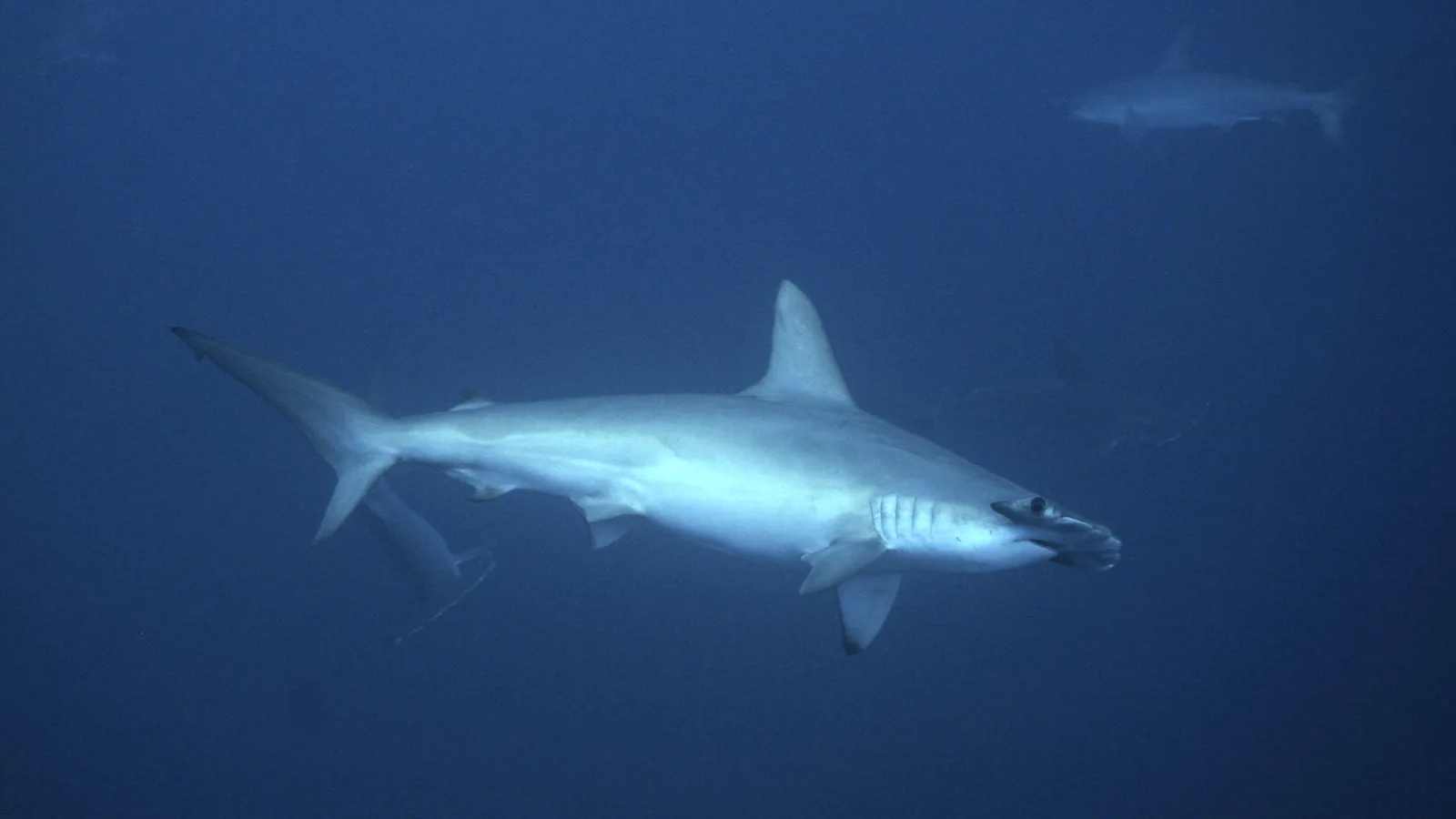
Shark encounters are a reason experienced divers travel to the Red Sea, not a reason to stay away. In 2025 the International Shark Attack File confirmed 65 unprovoked shark bites worldwide — in line with the 2020–2024 average of about 61 a year — alongside nine unprovoked fatalities. That death toll was slightly above the recent norm, but most of it occurred far from Egypt (Australia alone recorded five fatalities, all involving white sharks), and fatal bites overwhelmingly involve surface activities such as swimming and surfing rather than guided reef dives. The Florida Museum, which keeps the file, describes the chance of being bitten as "extremely low" and points out that rip currents pose a far greater risk to people at the coast than sharks do.
Put diving-specific numbers alongside that and the picture is reassuring: the Divers Alert Network estimates the recreational scuba fatality rate at roughly two per 100,000 dives, from all causes combined — the great majority of them health- or behaviour-related, not animal encounters. Most sharks a diver might actually meet on a reef, such as grey reef or whitetip reef sharks, show no interest in people and keep their distance. The rare serious incidents in Egyptian waters made global headlines precisely because they are so unusual.
Myth: It isn't safe to travel to Egypt right now
The reality
Travel-safety worries are usually about the country in the abstract, not the diving coast in particular — and official guidance draws exactly that distinction. As of 2026 the UK Foreign, Commonwealth & Development Office does not advise against travel to the main Red Sea resort areas — Sharm el-Sheikh, Hurghada, Marsa Alam and the mainland resort coast, including Makadi Bay, Sahl Hasheesh and El Gouna. Its restrictions are geographically specific and remote from the dive resorts: they cover North Sinai, the northern part of South Sinai, a strip within 20 km of the Libyan border, and certain interior desert and border zones — not the resort south where the diving happens.
These resort towns receive millions of holidaymakers every year, and the surrounding tourism infrastructure is heavily protected with routine security checks at airports and on resort roads. Two sensible habits still apply to any trip: check the current official advice for your own country shortly before you travel, because guidance can change; and make sure your travel insurance is valid for where you are going, since cover is typically void if you enter an area your government has advised against.
Myth: Strong currents make the Red Sea unsafe for ordinary people
The reality
Guided diving is the norm in the Red Sea, and local guides plan each dive around the day's conditions — reading the current, choosing entry and exit points, and matching the site to the group's experience. Beginners are taken to sheltered reefs and calm bays with mild or no current, and many resorts have easy "house reefs" where new divers build confidence a few metres from shore.
Stronger "drift" dives — where a gentle current carries you along a reef while the boat follows and picks you up at the end — are an optional, supervised step you take as experience grows, not something a first-timer is dropped into. Handled by a competent guide, a mild current usually makes a dive easier and more relaxing, because you glide along the reef instead of finning against the water.
Myth: You have to be a strong swimmer or seriously fit
The reality
To earn an entry-level Open Water certification, the water-skills test is to swim 200 metres (or 300 metres in mask, fins and snorkel) with no time limit, using any stroke you like, and to float or tread water for 10 minutes using any method. That is a comfort-in-the-water check, not an athletic feat — there is no speed or style requirement.
Training agencies state that you need only basic swimming ability and an average level of fitness, and that anyone who can meet the performance requirements can qualify, including many people with physical challenges. Diving itself is slow and relaxed: a properly weighted diver hangs weightless in the water and glides on small fin kicks, rather than fighting to stay afloat. Where you should be honest with yourself is health rather than fitness — every diver completes a short standard medical questionnaire first, and certain conditions call for a doctor's sign-off. A short health self-check for Red Sea diving explains what that questionnaire covers.
Myth: Diving is only for people who are already certified or experienced
The reality
Complete beginners can breathe underwater on their very first day. Introductory "try dive" programmes (such as Discover Scuba Diving) are open to anyone aged 10 and over, require no prior certification, and take place under direct instructor supervision at a maximum depth of 12 metres.
If the taster hooks you, a full Open Water certification usually takes three to four days, and the theory can be completed online at home before you travel, so you spend more of your holiday actually in the water than in a classroom. That certification then qualifies you to dive to 18 metres, lasts for life, and is recognised at dive centres worldwide. Experience is something you accumulate gradually, dive by dive — it is a result of starting, not a prerequisite for it.
Myth: The Red Sea is only for advanced or wreck divers
The reality
The region's fame rests partly on serious sites, and that reputation can be intimidating. Some of the most celebrated dives genuinely are for experienced divers: the SS Thistlegorm, the Red Sea's iconic World War II wreck, sits between roughly 16 and 32 metres with current and enclosed sections, and is squarely an advanced dive; the remote offshore shark reefs — the Brothers, Daedalus and Elphinstone — are usually reached by liveaboard and suit confident, experienced divers.
But those headline sites sit alongside an enormous number of gentle ones. The Egyptian coast is lined with shallow fringing reefs, calm lagoons, sheltered coral gardens and shore-accessible house reefs in 5–12 metres of water, teeming with colour and easy to dive. Beginners and occasional holiday divers are extremely well served here; the advanced wrecks and offshore reefs are simply an option to grow into, not the entry fee.
Myth: Summer is too hot to dive
The reality
Egyptian summer air temperatures are certainly high, but the diving happens in the water — and the Red Sea is divable in every month of the year. Surface temperatures peak in high summer at around 28–29°C in July, August and September (June is a touch cooler, near 26°C), warm enough that many divers wear only a rash guard or a thin "shorty" wetsuit, and the water feels cooling rather than punishing once you drop out of the sun.
Summer does trade a little clarity for life: seasonal plankton can lower visibility in places, but that same plankton is what draws larger pelagic species inshore. And the water is at its coolest not in December — still around 24°C — but in late winter, roughly 22°C in February and March, when a 5 mm wetsuit (sometimes with a hood) is the norm. In short, there is no month when the Red Sea is too hot, or too cold, to dive comfortably. For a month-by-month breakdown, see the best time to dive the Red Sea.
Myth: The reefs are dead or bleached beyond seeing anything
The reality
The northern Red Sea — and especially the Gulf of Aqaba at its top — is home to some of the most heat-tolerant coral on the planet. These corals can withstand temperatures several degrees above their summer maximum, with laboratory work recording tolerance of more than 5°C above the summer norm, whereas most corals worldwide begin to bleach when temperatures rise as little as about 1°C above their usual summer maximum for a sustained period (the threshold used in NOAA's global bleaching monitoring). That resilience is why the region has largely escaped the mass-bleaching events that have hit other tropical reefs, and why scientists have flagged it as a potential coral refuge from climate change.
That does not make the reefs invincible. A record-breaking marine heatwave in 2024 — the most intense thermal stress recorded anywhere on Earth that year — pushed even these normally bullet-proof northern corals to show some shallow bleaching, and local pressures such as tourism and coastal development are real. But "dead" is simply wrong. The Red Sea remains one of the healthiest and most biodiverse tropical reef systems a visitor can dive, with more than 1,000 fish species (around a tenth of them found nowhere else on Earth) and hundreds of species of hard and soft coral. Because little river water flows into the sea, it stays exceptionally clear, with visibility commonly 20–40 metres and more on offshore walls.
Myth: If you dive here you're guaranteed to see sharks, dolphins and mantas
The reality
This is the flip side of the shark fear, and it deserves an honest answer: the big animals are wild, seasonal and never guaranteed. Reputable information sets expectations rather than promising a checklist. Roughly:
- Reef sharks are possible year-round on many reefs — but on any given dive, sightings still aren't assured.
- Schooling scalloped hammerheads are mainly a summer phenomenon (around June–August) at remote offshore reefs.
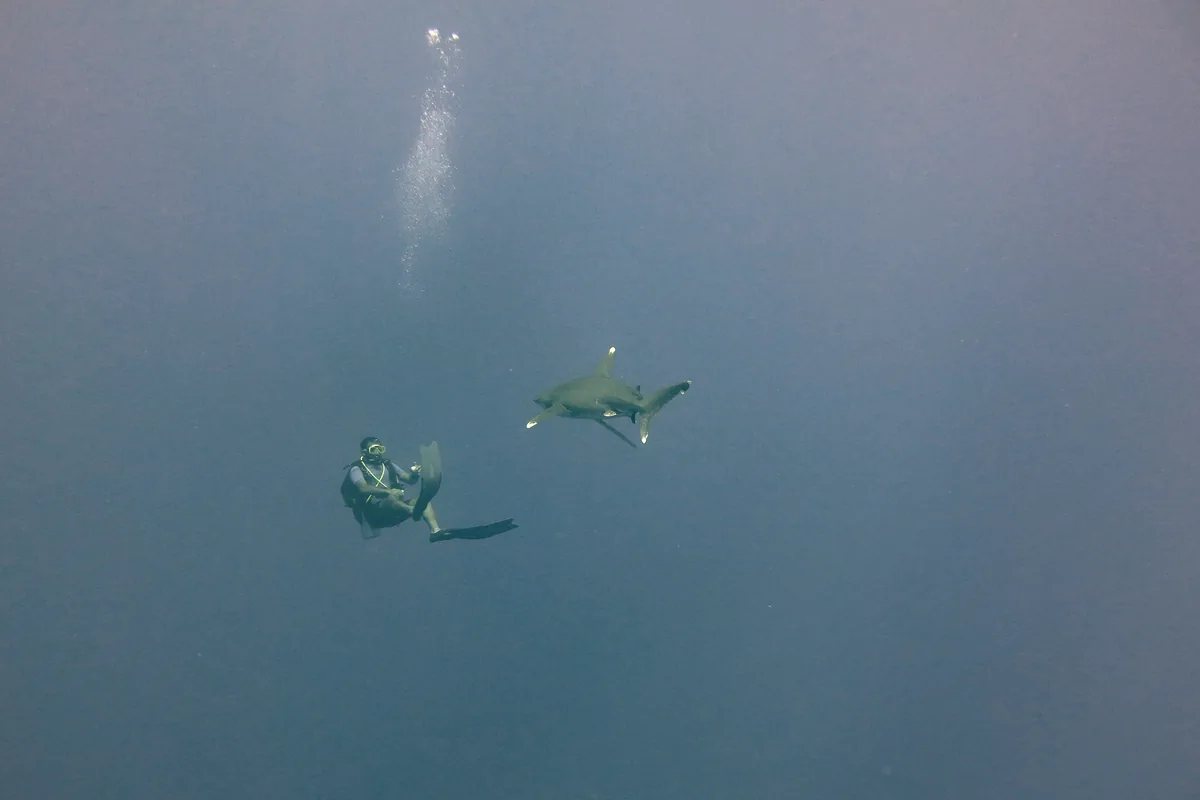
- Oceanic whitetips are most reliable in autumn and early winter (roughly October–December) at offshore sites such as the Brothers, Daedalus and Elphinstone.
- Whale sharks and manta rays are seasonal and uncommon, mostly late spring to summer (about May–August) and mainly offshore; the Red Sea is not a primary destination for these filter-feeders, unlike the Maldives.
- Dolphins are free-ranging and can turn up gloriously — but they cannot be scheduled.
What you can realistically expect on ordinary reef dives is superb coral, clouds of anthias and other reef fish, morays, turtles, octopus and the occasional larger visitor — an outstanding show in its own right. Treat any operator promising guaranteed sightings of a specific species with caution.
Myth: You have to buy expensive gear before you can start
The reality
You almost never buy anything to learn. Most beginners dive on rental equipment, and dive centres routinely include the full kit — tank, weights, buoyancy jacket, regulator and wetsuit — in the price of a try dive or a certification course. There is nothing to purchase before your first breath underwater, and no need for a personal dive computer as a beginner, because early dives are guided, supervised and well within no-stop limits.
If you catch the bug, the usual first personal buys are the fit-sensitive basics — a mask, snorkel and fins — which run roughly €150–350 (about £130–300) for a decent set, and even those are optional for holiday divers happy to rent. Prescription mask lenses exist for anyone who needs them, so glasses are no barrier either. Owning a full set of gear is a choice for people who dive often, not an entry requirement for those who dive occasionally.
Myth: Diving the Red Sea is prohibitively expensive
The reality
The Red Sea is one of the best-value dive destinations in the world. Prices vary by centre, season, group size and exactly what is included, but as a guide to the market: a guided introductory dive with all equipment typically costs in the region of €45–90 (about £40–80), and a full, internationally recognised Open Water certification — learning materials, equipment, four open-water training dives and the certification itself — commonly runs about €250–370 (roughly £220–330). That certificate then lasts for life and is honoured at dive centres worldwide.
For certified divers, day boats usually bundle two dives with guide, tanks, weights, lunch and hotel transfer into a single price, spreading the cost across a full day on the water. As always, the sensible move is to confirm exactly what a quoted price covers — and what it doesn't — before booking, rather than choosing on headline price alone. For detailed 2026 market ranges by trip and course, see the Red Sea diving prices guide.
How to tell honest information from marketing
Good dive information is specific, checkable, and comfortable telling you what it cannot promise. A trustworthy source gives real numbers — water temperatures by season, maximum depths, exactly what a price includes — freely admits that sightings of sharks, dolphins or mantas are never guaranteed, and matches a dive site to your experience instead of insisting everything suits everyone. Vague superlatives such as "the best," "totally safe" or "guaranteed," with no figures behind them, are a warning sign; so is any operator who waves away the standard medical questionnaire rather than asking you to complete it. The same scrutiny applies to the operator itself — a criteria-led approach to choosing a Red Sea dive centre is the surest safeguard.
Before booking, sanity-check claims against independent, non-commercial references: training bodies (such as PADI) for certification prerequisites and depth limits; dive-medicine organisations (such as the Divers Alert Network) for health and safety questions; scientific monitoring (such as NOAA's Coral Reef Watch) for reef-health facts; the International Shark Attack File at the Florida Museum for shark risk; and your own government's official foreign-travel advice for safety and entry questions. When an operator's medical, safety and pricing information lines up with those neutral sources, that consistency is a far more reliable signal than any marketing headline.
Frequently asked questions
Can I scuba dive if I wear glasses or contact lenses?
Yes. Ordinary glasses won't work under a dive mask because it won't seal, but the standard solution is a mask fitted with corrective ("prescription") lenses — either drop-in lenses for common prescriptions or laminated lenses made to your exact prescription, including astigmatism and bifocal options. Many divers instead wear soft contact lenses under the mask. And because water magnifies objects by about a third, people with only a mild prescription often find they don't need correction at all. Poor eyesight is not a barrier to diving.
What if I get seasick on the boat?
Seasickness is common and very manageable, and many people find the nausea eases the moment they descend, away from the surface motion. Dive-medicine guidance is to take anti-nausea medication either the evening before, or at least 30–60 minutes before boarding — and to choose a non-drowsy formulation, and test it on dry land first, since some cause drowsiness or slow reactions. Ginger, watching the horizon, sitting near the middle of the boat, and avoiding alcohol and heavy meals all help too. Choosing shore or house-reef diving avoids long boat rides altogether.
Is there an upper age limit for scuba diving?
There is no upper age limit. The minimum age for most programmes is 10, and above that, health matters more than age. Before diving you complete a short standard medical questionnaire; most people are cleared straight away, while certain conditions require a doctor's sign-off first. Plenty of people learn to dive in their 50s, 60s and beyond.
I'm not a confident swimmer — can I still try it?
Very likely yes, for an introductory dive. A "try dive" such as Discover Scuba Diving does not require the formal swim test — you only need to be reasonably comfortable in water, with an instructor supervising you throughout. Full Open Water certification does include a no-time-limit swim (200 metres, or 300 metres with mask, fins and snorkel) and a 10-minute float, so if you want to certify it's worth building basic water confidence first. A taster is the low-pressure way to find out how you feel.
What if I panic or don't enjoy it once I'm underwater?
On an introductory dive the instructor stays right beside you the whole time, and skills are introduced gradually in shallow water before you go anywhere. You are never trapped: you can signal at any point and ascend slowly to end the dive. Because a try dive is a low-commitment taster, it is a low-risk way to discover whether diving is for you before investing in a full course.
How deep will I actually go on a first dive or a beginner course?
Introductory try dives are limited to a maximum of 12 metres, and an entry-level Open Water certification qualifies you to a maximum of 18 metres. In practice, beginners spend most of their time shallower still, where the water is brightest, warmest and most colourful and reef life is densest — depth is not what makes a Red Sea dive spectacular.
How long does it take to learn — do I need to train before my holiday?
An introductory try dive takes just a few hours on the day, with no advance preparation. A full Open Water certification typically takes three to four days. The theory can usually be completed online at home beforehand, so if you want to certify on your trip you can arrive with the knowledge development done and spend your holiday time in the water rather than the classroom.
How long do I have to wait after diving before flying home?
Because your tissues still hold extra nitrogen after a dive, dive-medicine guidance is to wait at least 12 hours after a single no-decompression dive, and at least 18 hours after multiple dives or several consecutive days of diving, before flying. Many divers simply leave a full day between their last dive and the flight home to be safe — worth remembering when planning the final day of a trip.
Do I need special diving insurance?
It is strongly recommended. Ordinary travel insurance often excludes scuba diving or caps the depth it covers, so check the wording and, if needed, add scuba cover to your planned depth. Dedicated dive-accident insurance — including cover for things like recompression treatment — is available inexpensively from dive-medicine organisations, and it is one of the cheapest forms of peace of mind a diver can buy.
Ready to see it for yourself?
The surest way past the myths is a first breath underwater. Aquarius runs try dives and PADI courses for complete beginners across the Red Sea — every question answered honestly before you book.
Learn to dive →Facts in this guide were checked against training agencies, dive-medicine bodies, reef-science monitoring and official travel advice in August 2026. Seasons, prices and travel guidance change over time, so confirm current details before booking. This guide is informational and does not rank or endorse specific dive operators.