Where to see them
When to see them
Scalefin anthias are true year-round residents rather than seasonal visitors: a healthy school holds its patch of reef in every month, and there is no particular time of year that reliably improves the odds of finding one. What changes from dive to dive is how the school behaves rather than whether it is present — studies at Eilat report that the fish feed up-current of their coral shelter, commonly facing the oncoming current, and swing round to a new position when the current changes direction. Reproduction seems to follow its own separate rhythm: spawning in the Red Sea is reported to take place around dusk and to peak in the winter months, roughly December to February, though this has not been confirmed as a pattern across the whole Red Sea.
Year-round resident Feed up-current of the reef, facing the flow
How to recognise a scalefin anthias
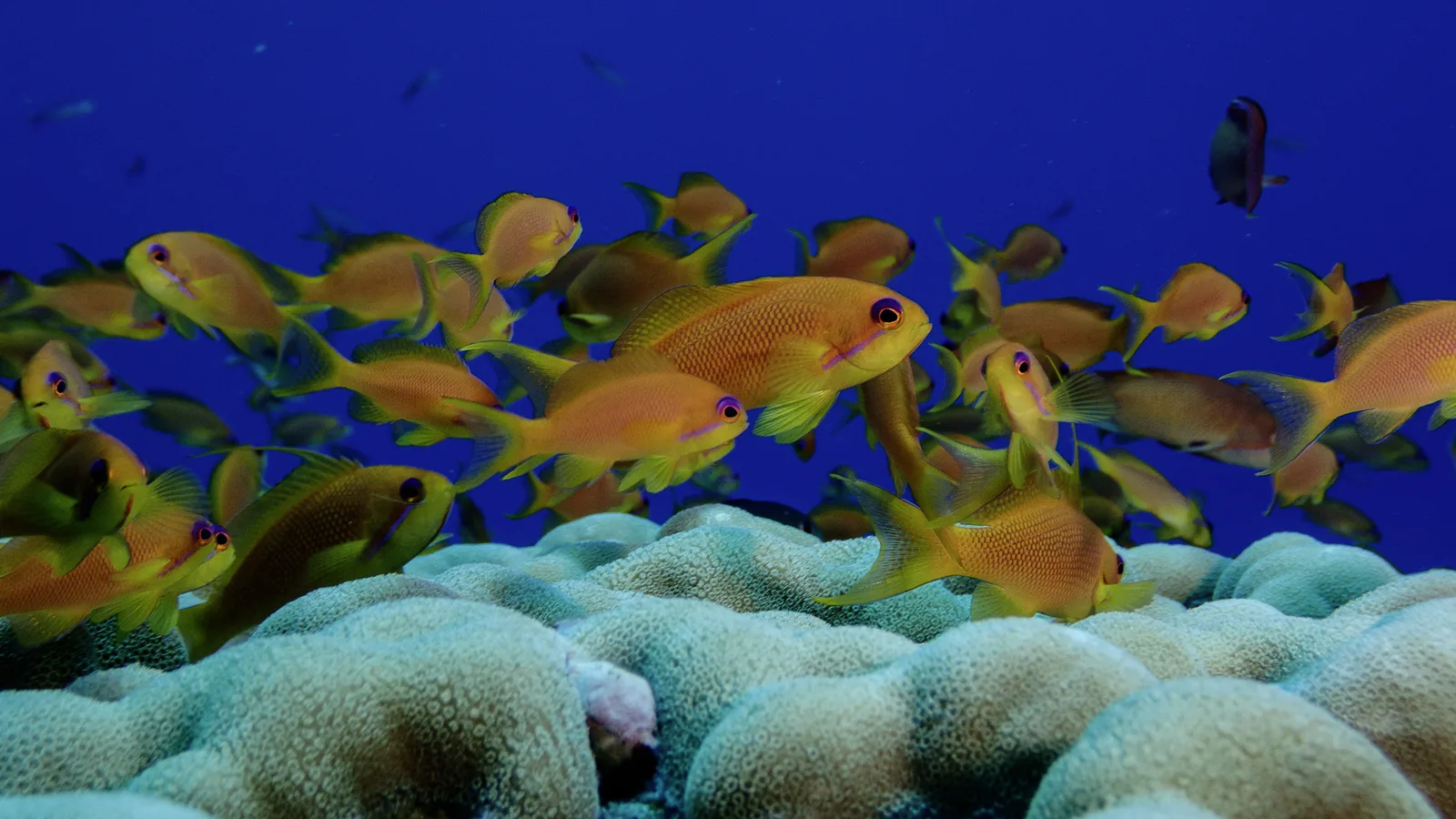
Scalefin anthias are usually easy to notice from a distance — the orange-gold cloud gives the species away before a diver gets close enough to make out individual fish — but the school is made up of two very different-looking sexes, plus at least one other reef fish that habitually mingles with it. The key features to check:
- Body shape: A small, deep-bodied, oval basslet with a forked tail, rarely mistaken for anything else once the colour and schooling habit are taken into account.
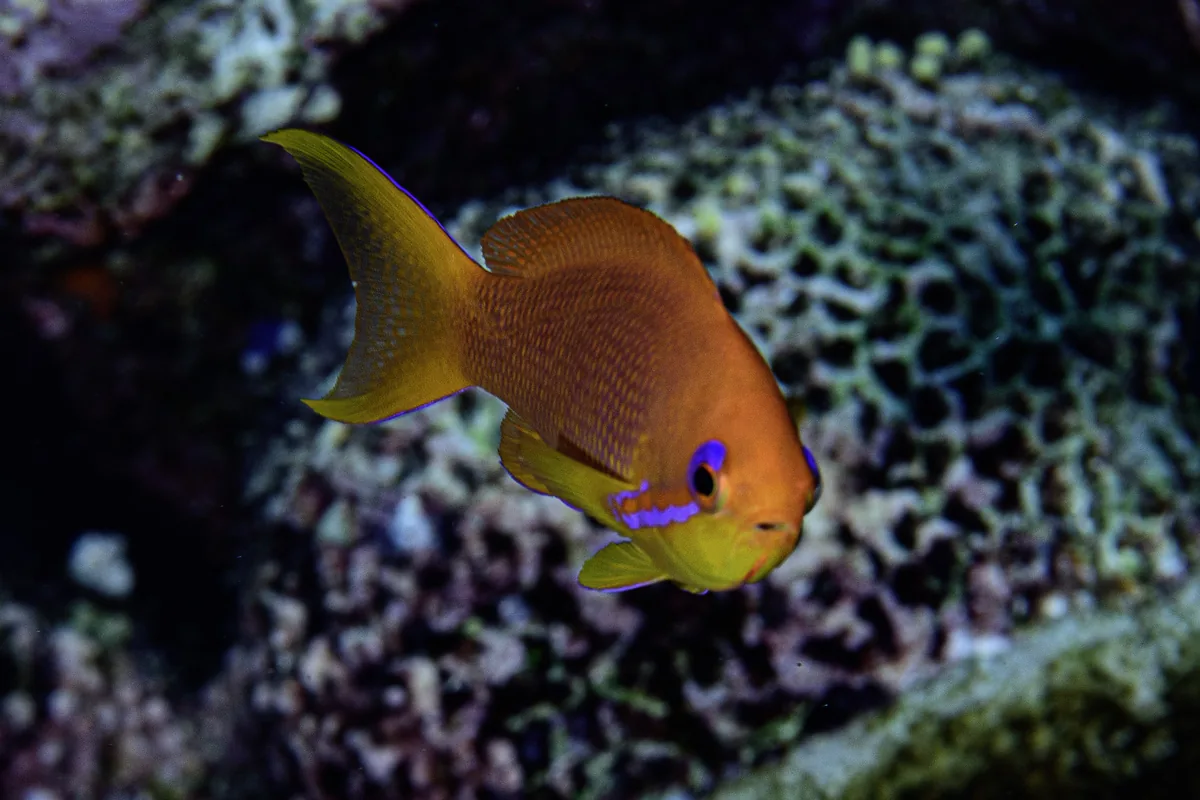
- Female colour: Golden-orange over most of the body, a yellow tail, and a distinctive violet or lavender stripe running from below the eye back towards the pectoral fin.
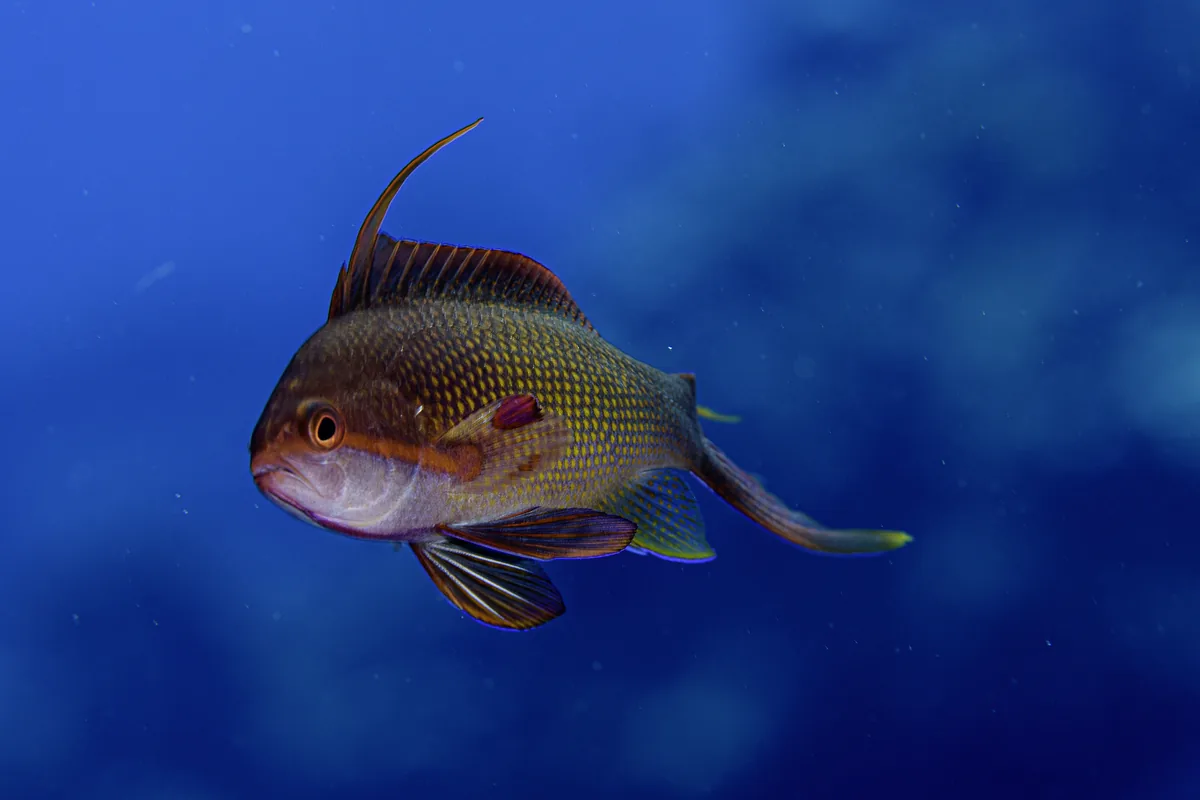
- Male colour: Larger and more strikingly coloured, often described as fuchsia or purplish-pink but variable — reports range from purple tones to shades of red with yellow or yellow-green scale centres — with a greatly elongated third dorsal-fin spine trailing behind the rest of the fin (females have a shorter one), elongated upper and lower lobes on the tail, and a red or purple patch on or near the pectoral fin. Colour also changes with the light: red light is absorbed by seawater within the first few metres, so in natural light at depth, without a strobe, a male can look much duller and browner than it does under artificial light.
- Group size and structure: Almost always seen in a mixed school — many females and a smaller number of larger males, each male presiding over his own harem within the school — rather than singly or in a simple pair.
- Feeding posture: Hovering with the body angled into the current, mouth open, picking individual specks of plankton from the water — a very different feeding style from a fish grazing the reef surface.
A note on the name. First described in 1855 by Wilhelm Peters, from Mozambique, the species was long known in the scientific literature as Anthias squamipinnis before being reclassified into the genus Pseudanthias; Eschmeyer's Catalog of Fishes, WoRMS, FishBase and the IUCN now all place the whole group in its own family, Anthiadidae, separate from the true groupers and seabasses (older books list it under Serranidae) — reef-fish taxonomy keeps being refined even for a species this familiar.
Look-alikes worth knowing. One easily confused fish is not another anthias at all. The midas blenny (Ecsenius midas) is golden-orange, can change colour quickly to match the fishes it swims with, and is often seen schooling with scalefin anthias, feeding on plankton in the open water above the reef; this is generally interpreted as a form of mimicry, in which a solitary fish may gain some protection by blending into a crowd. It has a blenny's slimmer, more elongate body, a small black spot near the anus and narrow dark margins on the front of its dorsal fin, but at a glance in a crowded school it can be easy to overlook.
Other anthias are also recorded in the Red Sea, though none forms the huge orange clouds typical of the scalefin anthias. The striped, or Red Sea, anthias (Pseudanthias taeniatus) is a Red Sea near-endemic, usually found deeper, on steep reef slopes between about 20 and 40 m; males are boldly banded with a mostly white tail, females are plainer, and the species reaches about 13 cm. The orange-head anthias (Pseudanthias heemstrai), another near-endemic recorded from the Gulf of Aqaba, off Dahab and off Yemen, typically lives on fore-reef slopes from about 15 m down to 40 m or more, and the male develops a white breeding band; the striped anthias is rated Least Concern by the IUCN, while the orange-head anthias has not been assessed. Separately, the name Pseudanthias squamipinnis is itself in flux across its huge Indo-Pacific range: the species was described from Mozambique, and Eschmeyer's Catalog of Fishes now restricts it to the Red Sea and western Indian Ocean, treating the Pacific populations as separate species (P. cheirospilos from Indonesia across the western Pacific, and P. nobilis in Japan), although FishBase, WoRMS and the IUCN still use the broader concept. The question does not affect how the fish is identified in the Red Sea, whose fish carry the original name.
Harems and the reef's built-in sex change
A scalefin anthias school is not a random crowd — large schools are built from harems, each structured around one dominant male and, typically, somewhere between five and ten females (published figures range from about two to twelve), so a big aggregation holds several harems and several males. The male patrols and defends his patch of reef, chasing off rival males and courting the females within his territory, while every fish in the harem, male included, matured first as a female.
That last point is the species' most studied piece of biology. Scalefin anthias are protogynous hermaphrodites: every individual matures first as a female, and the switch to male is triggered by social cues rather than by age or size alone. As long as a dominant male is present, his behaviour suppresses sex change in the females around him. If he is removed or dies, the largest and most dominant female in the harem typically begins changing into a functional male — a shift that can take as little as two to four weeks in an established harem, though it took several months (roughly 170 to 280 days) in all-female groups. The mechanism was demonstrated experimentally with Red Sea fish in 1970, in a study by Lev Fishelson published in the journal Nature.
Scalefin anthias are prey as much as they are predators of plankton. A survey of 29 reef sites from Jordan to Djibouti found the species to be the second most numerically abundant of fifty ornamental reef fish counted, behind only the blue-green damselfish, and the dominant species along the Jordanian and Egyptian coasts — a measure of how large its populations can be on healthy reefs, and a hint of how important it is as a food source further up the chain. Groupers are the best-documented predator: in a Gulf of Aqaba study, fish made up about 86 percent of the coral grouper's diet, and FishBase lists the scalefin anthias as its main prey. Other reef predators that hunt small fish, such as lionfish and jacks, may take some as well, although this is far less well documented.
New recruits to a school are not necessarily related to one another. A genetic study of newly settled juveniles in large scalefin anthias social groups found they were not predominantly siblings but a random sample of the offspring of many different matings — consistent with larvae being well mixed in the plankton before they settle.
Diet
Scalefin anthias are planktivores, feeding almost exclusively on zooplankton picked one animal at a time from the water column. A feeding fish hovers with its body angled into the current, picking off drifting zooplankton — copepods and other tiny crustaceans among them — as the water carries it past, a technique that depends on a steady supply of current-borne food, which is why schools so often cluster wherever a current sweeps across a reef crest, wall or pinnacle.
Unlike many reef fish that supplement a plankton diet with algae or benthic invertebrates picked off the coral, scalefin anthias rarely feed directly from the reef surface. Their role in the reef food web runs in both directions: by removing large numbers of zooplankton from the water column, a large school may help move nutrients from open water onto the reef, while the fish themselves — among the most numerous fish counted in surveys of Red Sea reefs — are an important prey item for the predators described above.
Watching and photographing scalefin anthias
Scalefin anthias are an easy, rewarding subject once their habits are understood, but a heavy-handed approach sends the whole school diving for cover in seconds:
- Approach slowly, and stay low. A school that senses a fast-moving diver dives for the coral instantly; a slow approach along the reef, keeping fin kicks well clear of the structure below, usually lets the fish settle back into the open.
- Watch from a little distance first. Anthias regroup and spread out again once they judge a diver to be harmless — hanging back and letting the school re-form usually produces a better view, and a better photograph, than crowding in for a closer look.
- Work with the current, not against it. Because the fish hover facing into the current to feed, positioning slightly downstream and below the school usually lets a diver watch and photograph natural feeding behaviour with less disturbance.
- Use a strobe or video light to see true colour. The male's pink, red and purple tones, in particular, fade quickly with depth without artificial light — a flash or video light brings the school's real colours back.
- Mind buoyancy near the coral heads and pinnacles the schools shelter around. These structures are exactly what suffers from a careless fin kick or a hand used to steady against the current.
Conservation status
The scalefin anthias is listed as Least Concern on the IUCN Red List (last assessed in March 2015 and published in 2016, with a stable population trend). Treated in the broad sense the IUCN uses, it is an extremely widespread species across the Indo-West Pacific, from the Red Sea and East Africa to Japan and south-eastern Australia, and Red Sea populations are generally reported as abundant and stable — the regional survey described above found it to be one of the most numerically dominant ornamental reef fish counted, which is consistent with a healthy population rather than a species under pressure.
It is collected for the marine aquarium trade, where its colour and manageable adult size have made it popular, but this is not considered a threat to wild populations given how abundant and widespread the species is. The clearest risk to scalefin anthias, as with almost every reef fish in this guide, is indirect: because the species depends on live coral structure for shelter and on healthy current-borne plankton supplies for food, anything that damages the reef itself — physical damage, pollution, or coral bleaching from warming water — removes the conditions the schools rely on, even though the fish is not itself directly targeted by exploitation.
Related Red Sea reef fish
Scalefin anthias share their reef with several other characterful residents, including some that depend on the anthias schools themselves:
- Coral grouper — one of the scalefin anthias's best-documented predators, and one that takes the anthias as its main prey in the Gulf of Aqaba.
- Lionfish — an ambush predator of small reef fish that shares the same reefs.
- Masked butterflyfish — a Red Sea near-endemic that shares the same coral slopes and reef flats.
- Longnose hawkfish — a motionless ambush specialist perched on the same gorgonian and coral structure the anthias schools hover around.
For the bigger picture of what lives on an Egyptian reef and how the seasons shape a dive, see the complete guide to scuba diving in the Red Sea. To browse the full encyclopedia species by species, visit the Red Sea marine life guides.
Frequently asked questions
It is almost always the scalefin anthias, Pseudanthias squamipinnis, a small planktivorous basslet that lives in dense, mixed-sex schools hovering just above the coral. Individually the fish are modest in size, but a healthy school can number in the dozens to hundreds, and the combined shimmer of their orange-gold bodies is one of the most recognisable sights on a Red Sea dive.
Females are golden-orange with a yellow tail and a violet stripe running from below the eye back towards the pectoral fin, and rarely grow past about 7 cm. Males are larger, up to about 15 cm, with a greatly elongated third dorsal-fin spine, elongated upper and lower tail lobes, and a red or purple patch on or near the pectoral fin; their overall colour is often described as fuchsia or purplish-pink but varies from fish to fish and place to place, and in ambient light at depth, without a strobe, a male can look considerably duller and browner, since red light is the first part of the spectrum that water absorbs.
Yes. Every scalefin anthias matures first as a female, a pattern called protogynous hermaphroditism. A harem is led by a single dominant male, and his presence actively suppresses sex change in the females around him. If he disappears, typically the largest and most dominant female in the group changes into a fully functional male over a period that can range from a couple of weeks to several months, taking over his role. The mechanism was demonstrated experimentally with Red Sea fish in 1970.
There is a large difference between the sexes. Males reach a maximum of about 15 cm, while females are considerably smaller, topping out at around 7 cm.
They feed almost entirely on zooplankton, hovering in open water and facing into the current to pick tiny drifting animals out of the water column one at a time. They rarely feed directly off the reef surface, and their close association with a strong, food-bearing current is one of the reasons the schools cluster where they do.
No. They are small, harmless plankton feeders with no venom and no aggressive behaviour towards divers, and they dart into the safety of the coral at the first sign of a threat. Their real predators are other reef fish, particularly groupers such as the coral grouper, which takes the scalefin anthias as its main prey.
Across much of the Egyptian Red Sea, wherever there is healthy coral and a current to carry plankton past it — reef crests, coral pinnacles, and current-swept walls all hold schools, and they are present year-round rather than on a seasonal cycle. Sheltered house reefs at Hurghada, Makadi Bay and Sahl Hasheesh hold accessible schools close to shore, while offshore, current-swept reefs — around Sharm el-Sheikh, the Straits of Tiran and Ras Mohammed, and Hurghada's offshore sites such as Umm Gamar and Erg Abu Ramada — are known for particularly dense anthias clouds.