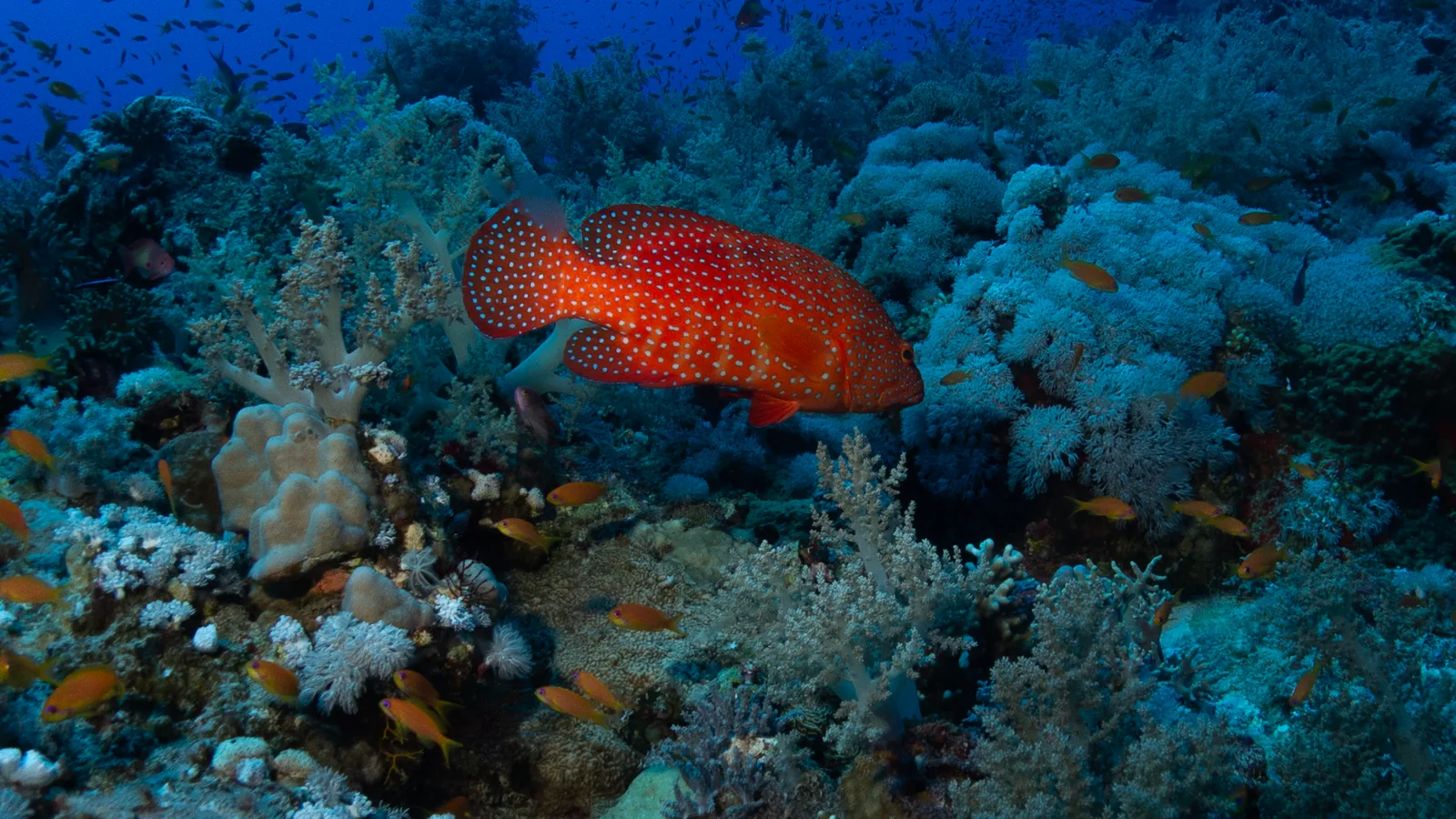
Where to see them
When to see them
The coral grouper is a permanent Red Sea resident rather than a seasonal visitor, so there is no particular month to plan a sighting around — it is on the reef, usually in more or less the same spot, all year round. What does vary through the day is activity: a coral grouper spends long stretches simply resting on its perch, then hunts in short, explosive bursts, and tends to be most active around dawn and dusk, when low-angle light and lengthening shadows give an ambush predator its best cover. A calm, clear-water day at any time of year is enough to bring out the full glow of its blue spotting.
Year-round resident Hunting peaks at dawn and dusk
How to recognise a coral grouper
A coral grouper is one of the easier fish on a Red Sea reef to name with confidence, provided the light is good enough to show its colour. The key features:
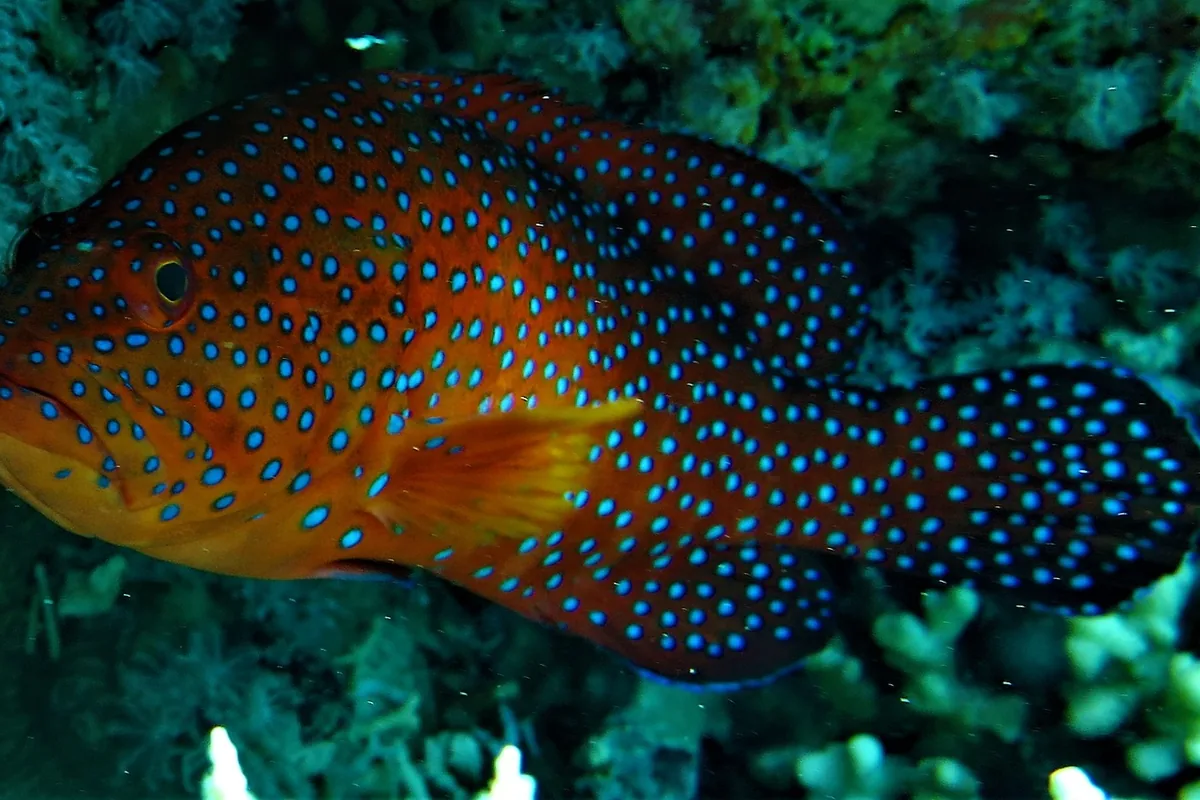
- Body shape: Oblong and moderately deep-bodied, with a large mouth and a rounded tail — the classic grouper silhouette, reaching a maximum of around 50 cm.
- Colour & spotting: An orange-red to reddish-brown body covered, almost without a gap, in small, bright electric-blue spots ringed with a darker edge. The spots run across the head and body and continue onto the dorsal, anal and tail fins.
- The darker rear: The back third of the body, the tail and the rear dorsal fin are often noticeably darker — a deep maroon to near-black — while the blue spotting carries on unbroken over the darker background, giving the tail a striking two-tone look.
- Fins & mouth: The pectoral fins are plain, translucent orange-yellow and largely unspotted, and the mouth is large for the fish's size, built for engulfing prey whole in a single strike rather than nibbling.
- Juveniles: Young coral groupers are more uniformly yellow to orange, with fewer, paler and more widely spaced blue spots than the densely marked adult.
Two other Red Sea fish are regularly confused with it. The yellowfin, or halfspotted, hind (Cephalopholis hemistiktos) shares the same reddish base colour but carries far fewer, larger blue spots concentrated on the head and lower body, a blue-edged tail, and — the clearest tell — yellow margins along its pectoral fins, rather than the coral grouper's dense, even, all-over spotting. The name "coral trout" is also occasionally applied to the coral grouper, which causes confusion with a genuinely different, much larger fish: the roving coralgrouper (Plectropomus pessuliferus, represented in the Red Sea by the subspecies P. pessuliferus marisrubri), which reaches up to 120 cm — more than double the coral grouper's maximum length — and carries a coarser, more widely spaced spot pattern.
Behaviour, territory and a hunting partnership
A coral grouper is built for patience, not pursuit. It spends much of the day resting almost motionless on top of a favourite coral head or at the entrance to a small cave, its bold colours blending surprisingly well against reef coral and sponge. When a small fish drifts within range, the grouper explodes off its perch in a single short rush rather than a sustained chase — an ambush strategy that depends on staying still and unnoticed far more often than it depends on speed.
The species is highly territorial and socially organised into harems: a dominant male defends a home range of up to roughly 475 square metres, inside which two to twelve females each hold and defend a smaller patch of their own. The male patrols this territory and visits each female in turn; when two coral groupers meet, the encounter is typically settled by a slow, parallel swim past one another rather than open aggression.
One of the most striking things a coral grouper does is share its ambush strategy with a very different predator. Groupers and giant moray eels are among the very few pairs of unrelated animals shown to hunt cooperatively using deliberate signals rather than simple opportunism. The landmark study, filmed on Red Sea reefs, documented a close relative of the coral grouper — the roving coralgrouper, Plectropomus pessuliferus — visiting a resting moray eel and shaking its head rapidly, three to six times a second, directly in front of the eel's face to recruit it for a joint hunt; the pair then worked a patch of reef together, the moray flushing prey out of crevices the grouper alone could never reach while the grouper waited to intercept anything that broke into open water. Hunting in partnership raised the grouper's catch rate almost fivefold compared with hunting alone. The coral grouper is built for exactly this kind of ambush around exactly the same crevices and caves moray eels use to rest, and divers on Red Sea reefs regularly find a coral grouper stationed close to, or trailing, a hunting moray — the same opportunity its larger relative has been filmed deliberately calling for, even though the head-shake signal itself has not been specifically studied in this species. Red Sea reefs have also produced some of the best evidence anywhere that reef predators, including octopuses, form similar loose, multi-species hunting alliances, each partner exploiting a different way of flushing or ambushing the same prey.
Diet — an ambush specialist
More than 80 percent of a coral grouper's diet is small reef fish, above all the scalefin, or lyretail, anthias (Pseudanthias squamipinnis) that hover in clouds above many Red Sea reefs, along with other anthias and cardinalfish (Apogon species). The remaining share is made up of small crustaceans such as shrimps and crabs, picked off the reef surface or flushed out of cover. As in related ambush-hunting groupers, activity tends to be greatest around dawn and dusk, when the low, angled light and lengthening shadows favour a predator that relies on surprise rather than speed; through the rest of the day the coral grouper is far more often seen resting on its perch than actively hunting.
Harems and a change of sex
Every coral grouper begins life as a female. The species is a protogynous hermaphrodite, and within a harem it is typically the largest, most dominant female that later transitions into a male — a change triggered by social cues within the group rather than by age or size alone. A single male then holds the harem's territory against rival males while its two to twelve females each defend a smaller sub-territory inside it, and the male's tenure lasts until it is displaced or lost, at which point the harem's leading female is generally the one that changes sex to replace it.
Coral groupers are broadcast, or pelagic, spawners: rather than building a nest or guarding eggs, a male and female rise together off the reef and release eggs and sperm directly into the water column, where fertilisation happens externally. The fertilised eggs and the tiny larvae that hatch from them drift with the current for a period before settling back onto a reef to begin life as a juvenile. There is no parental care at any stage — the harem system governs who breeds with whom, but once spawning is over, the open ocean takes over.
Watching and photographing coral groupers
A coral grouper's confidence and its stationary, perched habit make it one of the more approachable and rewarding subjects on a Red Sea reef:
- Bring a light. Red wavelengths are the first to be filtered out of sunlight underwater, so a coral grouper's fiery orange-red base colour can look flat brown or grey by eye at depth. A strobe or video light, even a small one, restores the true colour and makes the blue spotting glow.
- Approach low and slow. A grouper resting on a coral head will usually hold its position for a calm diver who approaches gradually from the side rather than head-on; sudden movement or a shadow cast directly over it is the surest way to send it retreating into a crevice.
- Watch the neighbours. A coral grouper stationed near a moray eel's den, or trailing a moray as it forages, is often a sign that a hunt is about to unfold — a rewarding scene to watch quietly from a short distance rather than crowd.
- Do not touch the perch. The same coral heads a coral grouper favours are living animals; good buoyancy and no contact protect both the coral and the grouper's home.
- Give the harem room. Several coral groupers holding territory on the same stretch of reef is normal harem behaviour, not crowding — give each fish its own space rather than following one animal from patch to patch.
Conservation status
The coral grouper is listed as Least Concern on the IUCN Red List (assessed 2018). Its very wide Indo-Pacific range — from the Red Sea and East Africa across the Indian Ocean to the central Pacific, north to southern Japan and south to northern Australia — together with generally common, stable populations keeps the species well away from any global threat category.
Locally, the coral grouper is of real economic importance: it is targeted by hook-and-line, spear and fish-trap fisheries across much of its range and is also collected for the marine aquarium trade, drawn by its vivid colouring. Neither pressure is currently considered a range-wide threat, but as a reef-associated ambush hunter tied to healthy coral cover and to the moray eels and anthias shoals it depends on, the coral grouper's long-term security is really a question of reef health rather than any species-specific measure. On a well-managed Red Sea reef it remains one of the most common, confident and photographed fish a diver will meet.
Related Red Sea reef predators
The coral grouper's habit of sharing a hunting ground — and sometimes a hunt — with other reef predators makes it a natural starting point for exploring some of the Red Sea's other characterful residents:
- Giant moray eel — the crevice-hunting partner whose caves and hunting style the coral grouper shares, and the species at the centre of the Red Sea's famous grouper-moray hunting partnership.
- Octopus — another intelligent Red Sea predator known to form loose, multi-species hunting alliances with reef fish.
- Lionfish — a slower, more visible ambush predator that hunts over the same coral heads the coral grouper patrols.
- Scorpionfish & stonefish — the reef's masters of camouflage-and-ambush, using patience in much the same way as the coral grouper.
For the bigger picture of what lives on an Egyptian reef and how the seasons shape a dive, see the complete guide to scuba diving in the Red Sea. To browse the full encyclopedia species by species, visit the Red Sea marine life guides.
Frequently asked questions
A coral grouper is one of the easiest groupers to name on sight: an oblong, orange-red to reddish-brown body is densely covered in small, bright electric-blue spots, each ringed with a darker edge, that run across the head, body and into the dorsal, anal and tail fins. The rear third of the body and the rounded tail are often noticeably darker — almost maroon-black — while the spotting continues unbroken over the darker zone. The pectoral fins are a plain, translucent orange-yellow, and the fish is usually found perched almost motionless on top of a coral head or at the mouth of a small cave rather than swimming in open water.
Yes. Coral grouper and coral hind are simply two common English names for the same species, Cephalopholis miniata; it is also sometimes called coral cod, coral rock cod or vermilion seabass. The name "coral trout" is occasionally used for it too, which causes confusion with a genuinely different and much larger Red Sea fish, the roving coralgrouper (Plectropomus pessuliferus), which can reach 120 cm — more than twice the coral grouper's maximum size.
Coral groupers are frequently seen resting close to a moray eel's den or trailing one while it forages, ready to snap up any small fish the eel flushes out of a crevice — the same ambush opportunity that has made Red Sea groupers famous in science. The deliberate signal behind this partnership, a rapid head-shake used to recruit a specific moray for a joint hunt, was documented in a close Red Sea relative, the roving coralgrouper, whose catch rate rose roughly fivefold when hunting with a moray instead of alone. The coral grouper hunts from the same kind of perch and shares the same reef holes, which is why divers regularly find the two species working the same patch of coral.
Coral groupers reach a maximum recorded length of around 50 cm, although most adults seen on the reef are considerably smaller, typically 25 to 35 cm, and the species matures at about 26 cm. They are a mid-sized member of the grouper family — larger than the small hinds that share the same coral but far smaller than giant groupers or the roving coralgrouper, which can be more than twice their length.
Coral groupers are ambush predators whose diet is more than 80 percent small fish, above all the scalefin anthias (Pseudanthias squamipinnis) that swarm in clouds above the reef, along with other anthias and cardinalfish. The remainder is made up of small crustaceans such as shrimps and crabs. Rather than chasing prey down, a coral grouper waits almost motionless on a coral perch and strikes in a single short rush, and — as in related ambush-hunting groupers — tends to be most active around dawn and dusk.
Yes. The coral grouper is a protogynous hermaphrodite, meaning every individual starts life as a female, and some later change into males as they grow. The species lives in harems of one dominant male and up to around a dozen females spread across a shared territory; if the male is lost, the largest female in the group is typically the one that changes sex and takes over.
Coral groupers are common, resident reef fish across the Egyptian Red Sea and are considered one of the easiest groupers to approach, which makes them a favourite subject for underwater photographers. Look for them perched on coral heads and around caves and ledges on exposed reef fronts and drop-offs, from sheltered house reefs at Hurghada, Makadi Bay and Sahl Hasheesh to the clearer, current-swept reefs off Ras Mohammed and the Straits of Tiran, where the anthias shoals they hunt are especially dense.