Where to see them
The longnose hawkfish is a habitat specialist rather than a fish of any single famous dive site. Find the right home — a big red gorgonian sea fan or a black-coral bush on a deep, current-swept slope — and there is a fair chance a hawkfish is tucked inside it. On an Egyptian Red Sea trip, the most reliable places to look are:
When to see them
The longnose hawkfish is a resident, not a seasonal visitor, so it is present in the Egyptian Red Sea all year round. There is no month to plan a trip around — what matters is the dive, not the calendar. Because the fish lives deep and stays close to its host coral, the real variables are conditions and attention: calm days with good visibility make the deeper gorgonian slopes more comfortable and easier to search, and a slow, observant diver with a guide who knows which fans hold hawkfish will always out-find a diver racing along the reef.
Year-round resident Best on calm, clear days over deep gorgonian slopes
How to identify a longnose hawkfish
Once it is spotted, the longnose hawkfish is impossible to confuse with anything else on the reef. The trouble is spotting it in the first place. The key field marks:
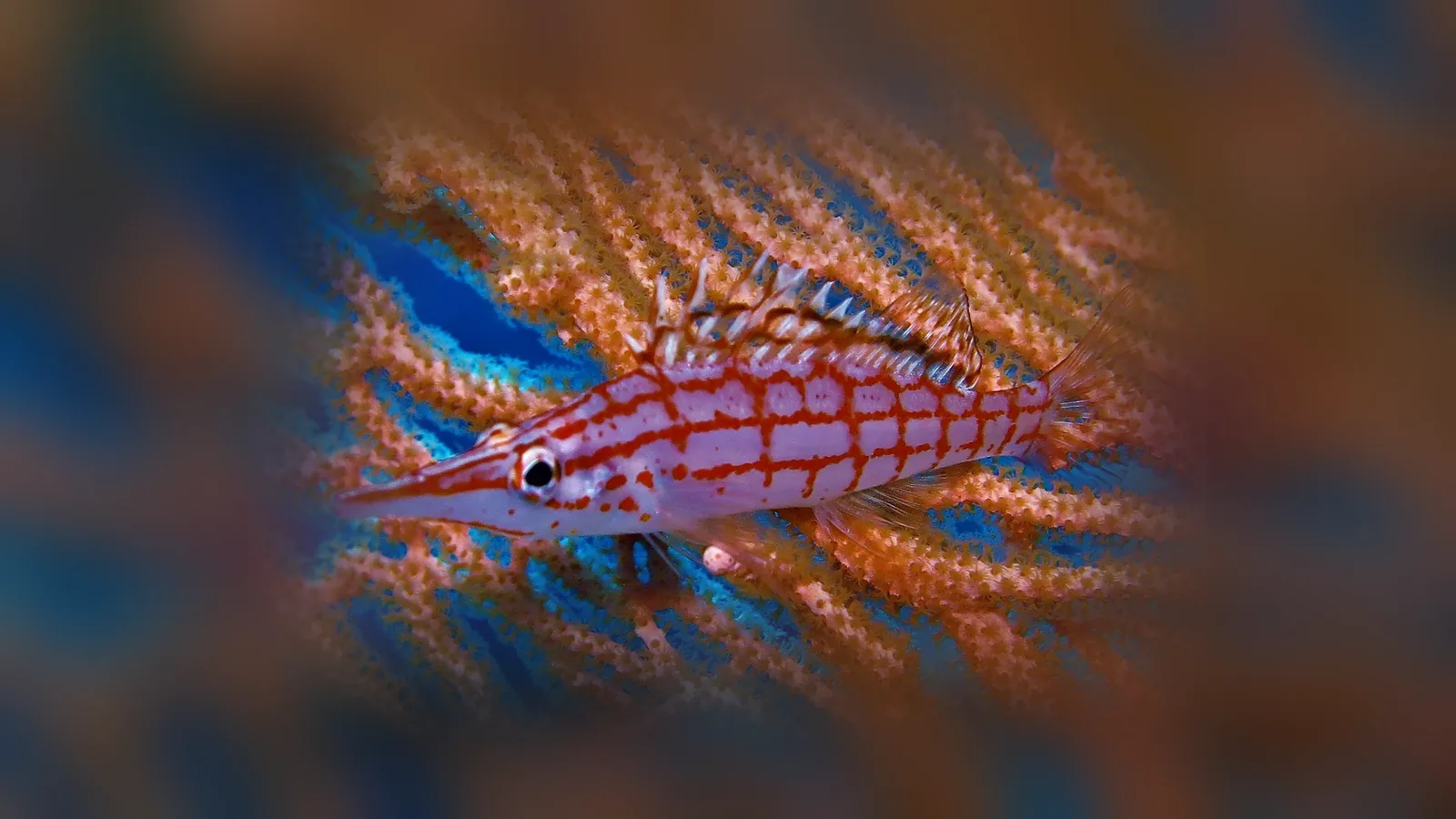
- The red lattice: a pale, whitish-pink body overlaid with a grid of fine red lines running both across and down the flanks, forming a distinctive red cross-hatch or tartan pattern. No other Red Sea reef fish carries this markings.
- The long snout: a slender, tapering, tweezer-like snout — roughly half the length of the head — tipped with a small mouth of tiny inward-facing teeth. It is a precision tool for picking prey from between coral branches, and it gives the fish its name.
- Cirri on the dorsal spines: tiny tufts of hair-like filaments (cirri) sprout from the tips of the spiny dorsal fin. These little brushes are shared by all hawkfishes and are where the family's scientific name, Cirrhitidae, comes from.
- Size and shape: small and delicate — most are 8–13 cm long, with a maximum of about 13 cm. The body is slightly compressed, and the lower pectoral-fin rays are noticeably thickened.
- Behaviour as a clue: a small fish sitting motionless on a gorgonian sea fan or black-coral bush, hopping deeper into the branches when you approach, is almost certainly a longnose hawkfish. It rests on the coral; it does not hover in the open.
A perch, not a swim — life without a swim bladder
The single most important thing to understand about the longnose hawkfish also explains its whole way of life: like all hawkfishes, it has no swim bladder. In most bony fish this gas-filled organ acts as a buoyancy float, letting the animal hang weightless in the water. Without one, the hawkfish is naturally denser than the water around it and simply cannot hover. Its solution is to sit. It rests its body on the reef, propped up on the thickened lower rays of its pectoral fins, which spread out beneath it like a pair of splayed hands.
From that perch it moves in short, quick hops rather than sustained swimming — a dart to the next branch, a shuffle around the far side of the fan, a flick down into cover. This sit-and-wait style is precisely what earned the family its common name: like a hawk on a fence post, the fish watches from a fixed vantage point and pounces on anything small enough to eat that drifts within reach. It is an efficient way to live on a current-swept slope, where staying put and letting the water bring the food past is far less costly than swimming against the flow.
The sea-fan specialist: habitat and camouflage
The longnose hawkfish is almost never found away from a large gorgonian sea fan or a bushy black coral, and the partnership is no accident. These corals grow on steep outer slopes and drop-offs where the current runs strong, and that same current delivers the drifting plankton the fish feeds on. The gorgonian gives the hawkfish a shaded, three-dimensional refuge to hunt from and hide in; the fish, in turn, spends almost its entire life within the reach of a single fan.
Camouflage seals the arrangement. Many of the sea fans the hawkfish favours are themselves red, and the fish's fine red grid breaks up its outline against that background so effectively that even experienced divers swim straight past occupied fans. When threatened, the hawkfish does not flee into open water — it cannot cruise far anyway — but instead shuffles around the branches, keeping the fan between itself and the intruder. That habit is at once its best defence and the reason a patient diver, circling slowly, is eventually rewarded with a clear view. The same cryptic strategy is used by other Red Sea ambush specialists, such as the bottom-hugging crocodilefish, which vanishes against sand and rubble the way the hawkfish vanishes into its fan.
Diet: a tweezer-nosed micro-hunter
Everything about the longnose hawkfish's anatomy points to a diet of very small prey. It feeds mainly on tiny benthic and planktonic crustaceans — copepods, shrimp larvae, mysids and similar zooplankton — that drift past on the current or shelter among the coral branches. That long, fine snout is the key tool: it reaches into the narrow gaps of the gorgonian to pluck out prey a blunt-faced fish could never reach, and it lets the hawkfish pick individual morsels from the water with tweezer-like precision.
The fish hunts by the same sit-and-wait method it uses for everything else. It perches, watches, and makes a fast, short lunge when a food item comes within range, returning immediately to its vantage point on the coral. Feeding activity picks up around dawn and dusk and whenever the current strengthens and carries a denser drift of plankton over the reef.
Born female: reproduction and the dusk spawn
The longnose hawkfish has one of the more remarkable life histories on the reef. Like all hawkfishes, it is a protogynous hermaphrodite: every individual begins life as a female, and the dominant fish in a group can later change sex to become male. In many hawkfish species this produces a small harem — one male guarding several females — but the longnose hawkfish is usually seen instead as a single monogamous pair sharing one sea fan.
Spawning is a quiet, brief event tied to the fading light. At dusk the pair leaves the shelter of the coral and rises a short way off the reef, releasing eggs and sperm together into the water column before dropping back to safety. The fertilised eggs are pelagic, drifting in the open sea as part of the plankton until the larvae eventually settle onto a reef of their own. Little is documented about the fish's lifespan in the wild; in aquaria, where it is a popular species, individuals commonly live around five to seven years and sometimes reach ten.
Finding and photographing the longnose hawkfish
For many divers the longnose hawkfish is the whole point of a macro dive, and it makes a superb — if testing — photographic subject. A few principles keep both the fish and the reef happy:
- Search the fans, not the water. The fish will not come to you across open reef. Work slowly along deep gorgonians and black corals, scanning the branches for the red grid, and let a knowledgeable guide point you to fans that reliably hold hawkfish.
- Nail your buoyancy first. This is deep, close-in macro work beside fragile coral. Neutral, hands-off buoyancy is non-negotiable — brace nothing on the gorgonian, which is a living animal that is easily damaged.
- Approach from the side and wait. The hawkfish keeps the fan between itself and the camera. Rather than chasing it round and round, settle at a respectful distance, hold still, and let it come back to face you.
- Think macro. A macro lens captures the intricacy of the red lattice, the long snout and the cirri on the dorsal spines. A side-on portrait against the sea fan tells the fish's whole story in one frame.
The same slow, respectful approach rewards divers with the Red Sea's other small treasures — the jewel-like nudibranchs and countless cryptic reef characters that a hurried diver never notices.
Conservation and the aquarium trade
The longnose hawkfish is listed as Least Concern on the IUCN Red List. It owes that secure status to an exceptionally wide range: it is found from the Red Sea and the coast of East Africa, right across the Indo-Pacific to Hawaii, and on into the eastern Pacific from the Gulf of California to the Galápagos — one of the broadest distributions of any reef fish. No major threats are recognised across that range, and the species is naturally uncommon rather than declining.
It is a prized fish in the marine-aquarium trade and is collected for it, but the volumes involved are not thought to significantly affect wild populations. The more meaningful long-term concern is indirect: the longnose hawkfish depends entirely on healthy gorgonians and corals, so anything that degrades those reef habitats — warming seas, coral loss, physical damage — would erode the homes it cannot live without. For divers, the practical conservation message is the one the reef always asks: admire it in place, keep well off the sea fans, and take nothing but photographs.
Related Red Sea reef life
Divers who fall for the longnose hawkfish are usually the sort who slow down and look closely, and the Red Sea rewards that habit with a whole cast of small, cryptic and colourful characters:
- Crocodilefish — a flattened, bottom-dwelling ambush predator and another master of Red Sea camouflage, hiding against sand and rubble instead of a sea fan.
- Nudibranchs — the jewel-coloured sea slugs that share the macro diver's attention on every reef.
- Lionfish — a far more conspicuous reef hunter, often found on the same walls, and a favourite of wide and macro photographers alike.
- Red Sea anemonefish — an endemic reef resident that, like the hawkfish, rarely strays from the single patch of reef it calls home.
For the wider picture of where these reefs sit and how to dive them, see the complete guide to scuba diving in the Red Sea. To meet more of the reef's residents, browse the lionfish and Red Sea anemonefish guides, or explore the full Red Sea marine life encyclopedia.
Frequently asked questions
The longnose hawkfish is unmistakable once you find it. It is a small fish, rarely more than about 13 centimetres long, with a whitish-pink body overlaid by a lattice of fine red lines that run horizontally and vertically to form a red cross-hatch or tartan pattern. Its most distinctive feature is a long, tapering, tweezer-like snout, and, like all hawkfishes, it carries tiny tufts of hair-like cirri at the tips of its dorsal-fin spines. The red grid makes it beautifully camouflaged against the branches of the sea fans it lives on.
Longnose hawkfish favour deeper, current-swept outer reef slopes and drop-offs, usually below about 25 metres and down to 100 metres or more. They are almost always found perched among the branches of large gorgonian sea fans or black-coral bushes, which grow where the current is strong enough to bring a steady supply of plankton. They are present across the Egyptian Red Sea but are considered uncommon, and are a prized find rather than an everyday sighting.
Hawkfishes lack a swim bladder, the gas-filled organ most bony fish use to stay neutrally buoyant. Without it the longnose hawkfish is naturally heavier than water and cannot hover in open water for long, so it rests its body weight on the reef, propped on the thickened lower rays of its pectoral fins. It moves in short, darting hops from perch to perch, and this sit-and-wait habit is exactly what gave the hawkfishes their name.
It is a small reef fish. The maximum recorded length is about 13 centimetres, and most individuals a diver sees are between about 8 and 13 centimetres. Its slender shape and long snout make it look even smaller and more delicate among the sea-fan branches, which is one reason it is such a rewarding macro-photography subject.
Yes. Like all hawkfishes, the longnose hawkfish is a protogynous hermaphrodite, meaning every individual begins life as a female and the dominant fish in a group can later change sex to become male. Unlike some of its relatives that form harems of one male and several females, the longnose hawkfish is most often seen living as a single monogamous pair on its sea fan. Spawning takes place at dusk, when the pair rises a short way off the reef to release eggs and sperm into the current.
The longnose hawkfish is listed as Least Concern on the IUCN Red List. It has one of the widest distributions of any reef fish, ranging from the Red Sea and East Africa across the Indo-Pacific to Hawaii and the eastern Pacific, and no major threats are currently recognised. It is collected for the marine-aquarium trade, but this is not thought to significantly affect wild populations. Because it depends on gorgonians and corals, the main long-term concern is the loss of that reef habitat.
Patience and a light touch. The longnose hawkfish is a classic macro subject, so a macro lens and good buoyancy are the essentials. Approach the sea fan slowly and from the side, let the fish settle, and avoid touching or bracing on the gorgonian, which is a fragile living animal. The fish tends to keep the sea fan between itself and the camera, so a calm, patient wait for it to face you, rather than chasing it around the fan, gives the best portrait.