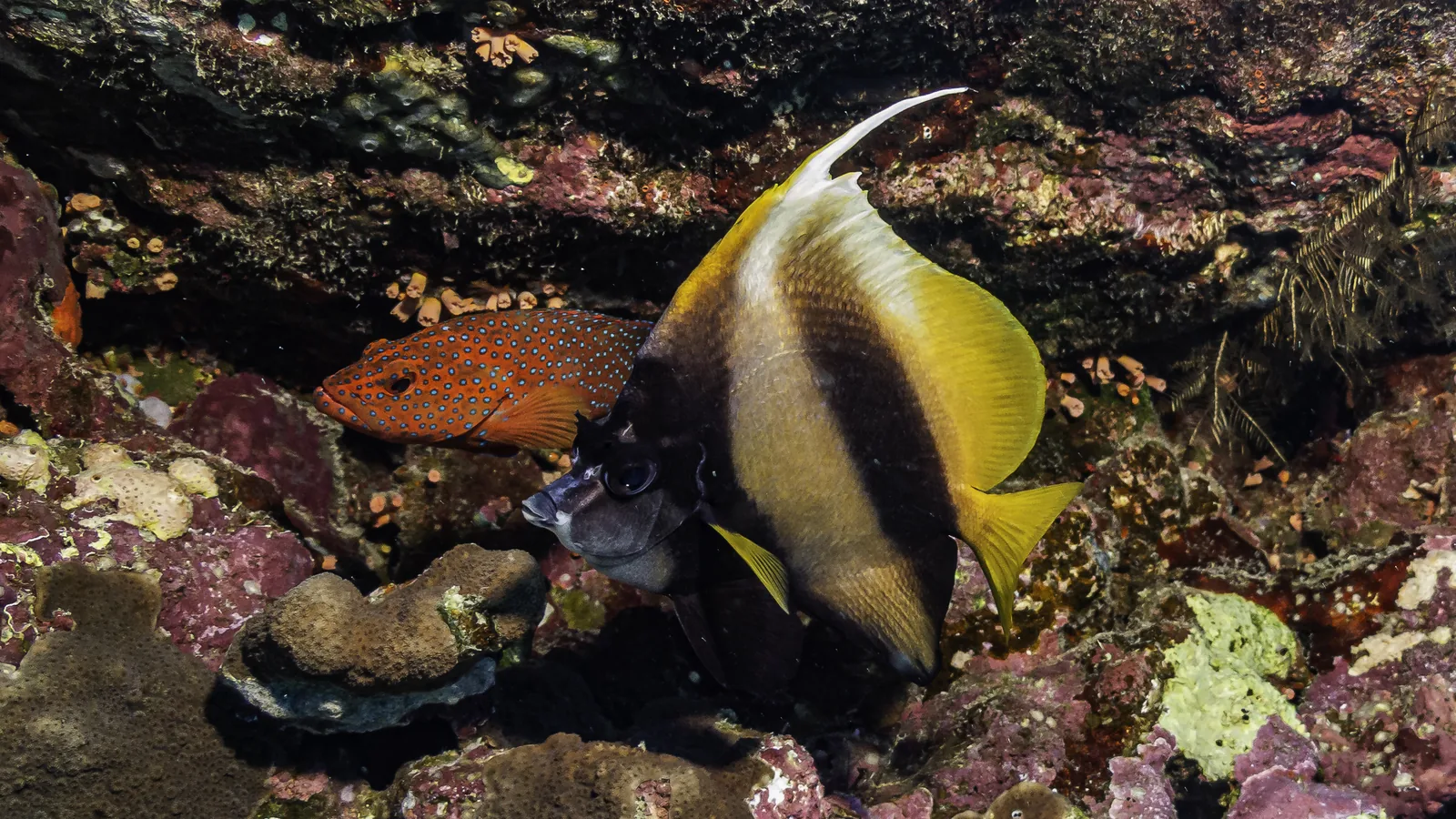
Where to see them
When to see them
The Red Sea bannerfish is a true year-round resident rather than a seasonal visitor, so there is no particular month that improves the odds of a sighting — it holds its patch of reef in every season. What does change through the year is water clarity and current strength, and both affect how easily the fish can be watched: calm, clear conditions let a pair hover out in the open for long stretches, while stronger current tends to push them tighter against the coral. Juveniles are present year-round too, sheltering lower on the reef regardless of the month.
Year-round resident Adults on the slopes, juveniles in loose schools
How to recognise a Red Sea bannerfish
The Red Sea bannerfish is easy to notice and, once its family of look-alikes is known, not too hard to name with confidence. The key features to check:
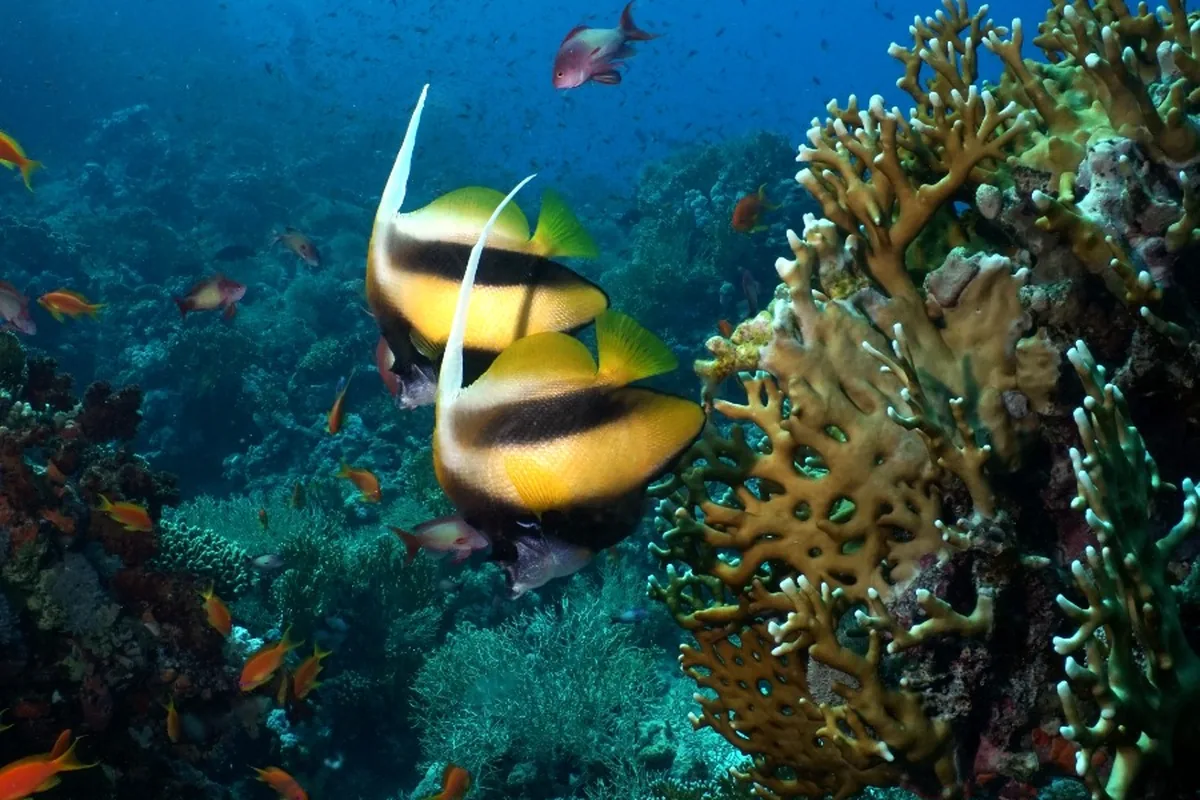
- Body shape: A deeply compressed, disc-like body, tall from back to belly and flattened side-to-side — the typical butterflyfish silhouette — reaching a modest maximum of around 18 cm.
- Colour: Pale, almost white forward on the body, grading into yellow towards the rear and belly.
- Two black bands: A forward band runs from the start of the dorsal fin down through the eye towards the pelvic fin, and a second, rear band runs from the soft dorsal down to the anal fin. Together they give the fish its bold, angled, black-and-white look.
- The banner: A very long, white, streamer-like filament trails from the front of the dorsal fin — the "banner" that gives the fish its name, fluttering behind it as it swims.
- Fins: The soft dorsal, pectoral, anal and tail fins are bright yellow; the pelvic fins are black. A yellow tail, rather than a dark one, is one of the more useful things to check at a glance.
Look-alikes worth knowing. At a glance a bannerfish's long white streamer and black-and-white body invites confusion with the Moorish idol (Zanclus cornutus), which is common in the Red Sea and shares a similar profile — but the two are not even in the same family. The Moorish idol has a long, tube-like snout with small bony bumps above the eyes, a solid black tail edged in white, and a yellow saddle across its snout rather than yellow fins; the Red Sea bannerfish has a short, blunt mouth, a plain face, and a bright yellow tail. Since both fish carry a trailing dorsal filament, the streamer alone is not a reliable way to separate them — the tail colour and snout shape are.
Two very close relatives complicate the picture further. The schooling bannerfish (Heniochus diphreutes) — nicknamed the "false Moorish idol" — is also present in the Red Sea and looks almost identical: a white body, two black diagonal bands, yellow fins and a similar trailing filament. The most reliable way to separate the two in the water is behaviour and group size: the Red Sea bannerfish is usually solitary, paired, or in small loose clusters near the reef structure, while H. diphreutes forms genuinely large, tightly packed schools, often hanging in open water over a drop-off, with adults schooling just as readily as juveniles. Meanwhile, the wide-ranging pennant coralfish (Heniochus acuminatus) — found from East Africa to the central Pacific — shares the same body plan and is the species behind the everyday name "pennant bannerfish." In Red Sea and Gulf of Aden waters, however, it is replaced by the Red Sea bannerfish described here, which tops out smaller at full size (about 18 cm against up to 25 cm) and is far more geographically restricted.
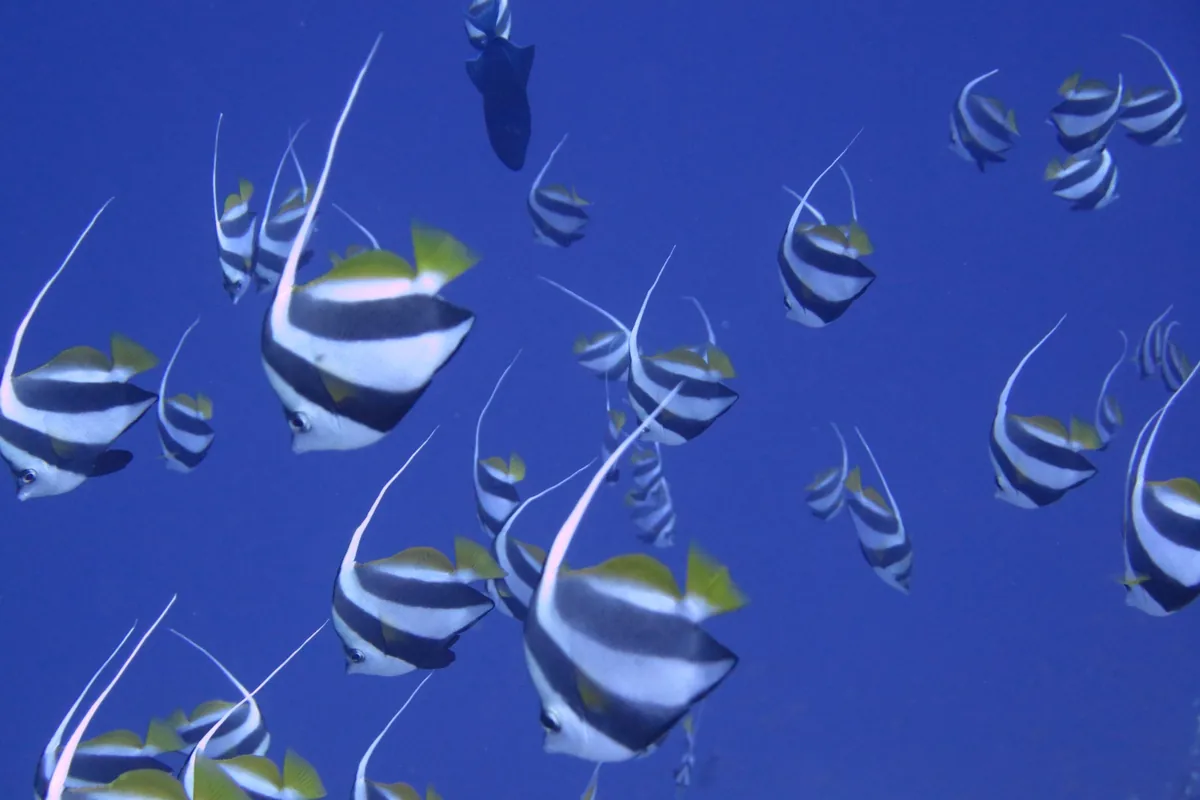
Pairs, small groups, and a part-time cleaning job
Adult Red Sea bannerfish are usually seen alone, in a monogamous pair, or in small, loosely associated groups of half a dozen fish or so working the same stretch of coral slope. They are active by day, spending long stretches hovering just off the reef to intercept drifting zooplankton, and they retreat into the reef structure to rest at night. Juveniles behave rather differently: instead of pairing up, young fish gather in large, loose schools over open ground near the base of the reef, sometimes mixing with juveniles of the closely related schooling bannerfish. These aggregations can be striking from a distance — dozens of near-identical black-and-white fish drifting together with their white filaments trailing like a field of tiny flags.
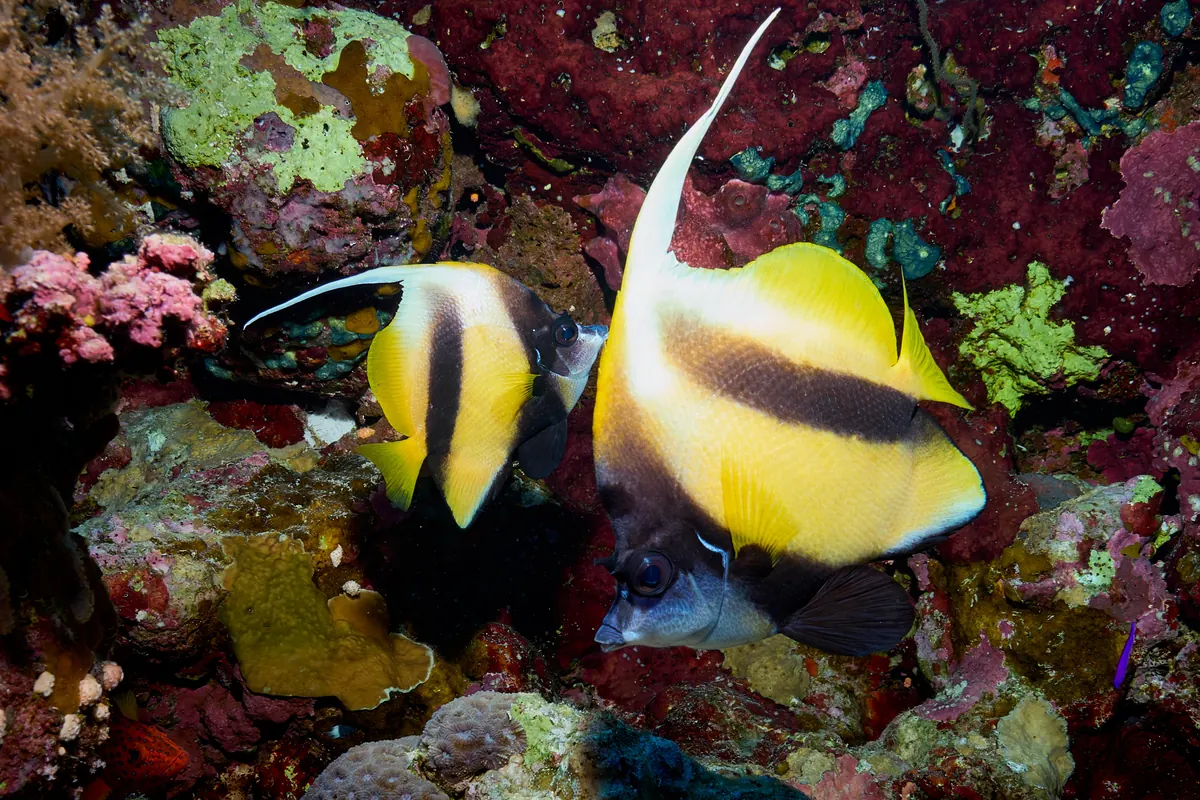
One of the more surprising behaviours recorded in young Red Sea bannerfish, and shared with several of their Heniochus relatives, is facultative cleaning: rather than relying on plankton alone, juveniles will sometimes approach a larger reef fish and pick parasites or dead skin from its body, acting as a part-time cleaner before settling permanently into the adult diet and lifestyle. It is an occasional habit rather than a dedicated profession — unlike a true cleaner wrasse, a young bannerfish does not hold a fixed cleaning station — but it is a good illustration of how flexible and opportunistic these fish are as juveniles, before adult pairing and site-fidelity take over.
Diet
The Red Sea bannerfish is best described as an opportunistic omnivore built around a planktivorous core diet. Most of its feeding time is spent hovering in the current, picking zooplankton out of the water column one mouthful at a time with a small, forward-pointing mouth. It supplements this with small benthic invertebrates taken directly from the reef surface, and — like several of its butterflyfish relatives — it will occasionally take algae and nip at coral polyps and other sessile invertebrates, although this makes up only a minor part of its diet compared with the drifting plankton it relies on day to day.
Juveniles add the occasional parasite meal from a client fish's skin to this same generalist strategy, described above, before the adult's more settled, pair-bonded foraging routine takes over.
Watching and photographing Red Sea bannerfish
Red Sea bannerfish are a gentle, undemanding subject once a diver understands how they move:
- Approach slowly and level. Bannerfish are naturally a little flighty and tend to drift away from anyone closing in too fast; a slow, level approach along the reef, rather than head-on, keeps a pair or small group in view for longer.
- Give a school a little space. A loose juvenile aggregation will scatter if crowded; hanging back and letting it settle usually gives the best view — and the best photographs — of the massed white filaments.
- Look for the second fish. Because adults are usually paired, spotting one bannerfish is often the cue to check nearby for its partner working the same patch of coral.
- Use the current, don't fight it. Bannerfish typically hover facing into the current to intercept plankton; positioning downstream and slightly below lets the fish keep feeding naturally while you watch.
- Mind your buoyancy near the coral. The bannerfish's favoured habitat — coral slopes, fire-coral clusters and reef flats — is exactly the structure that suffers most from a careless fin kick or a hand on the reef.
Conservation status
The Red Sea bannerfish is listed as Least Concern on the IUCN Red List (assessed 2010). It is not targeted by any significant fishery, and while it is collected in modest numbers for the marine aquarium trade, this is not considered a threat to wild populations across its range. Unlike many reef fish assessed as Least Concern because they are common across a vast area, the Red Sea bannerfish earns that status while holding one of the more restricted ranges of any Red Sea reef fish — a near-endemic that lives almost nowhere outside the Red Sea and the neighbouring Gulf of Aden, filling the ecological niche held elsewhere in the Indo-Pacific by the more wide-ranging pennant coralfish.
That narrow range is exactly why healthy Red Sea coral matters so much to the species: there is no larger population elsewhere to fall back on. Individuals occasionally turn up well outside their natural home, including a handful of Suez Canal migrants recorded in the eastern Mediterranean and Turkey's Gulf of Antalya, and even a small introduced population in Florida traced to the aquarium trade — curiosities that only underline how tightly the wild population is otherwise bound to the Red Sea.
Related Red Sea reef fish
The Red Sea bannerfish shares its reef with several other characterful residents that reward the same patient, unhurried style of diving:
- Masked butterflyfish — another Red Sea near-endemic butterflyfish, often seen on the very same coral slopes.
- Emperor angelfish — a larger, equally striped reef resident that patrols the same walls and drop-offs.
- Longnose hawkfish — a motionless ambush specialist perched on the same gorgonian and coral structure.
- Red Sea anemonefish — the endemic clownfish guarding its own patch of anemone nearby.
For the bigger picture of what lives on an Egyptian reef and how the seasons shape a dive, see the complete guide to scuba diving in the Red Sea. To browse the full encyclopedia species by species, visit the Red Sea marine life guides.
Frequently asked questions
The confusion is common because both are black-and-white reef fish with a long trailing dorsal filament, but they belong to entirely different families. The Moorish idol (Zanclus cornutus) has a long, tube-like snout with small bony bumps above the eyes, a solid black tail edged in white, and a yellow saddle across the snout rather than yellow fins. The Red Sea bannerfish has a short, blunt mouth, a plain face, and bright yellow tail, dorsal, pectoral and anal fins — a yellow tail rather than a black one is the fastest way to tell them apart, since both fish carry a similar trailing filament.
Almost. It is a Red Sea near-endemic, naturally found only in the Red Sea and the neighbouring Gulf of Aden, where it replaces the more wide-ranging pennant coralfish (Heniochus acuminatus) found across the rest of the Indo-Pacific. A handful of individuals have turned up well outside this range as Suez Canal migrants in the eastern Mediterranean and Turkey, and as an aquarium-trade introduction in Florida, but the wild, self-sustaining population is confined to the Red Sea region.
It is an elongated ray of the dorsal fin, drawn out into a thin, streamer-like filament that can trail well behind the rest of the body. It gives the fish its common name — bannerfish — because it moves and flutters like a small banner or pennant as the fish swims. The filament carries no known function beyond display and is a feature shared with several other Heniochus species, so on its own it is not enough to identify which one you are looking at.
They are a modest-sized butterflyfish, reaching a maximum length of about 18 cm. That makes them noticeably smaller at full size than their closest look-alike, the pennant coralfish (Heniochus acuminatus), which can reach up to 25 cm elsewhere in the Indo-Pacific.
They feed mainly on zooplankton picked out of the water column, supplemented with small benthic invertebrates taken from the reef surface. Like several of their butterflyfish relatives they will also take algae and occasionally nip at coral polyps and other sessile invertebrates, though drifting plankton makes up the bulk of an adult's diet.
Yes, at least occasionally. Juveniles of several Heniochus species, including close Red Sea relatives, have been recorded acting as facultative cleaners, picking parasites and dead skin from the bodies of larger reef fish. It is an opportunistic habit rather than a dedicated occupation — a young bannerfish does not hold a fixed cleaning station the way a true cleaner wrasse does — but it is a documented part of how juveniles supplement their planktonic diet before settling into typical adult behaviour.
Almost anywhere there is healthy coral. Adults are a common sight hovering over coral slopes and reef walls, sheltered house reefs at Hurghada, Makadi Bay and Sahl Hasheesh regularly hold resident pairs, and offshore, current-swept sites such as the Straits of Tiran and Ras Mohammed support larger aggregations, including the loose juvenile schools that gather over open ground near the base of the reef.