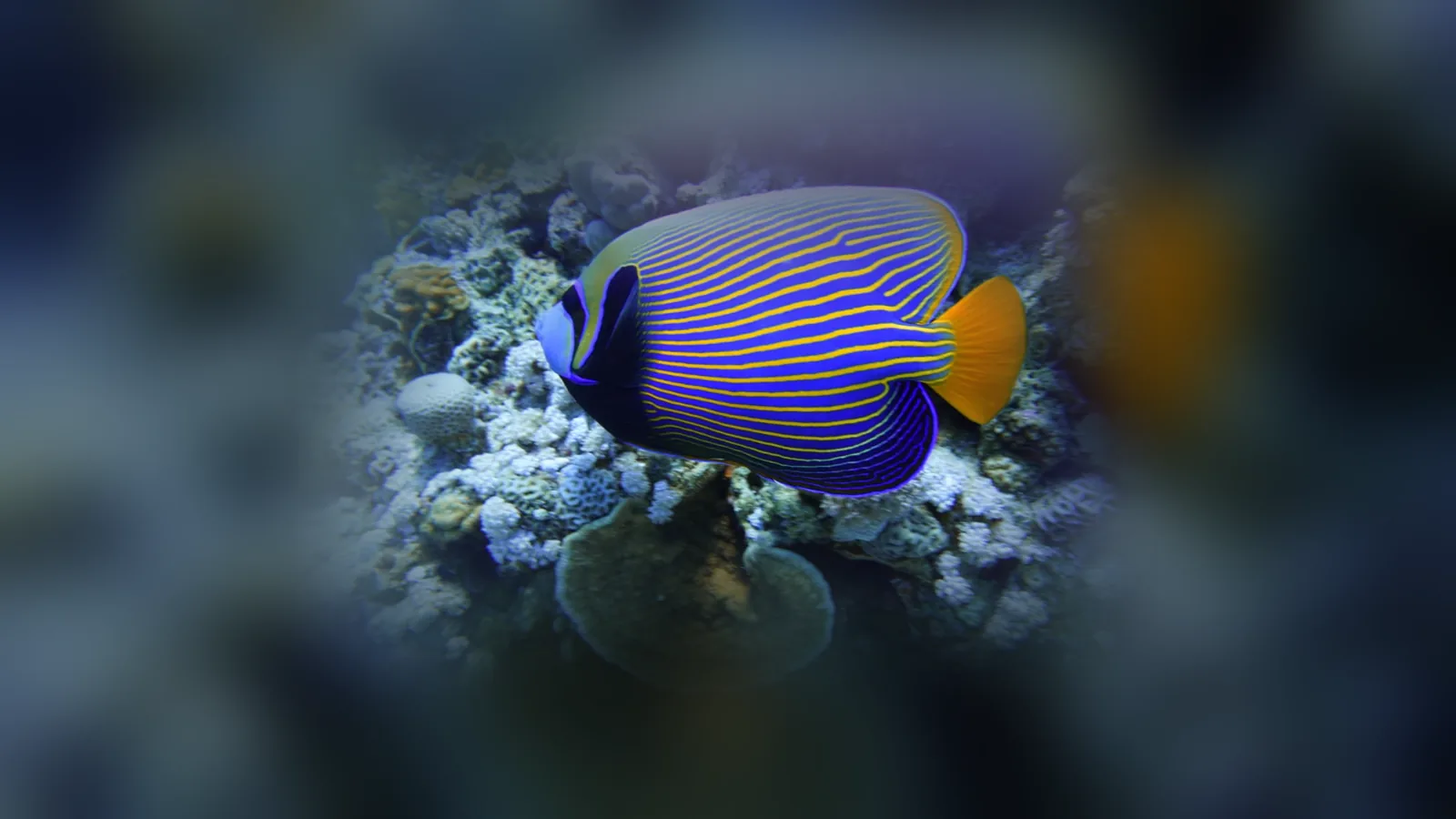
Where to see them
When to see them
Emperor angelfish are permanent residents of the Red Sea rather than seasonal visitors, so there is no particular month to plan around — they are on the reef every day of the year. What changes with conditions is not whether they are present but how easily they are seen: warm, clear water makes the adult's colours blaze, while a careful look into caves and under ledges is what reveals the very different juveniles. Both life stages can be found on the same reef in any season.
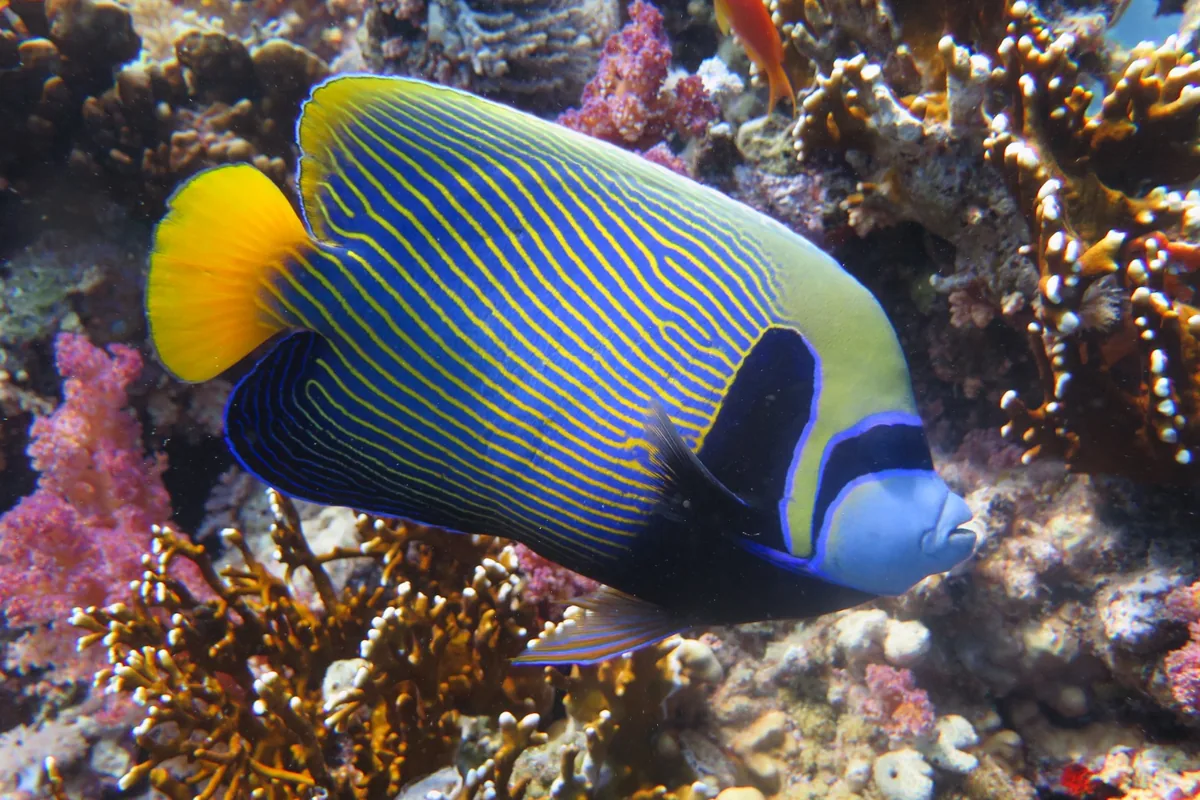
Year-round resident Adults on the slopes, juveniles in caves
How to recognise an emperor angelfish
The adult emperor angelfish is one of the easiest reef fish to name at a glance; the juvenile takes a little more knowledge. The key adult features:
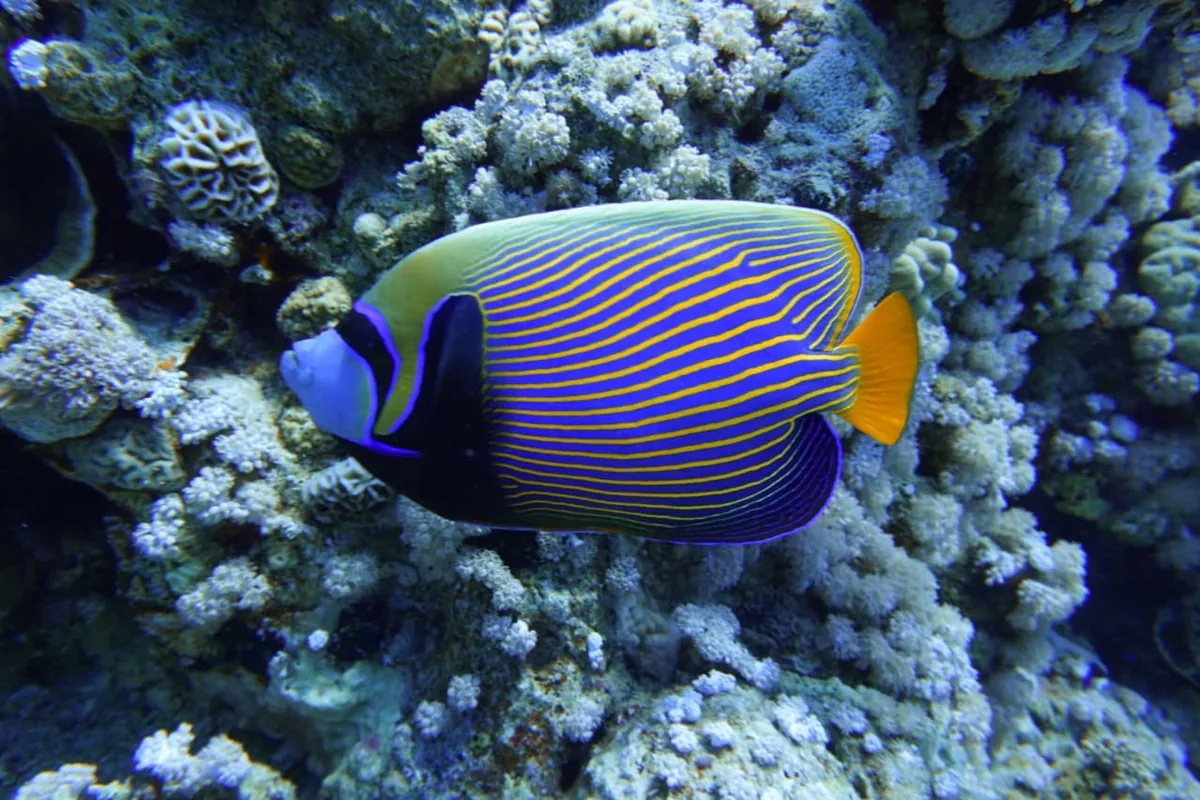
- Body shape: Oval and deep-bodied — tall from back to belly and flattened side-to-side, the classic disc-shaped angelfish silhouette, reaching about 40 cm.
- Stripes: Around twenty-five narrow, electric-blue and yellow stripes running the length of the body. Look closely and the blue lines carry a faint darker edge, which gives the pattern its glowing, enamelled look.
- The mask: A broad dark blue-black band runs across the eyes like a bandit's mask, bordered in bright blue — a signature emperor feature that hides the eye from view.
- Bar and tail: A darker vertical bar, edged in electric blue, sits just behind the gill cover over the base of the pectoral fin, and the rounded tail is a solid bright yellow. That yellow tail is the fastest way to separate an adult emperor from the similar koran angelfish, whose tail is pale and whitish.
- Mouth: A small mouth with pale blue-white lips — the compact, nibbling mouth of a fish built to pick sponges and encrusting growth off the reef rather than to seize other fish.
The juvenile that looks nothing like the adult
Few reef fish change as completely as the emperor angelfish. A juvenile is dark blue to almost black, patterned with concentric white and electric-blue rings that curl into a target-like design towards the tail. This ringed pattern is a diagnostic field mark: no other angelfish juvenile in the Red Sea wears true concentric circles, so a small dark fish covered in blue-and-white rings inside a cave is almost certainly a young emperor. The nearest look-alike, the juvenile koran (or semicircle) angelfish, shows more open, C-shaped lines rather than closed circles.
The switch from rings to stripes is a slow rearrangement rather than a quick moult. The first signs usually appear when the fish reaches roughly 8 to 12 cm, and the full transformation takes about two to two and a half years. In between comes a striking sub-adult stage in which broken rings and half-formed stripes overlap on the same body — a fish that looks like two patterns competing for the same canvas. Because the change is so gradual, a diver can meet juveniles, sub-adults and adults of the same species on one reef and, without knowing the story, take them for three different fish.
Behaviour, territory and that knocking sound
Adult emperor angelfish are bold, day-active reef fish that hold and defend a territory. They forage over the coral by day, working methodically across their home range, and retreat into caves and crevices to rest at night. They are most often seen singly or in pairs; where the species has been studied closely, a dominant male holds a home range that overlaps those of one or more females. Adults are notably intolerant of rivals and will chase off other large angelfishes that intrude on a prized feeding patch, which is part of why a single emperor tends to dominate a stretch of reef.
One of the species' more surprising traits is that it is not silent. When startled, cornered or handled, an emperor angelfish can produce a sharp knocking or grunting sound — a defensive signal that a careful diver will rarely provoke. Juveniles behave very differently from the territorial adults: they are shy and stay close to shelter, and young emperor angelfish have been recorded acting as part-time cleaners, picking parasites from larger fish that visit their patch of reef.
Diet — a sponge and tunicate specialist
The emperor angelfish is a grazer of the reef surface rather than a hunter of other fish. Its diet is built around sponges and tunicates — soft, encrusting invertebrates that most fish cannot digest — supplemented with algae and other encrusting growth scraped from coral and rock. The compact mouth and specialised gut let it process material that is off the menu for almost everything else on the reef, which makes the species a meaningful part of how a coral community stays in balance.
That same specialisation is why the emperor angelfish has a reputation as a difficult fish to keep in captivity: a sponge-heavy diet is very hard to reproduce in an aquarium. On a wild Red Sea reef, though, the food is all around it, and a healthy adult spends its day steadily working the coral for the encrusting life it depends on. Watching one feed is a good reminder that the reef's most beautiful residents are often its fussiest eaters.
Pairs, harems and spawning
Emperor angelfish are broadcast, or pelagic, spawners. Courtship and spawning take place at dusk and can continue through much of the lunar month, with the male displaying to the female before the pair rises together off the reef and releases eggs and sperm into open water. The fertilised eggs are pelagic — they drift with the current — and the tiny larvae spend their first weeks adrift in the plankton before settling onto a reef to begin life as a ringed juvenile. There is no parental care; the reef simply receives a new generation from the water column.
Sex and pairing in the large angelfishes are still not fully documented, and reports vary between monogamous pairs and small harems of a male with one or more females. What is consistent is the pattern of a defended territory, a dusk-timed spawning ascent and a long larval drift — a life history shared by many of the reef's angelfishes, and one reason the emperor is so widely distributed across the Indo-Pacific, from the Red Sea to the central Pacific.
Watching and photographing emperor angelfish
Emperor angelfish reward patience and calm, and they make superb photographic subjects when treated with respect:
- Approach slowly. A territorial adult is confident on its home reef but will keep its distance from a diver who rushes it. Slow, level fin strokes and an unhurried approach let the fish carry on foraging, which gives the best and longest views.
- Check the caves. The ring-patterned juveniles hide in dark recesses and under overhangs. A gentle look into a shaded hole — without reaching in — is often the only way to find one.
- Light brings out the colour. The blue-and-yellow stripes and the enamel-blue mask come alive with a little strobe or video light; in ambient light at depth the colours mute towards blue.
- Do not chase or corner. Chasing a fish onto its cave, or blocking its exit, is exactly what provokes the defensive knocking sound and ends the encounter. Let a curious adult set the distance and it will often circle back.
- Respect the reef. Emperor angelfish depend on healthy sponge and coral growth. Good buoyancy and no contact with the reef protect the very habitat the fish needs — the single most useful thing any diver can do for the species.
Conservation status
The emperor angelfish is listed as Least Concern on the IUCN Red List (assessed 2010). Its enormous Indo-Pacific range — from the Red Sea and East Africa across the Indian and Pacific Oceans to Hawaii and French Polynesia — and its generally stable populations keep it well clear of any global threat category. It is collected for the marine-aquarium trade, but this is not considered a range-wide threat, and no targeted food fishery pressures it.
The species' real dependence is on the reef itself. As a sponge-and-tunicate specialist tied to healthy, structurally complex coral, the emperor angelfish is only as secure as the habitat it grazes — which makes coral-reef protection, rather than any species-specific measure, the meaningful conservation story. On a well-managed Red Sea reef the emperor angelfish remains a common, confident and reassuringly permanent resident.
Related Red Sea reef fish
The emperor is one of several large angelfishes on Red Sea reefs — divers regularly see the yellowbar angelfish (Pomacanthus maculosus) and the Arabian, or asfur, angelfish (Pomacanthus asfur), while the small, brilliantly banded royal angelfish (Pygoplites diacanthus) works the same coral. Divers drawn to the emperor's colours and reef-fish character often want to read about the Red Sea's other coral-reef residents:
- Red Sea anemonefish — the endemic clownfish that guards its own patch of anemone with the same territorial confidence.
- Lionfish — a slow, ornate reef predator that hunts the same coral heads the angelfish grazes.
- Masked pufferfish — another characterful, coral-associated fish common across Egyptian reefs.
- Moray eel — the cave-dweller whose overhangs also shelter juvenile emperor angelfish.
For the bigger picture of what lives on an Egyptian reef and how the seasons shape a dive, see the complete guide to scuba diving in the Red Sea. To browse the full encyclopedia species by species, visit the Red Sea marine life guides.
Frequently asked questions
An adult emperor angelfish is unmistakable: around twenty-five electric-blue and yellow stripes run the length of an oval, deep body, a dark blue-black band masks the eyes, and the rounded tail is bright yellow. A darker bar edged in blue sits behind the gill cover over the base of the pectoral fin, and the small mouth has pale blue-white lips. The yellow tail is the quickest way to separate it from the similar-looking koran angelfish, whose adults have a pale, whitish tail.
Juvenile emperor angelfish are dark blue to almost black and patterned with concentric white and electric-blue rings that curl around the rear of the body — a target-like design no other angelfish juvenile shares, which makes it a reliable field mark. The fish keeps this pattern while it is small and secretive in reef caves. Over roughly two years it slowly rearranges into the striped adult, passing through a mixed sub-adult stage where broken rings and forming stripes appear together.
The change is gradual rather than sudden. Many individuals begin to show the first signs at around 8 to 12 cm, while some still carry juvenile rings past 15 cm. The full transformation from rings to adult stripes typically takes about two to two and a half years, so a sub-adult showing both patterns at once is a common and normal sight on the reef.
Emperor angelfish grow to about 40 cm, and reef adults are commonly around 30 cm. They are among the larger angelfishes on the reef — noticeably bigger and deeper-bodied than the palm-sized pygmy angelfishes that share the same coral.
They are specialist grazers of the reef surface, feeding mainly on sponges and tunicates along with algae and other encrusting growth. That sponge-heavy diet is one reason the species is difficult to keep in home aquariums, and on the reef it makes the emperor angelfish part of how a healthy coral community stays in balance.
Yes. When startled or cornered, an emperor angelfish can produce a sharp knocking or grunting sound. It is a defensive signal, most often heard when the fish is threatened, and it is one of several angelfishes known to be able to make noise. Divers rarely trigger it if they keep a calm, unhurried distance.
Yes. The Red Sea sits at the western edge of the emperor angelfish's wide Indo-Pacific range, and the species is a resident, year-round reef fish across Egyptian dive sites. Adults hold territories on coral slopes and around caves and ledges, while the secretive juveniles shelter deeper inside the reef, so both can be seen on a single trip with a little patience.