Where to see them
When to see them
Crown-of-thorns starfish are present on Red Sea reefs throughout the year; there is no migration or seasonal absence to plan a trip around. What changes is not whether the species is there but how easy it is to find: its cryptic, largely nocturnal habits mean a patient look into cave mouths and beneath coral ledges is usually more productive than scanning open reef in daylight. Numbers can also shift from year to year and site to site as local populations rise and fall, a reminder that this is a species best judged over time rather than from a single dive.
Year-round resident Most active after dark; check caves and ledges by day
How to recognise a crown-of-thorns starfish
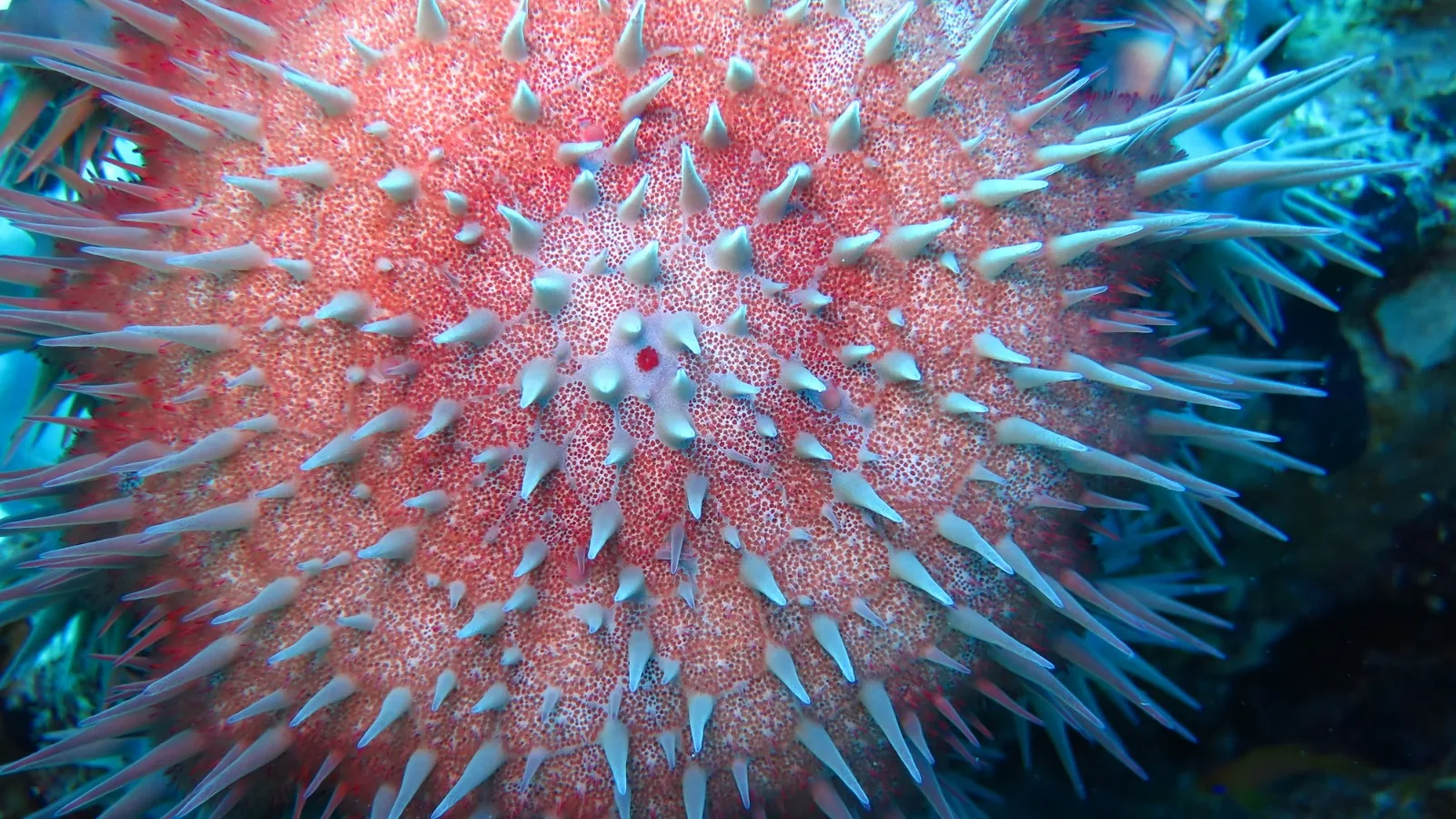
Nothing else on a Red Sea reef looks quite like it. Most sea stars are thick-bodied, five-armed and short-spined; the crown-of-thorns is a flattened, multi-armed disc bristling with long spines, and once seen it is rarely mistaken for anything else.
- Arms: Adults typically carry between fourteen and twenty-one arms radiating from a broad central disc, though published counts range from around eight up to roughly twenty-three in the largest animals. A newly settled juvenile begins with the ordinary five-armed sea-star body plan and adds arms gradually as it grows.
- Spines: Long, stiff, needle-like spines roughly 4 to 5 cm long cover the entire upper surface, while shorter, blunter spines line the underside. The spines are made of calcium carbonate and coated in a natural toxin, which is exactly what makes the animal dangerous to handle.
- Size: Most adults measure around 25 to 35 cm across, though exceptionally large individuals can reach roughly 80 cm in diameter and weigh up to about three kilograms — among the largest sea stars found anywhere.
- Colour: Highly variable — shades of grey-green, dull red, purplish-brown and mottled combinations are all normal, sometimes with spine tips tinted orange or red. Colour alone is not a reliable way to identify the species; arm count and spine structure are far more diagnostic.
The scientific name most widely used for this species, in the Red Sea and elsewhere, is Acanthaster planci. Genetic research published since 2008 has shown that what was long treated as a single, wide-ranging species is in fact a complex of several closely related species, and in 2022 the Red Sea population — from specimens collected in 2017 — was formally described as its own species, Acanthaster benziei, distinct from the Pacific population (referred to as Acanthaster cf. solaris) and from other Indian Ocean lineages. General references, dive guides and much of the existing scientific literature still use the older, broader name Acanthaster planci for the Red Sea animal, and both names describe the same starfish divers encounter on Egyptian reefs.
How it feeds — a coral predator
The crown-of-thorns starfish feeds in a way most reef visitors never see up close, and it is unlike almost anything else on the reef. After climbing onto a colony of living coral using rows of tube feet on its underside, it pushes its own stomach out through its mouth — located at the centre of the underside, not the top — and spreads it directly over the coral's surface. Digestive enzymes released by the everted stomach dissolve the coral polyps' soft tissue externally, and the starfish then draws the liquefied material, together with its stomach, back inside its body. What is left behind is the coral's bare, bleached-white skeleton: a feeding scar that can remain visible for months.
The species shows a clear preference for fast-growing, branching and tabular corals such as Acropora, Montipora and Pocillopora over slower-growing, massive coral heads, and a single adult can strip several square metres of living coral from a reef over the course of a year. Because it targets the fastest-growing corals first, feeding at natural, low densities can actually help slower-growing species keep pace, which is part of why the crown-of-thorns starfish is considered a normal, even useful, presence on a reef under ordinary conditions.
The adult's coral diet is not how the species starts life. Juveniles hatch as tiny, five-armed animals and spend an early phase — sometimes lasting many months, and in some studied cases several years — hidden in reef rubble and crevices, grazing harmlessly on crustose coralline algae rather than coral. Only once they reach a certain size do they switch to eating coral and take on the destructive habits of the adult. Because this early stage is so cryptic, researchers have described it as a "hidden army": large numbers of future adults can go undetected for a long time before a cohort switches diet together, which is one reason population outbreaks can appear to erupt with little obvious warning.
Population outbreaks and reef health
Almost everything about how a crown-of-thorns starfish is perceived depends on how many of them are sharing a reef. On a healthy reef with only a handful of individuals per hectare, feeding pressure stays well below the reef's own coral growth rate, and the species behaves as a normal, background part of the ecosystem — in some cases even helping to maintain coral diversity by keeping the fastest-growing corals in check. An outbreak is a very different situation: densities can climb into the hundreds of individuals per hectare, and feeding pressure at that scale can outstrip coral growth entirely, stripping wide sections of reef down to bare skeleton within a few years. Alongside coral bleaching, crown-of-thorns outbreaks are considered one of the most significant recurring causes of coral loss across Indo-Pacific reefs, with knock-on effects for the fish and invertebrates that depend on live coral for shelter and food.
What triggers an outbreak is genuinely debated among reef scientists, and the evidence points to more than one contributing factor rather than a single cause. The two most widely discussed hypotheses are nutrient-rich runoff from agricultural or coastal land, which may boost the phytoplankton that drifting starfish larvae feed on and improve their odds of survival, and the loss of natural predators through overharvesting — chiefly the giant triton snail (Charonia tritonis), historically collected for its shell, along with certain reef fish known to prey on the starfish. Warmer sea temperatures speeding up larval development have also been proposed as an additional factor. Research on each hypothesis continues, and reef managers generally treat outbreaks as the product of several pressures acting together rather than one clear-cut trigger.
The Red Sea has its own documented history of outbreaks. A well-studied event was recorded in 1998 on a reef near Hurghada, Egypt, and the coral there was tracked by researchers for years afterward; the resulting estimate for how long the reef's stony coral cover would take to fully recover — around sixty-five years, at the observed rate of regrowth — illustrates just how long the effects of a serious outbreak can persist on a Red Sea reef, even long after the starfish themselves are gone.
Venomous — never touch
The same spines that make the crown-of-thorns starfish so distinctive also make it genuinely dangerous to handle. Each spine is coated in a natural toxin — chiefly compounds called asterosaponins, alongside plancitoxin proteins that are linked to tissue and liver effects in more serious envenomations — that produces an immediate, sharp, stinging pain on contact, along with bleeding, swelling and redness that can persist for a week or more; the venom's blood-thinning effect can also make the wound bleed more than a typical puncture would. In more significant cases, nausea, numbness or tingling around the wound, and joint aches have also been reported. The spines themselves are brittle and can snap off under the skin, sometimes requiring a doctor's help to remove the fragments completely.
Commonly recommended first aid for a puncture includes immersing the affected area in water as hot as can be comfortably tolerated (never scalding) for around 30 to 90 minutes, which is thought to help ease the pain, together with careful removal of any visible spine fragments and thorough cleaning of the wound. Anyone with persistent pain, an embedded spine that will not come out, signs of infection, or a more severe reaction should seek medical attention rather than treat the sting at home. Although exceptionally rare, a human death from anaphylactic shock following a crown-of-thorns sting has been documented in the medical literature — in a person who had been stung before — so difficulty breathing, swelling of the face or throat, dizziness or a rapid heartbeat after a sting should be treated as a medical emergency and needs immediate help. This is general safety information, not a substitute for professional medical care. For this reason, divers and snorkellers are advised never to touch, hold or otherwise handle a crown-of-thorns starfish, and to treat it with the same distance and respect given to any other venomous marine animal.
It is also worth knowing that trying to remove or break one up is both risky and, historically, counter-productive. A crown-of-thorns starfish that is cut into pieces does not simply die — research has shown it can regenerate from a fragment that still contains part of its central disc, meaning a well-intentioned attempt to destroy one can end up producing more starfish rather than fewer. Where a genuine outbreak needs to be controlled, reef-management programmes rely on trained divers using a single targeted injection of a reef-safe solution — typically bile salts or ordinary household vinegar — directly into each animal, which kills it without harming the surrounding coral or marine life. This kind of removal is a deliberate, managed conservation activity carried out under a specific programme, not something a recreational diver should ever attempt.
Conservation status
The crown-of-thorns starfish has not been formally assessed by the IUCN and currently carries no official conservation category. That is not simply an oversight: the taxonomic picture for the species has changed significantly since 2008, with what was once treated as a single, wide-ranging species now understood to be a small group of closely related species, including the Red Sea's own recently described population. A fresh, species-by-species assessment is a substantial undertaking that has not yet been completed for any of them.
More importantly, the conservation story around this species is almost entirely unlike that of a threatened animal. Crown-of-thorns starfish are not rare, and the central concern is essentially the opposite of extinction risk: managing localised overabundance so that outbreaks do not cause lasting damage to coral reefs. The species' own natural predators are a useful illustration of how these issues connect — the giant triton snail and several reef fish known to prey on adult starfish have themselves been reduced by historical overharvesting, and protecting those predator populations is one of the approaches reef scientists are studying as a longer-term, more natural check on future outbreaks. In this sense, looking after the crown-of-thorns starfish's story on a Red Sea reef is really a story about looking after the coral, and the wider reef community, around it.
Related Red Sea reef life
The crown-of-thorns starfish is one of many invertebrates that shape life on an Egyptian reef, from grazers and filter feeders to some of its most characterful residents. Divers interested in the Red Sea's less conventional marine life often want to read further:
- Giant clam — a huge, sedentary filter feeder embedded in the same coral it helps support.
- Nudibranchs — small, brilliantly coloured sea slugs that graze sponges and hydroids across the same reef.
- Spanish dancer — the Red Sea's largest nudibranch, another slow-moving invertebrate best found at night.
- Octopus — a highly intelligent, soft-bodied predator that shares the same coral heads and crevices.
For the bigger picture of what lives on an Egyptian reef and how the seasons shape a dive, see the complete guide to scuba diving in the Red Sea. To browse the full encyclopedia species by species, visit the Red Sea marine life guides.
Frequently asked questions
The crown-of-thorns starfish is a large, many-armed sea star, most often referred to by the scientific name Acanthaster planci, that lives on coral reefs throughout the Indo-Pacific, including the Red Sea. It typically carries somewhere between fourteen and twenty-one thick, spine-covered arms around a wide central disc, and it is best known as a specialist predator of living hard coral. At the low numbers found on a healthy reef it is a normal, unremarkable part of the ecosystem; the species only becomes a serious concern when its population erupts into an outbreak.
Yes. Unlike most starfish, which scavenge or hunt small invertebrates, the crown-of-thorns starfish feeds almost entirely on living coral tissue. It climbs onto a coral colony, digests the tissue directly off the skeleton, and moves on, leaving a bare white patch behind. A single adult can strip several square metres of living coral over the course of a year, and its preference for fast-growing branching corals such as Acropora makes it one of the most efficient coral predators on the reef.
It feeds by everting its own stomach. After climbing onto a coral colony, the starfish pushes its stomach out through its mouth, on the underside of its body, and spreads it directly over the coral surface. Digestive enzymes released by the stomach dissolve the coral's soft tissue externally; the starfish then draws the liquefied material, along with its stomach, back inside. The coral skeleton is left behind bare and white, a feeding scar that is often the clearest sign a crown-of-thorns starfish has recently passed through.
At natural densities of only a few individuals per hectare, the species barely dents a reef's coral growth, and by preferring fast-growing corals it can even help other, slower-growing species hold their ground. An outbreak is different: population densities can rise into the hundreds per hectare, and the resulting feeding pressure can outstrip coral growth entirely, stripping large sections of reef down to bare skeleton within a few years. Along with coral bleaching, outbreaks are considered one of the most significant recurring threats to coral cover across Indo-Pacific reefs, including parts of the Red Sea.
The exact trigger is still debated among reef scientists, and more than one factor is likely involved. The leading hypotheses are nutrient-rich runoff from land, which may improve food availability and survival for the starfish's drifting larvae, and the loss of natural predators — particularly the giant triton snail and certain reef fish — through overharvesting, which removes a natural check on adult numbers. Warmer sea temperatures speeding up larval development have also been proposed as a contributing factor. No single explanation accounts for every outbreak that has been recorded.
Yes, though only if touched. The long, stiff spines that cover its upper surface are coated in a toxin that causes an immediate, sharp pain, bleeding and swelling that can last a week or more if a spine punctures skin. Divers and snorkellers are advised never to touch or handle a crown-of-thorns starfish, and to give it the same wide berth as any other venomous marine animal. Most stings are painful rather than dangerous and the brittle spines can break off under the skin, but severe reactions are possible: a single fatal case of anaphylactic shock has been documented in the medical literature, so any sign of a whole-body allergic reaction after a sting needs emergency care.
No. Seeing one or two crown-of-thorns starfish on a dive is entirely normal and is not a sign of a problem — at low numbers they are a natural part of the reef. Cutting or breaking one apart is also counter-productive: the starfish can regenerate from a fragment that still contains part of its central disc, so damaging one by hand risks both a venomous sting and, potentially, more starfish rather than fewer. Where an outbreak genuinely needs to be controlled, reef-management teams use trained divers who inject each animal with a reef-safe solution, a targeted method that recreational divers should leave to the professionals.