Where to see them
When to see them
Garden eels are permanent residents rather than seasonal visitors, so a colony is present on its patch of sand in every month of the year — there is no particular season to plan a trip around. What changes with conditions is not whether the eels are there but how easily a diver actually sees them behaving naturally: calm, current-light days make a slow, low approach across the sand much easier without stirring sediment, while a colony exposed to a strong tidal flow is harder to reach without startling every eel along the way. Whatever the month, patience and a flat, unhurried approach matter far more than timing.
Year-round resident Best watched on calm, low-current days
How to recognise garden eels
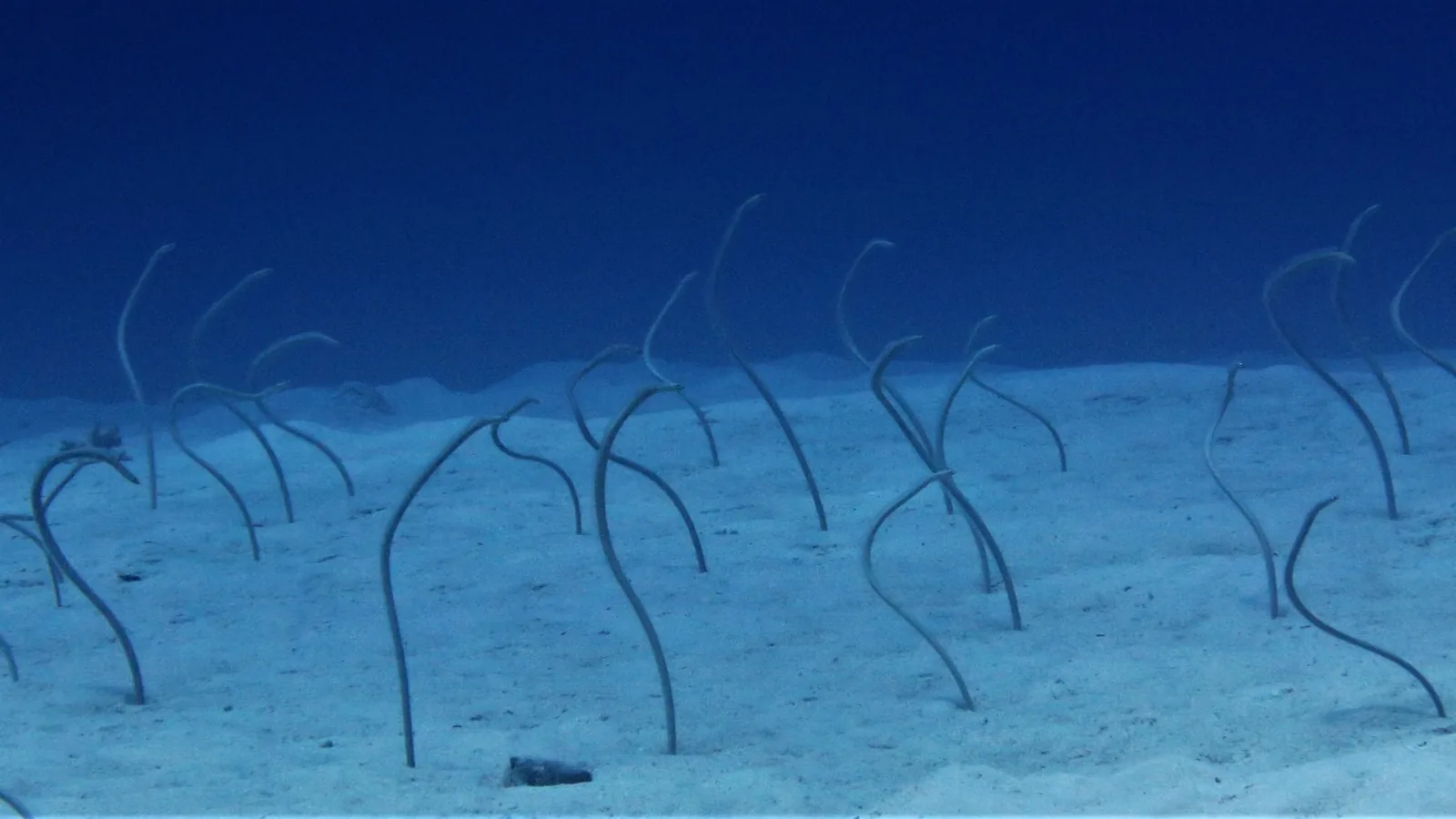
From a distance, a garden eel colony looks like nothing more than a patch of waving grass or seagrass on open sand — it is only up close that the colony resolves into hundreds of individual eels, each holding its own patch of ground. The two species most likely to be seen on an Egyptian reef are distinct once a diver knows what to look for:
- Body shape: Extremely slender, almost pencil-thin bodies built for a life spent mostly buried tail-down; only the upper third to two-thirds of the body ever appears above the burrow, and the eel narrows to a fine point at the tail that stays hidden in the sand.
- Red Sea garden eel (Gorgasia sillneri): Grey to brownish-grey overall, blending closely with the sand it lives on. It is the common garden eel of Egyptian Red Sea reefs, first described from a specimen collected in the Gulf of Aqaba, and males can reach around 84 cm — though only a fraction of that length is ever seen above the sand.
- Spotted garden eel (Heteroconger hassi): A paler, almost white body marked with small dark spots and three bolder dark patches — one around the gill opening and pectoral fin, one at mid-body, and one around the vent. Juveniles are almost entirely black before developing this adult pattern, and adults grow to roughly 40–60 cm.
- Posture: Every eel in a colony faces the same way, upstream into the current, holding a straighter posture in gentle flow and a more curved, closer-to-the-burrow stance when the current picks up — a subtle detail only visible to a diver patient enough to watch without approaching.
- The colony effect: Individual markings matter less than the group behaviour — what identifies a garden eel field at a glance is the density and synchronised swaying of dozens or hundreds of eels over open sand, a sight shared by no other Red Sea reef fish.
Life in a burrow
A garden eel is one of the most sedentary fish on the reef: each individual digs and occupies a single burrow for essentially its whole adult life, never straying further than the length of its own body from the entrance. The burrow itself is not a simple hole in loose sand — the eel coats the surrounding grains with mucus secreted from its own skin, cementing them together into a semi-permanent tube strong enough to resist collapsing in the current. The tail stays anchored deep inside this tube while the front third to two-thirds of the body extends up and forward into the water column to feed.
Feeding is a matter of individual strikes rather than passive filtering: an eel picks off zooplankton as each item drifts past in the current, rather than sweeping the water indiscriminately. Researchers tracking garden eel colonies in three dimensions found that the eels change strategy as the current strengthens — in gentle flow they extend further from the burrow and hold a straighter posture, but as the current picks up they pull back closer to the entrance, curve their bodies, and narrow their attention to prey passing very close by, trading reach for a shorter, safer retreat. Because every eel is fixed in place, a colony behaves almost like an extension of the reef itself: neighbours keep a remarkably consistent spacing, close enough to share the safety of numbers but far enough apart that no burrow can be reached from another.
Behaviour: the garden that vanishes
The single most memorable thing about garden eels, for most divers, is not how they look but how they disappear. Unlike almost any other reef fish, a garden eel cannot swim away from danger — each individual can only retreat into its own burrow. The result is one of the reef's more theatrical sights: as a diver, a boat's shadow, or anything else approaches, the nearest eels sink tail-first out of sight first, and the reaction spreads outward through the colony like a ripple, until a patch of sand that a moment ago held hundreds of swaying eels appears completely empty. Approach too fast, or swim directly at the colony, and every eel within range can vanish before a diver gets anywhere close.
The eels do not stay hidden for long once the perceived threat has passed. A diver who stops, settles low over the sand and simply waits will usually see the nearest burrows reopen within a minute or two, with cautious heads emerging first before the whole colony gradually re-establishes its swaying rhythm. Because the response is so consistent, a garden eel colony is as much a lesson in underwater patience as it is a photographic subject.
Watching garden eels
A colony rewards a diver who slows down and reads its warning signs — the same behaviour that makes garden eels frustrating to approach also makes them a satisfying species to watch properly:
- Approach low, flat and slow. Swim close to the sand rather than descending from above, and cover the last few metres at a crawl — the faster and more directly a diver approaches, the further out the colony will react.
- Come in from the side, not head-on. Eels facing into the current see anything approaching from directly downstream far more easily than something drifting in at an angle.
- Use distance and patience, not proximity. Because the retreat radius scales with approach speed, most divers get a better view — and a better photograph — by settling at a comfortable distance and using a zoom lens rather than trying to creep within arm's reach.
- Keep buoyancy tight over the sand. Fin strokes that stir sediment or brush the bottom disturb the whole colony at once, and a fin or knee that collapses a burrow destroys the eel's own building work.
- Watch, don't chase. Chasing a retreating colony only guarantees an empty patch of sand; staying still and letting the eels re-emerge in their own time is the only way to see the behaviour that makes them worth watching in the first place.
Pairs across the sand
Because no garden eel ever leaves its burrow, mating requires two individuals to reach each other without either one giving up its own tube. When a male and a female are ready to spawn, they identify a nearby partner and stretch the front two-thirds of their bodies out of their respective burrows toward one another, intertwining together while their tails stay anchored in their separate holes. Pairs have been recorded remaining locked together in this way for hours during a single spawning event. If the nearest eel of the opposite sex is too far away to reach, a male may dig an entirely new burrow closer to a chosen female before spawning can take place.
Fertilised eggs are released into open water and drift with the plankton for a period before the tiny larvae settle. Once a young eel finds suitable open sand, it digs its own first burrow and begins the same sedentary life its parents led — a single, permanent address for the rest of its life, barring disturbance.
Conservation status
Conservation assessments for garden eels are mixed and, for the Red Sea's own species, genuinely uncertain. The Red Sea garden eel, Gorgasia sillneri, was assessed by the IUCN in 2019 and listed as Data Deficient — not because it is known to be declining, but because there is not enough population data across its Red Sea and western Indian Ocean range for a firmer category to be assigned. The more widely distributed spotted garden eel, Heteroconger hassi, has fared better under assessment and is listed as Least Concern, reflecting its broad Indo-Pacific range and locally abundant colonies wherever suitable open sand is found.
What both species share is a vulnerability that has little to do with fishing pressure: because every individual is tied to one burrow for essentially its whole life, a colony cannot relocate if its patch of sand is disturbed. Anchors, boat groundings, and divers who kneel, stand on, or fin heavily across a colony can collapse burrows outright, and repeated disturbance can push a colony to abandon a site rather than rebuild. Since garden eels are not known to be targeted by any fishery and are notoriously difficult to keep well in captivity, careful diving practice on and around a colony's sand — rather than any catch limit — is the meaningful safeguard for the species.
Related Red Sea sand-and-reef species
Garden eels share the Red Sea's open sand with several other species that rely on soft bottom rather than hard coral. Divers who enjoy spotting the subtler residents of a sandy plateau often go on to look for:
- Striped eel catfish — the small, densely packed shoals of young catfish that swirl over the same kind of open sand.
- Bluespotted ribbontail ray — a partly buried sand-dweller that, unlike the eels, can dart away in a burst rather than retreat into a hole.
- Crocodilefish — a flattened ambush predator that lies motionless on the very same sand flats.
- Moray eel — a true eel of the same order that hunts from reef crevices rather than an open burrow.
For the bigger picture of what lives on an Egyptian reef and how the seasons shape a dive, see the complete guide to scuba diving in the Red Sea. To browse the full encyclopedia species by species, visit the Red Sea marine life guides.
Frequently asked questions
Garden eels are a group of slender, burrow-dwelling eels in the subfamily Heterocongrinae, part of the conger eel family Congridae. Around three dozen species are recognised worldwide, split between the genera Gorgasia and Heteroconger, and they live in colonies on open sandy sea floors rather than among coral. In the Red Sea the resident species is the Red Sea garden eel, Gorgasia sillneri, alongside the more widely distributed spotted garden eel, Heteroconger hassi.
The swaying is simply the eel adjusting its position to face into the current and pick off drifting zooplankton as it passes; every eel in a colony orients the same way, so a shift in current direction moves the whole field of eels together. From a distance the synchronised movement of dozens or hundreds of eels looks exactly like grass or seagrass bending in the water, which is where the name 'garden eel' comes from.
Each eel keeps its tail anchored inside its own burrow and extends the front part of its body up into the current, striking at individual zooplankton as they drift past rather than filtering water indiscriminately. In stronger currents, eels have been observed pulling back closer to the burrow entrance and adopting a curved posture, trading reach for a shorter, safer retreat if a strike goes wrong or a predator appears.
Unlike almost any other reef fish, a garden eel cannot swim away from a threat — its only escape is to retreat tail-first into its own burrow. That single point of vulnerability makes the whole colony react instantly to anything approaching too fast or too directly, with eels nearest the disturbance disappearing first and the reaction spreading outward through the group like a ripple.
The key is a slow, low, flat approach across the sand rather than swimming toward the colony from above or head-on, combined with settling at a comfortable distance and simply waiting. Eels that have retreated will usually begin re-emerging within a minute or two once movement stops, so patience — not proximity — is what rewards a diver with a proper look at the colony's behaviour.
Yes. Garden eels are true eels of the order Anguilliformes, placed in the conger eel family Congridae within the subfamily Heterocongrinae. Their unusual, near-vertical, burrow-anchored lifestyle sets them apart from free-swimming congers and morays, but anatomically and taxonomically they are eels through and through.
Garden eel colonies favour open sandy plateaus and slopes bordering reef structure, typically wherever a gentle to moderate current keeps zooplankton moving past. They range from sheltered sand patches close to house reefs at destinations such as Hurghada, Makadi Bay and Sahl Hasheesh, to larger, current-swept colonies on the sand beside major reef systems such as Ras Mohammed National Park near Sharm El Sheikh.