Where to see them
When to see them
The striped eel-catfish is a permanent resident of the Red Sea rather than a seasonal visitor, so there is no particular month to plan a sighting around — solitary adults are on the sand every night of the year, and a careful look under a ledge by day will usually turn one up. Juvenile catfish balls appear less predictably: new balls of tiny fish can be spotted at different times through the year rather than in one narrow window, so encountering one is more a matter of checking sandy patches on any given dive than timing a trip to a specific season.
Year-round resident Juvenile balls by day, adults mostly nocturnal
How to recognise a striped eel-catfish
The striped eel-catfish is one of the easier reef animals to place, once a diver knows to look for a fish shape that does not quite match anything else on the reef. The key features:
- Body shape: A slim, cylindrical body that tapers smoothly toward the tail without a distinct caudal fin — the second dorsal fin, tail fin and anal fin are fused into one continuous fin, exactly as they are on a true eel, which is where the common name comes from. Adults reach roughly 32 cm.
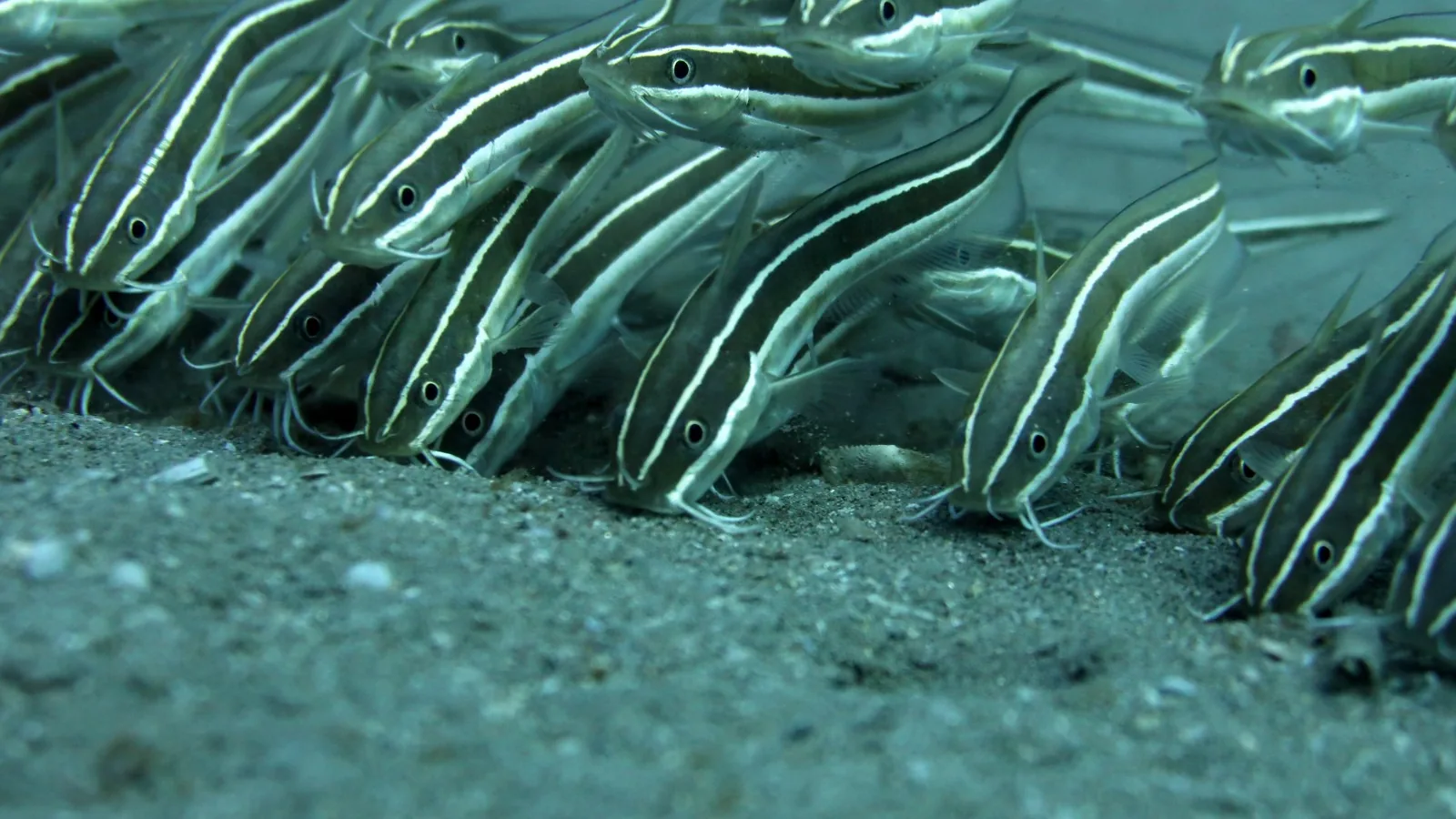
- Colour and stripes: A dark brown to almost black body marked with two or three pale, cream-to-white stripes running the full length of the fish — the single most useful field mark, visible on both juveniles and adults.
- Barbels: Four pairs of slender, whisker-like barbels ring the mouth, used to feel and taste for food across the sand — a catfish trait that instantly separates it from every other Red Sea reef fish.
- Spines: A single serrated, venomous spine at the front of the first dorsal fin, and one more in each pectoral fin — usually held flat against the body but raised when the fish feels threatened.
- Two life stages, one identity: Juveniles and adults share the same dark, striped colouring, but juveniles are almost always seen packed into a dense catfish ball rather than swimming alone.
One nuance worth knowing: genetic studies have shown that a virtually identical sibling species, Plotosus japonicus, has also been recorded in the northernmost Red Sea, and the two cannot be reliably told apart underwater by eye. In practice, any striped, barbelled catfish met on a Red Sea dive is simply called the striped eel-catfish, and the safety advice below applies equally to both.
The catfish ball
The single most memorable sight this species offers is not an adult at all, but a juvenile catfish ball — a dense, roughly spherical school of anywhere from a few dozen to several hundred young fish. Rather than swimming in the ordered formation of a typical baitfish school, the ball rolls and tumbles across open sand as one writhing unit, the tiny catfish inside feeding together on whatever their sweeping barbels turn up.
The behaviour is understood as a defensive strategy rather than true social schooling: a ball of hundreds is too large for most predators to swallow whole and too confusing to let any one juvenile be singled out — safety through sheer numbers rather than speed or camouflage. As the young fish grow, the ball loosens and breaks apart, and the species settles into the solitary, ledge-sheltering life of an adult.
For a diver or snorkeller, a catfish ball is one of the Red Sea's great small-critter sights, easy to watch for long minutes as it drifts across the sand. Despite its clumped, almost harmless-looking appearance, it is made up entirely of already-venomous fish — see below for why it should always be watched, never touched.
Diet — a nocturnal sand specialist
The striped eel-catfish feeds mainly after dark, moving out from its daytime shelter to work open sand and rubble for small invertebrates — crustaceans, molluscs and worms — plus the occasional small fish. Its barbels do much of the work, sweeping continuously across the substrate to feel and taste for prey hidden below the surface, letting it forage effectively in near-total darkness.
Like other members of the eeltail catfish family, it also carries clusters of ampullary electroreceptor organs concentrated around the head and barbels, thought to help it detect the faint electrical signals given off by buried prey — a sense most bony reef fish simply do not possess, and one more reason it stands apart from everything else sharing the sand around it.
Behaviour and reproduction
Adult striped eel-catfish are largely nocturnal, spending the day sheltering alone or in loose groups of up to about twenty under ledges, in rubble crevices or beneath coral overhangs, then emerging onto open sand at dusk to forage. When threatened, a resting or cornered fish raises its dorsal and pectoral spines as a warning rather than fleeing — a defensive posture, and a clear signal to leave it alone.
Breeding follows an unusual pattern for a reef fish: the male excavates a simple nest and entices a female to spawn there. After fertilisation the female departs, and the male alone guards the small cluster of eggs for roughly ten days until they hatch. The larvae then drift as plankton before settling onto the reef, where they group together as the juveniles that form the catfish ball described above — a life history running from a guarded nest, through a pelagic larva, to a defensive ball of young, and finally to the solitary adult.
A fish never to touch
The striped eel-catfish carries one of the more potent venoms a diver is likely to encounter on a Red Sea reef, and dive professionals treat it with real caution for good reason. The delivery system is a serrated, venom-grooved spine at the front of the first dorsal fin, plus a matching spine in each pectoral fin. These are not offensive weapons; they are a passive defence that only activates if the fish is grabbed, stepped on or pressed against — exactly the scenario every diver should avoid creating.
A sting typically causes immediate, intense, throbbing pain that can persist for hours, along with swelling, redness and sometimes numbness, weakness or nausea. In more serious cases the venom has been linked to extensive tissue swelling and, rarely, more severe complications. The species is widely described as one of the most dangerously venomous fish in its range; documented medical case series have not confirmed an outright human fatality, but stings are painful and occasionally severe enough that they are never worth risking. Because the spine is fragile and can break off in the wound, stings also carry a real risk of infection.
The rule for divers, snorkellers and instructors alike is simple: never touch, handle or corner a striped eel-catfish, adult or juvenile, no matter how still, sluggish or clustered it appears. A catfish ball in particular can look almost toy-like as it rolls across the sand, but every fish inside it can already deliver a full sting. Good buoyancy and a hands-off approach to the reef are the best protection, since most stings happen when a hand or foot is placed without being looked at first.
If a sting does occur: get out of the water, keep the affected area still, and immerse it in water as hot as can be tolerated without burning the skin — commonly cited as around 45 °C (113 °F) — for thirty to ninety minutes, since heat is known to help break down this type of venom and ease the pain. Check for any spine fragment left in the wound, clean it, and seek medical attention promptly, particularly for a deep puncture, a spine that will not come out, or any dizziness, breathing difficulty or spreading redness. This is general information, not a substitute for professional medical care — anyone stung should be assessed by a doctor or diving-medicine physician.
Conservation status
The striped eel-catfish is listed as Least Concern on the IUCN Red List, most recently reassessed in 2024. Its very wide Indo-Pacific range — from the Red Sea and East Africa to Samoa, and from southern Japan south to Australia — together with its tolerance of habitats from coral reefs to estuaries and tide pools, keeps it well away from any global conservation concern. It has even established a population in the Mediterranean after arriving through the Suez Canal, now managed there as an introduced species rather than a threatened one.
On Red Sea reefs the species faces no specific conservation pressure of its own; the main risk runs the other way, in the form of a sting a careless hand can receive. Left alone, it remains a common, resilient part of a healthy sand-and-reef community, turning over the substrate every night in search of its next meal.
Related Red Sea reef residents
The striped eel-catfish shares its "look, but never touch" reputation with several other venomous or otherwise hazardous Red Sea residents that reward the same respectful distance:
- Scorpionfish & stonefish — masters of camouflage on the reef floor, with venomous spines of their own and an even greater need to be seen before they are approached.
- Lionfish — another slow, confident reef predator carrying venomous fin spines, usually found hovering near the same ledges and overhangs.
- Moray eel — the reef's other classic crevice-dweller, sharing many of the same ledges the striped eel-catfish shelters under by day.
- Bluespotted ribbontail ray — a sand-dwelling species with its own venomous tail spine, often resting on the very same sandy patches.
For the bigger picture of what lives on an Egyptian reef and how the seasons shape a dive, see the complete guide to scuba diving in the Red Sea. To browse the full encyclopedia species by species, visit the Red Sea marine life guides.
Frequently asked questions
A striped eel-catfish has a dark brown to almost black, eel-like body that tapers smoothly to a point, because the second dorsal, tail and anal fins are fused into one continuous fin the way they are in a true eel. Running the length of the body are two or three pale cream to white stripes, and around the mouth sit four pairs of slender, whisker-like barbels used to feel and taste for food in the sand. Adults reach about 32 cm and are usually seen alone or in small groups under a ledge; juveniles look identical in colour but are found packed into a dense, constantly moving ball of dozens to hundreds of fish.
Yes. The first spine of the dorsal fin and the spine in each pectoral fin are serrated and deliver a potent venom, and this species is widely regarded as one of the more dangerously venomous fish a diver can encounter on a Red Sea reef. A sting causes intense, throbbing pain that can last for hours, along with swelling, redness and sometimes numbness or nausea, and severe cases have involved extensive tissue damage. It should never be touched, handled or cornered, even though it does not behave aggressively toward divers who leave it alone.
A catfish ball is the tightly packed, roughly spherical school formed by juvenile striped eel-catfish, sometimes numbering in the hundreds. Rather than swimming in an organised line like most schooling fish, the ball rolls and tumbles across open sand as the young catfish feed together, boiling over itself in a constant, writhing motion. The behaviour is thought to be purely defensive: a ball this size and shape is too large for most predators to swallow and too confusing to let one fish be singled out, which gives the small, still-developing juveniles inside real protection.
Yes. Juvenile striped eel-catfish carry the same venomous dorsal and pectoral spines as adults from a very small size, so a catfish ball is not a harmless curiosity despite its tight, tumbling, almost toy-like appearance. Divers and snorkellers should watch a catfish ball from a comfortable distance and never reach into or disturb it, both to avoid a sting and to avoid stressing the young fish out of the formation that is protecting them.
Get out of the water, keep the injured area still, and immerse the sting in water as hot as can be tolerated without burning the skin, generally around 45 °C (113 °F), for thirty to ninety minutes; the heat helps break down the venom's proteins and eases the pain. Clean the wound and check for any spine fragment left in the skin. Because stings can cause severe swelling, secondary infection or, rarely, a more serious systemic reaction, medical attention should be sought promptly, especially for a deep puncture, a spine that will not come out, or any dizziness, breathing difficulty or spreading redness.
It feeds mainly at night on small invertebrates living in and on the sand, including crustaceans, molluscs and worms, along with the occasional small fish. Its barbels sweep the substrate for scent and texture, and like other members of the eeltail catfish family it carries clusters of electroreceptor organs concentrated around the head, which are thought to help it sense the faint electrical signals given off by prey buried out of sight — a sense most reef fish simply do not have.
They are a common, year-round resident across the Egyptian Red Sea, most often found on open sand and rubble beside the reef rather than on the coral itself. Solitary or small groups of adults shelter under ledges and coral overhangs by day, while the unmistakable juvenile catfish balls turn up on shallow sand flats, in lagoons and along house reefs at popular dive destinations including Hurghada, Sharm el-Sheikh, Makadi Bay and Sahl Hasheesh — as well as on shore-diving and night-diving sites where sandy entry points are common.