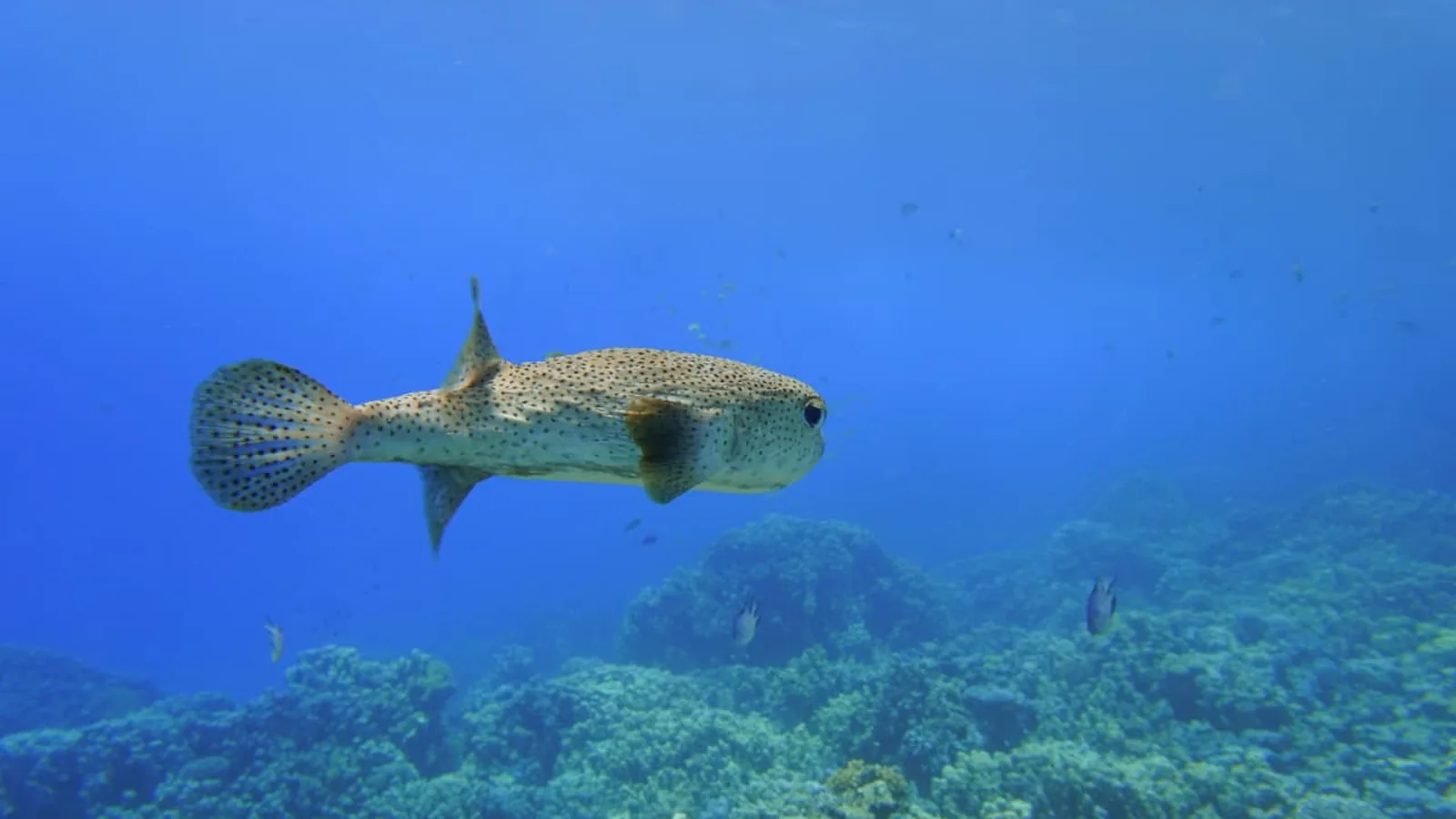
Where to see them
When to see them
Like most reef-resident fish, porcupinefish do not migrate with the seasons, so there is no particular month that improves the odds of a sighting — both Red Sea species are present on the reef every day of the year. What changes far more than the calendar is the clock: porcupinefish are largely nocturnal, tucked out of sight for most of the daylight hours and considerably more active and easier to watch once the sun goes down. A day dive rewards a patient look into caves and overhangs; a night dive is often the better chance to see one moving and feeding out in the open.
Year-round resident Sheltering by day, most active after dark
How to recognise a porcupinefish
Every porcupinefish shares a short list of unmistakable features before a diver even gets close enough to separate the two Red Sea species.
- Body & spines: A short, blunt-nosed, almost box-like body covered from head to tail in long, two-rooted spines. Each spine is hinged rather than fixed, so it lies flat and nearly invisible against the skin when the fish is relaxed, and stands fully erect, perpendicular to the body, only once the fish inflates.
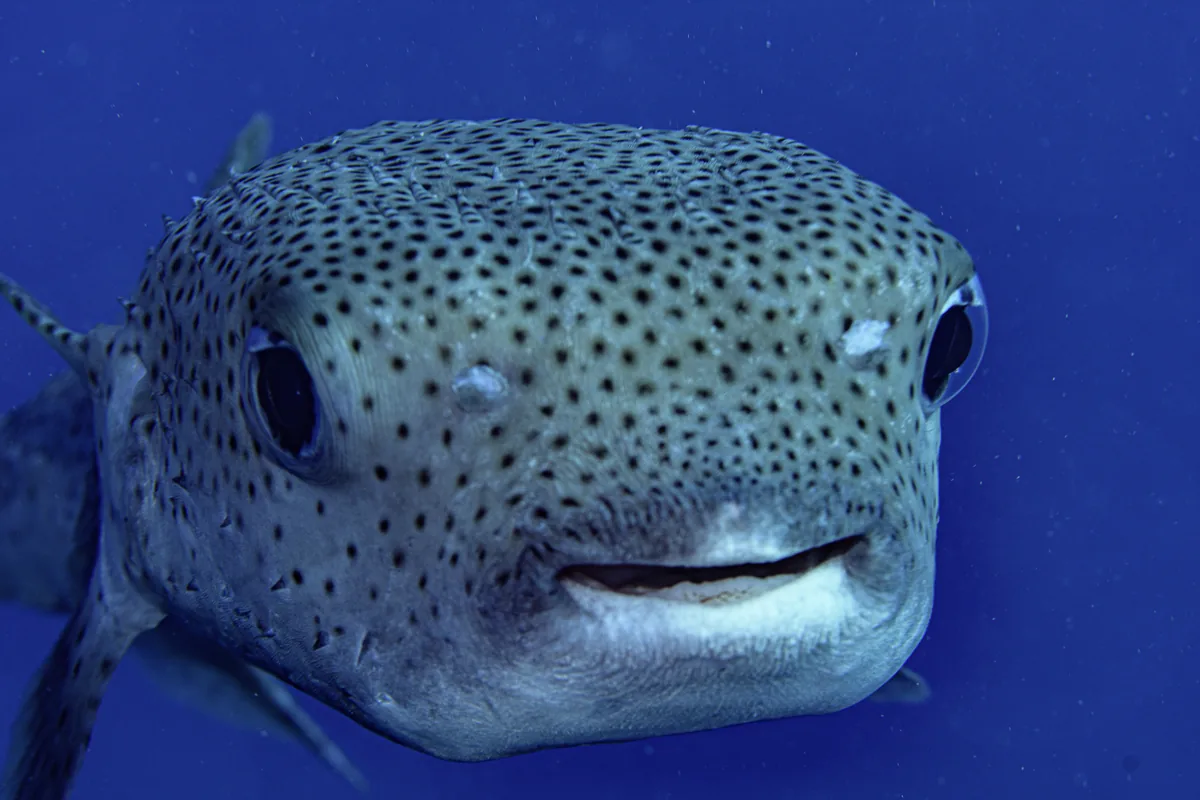
- Eyes: Large, round eyes set high on the head — an adaptation for a fish that does much of its hunting after dark — which give even a perfectly calm porcupinefish a wide-eyed, faintly startled expression.
- The beak: Instead of individual teeth, a porcupinefish carries a single fused, beak-like plate in each jaw — the feature that gives the genus its scientific name, Diodon, from the Greek for "two teeth." The plates grow continuously through the fish's life to replace the wear of crushing hard prey.
- Fins: Small, rounded pectoral fins beat rapidly, and a single dorsal and anal fin sit well back near the tail; there are no pelvic fins at all, which, together with the stiff, spiny body, makes porcupinefish slow, somewhat clumsy swimmers rather than fast, agile ones.
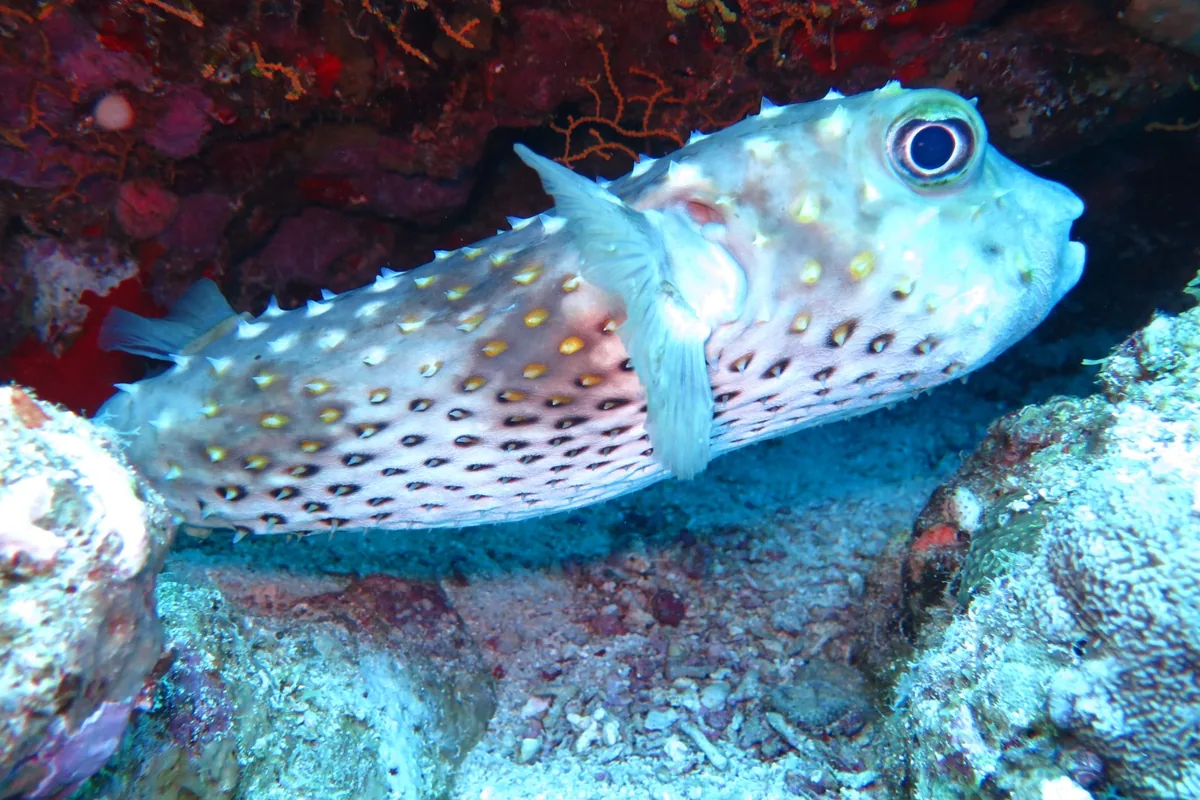
The two porcupinefish most likely to be met on an Egyptian reef differ enough, once a diver knows what to check, to be told apart with confidence:
- Spot-fin porcupinefish (Diodon hystrix) — the larger of the two, with a pale, whitish-grey body covered evenly in small, dark spots that carry on across the fins; spots on the dorsal, tail and pectoral fins are the clearest giveaway. It lacks large dark blotches, and its spines, though long, are shorter than those of its relative.
- Long-spine porcupinefish (Diodon holocanthus) — smaller and stockier, patterned with a scattering of large, dark blotches on the back and sides rather than an even coat of spots, and with plain fins that carry no spots at all. Its spines are noticeably longer for the fish's size, which is where the common name comes from.
Neither species should be confused with the Red Sea's true pufferfish, such as the masked pufferfish (Arothron diadematus): a pufferfish has smooth, or at most finely prickly, skin with no long erectile spines, and its beak is divided into two plates per jaw rather than the single fused plate carried by a porcupinefish.
The inflating defence
A porcupinefish's headline trick is also its last line of defence. When it feels genuinely threatened, it gulps water rapidly into an unusually elastic section of its digestive tract, ballooning to roughly three times its resting diameter within seconds. The same expansion that swells the body also forces every spine on the skin to stand erect, perpendicular to the surface, turning a slow, soft-bodied fish into a spiky ball that is difficult for almost any predator to get a grip on, let alone swallow — an inflated porcupinefish has even been recorded choking a shark that tried.
There is no fixed limit to how many times an individual can inflate and deflate over its lifetime, and the mechanism works equally well against a predator that grabs the fish or one that merely threatens it from a distance. It is, however, a genuine stress response rather than a display, and it comes at a real physiological cost — which is exactly why divers and snorkellers should never deliberately provoke it.
Diet — a specialist in hard-shelled prey
Diodon is built to eat what other reef fish cannot reach. The fused beak plates, backed by additional crushing plates on the roof of the mouth, let a porcupinefish break open sea urchins, hermit crabs, crabs, snails and other molluscs with thick, well-defended shells. That diet of hard, abrasive prey wears the beak down constantly, so — much like the incisors of a rodent — the tooth plates grow throughout the fish's life to keep pace.
Porcupinefish feed mainly at night, when they leave their daytime shelter to forage alone over sand, rubble and the sandy edges of the reef, tracking down prey largely by sight. They are not schooling fish and rarely forage in groups; a solitary porcupinefish working a patch of sand after dark, listening and looking for the next hidden shell to crush, is the typical picture.
Behaviour — solitary, slow and mostly nocturnal
Porcupinefish spend the day largely inactive, wedged into a cave, crevice or the shade beneath a coral overhang, and become considerably more mobile after sunset. This day-to-night switch, combined with a body built for defence rather than speed, shapes almost everything else about how the fish behaves. Small, rapidly beating pectoral fins and a rearward dorsal and anal fin give a porcupinefish a hovering, somewhat ungainly swimming style, and with no pelvic fins to help it manoeuvre, it relies on stealth, camouflage and its inflating defence rather than speed to stay out of trouble.
The species is essentially solitary rather than territorial: individuals do not defend a patch of reef the way some angelfish or damselfish do, and encounters between porcupinefish are generally tolerant rather than aggressive. Many are also fairly site-faithful, resting in or near the same shelter on successive days, which is why a particular ledge on a regularly dived reef can become a reliable spot to find one.
Toxic to eat, and best left uninflated
Every porcupinefish carries tetrodotoxin, an extremely potent nerve toxin concentrated mainly in the liver, intestines and gonads but also present in the skin; females typically carry higher concentrations in their ovaries than males do in their testes. In humans, tetrodotoxin poisoning blocks the nerve signals that control muscle movement and can be fatal, most often through respiratory failure, which is why porcupinefish are not a food fish and should never be handled with the intention of eating them.
That toxin is a poison, not a venom, and the difference matters underwater. A porcupinefish has no venom gland, no stinger and no bite capable of injecting toxin into a diver — its spines are a purely mechanical defence, sharp enough to deter a predator's mouth but delivering nothing on contact. In practice this means a diver who simply observes and does not touch faces no real risk from the animal at all.
The one genuine welfare concern is provoking inflation. Ballooning up is a real stress response that drains a fish's energy reserves and compresses its internal organs, and full recovery afterwards can take hours. The risk is worse if the fish is lifted toward the surface or otherwise made to gulp air instead of water while inflating, because it may then be unable to release that air normally and can be left floating helplessly at the surface — sometimes fatally. Divers and snorkellers should never chase, corner, lift or otherwise try to make a porcupinefish inflate for a photograph; watched calmly from a small distance, it will simply go about its night, or its daytime rest, undisturbed.
Conservation status
Both of the Red Sea's common porcupinefish are listed as Least Concern on the IUCN Red List: the spot-fin porcupinefish (Diodon hystrix) was assessed in 2015, and the long-spine porcupinefish (Diodon holocanthus) carries the same rating. Each has an enormous circumtropical range spanning the Indo-Pacific and the Atlantic, broad tolerance of different reef and sandy habitats, and no evidence of a significant population decline, so neither is currently considered at risk at a global level.
Porcupinefish are not targeted by any major food fishery — their toxic flesh sees to that — though they do turn up as incidental bycatch in reef fisheries elsewhere in their range, and in some parts of the world dried, inflated specimens are still sold as tourist curios, a historical practice that long predates modern conservation concern. Neither species is listed under CITES. As with most reef fish, the more meaningful long-term protection for porcupinefish is the one that protects the whole ecosystem they depend on: keeping Red Sea coral reefs healthy, structurally complex and undisturbed.
Related Red Sea reef fish
Porcupinefish share their reef with several other Red Sea fish known for an unusual defence or an eye-catching look. Divers who enjoy spotting a Diodon often want to read about:
- Masked pufferfish — the Red Sea's most common true pufferfish, smooth-skinned and similarly loaded with tetrodotoxin but without a single erectile spine.
- Lionfish — a slow, ornately finned predator that, like the porcupinefish, relies on a very visible defence rather than speed.
- Scorpionfish & Stonefish — camouflage specialists at the opposite extreme, venomous rather than merely toxic, and far harder to spot.
- Octopus — another reef master of instant defensive transformation, though by colour and shape rather than inflation.
For the bigger picture of what lives on an Egyptian reef and how the seasons shape a dive, see the complete guide to scuba diving in the Red Sea. To browse the full encyclopedia species by species, visit the Red Sea marine life guides.
Frequently asked questions
The clearest sign is the spines. A porcupinefish (genus Diodon) is covered in long, sharp, two-rooted spines that normally lie flat against the body and stand fully erect only once the fish inflates. A true pufferfish, such as the Red Sea's masked pufferfish, has smooth or at most finely bumpy skin with no long erectile spines at all. The two groups also differ at the mouth: a porcupinefish carries a single fused beak plate in each jaw, giving the genus its name Diodon, meaning 'two teeth,' while a pufferfish's beak is divided into two halves per jaw, for four plates in total.
It is a defence, not a display. When threatened, a porcupinefish rapidly gulps water into a highly elastic section of its digestive tract, swelling to roughly three times its resting size within seconds. The sudden expansion forces the spines, which normally lie flat, to stand out stiffly in every direction, turning a slow, soft-bodied fish into a spiny ball that few predators can get a grip on, let alone swallow — a defence effective enough to have been recorded choking a shark that tried. A porcupinefish can inflate and deflate many times over its life with no fixed limit, but each episode is a genuine stress response rather than a party trick.
It is poisonous if eaten, not venomous. Porcupinefish flesh and organs, especially the liver, intestines and gonads, contain tetrodotoxin, an extremely potent nerve toxin that can be fatal if consumed; the toxin also occurs in the skin. That makes them dangerous as food, not as an animal to encounter underwater — a porcupinefish has no venom gland, no stinger and no bite that injects toxin into a diver. Its long spines are a purely mechanical, non-venomous defence, so the only real precaution for divers is admiring one without touching it or trying to make it inflate.
Porcupinefish are hard-shelled-prey specialists. Fused, beak-like tooth plates, backed by additional crushing plates on the roof of the mouth, let them break open sea urchins, hermit crabs, crabs and molluscs that most reef fish cannot touch. Because that diet wears the beak down, the tooth plates grow continuously throughout the fish's life. Porcupinefish feed mainly after dark, foraging alone over sand, rubble and reef edges at night and resting under ledges through the day.
It depends on the species. The spot-fin, or giant, porcupinefish (Diodon hystrix) is the larger of the two common Red Sea species, typically reaching around 40 to 50 cm with exceptional individuals recorded to nearly a metre. The long-spine porcupinefish, or balloonfish (Diodon holocanthus), is smaller and stockier, usually 30 to 40 cm and rarely much beyond 50 cm, though it carries noticeably longer spines for its size.
Yes, largely. Porcupinefish are most active after dark, when they leave the shelter of caves, ledges and overhangs to forage for hard-shelled prey over open sand and reef. By day they are far less mobile, tucked into a crevice or resting motionless under a coral head, which is why divers most often find them by looking into shaded gaps rather than out in open water — though a slow-moving individual can also be spotted crossing open sand on a daytime dive.
No. Provoking a porcupinefish to inflate is a genuine stressor, not a harmless photo opportunity. Ballooning up drains the fish's energy reserves and compresses its internal organs, and recovery afterwards can take hours. The risk is greater still if a fish is lifted toward the surface or otherwise made to gulp air rather than water, because it may then be unable to release that air normally and can be left floating helplessly, sometimes fatally. The responsible approach is the same one that applies to every reef animal: watch and photograph from a respectful distance, and never touch or chase.