Where to see them
When to see them
Teira batfish are permanent Red Sea residents rather than seasonal visitors, so there is no particular month to plan a trip around them — schools are on the wrecks and reefs every day of the year. The Red Sea sits at the western edge of a wide Indo-West Pacific range that runs from East Africa to Japan, Papua New Guinea and Australia, and the species has held a stable, resident population here for as long as it has been recorded. What changes with the season is the water itself: calmer, clearer conditions make it easier to appreciate the schools hovering around a wreck or pinnacle, while a patient look into sheltered shallows and harbours is what reveals the very different, sail-finned juveniles.
Year-round resident Schools build around wrecks, walls and pinnacles in every season
How to recognise a teira batfish
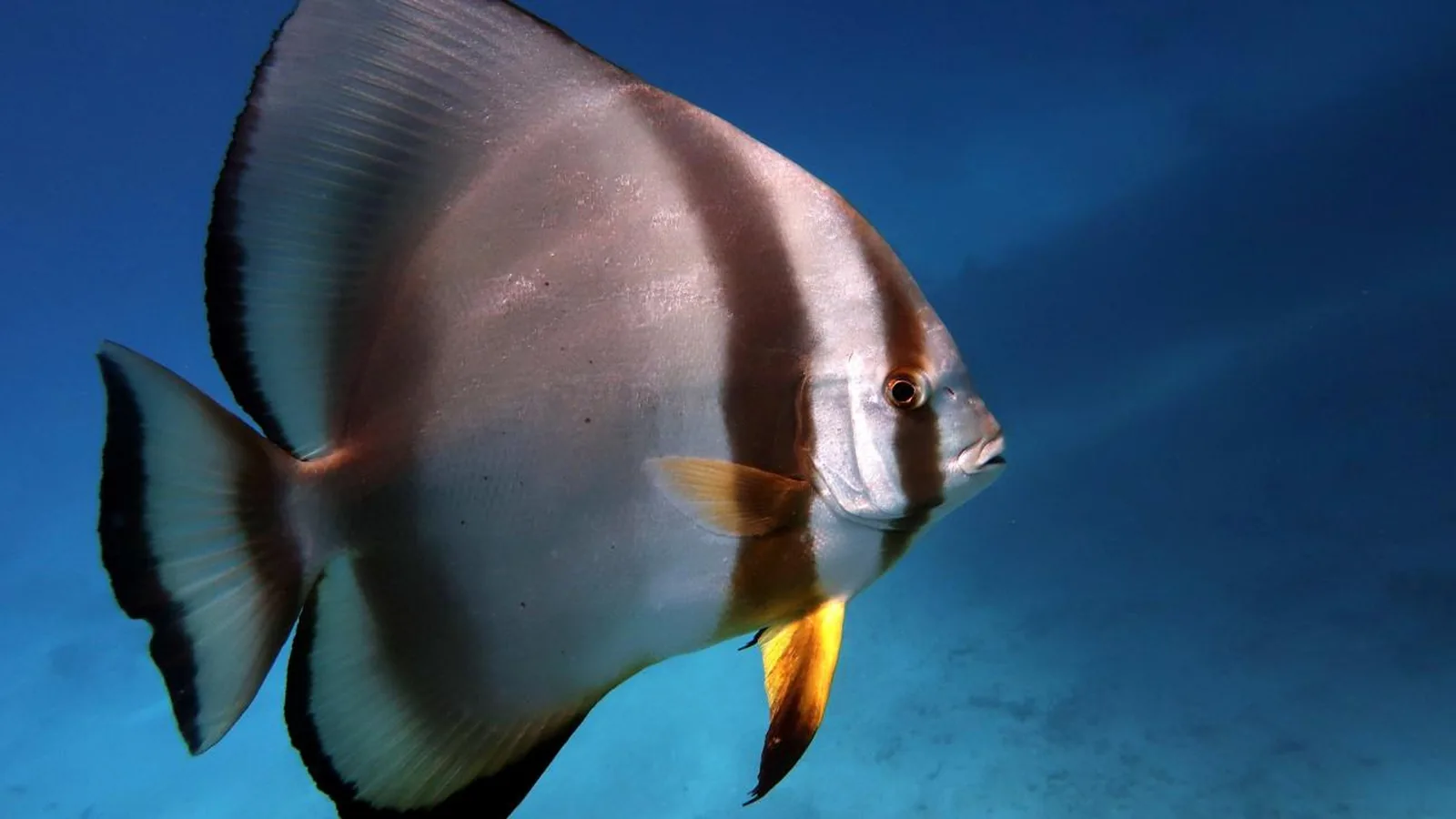
An adult teira batfish is easy to name once its shape and markings are known, and just as easy to mistake for one of its close relatives if they are not. The key adult features:
- Body shape: Large, oval and strongly laterally compressed — flattened side-to-side into a tall, rounded disc when seen broadside, reaching a maximum recorded length of about 70 cm. It is one of the biggest schooling reef fish likely to be encountered on a Red Sea dive.
- Colour: Silvery-grey to brownish overall, sometimes with a faint pinkish or golden cast in good light.
- Bars and blotch: Two dark vertical bars cross the body — one running straight through the eye, and a second through or just behind the base of the pectoral fin — together with a separate dark blotch on the lower body, close to where the anal fin begins.
- Fins: The pelvic fins are yellow to blackish and the anal fin is a solid, fairly bright yellow, giving an otherwise silver fish a splash of colour low on the body.
- The forehead hump: Large adults, roughly above 35 cm, develop a small bony hump running from the top of the head toward the eyes — a feature younger, smaller fish do not yet show.
- A fish that changes its own colour: Independent of age, a teira batfish can shift its whole tone within minutes — fading to a pale, almost bandless silvery-white, then darkening back to brown or grey with bold, blackish bars. The trigger seems to be mood or surroundings rather than the time of day, so the same individual can look quite different from one encounter to the next.
Two other Red Sea batfish are worth telling apart from the teira. The orbicular batfish (Platax orbicularis) is stockier as a sub-adult, with a taller, fan-shaped tail and often small black spots scattered across the flanks. The pinnate, or dusky, batfish (Platax pinnatus) has a more pointed, protruding snout and a concave head profile in larger fish, and its juvenile is unmistakable — jet black with a bold orange band outlining the entire body, rather than the plain brown "dead leaf" look of a young teira.
The juvenile that looks nothing like the adult
Few reef fish change as completely, or as strategically, as the teira batfish. Larvae drift in the open ocean before settling onto the reef edge, a mangrove fringe or a raft of floating debris at only two to three centimetres long. At that tiny size the juvenile is plain brownish and almost flat, and it drifts passively enough to be taken for a dead leaf carried by the current — a first line of defence against the many predators that patrol the shallows.
As the juvenile grows, roughly from about 5 to 10 cm, it develops something far more elaborate than leaf camouflage: the front rays of the dorsal and anal fins, together with the pelvic fins, become hugely elongated, stretching back toward the rear of the anal-fin base. The effect is a tall, narrow, almost triangular silhouette utterly unlike the rounded adult disc. This shape is not just for show — juveniles reinforce the disguise behaviourally, swimming slowly and often tilting onto one side so that the tall, ragged silhouette drifts like a dead leaf or a scrap of debris that most predators ignore. (The closely related pinnate batfish, Platax pinnatus, takes the trick further still: its black, orange-edged juvenile is a textbook mimic of a specific toxic flatworm.)
The transformation back toward the familiar adult shape happens gradually as the fish grows. The exaggerated fins do not vanish; they simply become proportionally shorter as the body itself grows outward and fills in, and by the time a fish passes roughly 35 cm it has typically added the small bony forehead hump described above. By the time it approaches full adult size, the sail-finned silhouette and the leaf-like drifting motion are gone entirely, replaced by the confident, schooling fish that gathers around Red Sea wrecks and reef walls.
Behaviour — schools, wrecks and famously curious fish
Teira batfish are a genuinely social species. They are seen singly and in pairs, but far more often in schools of around 20 individuals, and offshore aggregations approaching 100 fish have been recorded over open ground. Structure draws them in: wrecks, pinnacles and reef walls all concentrate schools, which is why the species has become so strongly associated with wreck diving across the Red Sea. At a site such as the SS Thistlegorm, a resident school will often hold station around the hull and superstructure for the whole of a dive.
What sets the adult teira batfish apart from most schooling reef fish is how little it minds a diver's company. Rather than scattering at the first approach, individuals or whole schools frequently swim in close, circle at arm's length, and tag along behind divers for much of a dive — a mix of curiosity and confidence that has made the species one of the most photographed fish on Egyptian reefs. That same social behaviour extends to defence: in open water a tight school offers each individual fish some protection simply through numbers, even though the adult's size and speed leave it with few serious natural predators on the reef.
Diet — an opportunistic generalist
Unlike specialist grazers that depend on one narrow food source, the teira batfish is an omnivorous generalist. Its diet spans zooplankton picked from the water column, small and sessile invertebrates, worms, and marine algae scraped from hard surfaces — and, notably for a reef fish, jellyfish, which few other fish are willing or able to eat. That breadth lets a school feed equally well hovering in open water off a wreck or working the surface of a reef, and it is one reason schools thrive in the plankton-rich currents that also draw divers to Red Sea drop-offs and pinnacles.
The compact, slightly protruding mouth is built for this generalist lifestyle rather than for chasing fast prey, and a feeding school will often work methodically through a patch of water or reef surface rather than hunting any single target. Watching a school feed around a wreck, picking plankton from the current one moment and grazing the hull's growth the next, is a good illustration of just how adaptable the species is.
Watching and photographing teira batfish
Because teira batfish are so approachable, the main etiquette challenge is protecting the fish, the site and the encounter rather than getting close enough to see them:
- Let the fish set the distance. A curious school will often approach a calm, slow-moving diver on its own; there is rarely any need to chase or corner an individual fish for a closer look.
- Never feed them. Feeding batfish, or any wreck fish, changes natural behaviour and can concentrate fish unnaturally around divers, boats or feeding points — good buoyancy and patience achieve the same close encounter without the downside.
- Mind the wreck. Many of the best teira batfish encounters happen on or around wrecks, which are fragile and often silty. Careful buoyancy protects both the historic structure and the visibility that makes the encounter worth having.
- Check the shallows for juveniles. The dramatically different, sail-finned juveniles hide in sheltered bays, harbours and among floating debris — a slow, careful look in calm shallow water is often the only way to find one.
- Use natural light where possible. The silver body and yellow fins photograph well in ambient light; a school circling overhead against the surface is a classic Red Sea wreck-diving image that needs no strobe to work.
Conservation status
The teira batfish is listed as Least Concern on the IUCN Red List, an assessment carried out in 2018 and published in 2019. Its very wide Indo-West Pacific distribution — from the Red Sea and East Africa across to Papua New Guinea, north to southern Japan and south to Australia, with occasional records reaching the Mediterranean via the Suez Canal — and generally stable populations keep it well away from any global threat category. In parts of its range it is caught commercially with hook-and-line, traps, spears, trawls and hand nets, though its flesh is not highly valued, and juveniles are also collected for the marine aquarium trade and, in some areas, farmed in aquaculture. None of these pressures is currently considered a threat to the species as a whole.
The teira batfish's real vulnerability, like that of many wreck- and reef-associated fish, is tied to the health of the structures it depends on. Physical damage to reefs and wrecks, and disturbance of the sheltered shallows where juveniles hide, matter far more to a local population than any direct fishing pressure. On a well-managed Red Sea reef or dive-site wreck, the teira batfish remains a common, confident and thoroughly memorable resident.
Related Red Sea reef fish
The teira batfish shares its schooling, wreck-loving habits with a handful of other bold, sociable Red Sea residents that divers often meet on the same dive. Those drawn to its curious nature and striking silhouette often want to read about the reef's other confident, characterful fish:
- Napoleon wrasse — another famously inquisitive, oversized reef fish that will often approach divers at close range.
- Reef sharks — the reef's more cautious large predators, most often seen along the same current-swept walls and drop-offs.
- Moray eel — a reef and wreck resident whose crevices and cavities shelter alongside the same wreck structures batfish patrol.
- Oceanic whitetip shark — a very different open-water resident, but one that shares the Red Sea's offshore blue-water habitat with wandering batfish schools.
For the bigger picture of what lives on an Egyptian reef and how the seasons shape a dive, see the complete guide to scuba diving in the Red Sea. To browse the full encyclopedia species by species, visit the Red Sea marine life guides.
Frequently asked questions
An adult teira batfish (Platax teira) is a large, rounded, laterally compressed fish that looks almost disc-shaped from the side, growing to about 70 cm. It is silvery-grey to brownish with two dark vertical bars — one running through the eye and a second through the base of the pectoral fin — plus a dark blotch on the lower body near where the anal fin begins. The pelvic fins are yellow to blackish and the anal fin is a solid yellow. Large adults, above roughly 35 cm, also develop a small bony hump on the forehead that smaller fish lack.
Juveniles hatch into a world full of predators and survive by disguise rather than size. Tiny juveniles are brownish and drift among floating debris and seaweed rafts, resembling a dead leaf, while slightly larger juveniles, roughly 5 to 10 cm, grow hugely elongated dorsal, anal and pelvic fins that give them a tall, sail-like, almost triangular profile completely unlike the compact adult disc. As the fish grows toward adult size those fins become proportionally shorter and the body fills out into the familiar rounded shape, so the change is a genuine transformation rather than simply added size.
Not permanently, and not simply with age. A teira batfish can shift its whole appearance within minutes, turning from a pale, almost bandless silvery-white to a darker brown or grey with bold blackish bars, then fading back again. This rapid, reversible colour change appears linked to mood or surroundings rather than to age, and it is separate from the true, slower transformation in body and fin shape that happens as the fish grows from juvenile to adult.
Teira batfish reach a maximum recorded length of about 70 cm, though many adults divers encounter are a little under that, commonly in the 50 to 65 cm range. They are among the larger schooling reef fish likely to be met on an Egyptian Red Sea dive, easily dwarfing the small, sail-finned juveniles that share the same reefs.
Teira batfish are strongly linked to wrecks and other solid structure. In the Red Sea they are famous for forming large, curious schools around wreck sites such as the SS Thistlegorm, where dozens of fish hover around the hull and superstructure and often follow divers for the length of a dive. They are just as at home on reef walls, drop-offs and offshore pinnacles, usually in pairs, small groups of around 20, or occasionally aggregations approaching 100 fish over open, current-swept ground.
They have a reputation as one of the least shy fish on the reef. Adult teira batfish are inquisitive and will often approach a diver directly, circle at close range, or tag along for much of a dive rather than fleeing. This confident, curious behaviour, combined with their striking silhouette, makes them a favourite subject for underwater photographers.
They are omnivorous generalists, feeding on zooplankton, small and sessile invertebrates, jellyfish, worms and marine algae. That broad diet lets a school forage over open water as well as pick food from the reef surface, and it is part of why they thrive around wrecks, where currents concentrate plankton and other small prey.