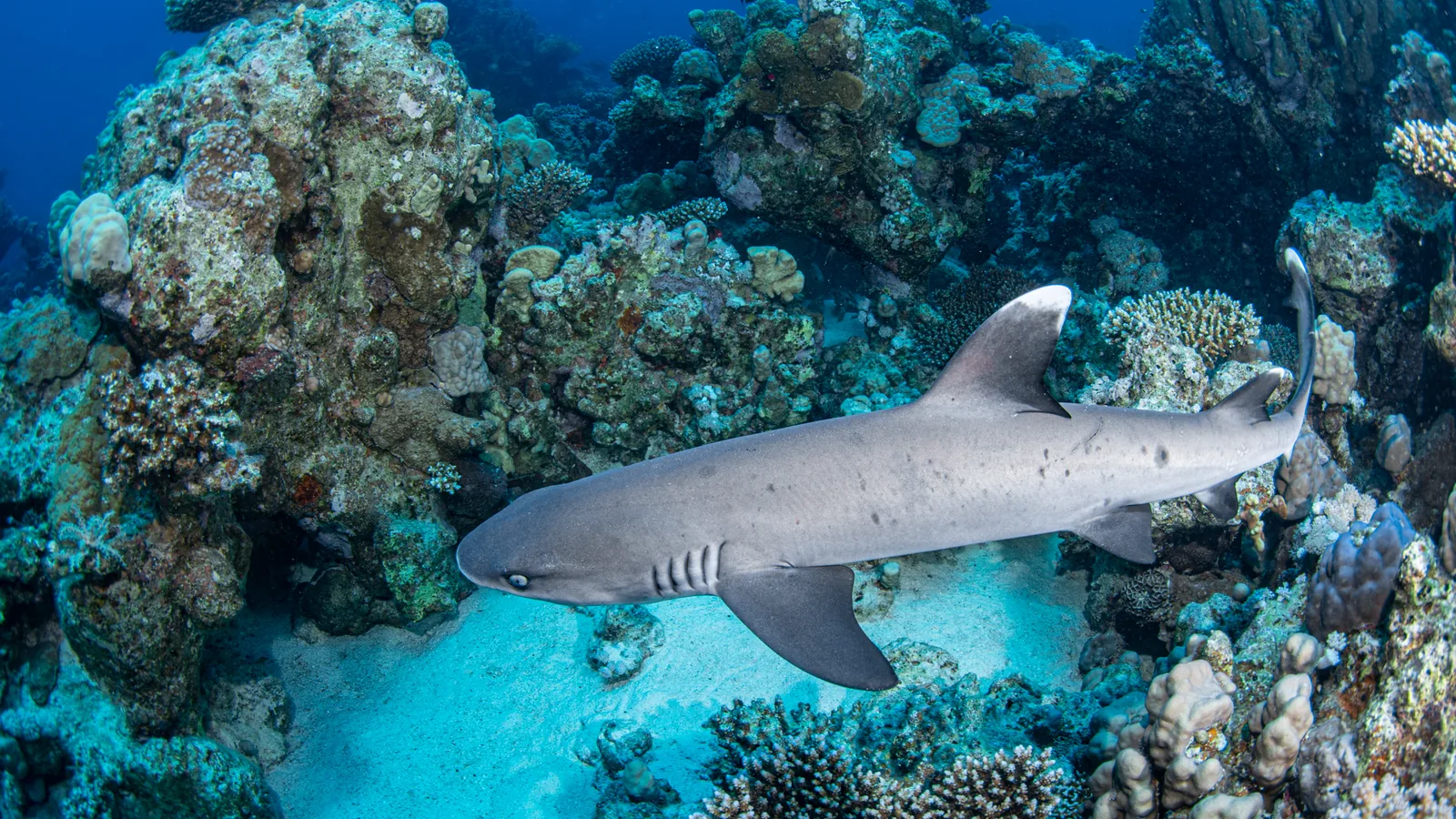
Shark & Yolanda Reef, Ras Mohammed (Sharm)Whitetip reef sharks resting under ledges by day; pelagic schools and tuna in the blue. Ras Mohammed National Park, accessible from Sharm by day boat.
Thomas Reef, Tiran Straits (Sharm)Vertical wall with regular whitetip and grey reef sharks; sometimes hammerheads in the blue on the back of the reef during summer.
Jackson Reef, Tiran Straits (Sharm)Famous wreck at the corner; hammerheads on the deep side in summer; whitetip and grey reef common at recreational depths.
Brothers Islands — Big & Little Brother (liveaboard)Among the best shark sites in Egypt — silvertips, oceanic whitetips, threshers, hammerheads, grey reef plus regular whitetips resting on the bottom.
Elphinstone Reef (Marsa Alam, day-trip + liveaboard)The most reliable oceanic whitetip site on the planet during October–December. Thresher sharks occasionally on the deep north plateau.
When to see them
Whitetip and grey reef sharks are year-round Red Sea residents. Pelagic species follow seasonal patterns: hammerheads peak May–September at Tiran and Daedalus; oceanic whitetips peak October–December at Elphinstone.
The whitetip is the reef shark most divers see first — and most often. It is small, slender, brown-grey, with a distinctive white tip on the first dorsal fin and the upper lobe of the tail fin (occasionally the pelvic fins too). The body shape is unusually slim for a shark — more pencil than torpedo. The second dorsal fin is unusually large, almost as big as the first, which is a key identification feature.
Identification
Size: Maximum 2.13 m, but adults rarely exceed 1.6 m. Most individuals seen by divers are 1.2-1.5 m.
Colour: Brown-grey dorsal, white ventral. Distinctive white tips on first dorsal, upper caudal lobe.
Shape: Slender body, short broad snout, large second dorsal fin (key ID feature distinguishing it from other species).
Teeth: Small, three-pronged ("tricuspidate") — used for grabbing small slippery prey.
Behaviour
Whitetips are predominantly nocturnal. By day, they rest on the sand under coral overhangs, in caves, or on ledges — sometimes piled on top of each other ("cuddle puddles"). By night, they actively hunt the reef, often working cooperatively to corner prey in coral crevices. Their flexible bodies and tough skin allow them to wriggle into tight spaces unavailable to other sharks. They are extraordinarily site-faithful — individual whitetips may return to the same resting cave for years.
Where to see them in the Red Sea
The whitetip reef shark was first scientifically described in 1837 by German naturalist Eduard Rüppell — and the type locality was the Red Sea. They are reliable encounters at virtually any reef site in Egyptian waters: house reefs, Hurghada day-boat sites (Sha'ab El Erg, Umm Gamar, Gota Abu Ramada), Sharm day-boat sites (Tiran straits, Ras Mohammed), and every offshore reef. Look for them sleeping at 10-25 m on sandy patches under coral.
Biology & conservation
Reproduction: Viviparous (placental). Litter size 1-5, typically 2-3 pups. Gestation period over 5 months.
Maturity: Females mature at ~1 m total length; males at ~82 cm.
Lifespan: Estimated 16-25 years (Smith et al. 1998 estimate ~16 years; some longer-lived individuals recorded).
IUCN status: Vulnerable (2020), declining.
Threats: Coral reef degradation, targeted fishing for fins and liver oil, slow reproductive rate.
Blacktip Reef Shark (Carcharhinus melanopterus)
The blacktip reef shark is the shallow-water specialist of the three — and by far the most visually striking. Every fin is tipped in unambiguous black, with a particularly bold black tip on the first dorsal fin, often contrasted by a clear pale band immediately below. Combined with their habit of patrolling shallow reef flats (sometimes with the dorsal fin breaking the surface), they are the species most non-divers see while snorkelling or wading.
Identification
Size: Maximum 1.8 m, typically 1.5-1.6 m. Smaller than whitetips on average.
Colour: Yellow-brown to grey-brown dorsal, white ventral, with conspicuous black tips on first dorsal, pectorals, pelvics, anal fin and tail. A pale band runs below the black tip of the first dorsal — diagnostic.
Shape: Stout build, short bluntly-rounded snout, oval eyes.
Diagnostic feature: Black-tipped first dorsal with the contrasting pale band below.
Behaviour
Blacktips are shy and skittish. They have extremely limited home ranges — adults often stay on a single reef their entire lives, with movements measured in hundreds of metres rather than kilometres. They feed primarily on small reef fish, cephalopods, and crustaceans, and occasionally on sea snakes and seabirds. They are typically solitary but will aggregate around concentrated food sources. They can tolerate brackish water and have been recorded entering river mouths and (in some regions) freshwater.
Their shyness around divers is genuine — most blacktips will move away when divers approach, sometimes pacing the reef edge at a constant distance rather than allowing close approach. They become bolder around feeding (which is why their reputation includes occasional bites of waders in shallow water near beach fish-feeding).
Where to see them in the Red Sea
Blacktips prefer Hurghada-area sites with extensive shallow lagoons and reef flats — places like the shallow areas around Giftun Island, Sha'ab Sabrina, and the lagoons of Sha'ab El Erg. They are less common at Sharm sites where the bathymetry drops more steeply from shore. Look for them in 2-15 m on sandy lagoon edges adjacent to reef walls.
Biology & conservation
Reproduction: Viviparous (placental). Litter size 2-4 pups. Gestation 7-11 months (longer in some regions).
Maturity: Females 96-130 cm; males 91-105 cm.
Lifespan: Estimated 13+ years.
IUCN status: Vulnerable (2020). Declining due to nearshore fishing pressure and reef habitat degradation.
Notable distribution: Reports of blacktips in the eastern Mediterranean — most likely Suez Canal migrants from the Red Sea population.
Grey Reef Shark (Carcharhinus amblyrhynchos)
The grey reef shark is the largest, the most "shark-shaped," and the most likely to leave a strong impression. Where whitetips are slender and blacktips are skittish, grey reefs are confident, well-built, and often investigative. They are also the most threatened of the three — designated Endangered by the IUCN in 2020 after evidence of substantial population declines globally.
Identification
Size: Maximum 2.55 m, but adults typically 1.5-1.7 m. Largest of the three Red Sea reef sharks.
Colour: Slate grey to bronze-grey dorsal, white ventral.
Diagnostic feature:Solid black trailing edge along the entire caudal (tail) fin. No other Red Sea reef shark has this complete black-edged tail. The first dorsal fin is either plain or has a small pale tip.
Grey reefs are active during the day, often forming loose schools at favoured sites (reef plateaus with current flow). They face into the current, letting oxygenated water pass over their gills, and use the upstream position to ambush prey carried in the flow. They are the most social of the three Red Sea reef sharks — daytime aggregations of 10-30 individuals at favoured sites are common.
Their behaviour toward divers is normally confident-curious rather than aggressive. However, grey reefs do have a documented threat display — back arched, pectoral fins lowered, exaggerated swimming pattern — that they perform when they feel cornered or threatened. If a grey reef performs this display, back away immediately. It is the only Red Sea shark species that gives a clear pre-attack warning.
Where to see them in the Red Sea
Brothers Islands (liveaboard) — North and South plateaus of Small Brother offer nearly guaranteed grey reef shark sightings.
Daedalus Reef (liveaboard) — Grey reef shark schools at the main plateau and along the walls.
Jackson Reef (Sharm day boat) — South plateau at 25-35 m.
Ras Mohammed (Sharm day boat) — Shark Observatory specifically.
Elphinstone Reef (Marsa Alam day boat or liveaboard) — North and south plateaus.
Maturity: 7-7.5 years; females 120-142 cm; males 110-145 cm.
Lifespan: Up to 25 years.
IUCN status: Endangered (2020). Population declines of 97% recorded in some studied areas (Great Barrier Reef fishing zones vs no-entry zones — Robbins et al. 2006).
Threats: Heavy fishing pressure for shark-fin trade, high site fidelity means localised depletion is severe.
Protection: Marine Protected Areas larger than 20 km of coral reef provide significant protection. The Egyptian offshore marine parks meet this criterion.
Diving with reef sharks — practical tips
All three reef shark species are safe to dive with under standard recreational protocols. A few notes:
Don't chase. Whitetips will leave their resting cave if pursued. Blacktips will simply move further. Grey reefs may display threat behaviour. Stay back, let the animal control the encounter.
Approach slowly. Frantic finning, vertical kicks, and rapid breathing all read as predator behaviour. Move smoothly, breathe calmly.
Get the angle right for photos. Sharks photographed from above look generic; sharks photographed from below or alongside look like sharks. Get low.
Use wide-angle lenses. Reef sharks rarely come closer than 2-3 m unless they're investigating you specifically. Wide-angle (10-17 mm rectilinear or 8-15 mm fisheye on full-frame) captures the animal in its environment.
Watch for threat displays from grey reefs. Arched back, lowered pectoral fins, exaggerated movement — back away calmly, maintain visual contact, ascend if necessary.
Don't touch sleeping whitetips. They look approachable while resting; harassment is harassment.
Conservation
All three reef shark species are declining globally due to:
Targeted fishing for the shark-fin trade, particularly grey reef and blacktip.
Bycatch in coastal gillnet and longline fisheries.
Coral reef degradation reducing habitat (especially for whitetip and blacktip, which depend on healthy reef structure).
Slow life history — small litter sizes, biennial breeding cycles, late maturity — that cannot keep pace with even moderate fishing pressure.
The Egyptian Red Sea is one of the global strongholds for all three species. Marine parks at Ras Mohammed, the Brothers, Daedalus, Elphinstone, and the southern reefs provide refuge. Recreational diving generates the economic value that makes these protected areas politically defensible. The sharks you dive with are economically more valuable alive than dead — and dive tourism is part of why they remain.
What divers can do
Choose no-feed, no-bait operators — Aquarius enforces this on every dive.
Photograph, identify, and report sightings to citizen-science platforms (eOceans, Divelogger, HEPCA's Red Sea database).
The whitetip reef shark is the most consistently encountered species across the most sites. Blacktips are abundant in their preferred habitat (shallow Hurghada-area reef flats) but absent from many sites. Grey reefs are common at specific offshore and deep-reef sites but require those particular dive sites to encounter reliably.
Yes. Whitetips at 10-20 m and blacktips in shallow water are easily within Open Water Diver depth limits. The deeper grey reef shark plateau dives (Brothers, Daedalus, Jackson Reef south) typically require Advanced Open Water for the 25-30 m depths. See our PADI Pathway guide.
Yes. All three are threatened. Whitetip reef shark and blacktip reef shark are listed as Vulnerable by the IUCN (2020). Grey reef shark is listed as Endangered (2020). Global populations have declined dramatically — by 97% in some studied regions — due to fishing pressure.
Grey reef shark, with a maximum recorded length of 2.55 m. Most individuals seen by divers are 1.5-1.7 m. Whitetips reach 2.13 m exceptionally, with most adults 1.4-1.6 m. Blacktips reach 1.8 m maximum.
Most common: Whitetip Reef Shark (Triaenodon obesus) and Grey Reef Shark (Carcharhinus amblyrhynchos), year-round residents up to 1.5 m. Pelagic species (oceanic whitetip, scalloped hammerhead, threshers) at offshore reefs Brothers/Daedalus/Elphinstone via liveaboard.
Whitetip and grey reef sharks are shy and non-aggressive. Whitetips often ignore divers entirely as they sleep under ledges. Oceanic whitetips are bolder — maintain a vertical position, hands close to body.
Whitetip reef sharks are nocturnal — they sleep under ledges by day, hunt cooperatively at night. Grey reef sharks are most active in current, at dawn and dusk.
In Sharm El Sheikh (Tiran and Ras Mohammed), whitetip reef shark sightings are very common but not guaranteed. Pelagic shark encounters require the offshore reefs Brothers/Daedalus/Elphinstone via liveaboard.