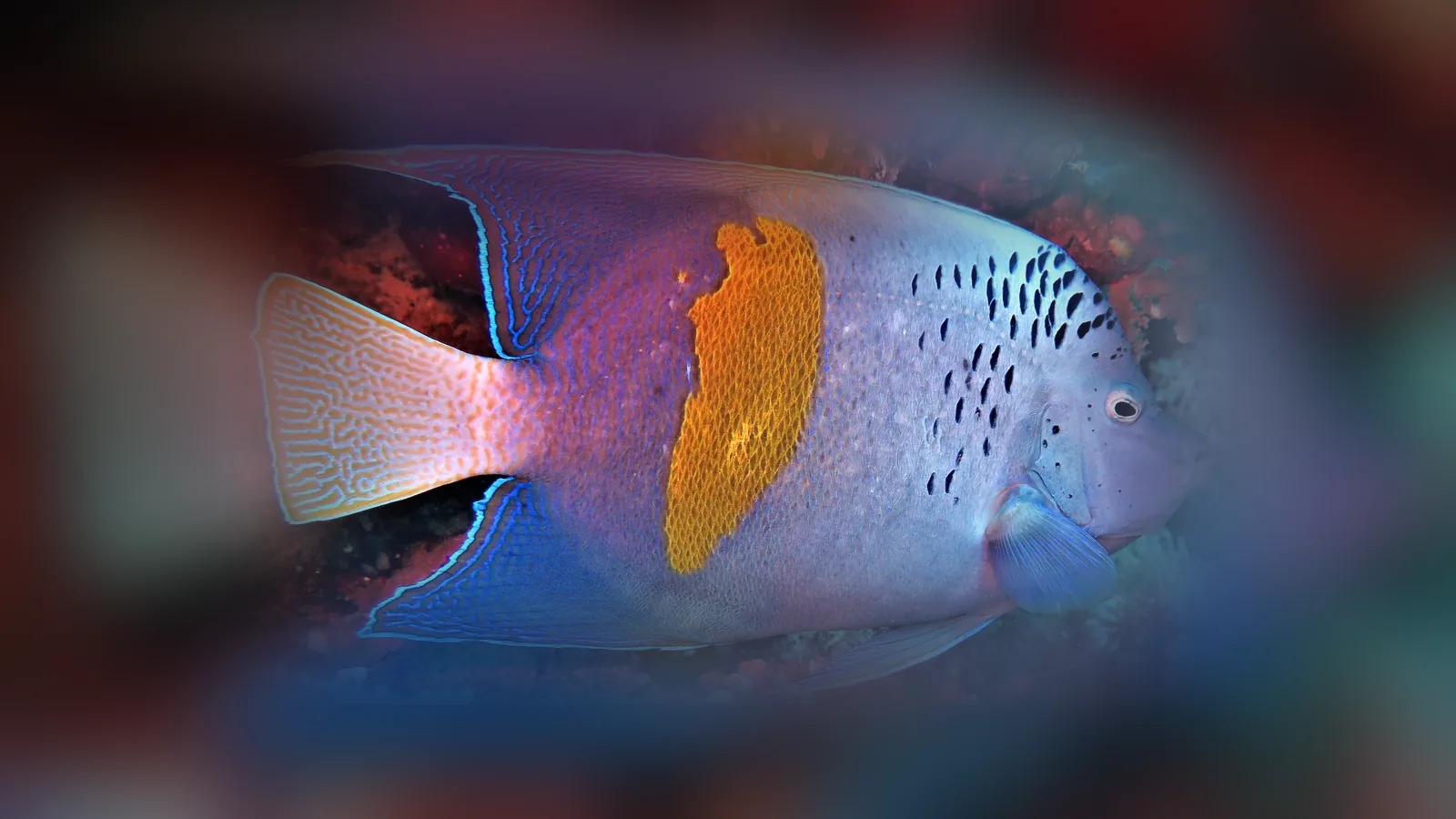
Where to see them
When to see them
Yellowbar angelfish are permanent residents of the Red Sea rather than seasonal visitors, so there is no particular month to plan around — they are on the reef every day of the year. What changes with conditions is not whether they are present but how easily they are seen: warm, clear water makes the blue body and yellow bar blaze, while a careful look into caves and under ledges is what reveals the very different juveniles. Both life stages can be found on the same reef in any season.
Year-round resident Adults on the slopes, juveniles near shelter
How to recognise a yellowbar angelfish
The adult yellowbar angelfish is one of the easier large reef fish to name once you know the mark; the juvenile takes a little more knowledge. The key adult features:
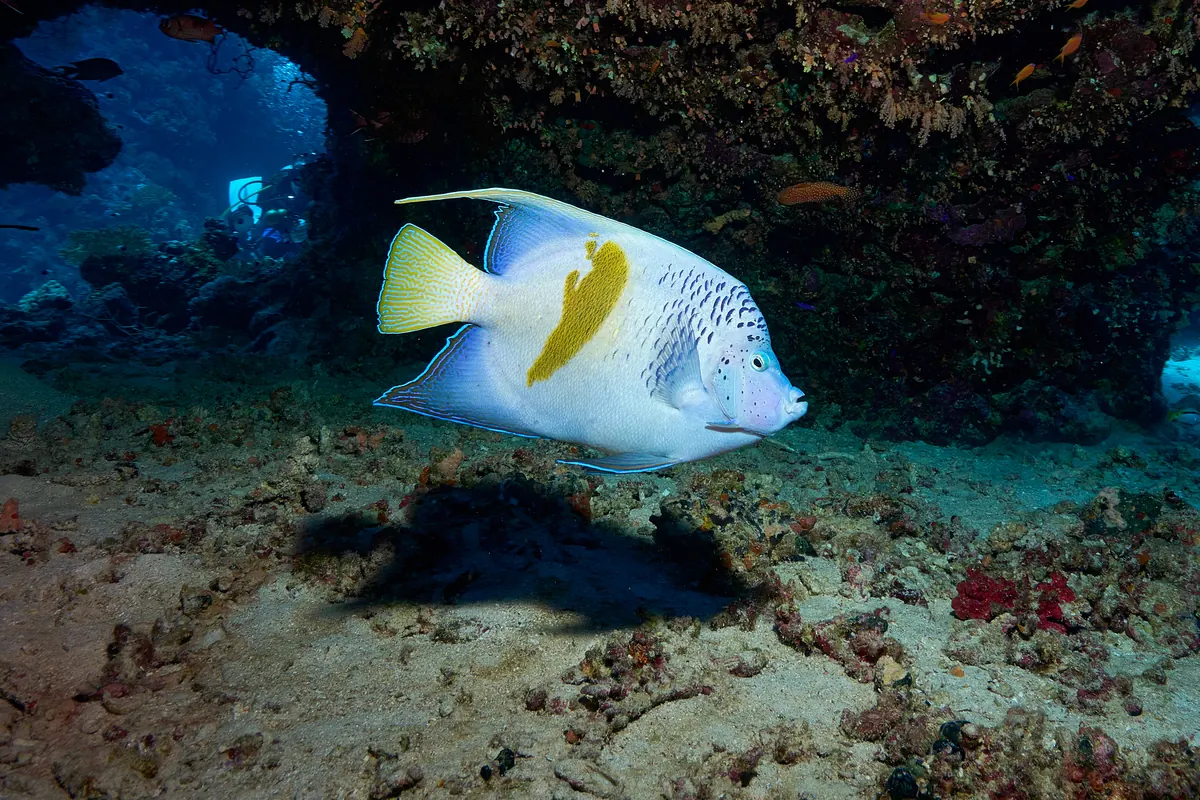
- Body shape: Oval and deep-bodied — tall from back to belly and flattened side-to-side, the classic disc-shaped angelfish silhouette, reaching about 50 cm and among the largest angelfishes on the reef.
- Colour: A rich blue-grey to purple-blue ground, the effect of a brownish-blue body with paler blue scale edges that give the fish a finely speckled, shimmering look up close. Small dark-blue, vertically elongated spots often scatter towards the head.
- The yellow bar: The signature feature — a single bold, uneven yellow bar set on the middle of the flank, frequently curved into a crescent or half-moon shape. It is the one field mark that names the fish, and it is why the species is also called the halfmoon or yellowband angelfish.
- Tail and fins: The rounded tail is pale yellow to almost clear, patterned with fine wavy blue lines — a paler tail than its close look-alike, the Arabian angelfish. Long trailing filaments extend from the rear of the dorsal and anal fins past the body, adding to the fish's flowing outline.
- Mouth: A small mouth set with fine, bristle-like teeth — the compact, nibbling mouth of a fish built to pick sponges and encrusting growth off the reef rather than to seize other fish.
The juvenile that looks nothing like the adult
A young yellowbar angelfish shares none of the adult's single-bar look. Like the juveniles of its close relatives — the emperor and the Arabian angelfish — it is dark blue to almost black and covered in a series of curved, alternating pale-blue and white bars that arc across the body. It is a strikingly different fish, and a diver meeting one for the first time could easily take it for another species entirely.
The banded pattern is more than decoration. It breaks up the outline of a small, vulnerable fish among the shifting light and shadow of the reef, and it seems to signal that the youngster is no threat — which lets it live close to shelter within the territories of larger fish. As the yellowbar grows, the bars gradually fade and reorganise, and over time the fish rearranges into the blue-and-yellow adult. Because the change is gradual, sub-adults that carry traces of both patterns are a normal sight, and telling a part-grown yellowbar from a young Arabian angelfish is one of the classic identification puzzles of Red Sea reef-fish watching.
Telling the Red Sea's blue angelfishes apart
Three large Pomacanthus angelfishes share the Egyptian reefs, and a moment's confusion between them is common. A quick way to separate them:
- Emperor angelfish (Pomacanthus imperator): Around twenty-five fine horizontal blue-and-yellow stripes and a dark mask across the eyes. If you see many thin stripes, it is an emperor, not a yellowbar.
- Yellowbar angelfish (Pomacanthus maculosus): Plain blue with a single large yellow bar on the flank and a pale, clear-to-yellowish tail. One bold mark, no stripes.
- Arabian, or asfur, angelfish (Pomacanthus asfur): Also blue with a yellow bar, but the tail is a bright, solid yellow and the yellow bar sits further forward — close enough that the pectoral fin touches it when folded back. Its body is often a darker indigo. On the yellowbar the bar sits further back and the tail is pale; that tail colour is the single most reliable way to tell the two apart.
Learn the yellow tail of the asfur, the striped body of the emperor and the one bold bar-and-pale-tail of the yellowbar, and the three sort themselves out at a glance for the rest of your diving.
Behaviour and territory
Adult yellowbar angelfish are bold, day-active reef fish. They are usually seen alone, working methodically over their patch of coral, and they have a reputation among divers for being curious rather than shy — a yellowbar will often carry on feeding, or even drift closer to inspect a still diver, where a more nervous fish would flee. They hold and work a home range on the reef, foraging over it through the day and retreating into caves and crevices to rest.
That confidence is one of the pleasures of the species: because it does not bolt, a calm diver can watch a yellowbar go about its business for minutes at a time, nibbling at the reef and turning its flank so the yellow bar catches the light. The juveniles behave very differently — shy, secretive and tied to shelter — so the two life stages give a diver two quite distinct encounters with the same fish.
Diet — a sponge and tunicate specialist
The yellowbar angelfish is a grazer of the reef surface rather than a hunter of other fish. Its diet is dominated by sponges and tunicates — tough, encrusting invertebrates that most fish cannot digest — supplemented opportunistically with other small invertebrates and with algae scraped from coral and rock. The fine, bristle-like teeth and a specialised gut let it process material that is off the menu for almost everything else on the reef.
That specialisation ties the fish tightly to a healthy, structurally rich reef, and it is part of why the large angelfishes are difficult to keep in home aquariums: a sponge-heavy diet is hard to reproduce in a tank. On a wild Red Sea reef the food is all around it, and a well-fed adult spends its day steadily working the coral for the encrusting life it depends on — a quiet reminder that some of the reef's most striking residents are also its fussiest eaters.
Breeding, and a fish that can change sex
Like many angelfishes, the yellowbar has a flexible sex life. It is a protogynous hermaphrodite: individuals mature first as females and, if circumstances call for it — typically when a dominant male is lost from a stretch of reef — a large female can change sex and become a male. Females are reported to reach maturity at a length of around 22 cm, at several years of age. This sex-changing strategy, common across the reef's angelfishes and wrasses, keeps a breeding population productive even when numbers of one sex run low.
Yellowbar angelfish are broadcast, or pelagic, spawners. A pair rises together off the reef and releases eggs and sperm into open water; the fertilised eggs and the tiny larvae then drift with the current for weeks in the plankton before settling onto a reef to begin life as a dark, banded juvenile. There is no parental care — the reef simply receives a new generation from the water column. Individuals are long-lived for a reef fish, with lifespans reported to reach two decades or more, so a large adult holding a favourite stretch of coral may have patrolled it for many years.
Watching and photographing yellowbar angelfish
The yellowbar's curiosity makes it a rewarding subject, but it still repays a calm, respectful approach:
- Let it set the distance. A confident adult will often keep feeding and may drift closer of its own accord. Slow, level fin strokes and an unhurried approach give the best and longest views; a sudden lunge sends even a bold fish away.
- Wait for the flank. The whole point of the fish is the yellow bar, so the strongest images come when it turns side-on. Hold position and let it present its profile rather than chasing it around a coral head.
- Light brings out the colour. The blue body and yellow bar come alive with a little strobe or video light; in ambient light at depth the blues deepen and the yellow mutes.
- Check the caves for juveniles. The dark, banded young hide in shaded recesses. A gentle look into an overhang — without reaching in — is often the only way to find one.
- Respect the reef. Yellowbar angelfish depend on healthy sponge and coral growth. Good buoyancy and no contact with the reef protect the very habitat the fish needs — the single most useful thing any diver can do for the species.
Conservation status
The yellowbar angelfish is listed as Least Concern on the IUCN Red List (assessed 2010). It is widespread and common across its range, no major threats have been identified, and it is not the target of any significant food fishery, so it sits well clear of any global threat category. It is occasionally collected for the marine-aquarium trade and appears in local fish markets around the Arabian Gulf, but neither is considered a range-wide pressure on the species.
The fish's real dependence is on the reef itself. As a sponge-and-tunicate specialist tied to healthy, structurally complex coral, the yellowbar angelfish is only as secure as the habitat it grazes, which makes coral-reef protection — rather than any species-specific measure — the meaningful conservation story. On a well-managed Red Sea reef the yellowbar remains a common, confident and reassuringly permanent resident.
Related Red Sea reef fish
The yellowbar is one of several large angelfishes on Red Sea reefs, and it shares the coral with a cast of other characterful residents. Divers drawn to its colour and confidence often want to read about the reef's other standout fish:
- Emperor angelfish — the striped, masked relative it is most often confused with, and the Red Sea's most photographed angelfish.
- Red Sea anemonefish — the endemic clownfish that guards its own patch of anemone with the same territorial confidence.
- Lionfish — a slow, ornate reef predator that hunts the same coral heads the angelfish grazes.
- Masked pufferfish — another characterful, coral-associated fish common across Egyptian reefs.
For the bigger picture of what lives on an Egyptian reef and how the seasons shape a dive, see the complete guide to scuba diving in the Red Sea. To browse the full encyclopedia species by species, visit the Red Sea marine life guides.
Frequently asked questions
The adult is unmistakable once you know the mark: a deep, disc-shaped blue-grey to purple-blue body crossed by a single bold, irregular yellow bar — often shaped like a crescent or half-moon — set on the mid-flank. The tail is pale yellow to almost clear with fine wavy blue lines, and long trailing filaments extend from the dorsal and anal fins. Nothing else on a Red Sea reef has that one-bar-on-blue look, which is why the fish is also called the halfmoon angelfish.
They are close relatives in the same genus, but as adults they look nothing alike. The emperor angelfish wears around twenty-five fine horizontal blue-and-yellow stripes and a dark mask across the eyes. The yellowbar is plain blue with a single large yellow bar or blotch on the side — no stripes and no mask. If you see many thin stripes it is an emperor; if you see one big yellow mark on a blue fish it is a yellowbar.
Both are blue Red Sea angelfish carrying a yellow bar, so they are easily confused. The quickest test is the tail: the yellowbar angelfish has a pale, clear-to-yellowish tail, while the Arabian, or asfur, angelfish has a bright, solid-yellow tail. The yellow bar also sits further back on the yellowbar and further forward on the asfur, and the asfur tends to be a darker, more indigo blue. On the reef, a pale or clear tail means yellowbar.
Like other angelfishes in its genus, the young yellowbar is dark blue to black and covered in a series of curved, alternating pale-blue and white bars — a completely different look from the single-bar adult. This bold pattern camouflages the small, secretive fish among reef shadows and helps it live safely close to shelter. The juvenile slowly loses the bars and grows into the blue-and-yellow adult as it matures.
The yellowbar angelfish grows to about 50 cm, which makes it one of the largest angelfishes on the reef. Most adults a diver meets are somewhat smaller than that maximum, but a mature yellowbar is still a big, deep-bodied fish — noticeably larger than the palm-sized pygmy angelfishes that share the same coral.
Yellowbar angelfish are grazers of the reef surface. Their diet is dominated by sponges and tunicates — tough, encrusting invertebrates that most fish cannot digest — along with other small invertebrates and algae taken opportunistically. That specialised, sponge-heavy diet ties the fish closely to a healthy, structurally rich reef and is part of what keeps a coral community in balance.
Not quite, but close. The yellowbar angelfish is a regional speciality of the Red Sea and the northwestern Indian Ocean — it also lives in the Gulf of Aden, the Arabian (Persian) Gulf, the Gulf of Oman and down the East African coast, and it is not part of the wider Indo-Pacific. That makes the Egyptian Red Sea one of the best and most accessible places in the world to see it, where it is a common, year-round resident of the reefs.