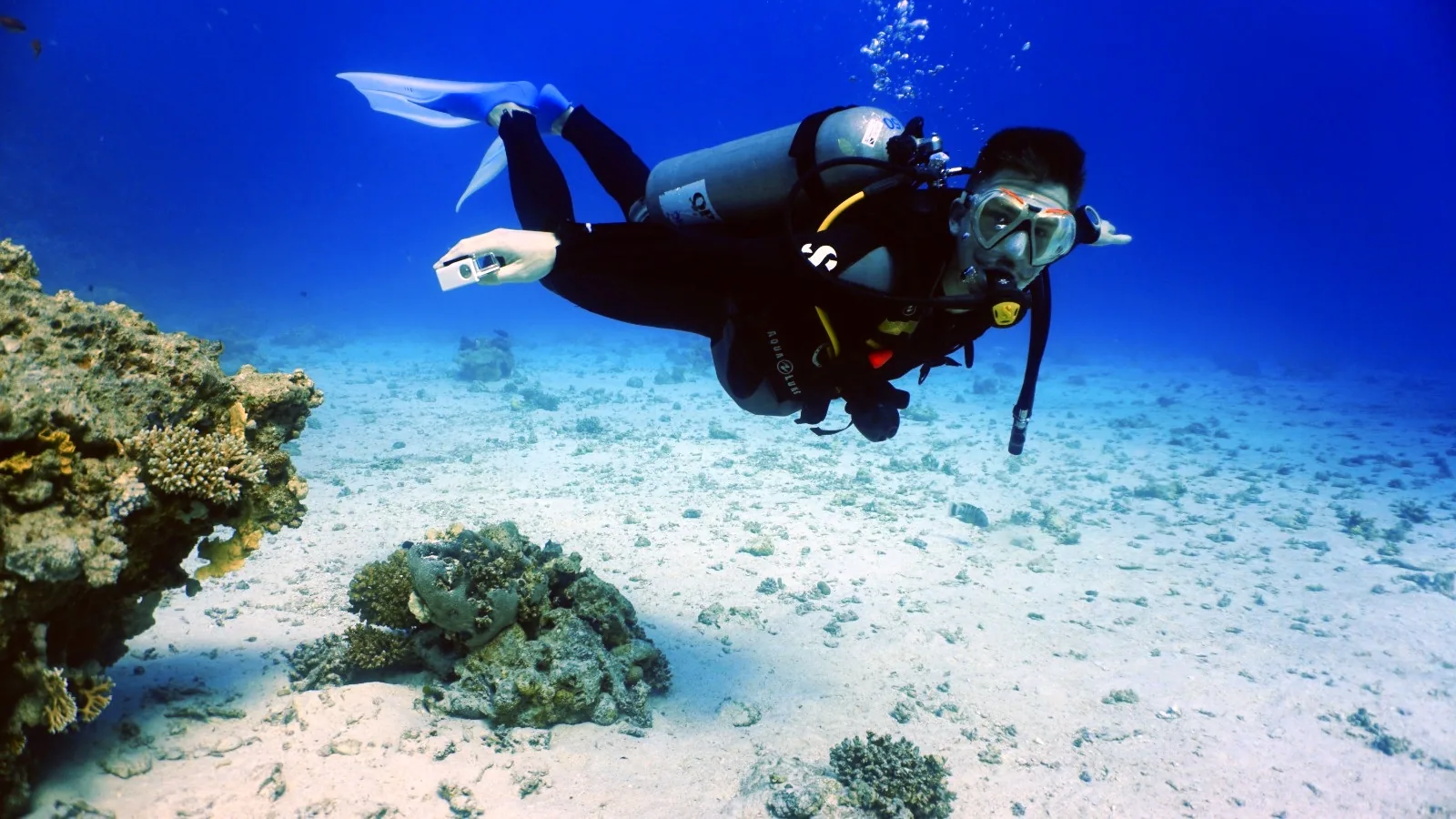
The Red Sea sells itself as a warm-water destination, and it delivers — which is precisely how it catches divers out. The swimsuit that felt perfect on a mid-morning snorkel is a very different thing by the third dive of the day, hanging at 25 metres in February with the sun still hiding behind the boat. Water strips heat from the body far faster than air does, and even bathwater-warm seas will quietly cool a diver who stays under long enough. Getting your exposure protection right isn't about surviving the cold — it's about still being warm enough on the last dive to actually enjoy it.
This guide covers what genuinely matters when you pick a wetsuit for Egypt's Red Sea coast: how warm the water really is through the seasons, how to map that to a sensible thickness, why fit matters more than the number printed on the label, and how a wetsuit differs from a rash guard, a dive skin and a semi-dry. It ends with sizing, care, and the perennial question — rent on holiday, or buy your own? The wetsuit is only one line on a longer kit list; for the rest, see what scuba gear you need to dive.
Why exposure protection matters — even in warm water
The single fact behind every wetsuit decision is a simple one: water carries heat away from the body far faster than air — by the Divers Alert Network's reckoning, 20 to 27 times faster. It's why you can lounge happily in 24°C air but start shivering within minutes in 24°C water. Submerged, the body leaks warmth constantly, and the deeper and longer the dive, the more of it drains away.
DAN puts useful numbers on where that starts to bite: most divers benefit from some thermal protection once the water drops below about 27°C, and meaningful thermal stress sets in below roughly 24°C. And the risk doesn't switch off just because the sea is tropical — DAN notes that immersion hypothermia (a core temperature under 35°C) can develop even in water of 29–33°C if you wear nothing to slow the heat loss and stay in long enough. Cold is cumulative, too: you chill faster on the second and third dives of the day, because the body starts each one with less heat in reserve and a shorter surface interval to rewarm.
Warmth is only half the job. A wetsuit — or even a thin skin — is also armour against what a reef can do to bare skin: a brush of fire coral or hydroids, a scrape on rock or wreck metal, the odd jellyfish or "sea lice" sting, and, topside on the boat, hours of hard Egyptian sun. For plenty of divers, that all-day sun-and-sting cover is reason enough to zip up, temperature aside.
How warm is the Red Sea? Water temperature by season
The Egyptian Red Sea is warm all year, but it is not a bathtub set to one temperature. Surface readings swing by around 6–7°C between the August peak and the late-winter low. The figures below are approximate open-water averages for the main resort areas — Hurghada and Sharm el-Sheikh — from long-run sea-surface data; daily readings vary with wind and site, and different sources differ by a degree or two. For the wider seasonal picture — weather, visibility and marine life alongside temperature — see the guide to the best time to dive the Red Sea.
- Summer (roughly July–September): the warmest water of the year — open-water averages of about 28–29°C, brushing 30°C in the shallows, with August the peak. This is the season you can get away with the least neoprene.
- Autumn (October–November): still warm, easing from the high 20s down toward the mid-20s°C as the season turns (roughly 27°C to 26°C).
- Winter (December–March): the coolest water, typically around 22–24°C and dipping to about 21°C at the February low — the year's chilliest weeks. Balmy by British or northern-European standards, but noticeably cooler at depth and over a full multi-dive day.
- Spring (April–June): warming back up, from the low-20s°C in April toward the mid-20s by June and the high 20s as summer arrives.
North vs south, and the thermocline
Where you dive matters. The Sinai north — Sharm el-Sheikh, Dahab and the surrounding coast — tends to sit a degree or so cooler at the winter low than the far south around Marsa Alam, and it catches more spring wind, which can make surface intervals and boat rides feel raw even when the water itself is fine. Diving off Sinai in January or February, you'll generally find slightly cooler water than someone the same week down south.
Depth matters just as much. In summer especially, a sharp thermocline can lurk on deeper walls and channels: the surface reads a balmy 28–30°C, then you drop past about 20 metres and the temperature falls away 2–4°C in a single fin-kick. This layering is most pronounced from July to September and on offshore, current-swept sites, and it largely fades in winter, when the water column feels far more even top to bottom. The lesson: pick your protection for how the dive feels at depth and on the last dive of the day, not for how the water feels as you step off the boat.
A practical thickness guide, mapped to the season
Wetsuit thickness is measured in millimetres of neoprene; where you see two numbers (say 5/3mm), the first is the thicker torso panel and the second the stretchier arms and legs. More neoprene, less heat lost — so a 5mm is warmer than a 3mm. Line the standard dive-industry thickness charts up against the Red Sea's temperature range and it falls out roughly like this:
- Water above ~28°C (high summer): a rash guard or dive skin, or a 1–2mm top / 3mm shorty, covers a single relaxed dive.
- Water ~24–28°C (spring, autumn and much of summer): a 3mm full suit is the sweet spot — or a 2–3mm shorty on the warmest days.
- Water ~20–24°C (winter): a 3–5mm full suit; most divers settle on 5mm for the coldest weeks.
Translated into a plain seasonal plan for the Egyptian Red Sea:
- High summer (Jul–Sep): a rash guard or 3mm shorty for a single easy dive; a 3mm full suit is the comfortable all-rounder once repetitive dives and that deeper thermocline come into play.
- Spring & autumn (Apr–Jun, Oct–Nov): the 3mm full suit is the Red Sea workhorse. Divers who feel the cold add a thin vest.
- Winter (Dec–Mar): a 5mm full suit, with a hood or hooded vest for anyone who chills easily or is racking up several dives a day.
One honest caveat: these are starting points, not commandments. Cold tolerance is wildly personal — two divers in the same 24°C water can reasonably want a 3mm and a 5mm respectively, and neither is wrong. Repetitive diving nudges everyone warmer: someone doing four or five dives a day for a week straight (a typical liveaboard) feels the chill stack up and is usually happier one grade thicker than a single-dive chart suggests. Stuck between two thicknesses? Go warmer — you can always crack the zip on a hot day, but you can't add neoprene at 25 metres.
Fit matters more than thickness
A well-fitting 3mm will out-warm a baggy 5mm every time — because a wetsuit does not actually keep water out. It works by trapping a thin film of water against the skin and letting the body heat it into an insulating layer. Let the suit gape and that warmed water is constantly flushed out at the neck, wrists, ankles and crotch and replaced with cold sea, so the cosy layer never gets a chance to form. This "flushing" is the number-one reason divers end up cold in a suit that is, on paper, plenty thick. Fit — not features — is what makes personal gear work, the same way a good seal beats every gimmick on the box when you're choosing a dive mask.
A scuba wetsuit should fit like a second skin: snug all over, with no baggy pockets or loose folds, but never so tight it fights your breathing or movement. Useful things to check when you try one on:
- Sleeves and legs: cuffs should reach the wrist bone and the ankle bone, with no gaps or bunched rolls of neoprene.
- Seals: the neck, wrist and ankle openings should be snug against the skin — the seal is what stops flushing. A neck seal should never choke; a diver should be able to turn the head side to side and breathe comfortably.
- Wrinkles: small creases are normal; large, loose folds signal a suit that will flush.
- Too tight is also wrong: a suit that restricts the chest or shoulders makes breathing harder and movement tiring, and can add to stress underwater.
Wetsuit vs rash guard vs dive skin vs semi-dry
These four garments are often lumped together, but they do different jobs:
- Rash guard: a lightweight top made from polyester/spandex or similar stretch fabric. It is built for sun protection, chafing prevention (especially under a BCD) and a little defence against stings — not for warmth. Ideal as a base layer or for a warm-water snorkel, but it provides minimal insulation for diving.
- Dive skin: a thin, full-body suit in Lycra/spandex or very thin neoprene. It gives full-coverage protection from sun, coral grazes and stings, and is comfortable in the warmest water, but like a rash guard it offers little thermal insulation for extended immersion.
- Wetsuit: neoprene foam that traps and warms a thin water layer. This is the main thermal tool for scuba diving and the right choice for anything beyond the very warmest, shortest dives. Neoprene also blocks stings and abrasion far better than thin fabric.
- Semi-dry: a thicker wetsuit (often 5–7mm) with close-fitting seals at the wrists, ankles and neck — and frequently a waterproof "dry" zip — designed to drastically cut flushing. It still lets a little water in, but keeps it in, staying warm for longer than a standard wetsuit. It sits between an ordinary wetsuit and a drysuit, and is a comfort upgrade for cold-sensitive divers in the Red Sea winter or on intensive multi-dive trips.
Sizing: men's, women's and unisex cuts
Because fit is everything, cut is worth attention. Wetsuits come in men's, women's and unisex sizing. Women's-cut suits are shaped for a longer torso relative to leg length and for bust and hip proportions, which usually seals better than sizing down a men's suit; men's and unisex cuts suit a broader, more uniform build. Neoprene from different brands can size quite differently, so a "medium" in one range is not a "medium" in another. The reliable approach is to try a suit on (or check a size against the maker's own chart), and to prioritise a suit that seals at the neck, wrists and ankles and fits the torso without gaping — a suit that fits the body but bags at the limbs, or vice versa, will flush. Where an off-the-peg suit can't do both, some divers look at a different brand, a tall/short variant, or a made-to-measure option.
Care — and renting vs buying
Neoprene lasts far longer with a little aftercare. The essentials: rinse the suit inside and out in fresh, cool water after every diving day to flush out the salt, sand and chlorine that dry it out (never hot water — it breaks the foam down); dry it in the shade, since UV is neoprene's enemy; and drape it folded over a wide hanger rather than hung by the shoulders, which stretches the seams. Let it dry fully before storing so mildew never gets started. The same salt-rinse discipline keeps the rest of a diver's kit alive too — see the guide to caring for scuba gear in salt water for regulators, BCDs and dive computers.
For an occasional diver on a one-off trip, renting at the destination makes good sense: no luggage weight, no paying for a suit worn once a year, and dive centres carry a spread of thicknesses to match the season. The trade-offs are fit — rentals are cut to suit "most people", not one person perfectly — and personal hygiene preferences. Buying your own pays off if you dive often, feel the cold, are hard to fit off the peg, or simply want a familiar, better-sealing suit; a 3mm and a 5mm between them cover almost anything the Red Sea throws at you across the year. As a rough guide to what owning costs, 2026 UK/European retail puts a basic 3mm full scuba suit from around £130–170 (roughly €150–200), rising to £300–350 for premium models, while a 5mm typically runs £240–450 (about €280–520); rental, by contrast, is usually a small daily fee or folded into a dive package. A common middle path is to rent on a first trip to learn what thickness a given season calls for, then buy once the preference is clear.
New to Red Sea diving?
Aquarius runs try dives and PADI courses with all equipment included — wetsuit, mask and fins sorted before the first breath. Pick your dates and level to get started.
Explore new-diver diving →Frequently asked questions
What wetsuit thickness do I need for the Red Sea?
It depends on the season. In high summer (July–September), when the water is around 28–30°C, a 3mm full suit or even a shorty/rash guard is usually enough. In spring and autumn a 3mm full suit is the reliable all-rounder, and in winter (December–March, water ~22–24°C) most divers move to a 5mm. If you feel the cold or are diving several times a day, go one step thicker.
Do I need a wetsuit to dive in Egypt?
For scuba diving, yes — some form of exposure protection is strongly recommended year-round. Water draws heat from the body more than 20 times faster than air, so even the Red Sea's warm seas will chill you over a long or repetitive dive, and DAN notes hypothermia is possible on tropical dives in just a swimsuit. A wetsuit also protects against stings, coral grazes and sun. Only for the warmest, shortest single dives might a rash guard or dive skin suffice.
What should I wear diving in the Red Sea in summer?
In peak summer the surface is around 28–30°C, so a rash guard, dive skin, or a 3mm shorty is comfortable for a single relaxed dive. A 3mm full suit is the popular choice once you factor in repetitive dives and the summer thermocline, which can drop the temperature 2–4°C below about 20 metres even when the surface feels warm. If you chill easily, the 3mm full suit is the safer bet.
What should I wear diving in the Red Sea in winter?
Winter water (roughly December–March) is the coolest, around 22–24°C, and coldest in February–March, with the northern Red Sea (Sharm, Dahab) a degree or two cooler than the south. A 5mm full suit is the standard choice, and cold-sensitive divers or those doing many dives a day often add a hood or hooded vest, or step up to a semi-dry. It is still comfortable diving — just cooler than the summer, especially by the last dive.
Wetsuit vs rash guard — what's the difference?
A rash guard is a thin stretch-fabric top made for sun and chafing protection with a little sting defence; it provides almost no warmth. A wetsuit is neoprene that traps and warms a thin layer of water against your skin, providing the actual thermal protection needed for diving. For most Red Sea dives you want a wetsuit; a rash guard is best as a base layer or for warm, brief snorkelling.
How should a wetsuit fit?
Snugly, like a second skin — no baggy folds or gaps, but not so tight it restricts breathing or movement. The neck, wrist and ankle seals should hug the skin, because those are the points where cold water "flushes" through a loose suit and steals your warmth. A well-fitting 3mm will keep you warmer than a baggy 5mm, which is why fit matters more than thickness.
Is it better to rent or buy a wetsuit for a diving holiday?
For an occasional or first-time diver, renting at the destination is sensible — no luggage weight, no cost for a suit used once a year, and dive centres match the thickness to the season. Buying your own makes sense if you dive often, feel the cold, are hard to fit off the peg, or want a familiar, better-sealing suit; a 3mm and a 5mm cover almost the whole Red Sea year. Many people rent on a first trip, then buy once they know what thickness suits them.
Sources & references
- Divers Alert Network (DAN) — exposure-related injuries guidance: water carries heat 20–27 times faster than air, thermal protection benefits divers below ~27°C, significant thermal stress sets in below ~24°C, and immersion hypothermia (core below 35°C) is possible even in 29–33°C water worn with no protection.
- Sea-surface temperature averages for the Egyptian Red Sea (Hurghada, Sharm el-Sheikh, Marsa Alam) — monthly open-water readings, from a ~21–22°C February low to a ~29°C August peak.
- Wetsuit thickness-vs-water-temperature charts — general dive-industry guidance (e.g. DeeperBlue's thickness & temperature guide): 3–5mm full suits for ~22–25°C water, stepping to 5–7mm or a semi-dry below ~21°C.
- Current wetsuit retail pricing (2026) — UK dive retailers such as Mike's Dive Store, showing 3mm scuba suits from about £149 and 5mm suits from about £240.
This is a general guide to choosing exposure protection; personal cold tolerance varies and the thickness recommendations are starting points, not rules. Verified August 2026.